

With the Ten Commandments as the summary of God’s law having been covered in Questions 8-12, the New City Catechism now asks a crucial question: Can anyone keep the law of God perfectly? Of course, perfect obedience was established back in Question 7, and it ought to have been lingering in our minds throughout the follow five questions. Each commandment ought to have hammered a nail into our conscience. No, I have not perfectly loved God; rather, I am often prone to idolatry. No, I do not perfectly worship the Creator but often set my affections upon created things. No, I do not hallow God’s name in all that I do. No, I do not perfectly esteem God’s design for rest and worship. No, I do not perfectly honor my parents and my forefathers in the faith. No, I do not perfectly love my neighbor as myself but am guilty murderous, lustful, and covetous thoughts against others. If the law of God is the standard according to His holy will that I am to obey perfectly, I fall thoroughly short. I have failed to perfectly do what He has commanded and often done what He has forbidden. Wretched man that I am!
Although it offers no comfort, the catechism notes that all of humanity is in the same boat: Since the fall, no mere human has been able to keep the law of God perfectly, but consistently breaks it in thought, word, and deed. The opening phrase is of monumental importance, but since it is the subject of Question 14, we will leave that discussion until next week. Post-fall no mere human has the capacity to keep God’s law perfectly; instead, we consistently break it on three levels: thought, word, and deed. Again, it is Jesus Himself who noted that we violate God’s law not simply through sinful actions but also through sinful thoughts and words. Of course, Jesus was not making any addition to God’s law but simply explaining it more clearly to us. The command from Deuteronomy 6:5 to love God with all our heart, soul, and might certainly covers thoughts, words, and deeds.
The catechism rightly draws this stark conclusion that no one is able to obey God’s law particularly from Romans 3:10-12:
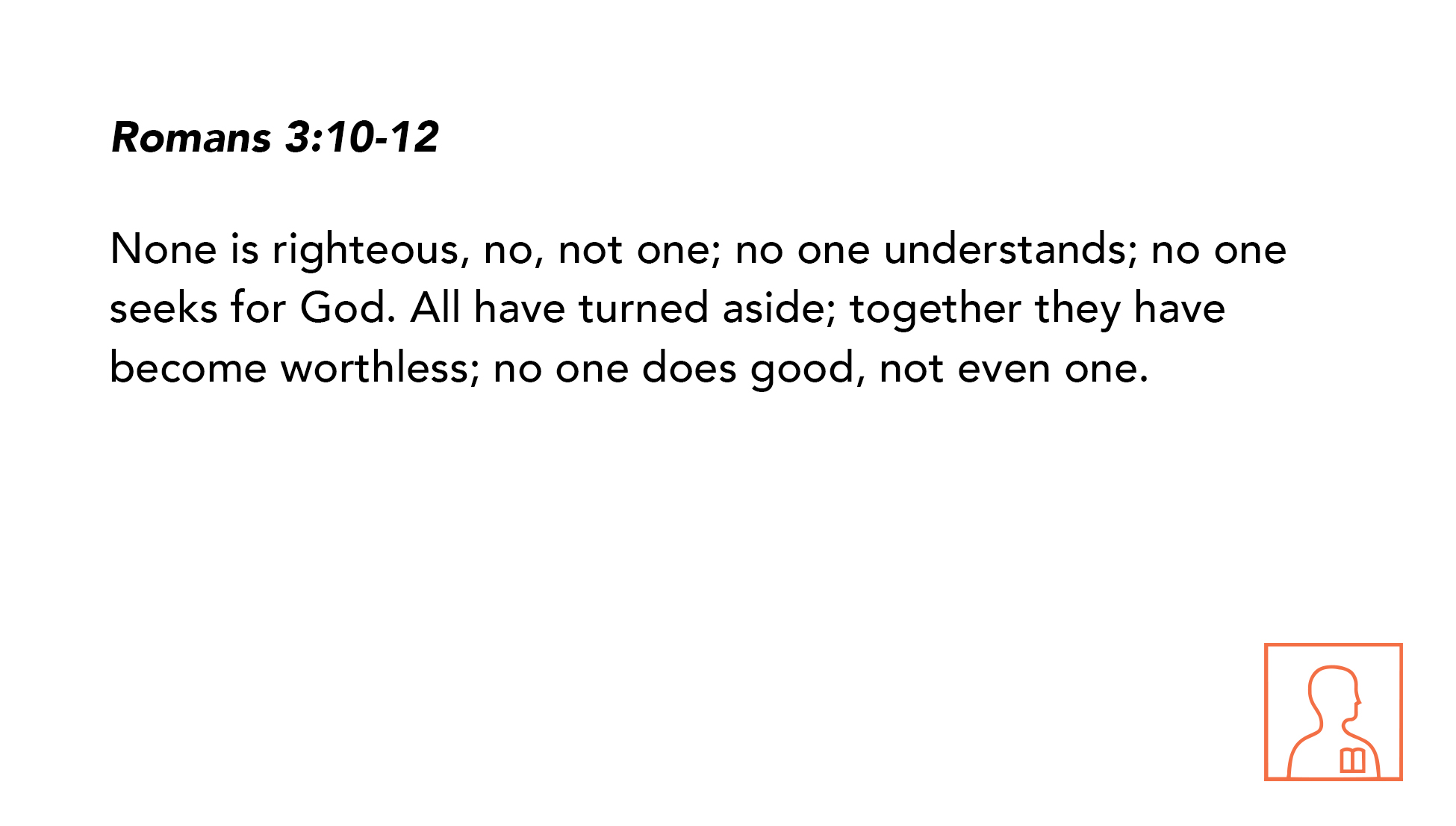
And the Scriptures are not hyperbolic here. Truly, no one is righteous. Not a single one of us is capable of perfectly obeying God. Indeed, Paul says later in Romans 8:7-8 that “the mind that is set on the flesh is hostile to God, for it does not submit to God’s law; indeed, it cannot. Those who are in the flesh cannot pleases God.” In ourselves, we are utterly unable to please God. This is because we are spiritually dead in our sins. Consider weighty words of Ephesians 2:1-3, which describes the fallen, sinful state of all humanity:
And you were dead in the trespasses and sins in which you once walked, following the course of this world, following the prince of the power of the air, the spirit that is now at work in the sons of disobedience–among whom we all once lived in the passions of our flesh, carrying out the desires of the body and the mind, and were by nature children of wrath, like the rest of mankind.
Slaves to the flesh. Slaves the world. Slaves to the devil. That is our miserable condition. We are spiritually dead, and the dead cannot please the Author of life.
Yet even this bleak question that is loaded with bad news does not wholly leave us without a glimpse at the good news to come (somewhat like the Old Testament in general). We find this sliver of hope in a single word: mere. No mere human has been able to keep the law of God. Jesus, the Captain of our salvation, is no mere human. As Question 22 will affirm, He is truly human. Amen! But He is not merely human. Rather, He is truly human and also truly God. He is truly human so that He can properly and sympathetically be our representative; however, He is truly God so that He can bring us the divinely authored and worked salvation that rescues us from the death and destruction of our sins. Thus, this bad news actually fuels our love of the good news.
Christian, in your flesh, you are incapable of obeying God’s law, and that is why your hope is in Christ rather than in yourself.
 B. C. Newton