

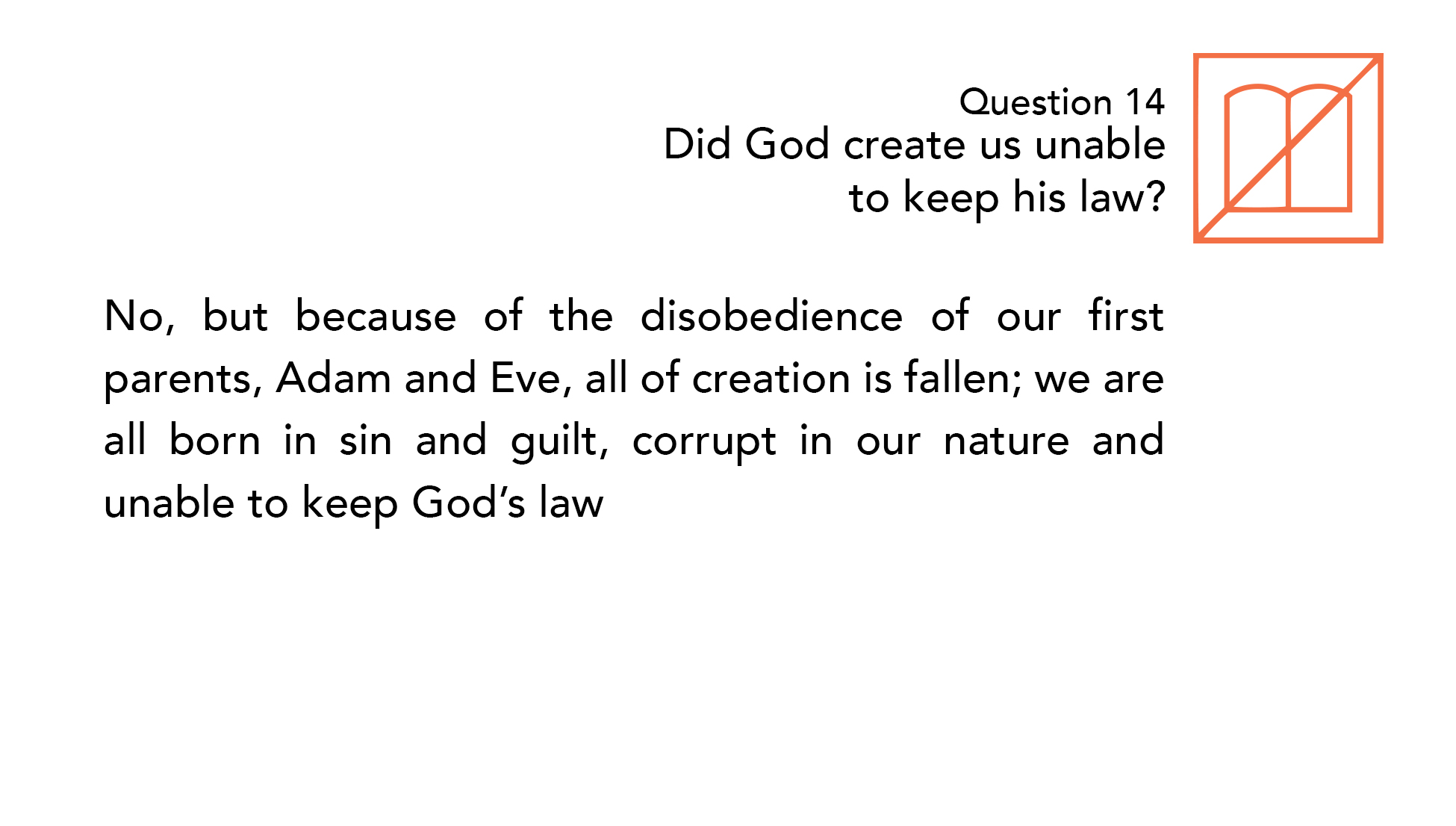
This question was forecast in the opening phrase to Question 13’s answer: “since the Fall.” No human has been able to keep God’s law since the Fall. Thus, we can imply that before the Fall humans were indeed able to keep God’s law, and now our present question makes that implication explicit. No, God did not create us unable to keep His law. That point is crucial because how could God hold our disobedience against us if He made us incapable of obedience? How could He find fault with us if He put the fault within us Himself? But that is not how God created us. As Question 6 of the Heidelberg Catechism says,
God created man good, and after His own image, that is, in righteousness and true holiness; that he might rightly know God his Creator, heartily love Him, and live with Him in eternal blessedness, to praise and glorify Him.
And that is precisely the picture that we find in Genesis 1-2. God surrounded Adam and Eve with life, joy, and happiness with Him, yet He also gave the genuine choice of disobedience, to rebel against Him by eating of the singularly forbidden tree. In a world full of blessedness, they chose the serpent’s lie and ushered in the curse of sin and death. We rightly call that tragic day the Fall because since then ‘all of creation is fallen.’ Because all the earth was under Adam’s domain, his sin brought a curse upon all of it as well. Fathers would do well consider how this principle still applies today, for a father’s sins will likewise damage the entire household.
Indeed, as the catechism goes on to say, Adam’s sin, as the father of all humanity, led to death reigning over all mankind “through that one man” (Romans 5:18). Or as Romans 5:12 says,
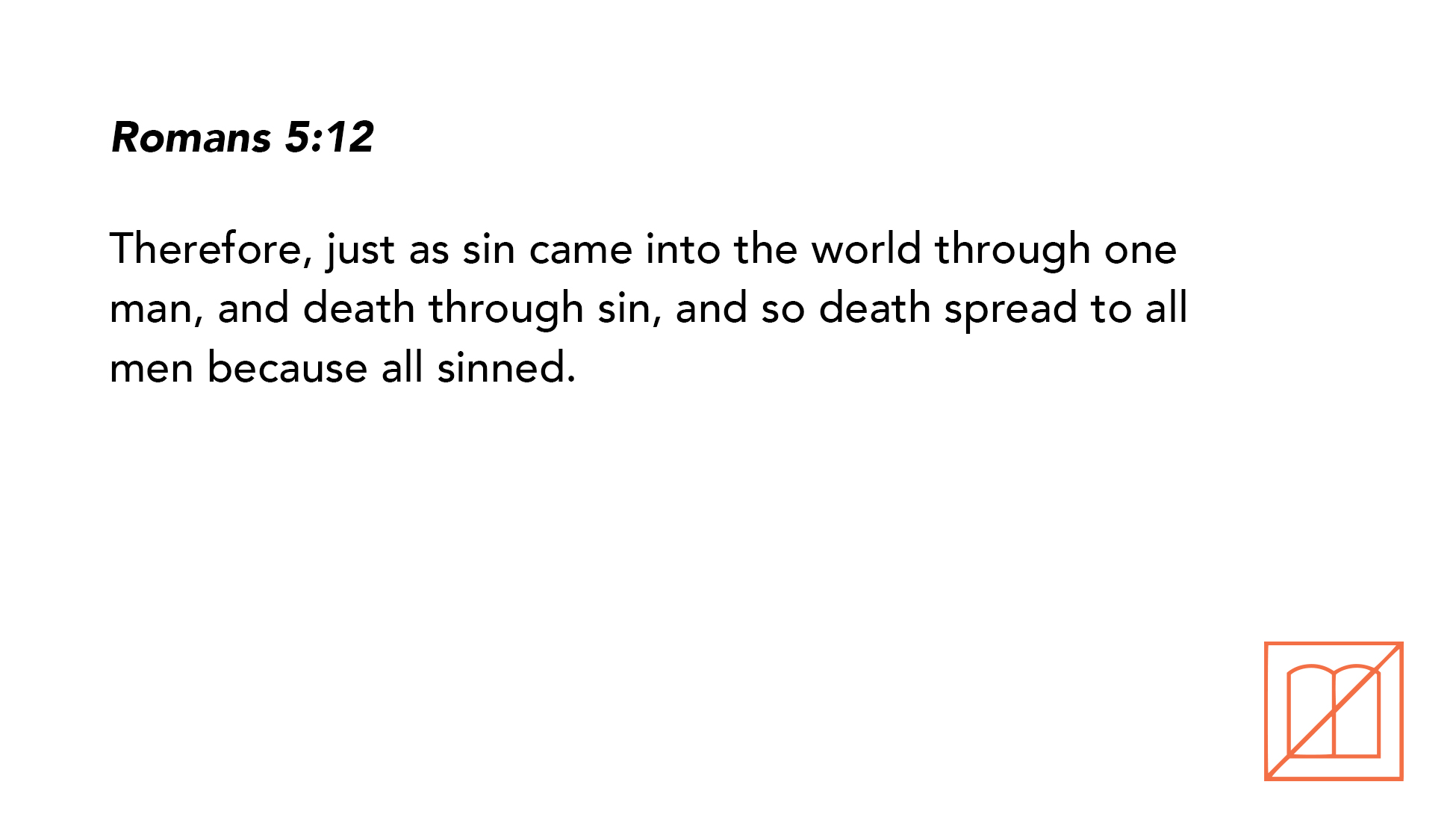
Because of Adam’s original sin, we are all born in sin and guilt, corrupt in our nature and unable to keep God’s law. With his choice to rebel against God in the garden, all of humanity lost the ability to obey God’s law. To support this Scripturally, we could easily cite Romans 8:7-8 and Ephesians 2:1-3 as we did in Question 13, but for brevity’s sake, I will only repeat the former:
For the mind that is set on the flesh is hostile to God, for it does not submit to God’s law; indeed, it cannot. Those who are in the flesh cannot please God.
In our flesh, that is, our natural state, we cannot submit to God’s law. We are wholly unable to keep His law because we have all become corrupt.
But how exactly did Adam’s decision to sin have such a drastic effect on all of humanity? The short answer is because Adam represented all of humanity. When God made His original covenant with Adam, He made with Adam as the father of us all, and when Adam broke that covenant, he broke it on behalf of us all as well. While that may go against every autonomous individual streak that we have within us, we see the necessity of representatives all throughout our republic. For example, if congress declares war, many men who took no part in that decision will die on the battlefield because of that decision. The cold hard reality is that our actions always impact others, for good or evil.
But what are we to do with verses like Deuteronomy 24:16, which reads: “Fathers shall not be put to death because of their children, nor shall children be put to death because of their fathers. Each one shall be put to death for his own sins”? First, that verse makes no denial of sin’s harmful effects on those closest to them, but only that a person ought not be put to death for someone else’s sin. Consequently, that is what Paul affirmed as well. Notice the last phrase of Romans 5:12: “so death spread to all men because all sinned.” We each deserve death because of our own sins. Sin brings death, and Adam’s sin brought sin to all of us as his descendants. Nevertheless, we still justly earn our own condemnation.
Thankfully, this is not the final question of the catechism, just as Adam’s sin was only the beginning rather than being the end. Instead, even while pronouncing His judgment upon Adam and Eve, God also promised a Savior who would come from woman’s seed rather than Adam’s seed. Let us, therefore, conclude by mediating upon Paul’s description of that Savior in Romans 5:17-19:
For if, because of one man’s trespass, death reigned through that one man, much more will those who receive the abundance of grace and the free gift of righteousness reign in life through the one man Jesus Christ. Therefore, as one trespass led to condemnation for all men, so one act of obedience leads to justification and life for all men. For as by the one man’s disobedience the many were made sinners, so by the one man’s obedience the many will be made righteous.
 B. C. Newton