

Jonathan Gibson’s book of liturgies for daily worship, Be Thou My Vision, was my first experience with bringing elements typically associated with corporate worship into my times of private worship, and I have not looked back since. Although devotional time ought to rightly be viewed as time that is explicitly devoted to the Lord through prayer and Bible reading, I often subconsciously viewed it as being more transactional than relational or reverent. Structuring that daily time with a call to worship, reading God’s law, confessing sin, and reading God’s assurance of pardon has helped me to truly view devotional or quiet times as a time of worshiping the living God.
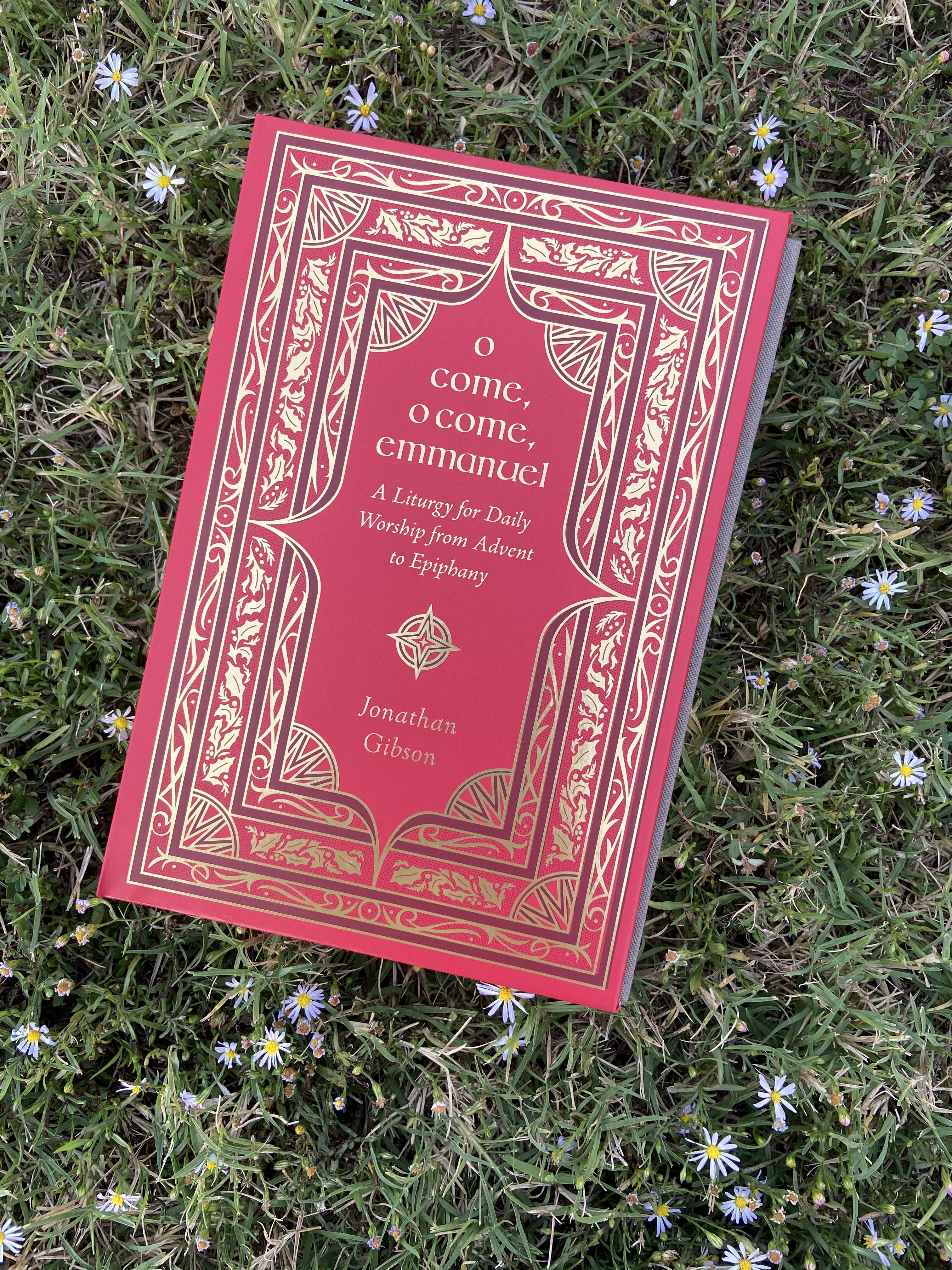
Now Gibson has written a Christmas-themed follow-up called O Come, O Come Emmanuel, which seeks to bring the same approach to the seasons of Advent and Christmas. Instead of thirty-one untitled days as in Be Thou My Vision, liturgies are given for November 28 through January 6, thus running from Advent to Epiphany.
Each day still has a call to worship, a reading of God’s law, prayer of confession of sin, an assurance of pardon, creeds and catechisms, prayers of illumination and intercession, and times for reading Scripture and personal prayer. So, if you are familiar with Be Thou My Vision, you should feel right at home.
Gibson has, however, added a number of new elements:
The day now begins with a meditation on the incarnation of Christ from a prominent figure in church history, the calls to worship are tailored to the content of the day’s liturgy, focused on either the first or second coming of Christ; the element of adoration is a hymn or psalm appropriate to Advent, Christmastide, or Epiphany; three alternative Gloria Patri hymns and two alternative Doxologies rotate on a weekly basis; the catechism questions (from Heidelberg Catechism or Westminster Shorter Catechism) are focused on the necessity, accomplishment, and application of Christ’s work; the Scripture readings in Advent concern Old Testament types and prophecies of Christ’s coming, followed by New Testament Nativity readings in Christmastide, before concluding with some Epiphany readings; a new praise element, in the form of an ancient Christian prayer or hymn focused on the incarnation, follows the Scripture reading; finally, the liturgy closes with a scriptural benediction and a doxological postlude (based on Psalm 72:17-19).
P. 16

Loving both Christmas and Be Thou My Vision, I am beyond ready to make my way through O Come, O Come Emmanuel this Christmas season. And I certainly will use it personally, but we will also make use of it for family worship. Each evening we sing a hymn, read Scripture, share what we are thankful to God for from the day, and pray. With three little ones under the age of six, doing all four of those things is often a challenge, so we will not go through each liturgy in its entirety as a family. Instead, we will incorporate certain elements, like the meditations, hymns, and reading plan. Our girls also love candle-lit tea and poetry time after the sun has set, so I am sure that many of those readings will also come from this book.
Also, as with all of Crossway’s books, the design and quality of the book are both beautiful and make it lovely to hold and see upon the shelf, yet the contents within make it even more lovely to use.

 B. C. Newton