
There is a scene in the Lord of the Rings where Aragorn and his company are walking the paths of the dead, a haunted and dreadful road. Yet along the way, they find “the bones of a mighty man… He had fallen near the far wall of the cave, as now could be seen, and before him stood a stony door closed fast: his finger-bones were still clawing at the cracks. A notched and broken sword lay by him, as if he had hewn at the rock in his last despair.”
Aragorn looks upon the man for while and, pondering how long his bones have laid beside the door that he could not unlock, asks: “Whither does it lead? Why would he pass? None shall ever know!”
Those are the moments in Tolkien’s writing that endear some and infuriate others. The pragmatist asks why bother including such as scene at all, if there was never any intention of explaining who the dead man was and where the unopened door led to. However, I am among those who finds such details endearing because they imitate real life. Every day we pass by thousands of God’s imager-bearers each living their own story and walking through thousands of doors that we ourselves will never open.
It is also true of the Scriptures. No matter how much we read and study, there will always be new treasures to be found, new depths to be explored, and also much that must inevitably be left unexplored. This is exactly what we observed last year while studying Hebrews. Indeed, consider Hebrews 9:1-5:
Now even the first covenant had regulations for worship and an earthly place of holiness. For a tent was prepared, the first section, in which were the lampstand and the table and the bread of the Presence. It is called the Holy Place. Behind the second curtain was a second section called the Most Holy Place, having the golden altar of incense and the ark of the covenant covered on all sides with gold, in which was a golden urn holding the manna, and Aaron’s staff that budded, and the tablets of the covenant. Above it were the cherubim of glory overshadowing the mercy seat. Of these things we cannot now speak in detail.
The author of Hebrews clearly had a desire to explain each element of the tabernacle; however, he left them aside in order to keep to the topic of his sermon. Thus, as we dive into studying the details of the tabernacle, let us go forward in a sense of sober delight as we walk through the door that the author of Hebrews needed to reluctantly pass by.
CONTRIBUTIONS FROM THE HEART // VERSES 1-9
The LORD said to Moses, “Speak to the people of Israel, that they take for me a contribution. From every man whose heart moves him you shall receive the contribution for me. And this is the contribution that you shall receive from them: gold, silver, and bronze, blue and purple and scarlet yarns and fine twined linen, goats’ hair, tanned rams’ skins, goatskins, acacia wood, oil for the lamps, spices for the anointing oil and for the fragrant incense, onyx stones, and stones for setting, for the ephod and for the breastpiece. And let them make me a sanctuary, that I may dwell in their midst. Exactly as I show you concerning the pattern of the tabernacle, and of all its furniture, so you shall make it.
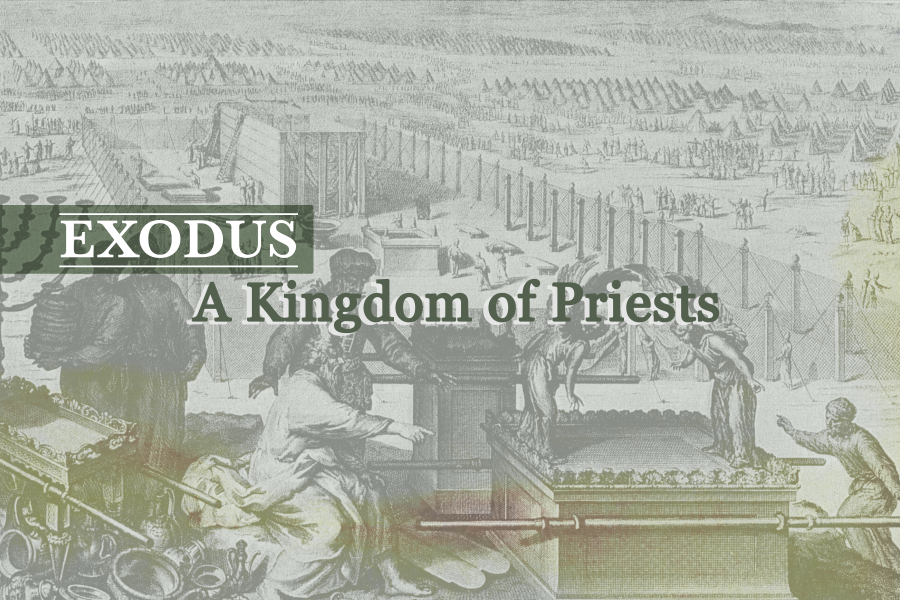
With the ratification ceremony concluded in Exodus 24, that chapter concluded with Moses’ ascent up Mount Sinai into the cloud of God’s glory, where he would stay for forty days and forty nights. The next section of Exodus (chapters 25-31) records for us the instructions that Moses received from God during that time upon the mountain. Specifically, these instructions are for the tabernacle, which is also called the tent of meeting because it would be the place where God would dwell in the midst of His people.[1] Notice that verse 9 commands that these commands must be followed exactly. And since we may easily get lost in the minute details that are described in the following chapters, let us also note from the beginning what details are not included for us in these chapters. Sailhamer explains:
The problem that faces the readers of the Pentateuch, however, is that the text itself explains very little of the heavenly meaning of the tabernacle and its parts. It appears that we, the readers, are invited to ponder the description of the tabernacle in these chapters with the expectation that they exhibit the pattern of the heavenly temple, but we are not given any help in explaining them. In other words, there appears to be an intentional mystery about the tabernacle and the meaning of its parts, with little desire to resolve it.
There is a lesson to be learned from this mystery, however. That is, the fact that the NT writers explain many of the tabernacle’s parts as “shadows” of the reality revealed in Christ (e.g., Heb 9:5) is in keeping with the purpose of these chapters. One could say that these chapters await just the spiritual explanation that the NT gives them. Without such an exposition, their sense would remain uncertain.
Pentateuch as Narrative, 299-300
Indeed, we ourselves will follow the pattern of theological interpretation that the author of Hebrews has especially laid out for us.
The first instruction that Moses received was of contribution rather than construction. Moses was to collect from the people: gold, silver, and bronze, blue and purple and scarlet yarns and fine twined linen, goats’ hair, tanned rams’ skins, goatskins, acacia wood, oil for the lamps, spices for the anointing oil and for the fragrant incense, onyx stones, and stones for setting, for the ephod and for the breastpiece. These were fine materials that were commonly associated with royalty, which means that they were fittingly put to use for constructing God’s dwelling place among His people. Indeed, that is the grand story of the remainder of Exodus. In chapter 19, Yahweh descended in glory upon Mount Sinai as the King coming down to meet with His people. Now the construction of the tabernacle is so that He can continuously be in their midst as their King even as they leave Sinai and inhabit the land of Canaan.
Being a nation of former slaves who were out in the middle of the wilderness, we should pause to consider where these sorts of rich materials would come from. The answer to that question was given to us back in 12:35-36:
The people of Israel had also done as Moses told them, for they had asked the Egyptians for silver and gold jewelry and for clothing. And the LORD had given the people favor in the sight of the Egyptians, so that they let them have what they asked. Thus they plundered the Egyptians.
These riches with which the tabernacle would be made came from the Egyptians, who had surrendered them to the Israelites as they left on the night of the Passover. Was this then the reason that God had His people plunder the riches of the Egyptians? Just so that they could build Him a tabernacle? No. If that were the case, then the LORD would have placed a particular demand upon the people, and He would have reinforced that indict by reminding that they were only able to plunder the Egyptians because of Him.
Yet that is not what God does. Instead, He says, From every man whose heart moves him you shall receive the contribution for me. They were to give willingly and from their heart. God had truly given them the wealth of the Egyptians, and the riches really did now belong to the Israelites. Indeed, it was that ownership of the wealth that made giving actually possible. We cannot properly give what does not truly belong to us. Nor can anything given out of coercion be rightly considered a gift, which is why taxes are not donations to the government. As the great Giver, our God gives freely to us, and in response, it is right that God’s people would give freely in imitation of Him.
2 Corinthians 9:7 tells us this plainly, saying: “Each one must give as he has decided in his heart, not reluctantly or under compulsion, for God loves a cheerful giver.” There is not a one-size-fits-all dollar amount for Christian giving; instead, we are each meant to be led by the Holy Spirit to give as the Lord leads us. Giving should be a cheerful and worshipful act for Christ’s followers. Sorrowfully giving what you think is the bare minimum or giving exuberantly to impress others are both sure to destroy the joy of giving.
It is also worth noting that, while there is a biblical principle that God tends to give more to those who give generously themselves, it is by no means a promise to be claimed. Indeed, to give in order to be given more by God destroys the joyful giving from the heart. Furthermore, the false preachers who make themselves rich by promising greater wealth to those who give to them will have those like the poor widow who gave from their poverty and the faithful ministers of God’s Word who scraped pennies and juggled secular employments sing for joy to God’s justice on the last day as they are cast in the darkest of pits.
THE ARK & THE MERCY SEAT
The specific instructions of the tabernacle begin with the most important of all the furnishings: the ark of the testimony (or covenant):
They shall make an ark of acacia wood. Two cubits and a half shall be its length, a cubit and a half its breadth, and a cubit and a half its height. You shall overlay it with pure gold, inside and outside shall you overlay it, and you shall make on it a molding of gold around it. You shall cast four rings of gold for it and put them on its four feet, two rings on the one side of it, and two rings on the other side of it. You shall make poles of acacia wood and overlay them with gold. And you shall put the poles into the rings on the sides of the ark to carry the ark by them. The poles shall remain in the rings of the ark; they shall not be taken from it. And you shall put into the ark the testimony that I shall give you.
Fundamentally, the ark was a box that would eventually contain the tablets of the Ten Commandments, Aaron’s budded staff, and a jar of manna. There was no universal system for defining measurements at that time, so a cubit is typically said to be around 18 inches. Thus, “it was a relatively small box, three and three-quarters feet long, two and a quarter feet wide, and two and a quarter feet high. It also had rings attached to the sides, through which poles were slid for carrying it” (Immanuel in Our Place, 49). Regarding these poles, Ryken writes:
These poles were never to be removed (Exod. 25:15). This may seem like a minor detail, but like all the details surrounding the tabernacle, it was important. Some of the other furnishings also had carrying poles, but only the ones for the ark were permanent. The reason was very simple: To touch the ark was to die. Remember, the ark represented the holy presence of God. It was sacred, not because it was some kind of magic box (as in the movie Raiders of the Lost Ark, starring Harrison Ford as Indiana Jones), but because it was the place where God was. In order to teach his people to revere his majesty, God had designated the ark as the special place of his earthly presence. Therefore, it was not to be touched! When it needed to be moved, the priests were supposed to use the poles, being very careful not to touch the ark itself. Therefore, the poles needed to stay in place all the time.
Exodus, 816
The severity of this is displayed in 2 Samuel 6:5-7. In that passage, David is having the ark brought to Jerusalem. Along the way, an ox stumbles, and a man name Uzzah grabbed the ark to prevent it from falling. Verse 7 then reads: “And the anger of the LORD was kindled against Uzzah, and God struck him down there because of his error, and he died there beside the ark of God.”
What was the error that Uzzah committed? R. C. Sproul says, “It was an act of arrogance, a sin of presumption.” Although he knew (or should have known) God’s commands regarding the ark, “Uzzah assumed that his hand was less polluted than the earth. But it wasn’t the ground or the mud that would desecrate the ark; it was the touch of man” (Holiness of God, 130).
The whole incident caused David to fear bringing the ark into Jerusalem, so it stayed with a man named Obed-edom for three months. Obed-edom must have been a godly man because “the LORD blessed Obed-edom and all his household” (2 Samuel 6:12). Only after hearing about that blessing did David bring it to Jerusalem, where it remained until it was presumably destroyed along with the temple.
Indeed, that passage is a miniature display of what the blessings and judgments that often come through the ark. In 1 Samuel, the Philistines capture the ark and bring it into the temple of their god Dagon. In the night, however, the LORD broke head and hands off of Dagon’s statue and then brought disease upon every city of the Philistines in which it was kept until it was sent back with gifts into Israel. Yet the Israelites in the town of Beth-shemesh looked upon the ark, and the LORD struck down seventy men.
But for Israel, ark represented God’s blessed presence in their midst. In Numbers 10, whenever Israel left Sinai, the ark went before them to seek a place of rest for them. Indeed, in verses 35-36, we read:
And whenever the ark set out, Moses said, “Arise, O LORD, and let your enemies be scattered, and let those who hate you flee before you.” And when it rested, he said, “Return, O LORD, to the ten thousand thousands of Israel.”
Of course, it was with the ark that also went before Israel as they entered Canaan through the parting of the Jordan. Israel marched with the ark around the city of Jericho until the LORD brought it walls down into dust.
None of this should be surprising though because symbols of both blessing and judgment are instructed for the ark’s cover:
You shall make a mercy seat of pure gold. Two cubits and a half shall be its length, and a cubit and a half its breadth. And you shall make two cherubim of gold; of hammered work shall you make them, on the two ends of the mercy seat. Make one cherub on the one end, and one cherub on the other end. Of one piece with the mercy seat shall you make the cherubim on its two ends. The cherubim shall spread out their wings above, overshadowing the mercy seat with their wings, their faces one to another; toward the mercy seat shall the faces of the cherubim be. And you shall put the mercy seat on the top of the ark, and in the ark you shall put the testimony that I shall give you. There I will meet with you, and from above the mercy seat, from between the two cherubim that are on the ark of the testimony, I will speak with you about all that I will give you in commandment for the people of Israel.
To represent God’s judgment, the cover had two golden cherubim. The only previous mention of these particular angels was in Genesis 3:24, which describes the consequences of the Fall: “[God] drove out the man, and at the east of the garden of Eden, he placed the cherubim and a flaming sword that turned every way to guard the way to the tree of life.” I agree with Ryken’s assessment that:
This seems to show their function. Unlike some of the other angels, the cherubim are not messengers but remain in God’s presence to deny access by anything unholy. They are the palace guards for the King of kings—“guardians of the sacred and throne attendants of the Almighty.”
Exodus, 817
Ezekiel’s description of the cherubim is no less inviting:
And from the midst of it came the likeness of four living creatures. And this was their appearance: they had a human likeness, but each had four faces, and each of them had four wings. Their legs were straight, and the soles of their feet were like the sole of a calf’s foot. And they sparkled like burnished bronze. Under their wings on their four sides they had human hands. And the four had their faces and their wings thus: their wings touched one another. Each one of them went straight forward, without turning as they went. As for the likeness of their faces, each had a human face. The four had the face of a lion on the right side, the four had the face of an ox on the left side, and the four had the face of an eagle. Such were their faces. And their wings were spread out above. Each creature had two wings, each of which touched the wing of another, while two covered their bodies. And each went straight forward. Wherever the spirit would go, they went, without turning as they went. As for the likeness of the living creatures, their appearance was like burning coals of fire, like the appearance of torches moving to and fro among the living creatures. And the fire was bright, and out of the fire went forth lightning. And the living creatures darted to and fro, like the appearance of a flash of lightning.
Ezekiel 1:5–14
Yet while the cherubim are likely meant to convey the judgment that will strike any who attempt to rebel against the LORD, the name of the cover itself is a symbol of God’s blessing. It is called the mercy seat because it was to be the place where God’s mercy for sin was found. After its construction, the mercy seat rather than Sinai would be the place in which Moses would meet with Yahweh and hear Him speak. However, Stuart suggests that the NIV’s translation “atonement cover” is a better rendering:
A weakness inherent in the connotation of the term “mercy seat,” however, occurs in connection with the functional nature of the kapporet: it was more likely a pedestal or standing platform than a seat, a reflection of the dazzling slab that appeared under the feet of Yahweh when the elders saw him on Mount Sinai (24:10)—not a throne or a chair or the like. Although it is true that God is elsewhere described in some English translations, including the NIV, as “enthroned between the cherubim,” this English translation may be suspect; a more literal translation would be “cherubim dweller” since the Hebrew wording makes no mention of a “throne” or any “enthronement.”
Exodus, 570
Indeed, calling this the atonement cover certainly fits best with its regular function in Israel’s worship. While inside the inner chamber of the tabernacle, no priest was permitted to enter that Most Holy Place except for the high priest, and he could only do so once a year on the Day of Atonement. On that day, the high priest would sprinkle blood seven times upon the mercy seat (or atonement cover) to make atonement for the sins of Israel.
Of course, as with all aspects of the tabernacle that we will study, the author of Hebrews called this only a copy and a shadow of the fullness that is Christ. Each Day of Atonement was merely a shadow of the true and better sacrifice that Jesus made through His own death. Our Lord’s death is the once for all sacrifice to cancel the guilt and penalty of our sins and restore us to God. And like the high priests of Israel, He did sprinkle His own blood upon the atonement cover but not upon the one that Moses was instructed to make. As Hebrews 9:24 says, “For Christ has entered, not into holy places made with hands, which are copies of the true things, but into heaven itself, now to appear in the presence of God on our behalf.” That is why the veil to the Most Holy Place was torn. The earthly copies have passed away and are of no use any longer. And we should rejoice that that is the case. Of the physical ark, only Moses had the privilege of experiencing verse 22: There I will meet with you, and from above the mercy seat, from between the two cherubim that are on the ark of the testimony, I will speak with you about all that I will give you in commandment for the people of Israel. Yet here is God’s command for us now through Jesus Christ:
Therefore, brothers, since we have confidence to enter the holy places by the blood of Jesus, by the new and living way that he opened for us through the curtain, that is, through his flesh, and since we have a great priest over the house of God, let us draw near with a true heart in full assurance of faith, with our hearts sprinkled clean from an evil conscience and our bodies washed with pure water.
Hebrews 10:19-22
As we come the Table of our King, we have a physical picture of our drawing near to the presence of our God. As the bread and the cup testify, it is only through the broken body and shed blood of our Savior that we are now able to have peace with God and even, in a marvel of all marvels, be adopted as His children! Yet as we come to the Table, we should remember that it is through Christ that we have access to the Father, but it is also in Christ that we meet with God and God meets with us. As Paul says, “For God, who said, ‘Let light shine out of darkness,’ has shone in our hearts to give the light of the knowledge of the glory of God in the face of Jesus Christ” (2 Corinthians 4:6). Therefore, as we eat and drink, let us taste and see the goodness of our God who has given us the very best of all things, His beloved Son who is Himself the true and better ark of the testimony.
[1] We should note the significant importance of verse 8; however, we will return to dwell upon it more fully in chapter 26 as we consider the overall structure of the tabernacle.
 B. C. Newton