
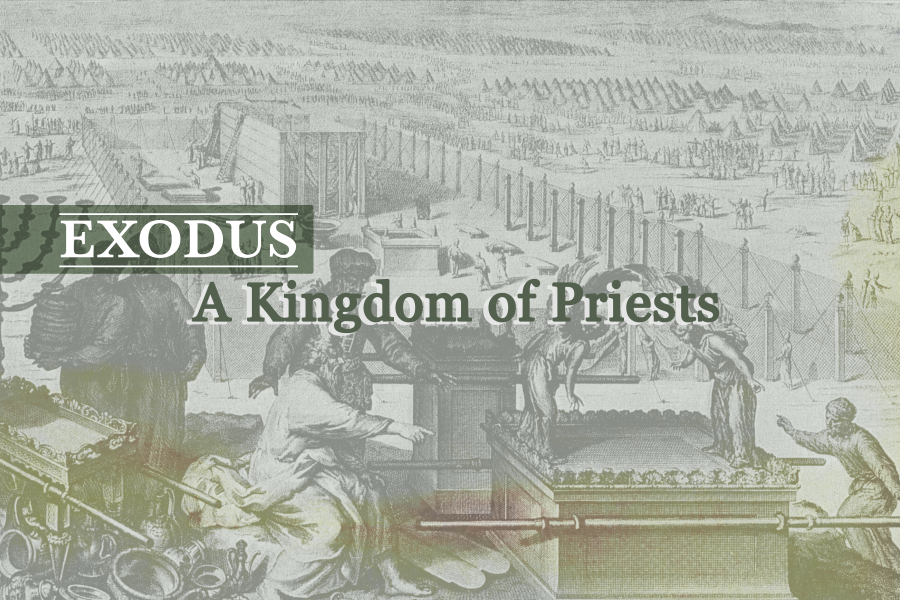
Presently, in our study of the book of Exodus, we are considering the instructions for the building of the tabernacle that Yahweh gave to Moses in the span of forty days upon Sinai. As we have noted, the instructions began with the ark of the testimony, the most holy item that would reside in the Most Holy Place. It then moved outward to the table for the bread of the Presence and the golden lampstand, which would furnish the Holy Place. In the previous chapter, we moved outward yet again by considering the instructions for the tabernacle itself. That outward movement continues in our present chapter as we study the design of the bronze altar and the courtyard around the tabernacle in which it stood. As has been our pattern, we will consider the design and function of altar and the courtyard, and then we will conclude with how they are point us toward Christ.
THE BRONZE ALTAR // VERSES 1-8
You shall make the altar of acacia wood, five cubits long and five cubits broad. The altar shall be square, and its height shall be three cubits. And you shall make horns for it on its four corners; its horns shall be of one piece with it, and you shall overlay it with bronze. You shall make pots for it to receive its ashes, and shovels and basins and forks and fire pans. You shall make all its utensils of bronze. You shall also make for it a grating, a network of bronze, and on the net you shall make four bronze rings at its four corners. And you shall set it under the ledge of the altar so that the net extends halfway down the altar. And you shall make poles for the altar, poles of acacia wood, and overlay them with bronze. And the poles shall be put through the rings, so that the poles are on the two sides of the altar when it is carried. You shall make it hollow, with boards. As it has been shown you on the mountain, so shall it be made.
These verses give us the description for how the bronze altar was to be built. Stuart notes:
Its top surface was thus four and a half feet high (“three cubits high”) off the ground and was a square seven and a half feet on each side (“five cubits long and five cubits wide”), providing a total of fifty-six and one-quarter feet of grilling area (minus whatever was taken up by the corner “horns” and any rim that may have surrounded the top, if either of these imposed upon the total surface of the top). (595)
Like the rest of the tabernacle, the altar needed to be portable, so it had loops and poles for carrying. It was also a hollow box, which, besides being necessary for building a fire, would also have made it much more maneuverable than if it were a solid cube.
As with the other pieces of furniture, it was to be built out of acacia wood, but unlike the items that actually belonged to the tabernacle itself, the altar would not be overlaid with gold but with bronze. This was for both a practical and theological purpose. Practically, gold is melted earlier than bronze, and the since the purpose of the altar was to burn sacrifices, bronze was a better metal to use than gold. Theologically, bronze being a less valuable metal represented being further away from the ark within the Most Holy Place.
The horns upon the corners of the altar likely served the practical function being place where the sacrificial animal could be bound while other preparations were made, for we read in Psalm 118:27: “The LORD is God, and he has made his light to shine upon us. Bind the festal sacrifice with cords, up to the horns of the altar!” However, they apparently took on the meaning of being a place of refuge, since both Adonijah and Joab fled from Solomon’s wrath by laying ahold of the horns of the altar.
Of course, the most important aspect of the altar was its use for burning the sacrifices that the Israelites would bring. As we discussed a few weeks ago, some of those sacrifices would be burned entirely, and some would only be roasted, have the fat burnt away, and then eaten. Yet regardless of the particular kind of sacrifice, Stuart notes that through these slaughtered animals:
God taught his people the basic principle of salvation from sin: something that God considers a substitute must die in my place so that I may live. Altar sacrifice was the primary way for this substitution to happen… By killing an animal, then cooking it on that grill in God’s presence (i.e., in front of the entrance to the tabernacle), and then eating it in God’s presence (symbolically sharing the meal with him), the Israelite worshiper learned over and over again the concept of substitutionary atonement and of covenant renewal. (594-595)
At least, it was supposed to reinforce that principle over and over again. Indeed, here is how Vern Poythress describes how a sacrifice was to be made:
In a typical case the process begins with the worshiper who brings an animal without defect to the priest. The worshiper has raised the animal himself or paid for it with his earnings, so that the animal represents a “sacrifice” in the modern sense of the word. It costs something to the worshiper, and a portion of the worshiper’s own life is identified with it. The worshiper lays his hand on the head of the animal, signifying his identification with it. He then kills the animal at the entranceway into the courtyard, signifying that the animals dies as a substitute for the worshiper.
From that point onward the priest takes over in performing the sacrificial actions. The intervention of the priest indicates that a specially holy person must perform the actions necessary to present the worshiper before God, even after the death of the animal. The priest takes some of the blood and sprinkles it on the side of the altar or on the horns of the altar…depending on the particular type of sacrifice… All of these actions constitute the permanent marking of the altar as testimony to the fact that the animal has died. (Cited in Ryken, Exodus, 817-818)
Each animal that an Israelite took from their field to slice its throat open before the bronze altar, screamed that “the wages of sin is death” (Romans 6:23). And as they placed their hand upon the animal’s head, they were to reflect that something innocent was taking their place. Because animals are not created in the image of God, they are not morally culpable as we are. Indeed, because humans alone were made in God’s likeness, Yahweh gave mankind dominion over all the animals of the earth. Thus, every sacrifice was the slaughter of what we were supposed to rule over in our own place.
THE COURTYARD // VERSES 9-19
The text moves on to describing the court of the tabernacle in verses 9-15:
You shall make the court of the tabernacle. On the south side the court shall have hangings of fine twined linen a hundred cubits long for one side. Its twenty pillars and their twenty bases shall be of bronze, but the hooks of the pillars and their fillets shall be of silver. And likewise for its length on the north side there shall be hangings a hundred cubits long, its pillars twenty and their bases twenty, of bronze, but the hooks of the pillars and their fillets shall be of silver. And for the breadth of the court on the west side there shall be hangings for fifty cubits, with ten pillars and ten bases. The breadth of the court on the front to the east shall be fifty cubits. The hangings for the one side of the gate shall be fifteen cubits, with their three pillars and three bases. On the other side the hangings shall be fifteen cubits, with their three pillars and three bases.
While the tabernacle itself was relatively small, this fence around the tabernacle that established its courtyard was significantly larger: “150 feet (100 cubits) long and 75 feet (50 cubits) wide, or 11,250 square feet” (Stuart, 598). Again, this is both practical and theological. Practically, the court must be larger than the tabernacle because its very purpose is to encircle it. Theologically, the court must be larger because it was the only area that the ordinary Israelite was allowed to enter. Indeed, its gate is far larger than the entrance to the tabernacle for that very reason:
For the gate of the court there shall be a screen twenty cubits long, of blue and purple and scarlet yarns and fine twined linen, embroidered with needlework. It shall have four pillars and with them four bases. All the pillars around the court shall be filleted with silver. Their hooks shall be of silver, and their bases of bronze. The length of the court shall be a hundred cubits, the breadth fifty, and the height five cubits, with hangings of fine twined linen and bases of bronze. All the utensils of the tabernacle for every use, and all its pegs and all the pegs of the court, shall be of bronze.
Regarding the colors of the entrance, Ryken cites Patrick Fairbairn as making the following point:
The question is not, whether such things might not have been used so as to convey certain ideas of a moral and religious nature, but whether they actually were so employed here; and neither the occasion of their employment, nor the manner in which this was done, in our opinion, gives the least warrant for the supposition.… A symbolical use of certain colors we undoubtedly find, such as of white, in expressing the idea of purity, or of red, in expressing that of guilt; but when so used, the particular color must be rendered prominent, and connected also with an occasion plainly calling for such a symbol. This was not the case in either respect with the colors in the tabernacle. The colors there, for the most part, appeared in a combined form; and if it had been possible to single them out, and give to each a distinctive value, there was nothing to indicate how the ideas symbolized were to be viewed, whether in reference to God or to His worshippers.
Again, the tabernacle consisted of three main areas. The smallest and central room of the tabernacle was the Most Holy Place, which had no entrance at all since only the high priest could enter on the Day of Atonement. Next was the Holy Place, which was twice the size of the Most Holy Place but that only the priests were allowed to enter into. The third area was the courtyard around the tabernacle. By the First Century, the second temple would contain multiple courtyards. The outermost was the Gentile’s Court, which was as far as Gentile’s to go. Then came the Women’s Court, which was as far as Israelite women were allowed to go. Next was the Court of the Israelites, which was only for Israelite men. Last was the Court of the Priests, into which only priests were permitted. But those distinctions are not commanded in Scripture, and the court of the tabernacle was open to anyone who was not ritually unclean.
But for what reason would an Israelite need to enter the court of the tabernacle? To make a sacrifice. The only two items within the court were the bronze altar and the bronze basin, but since only the altar is mentioned here alongside the instructions for the court, the altar clearly held a greater importance. Bringing their sacrifice was the main act of worship for the Israelites.
And although we might find the notion of slaughtering an animal to be anything but worshipful, we should consider how the psalmists viewed it. In Psalm 84:1-2, the sons of Korah sing: “How lovely is your dwelling place, O LORD of hosts! My soul longs, yes, faints for the courts of the LORD; my heart and flesh sing for joy to the living God.” Then in verse 10, we read: “For a day in your courts is better than a thousand elsewhere. I would rather be a doorkeeper in the house of my God than dwell in the tents of wickedness.” Or consider verse 4 of Psalm 100, which gives this command: “Enter his gates with thanksgiving, and his courts with praise! Give thanks to him; bless his name!”
Why did the psalmists have such a joyous view of making sacrifices in the court upon the bronze altar? After all, the act of sacrificing certainly confronted the worshiper with the deadly reality of their sin. So did the very layout of the tabernacle. Remember that the outside of the tabernacle was rather plain since the outer coverings were made of animal skins. The ordinary Israelites would never see the inside of God’s dwelling place on earth. He was so close to them and yet still so far. And the altar that stood between them and the tabernacle was a perpetual testimony that because of their sin, they could not enter into God’s presence.
Yet in the midst of these direct and painful reminders of one’s sin, the altar was ultimately where sin was dwelt with. It was where the guilty and stricken of heart came and went home assured that the Holy One had forgiven their sins. Psalm 65:3-4 explains it to us: “When iniquities prevail against me, you atone for our transgressions. Blessed is the one you choose and bring near, to dwell in your courts! We shall be satisfied with the goodness of your house, the holiness of your temple!” While we deserve nothing but death for our sins, the Judge of all the earth permits our punishment to be laid upon another. The Israelite would return to his or her house praising Yahweh for accepting the blood of their animal in place of their own.
The great problem, however, is that “it is impossible for the blood of bulls and goats to take away sins” (Hebrews 10:4). Indeed, the constant need to continually make such sacrifices proved their ultimate insufficiency as a substitute. We who have dominion over the animals cannot have our sins taken by them. Christ alone could accomplish that work. Being the eternal Word, He is infinitely greater than us. Yet in taking on flesh, He is also one of us. And by living a life of perfect obedience to the Father, His death was as undeserved as the animals that the Israelites sacrificed, and even more so since He is the Maker of all things. Even so, upon the cross, our sin was laid upon Christ. All of our iniquity was transferred onto Him. And with His death, He paid every last debt that we owed before God’s throne. Thinking of this blessed redemption, the Apostle Paul wrote in Roman 5:6-10:
For while we were still weak, at the right time Christ died for the ungodly. For one will scarcely die for a righteous person—though perhaps for a good person one would dare even to die—but God shows his love for us in that while we were still sinners, Christ died for us. Since, therefore, we have now been justified by his blood, much more shall we be saved by him from the wrath of God. For if while we were enemies we were reconciled to God by the death of his Son, much more, now that we are reconciled, shall we be saved by his life.
Again, the blood of animals never covered any sinner’s sins. Instead, they pointed forward to the once for all sacrifice that Christ would make for us. Although they did not know His name, all the Israelites who sacrificed and believed by faith that Yahweh had forgiven their sins were truly placing their faith in Christ. In this way, the animal sacrifices of the old covenant were more similar to our present taking of the Lord’s Supper than we might think. Both have no efficacy in and of themselves; rather, both point beyond themselves to Christ. Indeed, both were/are reminders.
Yet the reminder of the Lord’s Supper is far superior to the reminder of the animal sacrifices. The sacrifices reminded people of their sins, keeping the deadly consequences of rebelling against the Creator always before their eyes and creating a longing within them for the promised Savior to deliver them once and for all. Indeed, after making their sacrifice, they needed to pass the rest of the work onto a priest, who alone could enter the Holy Place. With the Lord’s Supper, we now look back upon that finished work of Christ to redeem us from our sins and now look forward to His return to make all things new. Therefore, let us give thanks to God that He has still left us a tangible reminder of Jesus’ once for all sacrifice.
 B. C. Newton