
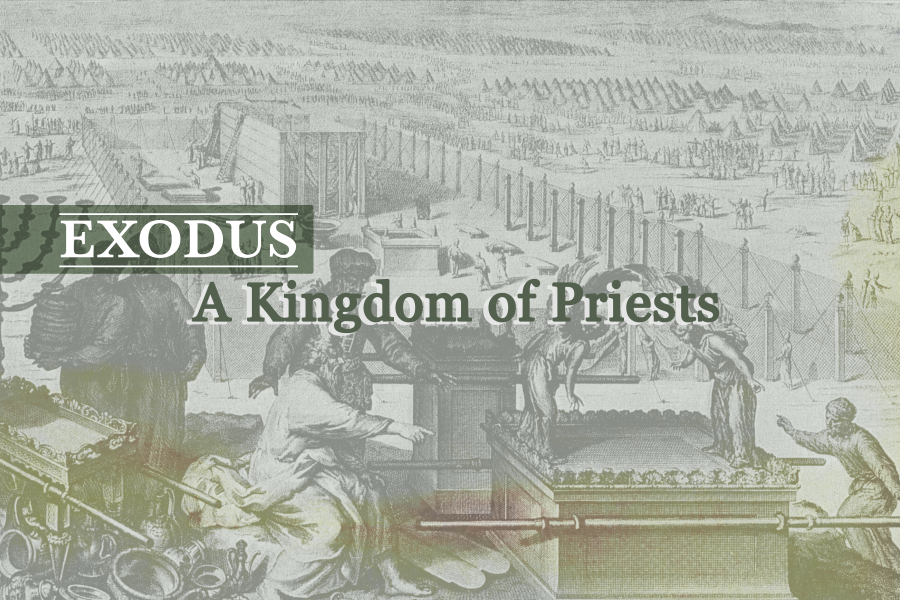
As the sun paints the clouds with a variety of glorious colors, which in their own nature are but dark and lowering vapors exhaled from the earth, so when the Son of righteousness arises, even the carnal ordinances and commandments of the law, dark and earthly as they seem, are gilded by His beams and wear a smiling appearance. By His kindly influence, who is the light of the World, the most barren places of the Scripture rejoice and blossom as the rose.
What portion of sacred writ is more apt to be perused without edification and delight than what relates to the Levitical priesthood: the qualifications of their persons, their apparel, their consecration, and the different parts of their function? And indeed it must be confessed a very hard task to reconcile with the wisdom of God the enjoining such numberless rites, purely for their own sake. But when we consider that Aaron, and his successors, were figures of our Great High Priest, we must acknowledge that these injunctions are neither unworthy of God nor useless to man but are profitable for doctrine and instruction in righteousness.
In the text before us, we find God’s instructions regarding the garments and the consecration of the priests who would serve in tabernacle. As we approach these multitude of descriptions and details given here, may McEwen’s words prove true. As we view these words in the light of their fulfillment in Jesus Christ, may we see the glory and the beauty of God in them like the painted clouds at sunset.
FOR GLORY & FOR BEAUTY // 28:1-43
Verses 20-21 of chapter structurally transitions the instructions that Moses received from the inanimate objects of the tabernacle onto the priests, who were very much a living, breathing element of the whole tabernacle complex. However, we will consider them alongside verses 38-44 of chapter 29 towards the end of this study.
Verse 1 of chapter 28 makes it explicit for the first time that Aaron and his sons are to be set apart as Israel’s priests. Just as with Moses himself, with Noah, with Abraham, with David, with the prophets, and the apostles, Aaron did not the mantle of leadership for himself; it was bestowed upon him. And the same pattern ought to continue with leadership in the church today, especially when considering the two biblical offices of elders/pastors and deacons.
Verses 2-5 then sets the subject for the rest of the chapter:
And you shall make holy garments for Aaron your brother, for glory and for beauty. You shall speak to all the skillful, whom I have filled with a spirit of skill, that they make Aaron’s garments to consecrate him for my priesthood. These are the garments that they shall make: a breastpiece, an ephod, a robe, a coat of checker work, a turban, and a sash. They shall make holy garments for Aaron your brother and his sons to serve me as priests. They shall receive gold, blue and purple and scarlet yarns, and fine twined linen.
Notice that the gold and the colors that were used to make the priests’ garments reflect the gold and the colors that were used for constructing the tabernacle. At its most basic level, the priests, and the high priest in particular, were displaying the glory and the beauty of the tabernacle through their garments. Since the ordinary Israelites could not enter the tabernacle to see the beauties and glory within, the garments of the priests were as though the inside of the tabernacle was coming out to be among the people.
Indeed, many elements of the high priest’s garments were for the comfort and benefit of the people of Israel. Upon the shoulders of the ephod, which is like a large apron, were two onyx stones that each had six of the tribes’ names written upon them, so that the high priest would bear their names before the LORD on his two shoulders for remembrance. The golden bells that hung from the hem of his robe were constant reminder to the Israelites that the high priest was at work, making intercession for them before God. The signet upon his turban, which read “Holy to the LORD,” was a reminder that their high priest had been consecrated for service to Yahweh and was accepted in His presence as their representative.
Of course, the garment piece that receives the most attention in the text is the breastpiece that was to be attached to the ephod. It held twelve precious stones, one for each of Israel’s twelve tribes, and it also held the Urim and the Thummim. No one knows what these things were exactly, but they are what made the breastpiece the breastpiece of judgment. They were later used by men like Joshua and David to prayerfully discern God’s will over particular matters. Douglas Stuart rightly notes:
Theologically, the Urim and the Thummim represented something on the order of last resort appeals to God for guidance—not individual guidance but national guidance on matters that would require the agreement and concerted effort of the whole people. The people’s first resort was supposed to be obedience to the written covenant since the written covenant constituted the most basic or foundational guidance, generally and perpetually applicable, that they possessed. The second resort would be to listen for direct divine guidance through the word of God from a prophet, something that God occasionally, but not necessarily regularly, gave them. The third resort would be prayer, seeking to understand how best to take a national direction of some sort, the Urim and Thummim would be drawn from the breastpiece pouch and examined for God’s answer to the people’s prayer. (Exodus, 613)
The Urim and the Thummim are one of the many ways in which God spoke to our fathers long ago, but as Hebrews 1:1 teaches, those former methods of discerning the will of God have passed away with the coming of Christ, who as God’s Son gives us the full and complete revelation of God. But neither should we use Scripture as a modern Urim and Thummim.
Most fundamentally, the priests’ garments were a reminder of their task before Yahweh on behalf of the people of Israel. They were clothed with the colors and designs of the tabernacle, but they also bore the names of the tribes of Israel. They ministered in the court, presiding over the sacrifices made at the bronze altar but also entering into the tabernacle itself. The priests were mediators, working daily between both heaven and earth, consecrated to Yahweh but representing the people.
THAT THEY MAY SERVE ME // 29:1-37
Speaking of consecration, the ceremony of consecration is described in 29:1-37. Again, we should keep in mind that this is not the description of Aaron’s actual consecration but rather the instructions that Moses was given for how to consecrate Aaron and his sons into the priesthood. At its simplest meaning, consecration means setting something apart for holy use that it may belong exclusively to God. In Exodus 12, the firstborn of Israel were consecrated to Yahweh as a way of showing that Israel itself was being taken as a holy nation to God. Tremper Longman III notes that “The verbs used in Exodus and Leviticus in reference to the initiation of the priests are “purify” (tahar), “anoint” (mashah), “ordain” (male’ with yad), and “consecrate” (qadash). These actions all combined to lift these individuals ritually out of the realm of the everyday, the common, and transport them into the heavenly or sacred” (124).
There was then a four-part process of consecration. First, the priests were washed, which was a sign of their ritual purification and reminder that nothing unclean may enter the presence of God, which meant that no human could come near without first washing. Second, the priests were dressed in the garments described in chapter 28. Third, the high priest was anointed with oil, which was a visible sign of God’s Spirit being poured upon him. Fourth and finally, sacrifices were made.
Verses 10-34 describe the three main sacrifices. First, in verses 10-14, a bull was sacrificed as a sin offering for the priests. Notice that in verse 10 Aaron and his sons were to lay their hands upon the head of the bull, symbolically placing their sins upon the bull so that it could receive the death that their sins deserved in their place. Second, in verses 15-18, the first of two rams was offered. Ryken notes that “the entire ram was committed to the flames. Nothing was left. This was a whole burnt offering, symbolizing total dedication to God. In the same way that the ram was offered to God, the priests offered themselves for God’s service. They, too, were totally dedicated to God” (905). Third and finally, in verses 19-34, a second ram was sacrificed. Because various ceremonies were performed with different pieces of this ram, the purpose seems to primarily be “to sanctify the priests for their sacred duties” (ibid).
In reading the instructions here, we probably tend to subconsciously imagine this ceremony of ordination and consecration as happening over the course of a morning or afternoon. Yet notice that verse 35 says, Through seven days shall you ordain them, and every day you shall offer a bull as a sin offering for atonement. The process was extensive because, though being consecrated for a holy vocation before the LORD, Aaron and his sons were no less sinners than anyone else in Israel. They were being called to preside over the sin offerings, but they needed sin offerings of their own. They were certainly able to sympathize with the sinners that they represented because they were equally sinners themselves.
THAT THEY SHALL KNOW & THAT I MIGHT DWELL // 27:20-21; 29:38-46
In verses 38-42, the regular burnt offerings of two lambs, one in the morning and the other in the evening, are described. These were the opening and closing sacrifices that began the workday of the priests. But as 27:20-21 describes, they still had nightshift work to do because they were responsible for keeping the golden lampstand lit throughout the night. These two most fundamental duties of the priesthood serve as bookends to the priests’ garments and consecration as a reminder that once the priests started their work, it would need to continue night and day in perpetuity. Although Aaron alone served as the high priest, his sons needed to be ordained alongside him because the workload was far too great for any one man to bear. Although he alone symbolically carried Israel upon his shoulders, he needed an entire system of priests to support him in that task.
Yet we should also keep in mind that duties of the priests were beyond being physically continuous acts. In wearing the garments and receiving the ordination, the priests became mediators between Yahweh and His people. They were Israelites themselves, but through their consecration, they also became pieces of the tabernacle. That is why verse 44 puts them all together: I will consecrate the tent of meeting and the altar. Aaron also and his sons I will consecrate to serve me as priests. The purpose of the tabernacle was to be the place where Yahweh would dwell with His people, His holy nation, His treasured possession. He would be their God, and they would be His people. They would know Him, which according to Jesus is eternal life (John 17:3), and He would dwell in their midst.
Those promises are nothing less than Eden reclaimed. They are God bringing people back to paradise, back to the restored communion with Him. And since all of Israel was to be kingdom of priests, the LORD’s intent was always for every nation to come to know Him as the one true God. Yet Aaron and His sons were incapable of accomplishing such a task. Again, they could sympathize all too well with the sins of the people, for they had just as many sins of their own.
This is why the author of Hebrews labors throughout his sermon to show that Jesus is the great and perfect high priest of our faith. Through becoming flesh and tabernacling among us, Jesus was tempted in every way that we are yet never yielded to sin. Thus, while we can rejoice that He is able to sympathize with our weakness, we also rejoice that He does not share in our weakness of sinning. He had no need for a seven-day consecration ceremony with seven slaughtered bulls as sacrifices to cover His sins. Instead, His very purpose in taking on human flesh was to be the Lamb of God who takes away the sins of the world. The sacrifice that He came to make was the once for all sacrifice of Himself. Likewise, He had no need to keep the golden lampstand lit, for He is the light of God who came into the darkness of our world.
And after making the sacrifice for our sins, our Lord now lives eternally as a perpetual high priest. Aaron died and needed to be replaced as the high priest. Yet Christ lives forever and is now seated at the right hand of the Father, where He makes constant intercession for us. Just as Aaron had the names of Israel’s tribes upon his shoulders, as the bride of Christ, we have been set as a seal upon His heart. There is no new more comforting than knowing that Jesus not only died to pay the penalty for our sins but is presently interceding on our behalf in the presence of the Father. This is the great hope and peace that the gospel offers.
But as we noted when we considered the tabernacle as a whole, the good news keeps getting better. Although Christ has ascended to heaven as our perfect high priest, His presence is still tabernacling here on earth through we who are now called the body of Christ. And though the indwelling Holy Spirit has made us into living tabernacles, He has also ordained and consecrated each and every Christian into His service as priests. What Israel never truly became is now a reality in the Christ’s church: the kingdom of God is a kingdom of priests.
Just as the role of the priests was essentially to serve and support the high priest, something similar is still true today. We are not mediators between God and men ourselves, but we do serve the Mediator. We do not offer lambs daily for the sins of the world, but we proclaim to the world the Lamb of God who alone can truly cleanse and forgive our sins. And as our Lord does for us in the presence of His Father, we intercede for the world around us in prayer, for one another, for those who oppose the truth and the gospel, for those who govern, etc.
And just as with the priesthood in Israel, our priesthood today is both the greatest of privileges and the most dreadful of all dangers. As 28:35 and 43 make clear, the priest had the most dangerous job in Israel. Each time he put on his garments and stepped into the tabernacle, he was an unclean man coming into the presence of the Holy One. Each time he was not immediately stricken dead was purely due to the grace of God. And being killed by God is not the same as being killed by a man, for man can only destroy the body but God can destroy both body and soul in hell.
Like the priests going into the tabernacle, our coming to the Lord’s Table is both a grace and danger. In Leviticus, Nabab and Abihu are consumed with fire for presumptuously bringing an unauthorized fire in the tent of meeting. Likewise, Paul warns us that those who take the Lord’s Supper in an unworthy manner have become “weak and ill, and some have died” (1 Corinthians 11:30). Notice that Paul is not making a threat but is simply stating a fact.
How then do we know if we are taking the Lord’s Supper in a worthy manner? The four-part consecration ceremony of the priests gives us a very good guide. First, have your sins been washed away through the blood of Christ, and have you symbolically been washed in the waters of baptism? If the answer to either of those questions is no, then refrain from taking the Lord’s Supper. If you have not trusted in Christ to forgive your sins, then go to Him now in prayer. If you have not yet been baptized, pursue that ordinance first.
Second, are you coming to the Table dressed in the confidence of your own good works, or do you come clothed in the righteousness of Christ alone?
Third, have you been anointed with the Holy Spirit, who’s indwelling alone brings us from being dead in sin to being alive with Christ?
Fourth, do you still place your entire trust each day, from morning to evening and even throughout the night, in the perfect sacrifice of the Lamb of God to take away your sins?
If so, then come boldly, not presumptuously nor flippantly, but confidently to the throne of grace. Taste and see the goodness of our great high priest who ever lives to plead for us.
 B. C. Newton