
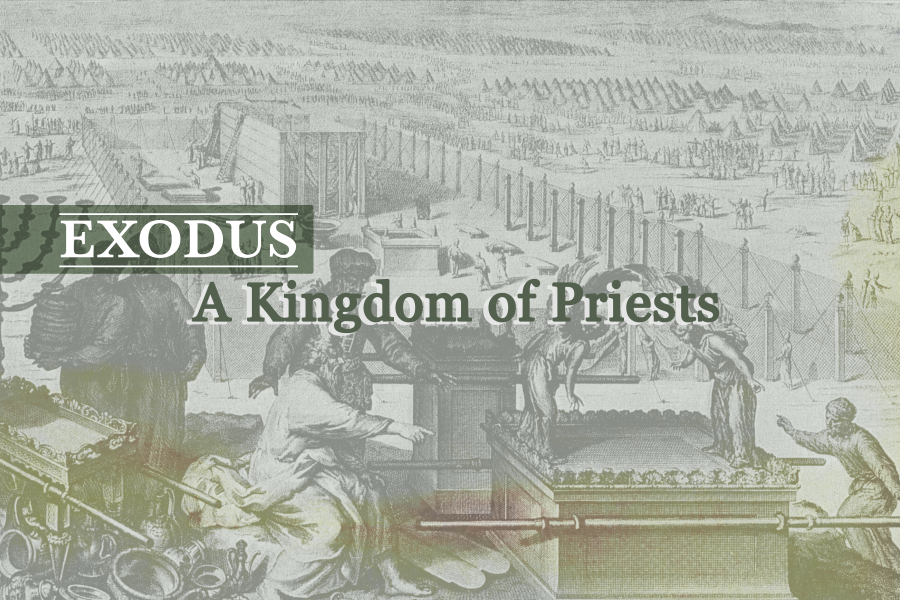
With Exodus 31, we reach the conclusion of God’s instructions for the tabernacle that He gave to Moses. These instructions began in chapter 25 and, in the context of Exodus, took place over a span of forty days and forty nights upon the summit of Mount Sinai. As we have said before, the reason that so much time is being given to the plans for the tabernacle is because it was designed to be (to borrow Beale’s phrase) “Eden remixed.” Through the tabernacle, God’s presence would dwell among His people. And because His people had not yet entered the land of Canaan that He promised to their father Abraham, it needed to be mobile, ready to go with Israel wherever the LORD sent them.
In the chapter before us, we have the final two sets of instructions. Just as the instructions began with the command to gather the necessary materials from the people of Israel, so they now conclude with the LORD summoning Moses to gather two craftsmen, Bezalel and Oholiab, who have been filled with God’s Spirit to make all that God commanded in the previous chapters. The final set of instructions is regarding the Sabbath, and the chapter concludes with Moses being given by God the two tablets of stone.
ARTS & CRAFTS FOR THE GLORY OF GOD // VERSES 1-11
Our text begins with Moses receiving instructions from Yahweh regarding the primary craftsmen tasked with constructing the tabernacle. Bezalel was evidently the chief craftsman, the architect, while Oholiab was likely his primary assistant and co-designer. Under their leadership, a number of other skillful men also participated in the construction of the tabernacle and its various items. Philip Ryken notes:
These men were not selected by a jury of fellow artists but were appointed by the sovereign and electing choice of God. What the Scripture literally says is that they were called by name (Exod. 31:2, 6). Bezalel and Oholiab were God’s personal choice for this job. And their calling as artists was so sacred that their names were preserved for posterity. Bezalel means “in the shadow of God.” It’s a good name for an artist working under divine direction, with God as the patron of his art. The meaning of Oholiab’s name was even more appropriate: “my tent is the Father-God.” Oholiab’s job was to build God’s dwelling on earth, and his name explained what that holy tent was designed to show—namely, that God is the shelter for his people.
Alongside their calling, Yahweh also put His Spirit upon them to enable them to rightly accomplish their task. Specifically, they were given through the Spirit ability and intelligence, with knowledge and all craftsmanship. Yet this specific gifting did not mean that Bezalel and Oholiab were chosen at random by the LORD, as if they were shepherds by trade who God was going to supernaturally empower to craft the tabernacle. No, as Douglas Stuart writes:
Only the best materials were to be used in the manufacture of the tabernacle and its furnishings, according to the instructions of chaps. 25-30. Here in 31:1-11 God insists as well that only the best workmanship be assigned to the actual task of construction. The process beings with the appointment of people who are already skilled, gifted artisans. To this is added the special spiritual filling of Yahweh, with the result that the completed tabernacle and everything in it will be of the top quality, an exact fulfillment of what Yahweh wanted, rather than a mere approximation. Worshipers of all succeeding generations could be sure that the tabernacle at which they worshiped was in fact built exactly as Moses had seen it in the divinely revealed plan. Indeed, when Moses carefully inspected the tabernacle and all its accoutrements, he found it “just as the LORD had commanded” (39:20). (Exodus, 649)
Indeed, verse 6 makes it clear that God giving a supernatural guidance to those who were already craftsmen by saying, And I have given to all able men ability… They were already able men who had accomplished the slow, grinding work of learning their craft, and now God was giving them His Spirit that they may make all that I have commanded you, making everything exactly as the LORD commanded.
As Christians who have God’s Spirit dwelling within us, we can make application to ourselves. Whatever craft we are setting our hands to do, we should do with all our might, and give God all the glory for being able to do so. Bach, the great classical composer, would often begin his works by writing “JJ” (for Jesu juva, which means ‘Jesus help’) at the top of the page, and after finishing he would put the initials SDG (for soli Deo gloria) at the bottom. That is precisely the approach that we all ought to take to whatever work the LORD has set before us. We should give ourselves wholly to our work with all our might, and after all our efforts are expended, we then give glory to God, for in Him we live and move and have our being and can do nothing apart from Him.
Of course, we should also note that our work can only being glorifying to God whenever it is done according to His will. As we have said before, Bezalel and Oholiab likely had much creative liberty for the particular designs of the tabernacle, yet where God gave exact instructions, they were to follow them precisely. Today, we may not be commanded to build a bronze altar to the LORD. However, we can rightly judge all of our labors through the lens of the two greatest commandments, loving God and loving our neighbor. For this reason, though a thief may have tremendous skill in stealing, he can never glorify God with his “craft,” for it defies the explicit command of God and it is to the harm of his neighbor. Yet in all other matters, we should work for the glory of God and the good of our neighbor. In that way, whether someone is employed to wash dishes at a restaurant or is a stay-at-home mom washing dishes, that work can be done with excellence and in dependance upon the Spirit.
Since the building of the tabernacle was labor of both craft and art, this seems to be an appropriate place to identify the foundational problem with most art being produced today. You see, default artistic philosophy around us is fixed almost entirely upon self-expression. Artistic integrity today means being true to myself and sharing myself with the world, and that worldview has led us to producing truly awful art. Instead, the artist ought to make art for the same reason that a chef cooks food or a plumber fixes pipes, that is, to glorify God by serving our neighbor. In other words, the artist should be outward, not inward, focused.
It is also worth noting that the same gifts that the Spirit gave to Bezalel and Oholiab for the specific task of making the tabernacle, Proverbs summons all of us to pursue as we endeavor to live our lives to the glory of God. The word for ability is (חָכְמָה), which often translated as wisdom. Indeed, ability is a fitting translation because is wisdom is the skill or ability of living life according to God’s design. Intelligence (תְבוּנָה) is translated as understanding in Proverbs 19:8, “Whoever gets sense loves his own soul; he who keeps understanding will discover good.” Knowledge (דַעַת) is what Proverbs 1:7 tells us begins with the fear of the Yahweh. Indeed, since we are now living tabernacles of God through the indwelling of the Holy Spirit within us, we ought to continuously pray that the Spirit would give us daily ability, intelligence, and knowledge for walking in the commands of our Father.
Of course, none of us can perfectly walk in such obedience in this life. Even Solomon, who was given wisdom directly from God, still fell into foolishness. Thankfully, in Isaiah 11:1-2, God promises the coming of the Christ:
There shall come forth a shoot from the stump of Jesse,
and a branch from his roots shall bear fruit.
And the Spirit of the LORD shall rest upon him,
the Spirit of wisdom and understanding,
the Spirit of counsel and might,
the Spirit of knowledge and the fear of the LORD.
Furthermore, while we have already seen that Jesus’ incarnation was the true and better tabernacle, God dwelling with us, Jesus also came to earth to do the work of His Father. Interestingly, in His earthly trade, Jesus was a craftsman (τέκτων), yet He came for the purpose of building a new and living tabernacle out of those whom He has redeemed. During the three days of Jesus’ death and resurrection, the true temple was destroyed and rebuilt, and by the pouring out of His Spirit upon His disciples, His temple is even now filling all the earth, for we belong to His body and we are the temple of the Holy Spirit. And though we still fight against our sinful flesh during this lifetime, we rest that the Architect “who began a good work in you will bring it to completion at the day of Jesus Christ” (Philippians 1:6).
ABOVE ALL // VERSES 12-17
Speaking of rest, because God has already given the Fourth Commandment regarding the Sabbath and commanded it again in the Book of the Covenant (23:12), our eyes may begin to gloss over at the repetition. We should remember, however, that repetition in the Bible means that we must pay attention. Repetition should cause us to pause and consider more carefully what we are reading. If it was important enough for God to repeat in His holy Word, then it is important enough for us linger over in humble, prayerful meditation.
The final set of instructions is an interesting one, for it seems to have very little to do with the tabernacle at all. Why, indeed, does God conclude His designs for the tabernacle with another command for the Israelites to keep the Sabbath day? Perhaps more pointedly, why does God place this instruction above all? Ryken gives a great answer:
The commandment is put here to remind Bezalel, Oholiab, and the rest of Israel’s artists that they did not have to work on the tabernacle all the time. They were serving the Lord, making the most important building in the world. Nevertheless, they still needed to keep the Sabbath. They could not use their sacred calling as an excuse not to take their holy rest. This is emphasized by the grammar of verse 13, where the word “must” (ʿakh) functions as a restrictive adverb. It makes an exception to what has just been said. God has been telling his artists to make the tabernacle; however, they were restricted from working on the Sabbath.
This reminds us not to use our service to God as an excuse for breaking his law. More specifically, it warns us not to come up with reasons why it is okay for us to break the Sabbath. If anyone had a good excuse, it was Bezalel and Oholiab. But even they had to honor God’s holy day. Of course, there are some kinds of work that must be done on Sunday: works of ministry, such as preaching the gospel; works of mercy, such as feeding the homeless; and works of necessity, such as putting out fires or performing emergency surgery. But the rule is to honor God on his holy day, and we should be slow to grant ourselves exceptions, even for what may seem like good reasons.
Indeed, the purpose behind this command fits fully within the instructions of the tabernacle, which was to be dwelling place of God among His people. As 29:43-46 said,
There I will meet with the people of Israel, and it shall be sanctified by my glory. I will consecrate the tent of meeting and the altar. Aaron also and his sons I will consecrate to serve me as priests. I will dwell among the people of Israel and will be their God. And they shall know that I am the LORD their God, who brought them out of the land of Egypt that I might dwell among them. I am the LORD their God.
In this way, the tabernacle is rightly the great culmination of why Yahweh brought Israel out of Egypt in the first place, which was so that they would know that He is Yahweh. And just as the tabernacle would be the place where Israel could meet with and know their God, so too did their keeping of the Sabbath teach them to know Yahweh. Specifically, the Sabbath day was a sign between me and you throughout your generations, that you may know that I, the LORD, sanctify you. And then in verses 16-17,
Therefore the people of Israel shall keep the Sabbath, observing the Sabbath throughout their generations, as a covenant forever. It is a sign forever between me and the people of Israel that in six days the LORD made heaven and earth, and on the seventh day he rested and was refreshed.
The Sabbath was a perpetual reminder to Israel that they were in covenant with Yahweh and that they now belonged to Him.
“Together the tabernacle and the Sabbath put God at the center of Israel’s time and space.” That being the case, it should not surprise us that the penalty for violating the Sabbath was death. When it came to the tabernacle, the priests had the most dangerous job in Israel. They went day after day into the holy presence of God, where the LORD had every right to strike them dead as the sinners that they were. But just as the tabernacle was holy space, the Sabbath was holy time. Therefore, every Israelite on the Sabbath came into a similar danger as the priests. To profane the Sabbath day was like profaning the tabernacle, for both are consecrated as holy. Indeed, the tabernacle would be consecrated as holy through sacrifices, but the Sabbath was consecrated as holy through God’s very act of creating the world.
If that is the case and all of Scripture is inspired by God and profitable for us, should it not be supremely important for us to keep the Sabbath day still? Indeed, there are many today who argue that Christians should still gather on Saturday because that pattern was established at creation. That is an admittedly weighty argument. Indeed, the only justification for not continuing to keep Saturday as the Sabbath comes from an event that was even more astounding and foundational than even creation: the life, death, and resurrection of Jesus Christ. Through the sacrifice of Himself to redeem us from our slavery to sin, Christ has also inaugurated the re-creation and restoration of the cosmos. From that blessed Sunday morning onward, our Lord has begun the process of making all things new, and Christians rightly began to gather for worship on Sunday morning as a sign of that work.
Furthermore, while I do not think that the Lord’s Day, as we now call Sunday, is an exact one-to-one replacement of the Old Testament Sabbath, we ought to keep the pattern of using a day for ceasing from the ordinary course of work and resting in the Lord. Treating the Lord’s Day as exactly that, a day set apart for the Lord, gives glory to Him, but as Jesus said, it is also for our own benefit. “The Sabbath was made for man, not man for the Sabbath” (Mark 2:27). God designed the work week for our own good, to turn our eyes away from our arrogant pride and onto Him as our Provider and Giver of rest.
WRITTEN WITH THE FINGER OF GOD // VERSE 18
The instructions that Moses received upon the mountain cease with verse 17, and in verse 18, we read: And he gave to Moses, when he had finished speaking with him on Mount Sinai, the two tablets of the testimony, tablets of stone, written with the finger of God. These were the two tablets with the Ten Commandments written upon them that depictions of Moses so often feature. In verses 15-16 of the following chapter, we find that the writing was on both sides of the tablets, and that they “were the work of God, and the writing was the writing of God, engraved on the tablets.” Thus, if the statement here that they were written with the finger of God was not sufficient, that makes it abundantly clear to us that God Himself engraved the tablets with His Words, not Moses. Douglas Stuart notes:
The reason for the two tablets has nothing to do with the length of the commandments as opposed to the size of the tablets (as if it were necessary to employ two tablets to fit all the commandments onto them, half on one and half on the other). The full text o the Ten Word/Commandments was written on each tablet, one copy being God’s and one copy being Israel’s… The fact that the two tablets were eventually placed together in the ark (Deut. 10:5; 1 Kgs 8:9; Heb 9:4) further symbolized the ark’s role as the point of contact for God and his people, the place where his covenant relationship with them was symbolized by, among other things, the law, obedience to which linked Israel to Yahweh and Yahweh to Israel. (656)
This is perhaps one of the most remarkable aspects of the Mosaic Covenant. All of Israel heard God audibly speak to them from Sinai, and then they received tablets with those words, engraved upon the tablets by God Himself. The marvelousness of that covenant is what makes the entire book of Hebrews necessary. Yes, the old covenant was filled with God’s goodness, glory, and grace, but even so, the new covenant that Christ has inaugurated is far, far better.
As amazing as it would be to see the actual tablets that were given to Moses, God has given us something far more wonderful. Through the giving of His Spirit, He now writes His law, not upon stone tablets, but upon the very hearts of His people, placing a desire within us to obey His commandments. And this was made possible through our Lord, who is God’s Word made flesh.
The tablets, the Sabbath day, and the tabernacle were all signs of God’s covenant with His people. And as we come to the Table of our King, we come to a new sign that Christ commanded us to observe. This bread and cup of the new covenant summon us fix our eyes upon Jesus. He is the great Architect of our salvation, redeeming and even now building His church, against which the gates of hell will not prevail. He is Himself our Sabbath rest, for in Him we rest from futile efforts to earn God’s favor and trust solely in His imputed righteousness. He is the Word of God who tabernacled among us, the Author of the law who willingly became born under the law, redeeming us from the curse of the law that we brought upon on own heads by becoming a curse for us. Our Lord has commanded us to eat and drink in remembrance of Him; therefore, let us turn our eyes upon Jesus, the one who sanctifies us.
 B. C. Newton