
As I have noted before, the final half of Exodus can be divided into a several sections. In chapters 20-23, we studied the Book of the Covenant that Yahweh spoke to Moses. Chapter 24 gave us the ratification ceremony of God’s covenant with Israel. Chapters 25-31 gave us the instructions for the tabernacle that Moses received from the LORD. We may rightly call chapters 32-34 the saga of the golden calf. Although the actual act of idolatry was recounted briefly over the course of the first six verses of chapter 32, the consequences of that sin continue to linger. Indeed, this structure reflects the very nature of sin. A moment of self-gratification leads to much sorrow and pain.
Chapter 32 ended with God bringing a plague upon the Israelites, which He had warned them of doing back in 15:26, and the text before us continues the press home the great damage that Israel’s sin has done toward their communion with Yahweh.
I WILL NOT GO UP AMONG YOU // VERSES 1-6
After rejecting Moses’ attempt to make atonement for Israel’s sin, Yahweh now gives Moses sorrowful instructions:
The LORD said to Moses, “Depart; go up from here, you and the people whom you have brought up out of the land of Egypt, to the land of which I swore to Abraham, Isaac, and Jacob, saying, ‘To your offspring I will give it.’ I will send an angel before you, and I will drive out the Canaanites, the Amorites, the Hittites, the Perizzites, the Hivites, and the Jebusites. Go up to a land flowing with milk and honey; but I will not go up among you, lest I consume you on the way, for you are a stiff-necked people.”
As we said of 32:7, we should again notice that God is distancing Himself from Israel. He does not call them His people but simply the people, and He again presents Moses as the worker of the exodus. Even so, the message seems to be somewhat good at first. After all, the LORD commands Moses to lead the people into the land of Canaan, fulfilling His promises to the patriarchs. He even reiterates the promise that He made at the end chapter 23 about the angel that would go before them to drive out the inhabitants of the land. But there is still something off about this promise as well. Back in chapter 23, Yahweh called the angel that would go before them “my angel,” and He said that His name was in Him. Thus, many believe that it was Jesus Himself who would go before Israel. Here, however, it seems that an ordinary angel would be sent to them.
Verse 3 then removes all doubt that Israel’s sin has yet to be dealt with. God commands them to go into the land flowing with milk and honey, but He will not go among them. Of course, the LORD gave Moses instructions for the tabernacle so that He could dwell among His people, but because they wanted an idol to go before them instead, Yahweh was now withdrawing is presence from them. One commentator notes that:
The significance of this turn of events cannot be stressed too highly. The whole purpose of the Exodus was for God and his people to be together. God’s presence with them will be firmly established in the proposed tabernacle. By saying “go ahead, but you’re going without me,” the events of the previous thirty-one chapters are being undone. This is not merely a setback; it means the end of the road.
This ought to also serve as a potent reflection for us to consider. God was effectively giving the Israelites His blessings but not Himself, and we should consider well what our reaction would be to such an offer. As James 1:17 says, “Every good gift and every perfect gift is from above, coming down from the Father of lights, with whom there is no variation or shadow due to change.” Therefore, it is certainly proper for us to rejoice in the blessings that God gives to us, just as God intended the Israelites to enjoy the land of milk and honey. However, God’s good gifts should always lift our eyes up to Him as the good Giver, and it would be improper to do anything else.
Although God is the Giver of all good gifts, we must always remember that He is Himself the Blessed One. He is the supreme Treasure. Thus, while many today simply imagine heaven to be a place of endless happiness and think very little of God being a part of it, the reality is that God’s presence is what makes heaven heavenly. The person who believes that he or she is decent enough for God to allow into heaven doesn’t understand the nature of eternal life. As Jesus Himself said, knowing God is eternal life (John 17:3). Thus, the person who has no desire to know God in this life will not find any happiness in knowing Him throughout all eternity.
To the Israel’s credit, they do have the proper reaction to God’s command through Moses:
When the people heard this disastrous word, they mourned, and no one put on his ornaments. For the LORD had said to Moses, “Say to the people of Israel, ‘You are a stiff-necked people; if for a single moment I should go up among you, I would consume you. So now take off your ornaments, that I may know what to do with you.’” Therefore the people of Israel stripped themselves of their ornaments, from Mount Horeb onward.
God’s refusal to dwell among them was rightly heard as being a disastrous word, and they mourned. They treated God’s message as though they had been stricken with death. They were sorrowful and removed all of their ornaments, which was a sign that they were in a time of mourning. They were physically displaying their sorrow over their sin and its effects. As Douglas Stuart notes:
In the ancient Near East, mourning tended to involve appearance, not just attitude, so that what one wore was a part of the appearance aspect of mourning. Nothing fancy could adorn the mourner because fancy dress was associated with cheerfulness and might contradict the desired pattern, which was thoroughgoing mourning behavior designed to appeal to a god (or the true God) for relief of suffering (including in this case relief from the unknown miseries that might be subsumed under “and I will decide what to do with you”). Therefore they removed all adornment and made their appearance “plain” as a sign of mourning. (691-692)
Matthew Henry also says,
God bade them lay aside their ornaments (Exodus 33:5; Exodus 33:5), and they did so, both to show, in general, their deep mourning, and, in particular, to take a holy revenge upon themselves for giving their ear-rings to make the golden calf of. Those that would part with their ornaments for the maintenance of their sin could do no less than lay aside their ornaments in token of their sorrow and shame for it.
There is something to be learned here of proper repentance. Since we have entirely removed a period of mourning entirely from our culture and largely emphasized happiness as the highest good in life, it is not surprising that we would also have a difficult time understanding what it means to mourn and lament over our sins. Yet there is a godly mourning that ought to accompany repentance. Does that mean that we should also strip ourselves of our ornamentation? Not necessarily. Joel 2:12-13 says, “’Yet even now,’ declares the LORD, ‘return to me with all your heart, with fasting, with weeping, and with mourning; and rend your hearts and not your garments.’”
In other words, God cares far more about the condition of your heart and the condition of your clothing. We should not dirty our faces and make a big show of our repentance like the Pharisees did when they fasted. But knowing that godly simplicity and humility is what the LORD desires, not a show, we should then consider what physical actions need to be taken as we repent of our sin. As Henry noted, it is no accident that God told them to take off their earrings for the remainder of their time in the wilderness. And we should at least give similar consideration to the instruments that we use for sin.
But notice also that this was no quick process. They did not express the proper amount of sorrow and then continue on with their lives. No, the people of Israel stripped themselves of their ornaments, from Mount Horeb onward. The Israelites did not adorn themselves for the remainder of their journey through the wilderness, which would end up being more than forty years. So also, for the Christian, our journey through the wilderness of this life ought to be one of continual repentance and sorrow for our sin as we cling to true and lasting joy that is found only in God Himself.
OUTSIDE THE CAMP // VERSES 7-11
Ryken gives a wonderful transition to the next section of verses:
At this point the Israelites weren’t quite sure what would happen next. God had told them that he wasn’t going with them. It was too dangerous—not for him, obviously, but for them. Yet they had repented of their sin. They had taken off the ornaments of their idolatry, as God had commanded. Now they were waiting to see what he would do.
The Bible does not resolve their tension right away. Will God go with the Israelites, or will they have to go without him? We don’t find out until later in the chapter. While we’re waiting, the Bible tells us about Moses and the tent of meeting. Many Bible scholars complain about what they see here as a change of subject. Some say that the next section of Exodus is “completely out of place.” The truth, of course, is that what comes next belongs right where the Holy Spirit put it. The Bible brings us to a crucial point in the story of salvation, but instead of resolving things right away, it leaves us hanging in suspense. This is an excellent way to tell a story.
During this time of waiting, we read:
Now Moses used to take the tent and pitch it outside the camp, far off from the camp, and he called it the tent of meeting. And everyone who sought the LORD would go out to the tent of meeting, which was outside the camp.
Upon first reading, this text can certainly be confusing. Isn’t the tabernacle called the tent of meeting? But since that wasn’t constructed yet, what is happening here with the tent of meeting? The Septuagint apparently attempted to clarify that this was not the tabernacle by calling this Moses’ tent and using a slightly different wording (σκηνὴ μαρτυρίου instead of σκηνὴ τοῦ μαρτυρίου). Moses was making a place to meeting with God, but without the sacrificial system of the tabernacle in place, Yahweh’s presence could not yet dwell in the midst of His people. Thus, this tent of meeting needed to be pitched outside of Israel’s camp, far off from the camp. Even so, this provided a place for the Israelites to seek Yahweh. If He went among them, He would consume them, but even here He was permitting Himself to be found by those who would go to Him in the wilderness.
The next verses tell us what happened at this tent of meeting:
Whenever Moses went out to the tent, all the people would rise up, and each would stand at his tent door, and watch Moses until he had gone into the tent. When Moses entered the tent, the pillar of cloud would descend and stand at the entrance of the tent, and the LORD would speak with Moses. And when all the people saw the pillar of cloud standing at the entrance of the tent, all the people would rise up and worship, each at his tent door. Thus the LORD used to speak to Moses face to face, as a man speaks to his friend. When Moses turned again into the camp, his assistant Joshua the son of Nun, a young man, would not depart from the tent.
Clearly, the LORD was using this process of Moses’ tent of meeting to shape the hearts of the Israelites, for they each stood at their tents and worshiped as they saw the pillar of cloud standing at the tent and meeting with Moses. Surely it was a comfort to them that at least Moses was able to have access to the LORD.
Indeed, Moses alone was permitted to speak to God face to face, as a man speaks to his friend. We should understand this as the figure of speech that it is. In verse 20 of this very chapter, God will also tell Moses, “You cannot see my face, for man shall not see me and live.” It is not saying that Moses was literally looking upon God’s face each time he spoke with God. Instead,
This figurative language is intended to convey the preeminence and uniqueness of Moses as a prophetic figure who experiences a special mode of revelation. The experience is personal and direct, not mediated through visions or dreams, and the message is always plain and straightforward, free of cryptic utterances.
But for all the signs of hope that these verses present, they are still rather bleak. In fact, the very premise of this tent of meeting being pitched outside the camp, far off from the camp, is a signal that something is not right. Back in 29:14, we saw our first usage of the phrase outside the camp, where we read: “But flesh of the bull and its skin and its dung you shall burn with fire outside the camp; it is a sin offering.” That usage will continue, especially in the book of Leviticus, as other regulations for sacrifices are made.
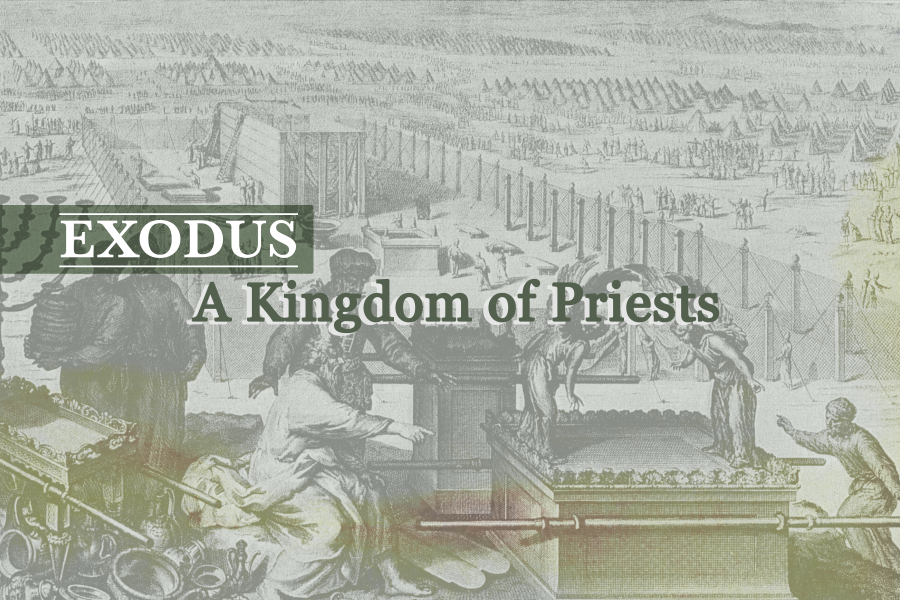
Because Israel was called to be a holy nation with the Holy One dwelling in their midst, Israel’s camp was a holy place upon the earth. The entire camp reflect the concentric circles that we observed with the tabernacle. At the center was the Most Holy Place, then the Holy Place, and around these was the fence that marked the court of the tabernacle. The tabernacle would then be placed at the center of Israel’s camp. The Levites, who would be tasked with transporting the tabernacle, would be camped in a circle around the tabernacle, and the rest of Israel would camp in a circle around them. Thus, we find concentric circles of holiness with the Most Holy Place at the center and the ordinary Israelites on the outermost ring. Outside of the camp was the place of defilement, so carrying ashes and other things relating to the sin offerings outside the camp was a picture of Israel’s sin being judged through the sacrifices. The sacrifices became an embodiment of Israel’s sins, so they needed to be burned outside the camp in the place of defilement.
By having this tent of meeting outside the camp, Yahweh was sending a message to Israel that, through their sin, they had become defiled. Their camp could not be a place of holy communion with Him because they had defiled themselves and become unclean. Thus, God was effectively saying that they wilderness was cleaner than being in their midst. Even though the Israelites could still seek God outside the camp, this was fundamentally an act of judgment.
Of course, there was another judgment still to come that would also take place outside the camp. As the Hebrews 13:11-12 says,
For the bodies of those animals whose blood is brought into the holy places by the high priest as a sacrifice for sin are burned outside the camp. So Jesus also suffered outside the gate in order to sanctify the people through his own blood.
Physically, He was crucified outside of Jerusalem’s gates, but more importantly, His crucifixion was a work performed outside the spiritual camp. While upon the cross, the fire of God’s wrath fell upon Christ in all its fullness. The King of glory, through whom all things were made, was made “to be sin who knew no sin, so that in him we might become the righteousness of God” (2 Corinthians 5:21). The eternal Son of God who has perpetual loving communion in the presence of the Father “redeemed us from the curse of the law by becoming a curse for us—for it is written, ‘Cursed is everyone who is hanged on a tree’” (Galatians 3:13). Christ took the full penalty of our sins upon Himself. He endured the wrath of God without any measure of mercy so that we can receive the mercy of God without any measure of His wrath.
Christ’s suffering was also an act of judgement that ought to lead us to repentance and to seek the LORD. Just as the Israelites displayed their repentance going to God outside the camp, meeting Him in the place of reproach since they themselves were more defiled than any physical place, our place of meeting with the LORD is also outside the camp. As the author of Hebrews goes on to exhort, “therefore let us go to him outside the camp and bear the reproach that he endured.”
Embracing Christ and His cross will never be without reproach, for it is inherently reproachful to the world because it is antithetical to our unholy and worldly hearts. Yet Paul rightly notes that “the word of the cross is folly to those who are perishing, but to us who are being saved it is the power of God” (1 Corinthians 1:18). All throughout Jesus’ earthly ministry He went to and touched those who were defiled. In so doing, He did not become defiled like them; rather, His touch cleansed them. The same is true with the cross. Although Christ became a curse for us, the Holy One could not suffer corruption (Psalm 16:10). Instead, just like lepers were made clean, the tree of cursing has become the tree of life. The cross, an instrument of death and unparalleled disgrace, has become the only fountain of life and of grace upon grace upon grace. It is through the cross of Christ that we find the true and perfect tent of meeting, where we too can meet with God.
Our text ends with an interesting description of Joshua staying continually beside the tent of meeting. As Moses’ assistant and the captain of Israel’s army, Joshua was likely keeping guard of the tent of meeting. Just as the actual tabernacle would never be unattended, even a night, Joshua performed a similar function here. Of course, the priests’ nightly duties were meant to comfort the Israelites that their mediation before God continued at all times, even when the sacrifices were being made. Joshua’s presence, however, seems to be less encouraging. When Moses was at the tent of meeting, Israelites could come and seek the LORD, but Joshua seems stationed while Moses is away to remind any wandering Israelite that they could only approach the LORD through Moses as their mediator.
The constant vigilance of Joshua is a dim reflection of the vigilance of Jesus (whose name in Hebrew is also Joshua). Joshua guarded this tent of meeting, which was a mere shadow of the glory of what the actual tabernacle would be. But even then, the tabernacle itself is only a copy and shadow of the heavenly tabernacle above. Our Lord, who is the greater Moses and greater Joshua, also sits vigilantly in the true heavenly tabernacle, but unlike Joshua, He does not sit as a guard to keep us away; rather, He sits as our perfect Mediator to give us confident access to the very throne of God.
Thus, as we come to the Table of our King this morning, let us indeed go to our Lord outside the camp. As we consider the bread and cup before us, let us marvel anew that Christ bore the shame and disgrace of our sins upon His shoulders and lives forevermore to secure our access to our Father’s throne of grace. Thus, as we eat this bread and drink of this cup, let us taste and see the goodness of our great Savior and perfect Mediator.
 B. C. Newton