
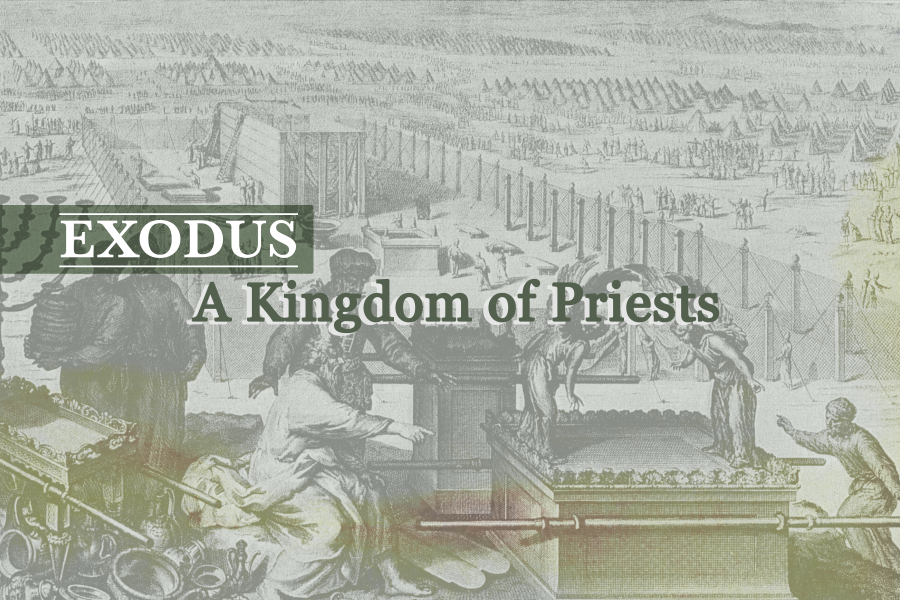
When reading through the book of Exodus, most find the second half much less exciting than the first half because of laws and because of these chapters and the previous chapters that they mirror, 25-31. Yet the structure of Exodus wants us to see that this what all the marvelous works that God did to bring Israel out of Egypt and through the wilderness has been building toward. Yahweh redeemed His people from their slavery in Egypt so that they could know Him and be His covenantal people.
The tabernacle was the physical expression of that covenant. The LORD appeared to Abraham, Isaac, and Jacob at certain moments throughout their lives, but He would now dwell in the midst of their descendants. Indeed, the tabernacle is also called the tent of meeting because it marked the place where Israel would always be able to meet with God. If they desired to seek Him, they knew that He would be found at the tabernacle.
The importance of the tabernacle explains why even more space is devoted to it in these chapters. The previous three chapters have recounted Israel’s breaking of the covenant through their worshiping of the golden calf, Moses’ continual intercession for them before the face of Yahweh, and the LORD’s pardoning of their sin. Now with the covenant reestablished, Israel is commanded to build the tabernacle according to the designs that Moses was given upon the mountain. Although the text before us is large, there are two large points that we will observe in them: first, the great giving of all Israel toward building the tabernacle and second, the obedience of the people in building the various elements of the tabernacle exactly as Yahweh commanded.
SUFFICIENT TO DO ALL THE WORK
Chapter 35 begins with one final command for Israel to keep the Sabbath. While these verses again feature some unique wording, they appear to be rather out of place in relation to the remainder of the text. Yet I believe that the reason for placing this command at the beginning of the building of the tabernacle is similar to the reason for commanding the Sabbath to be observed at the end of the instructions for the tabernacle. Although Israel was about to begin one of the most important building projects in all of history, the LORD is preemptively reminding them that it was no excuse for breaking the Sabbath. As glorious as the work on the tabernacle was, whoever does any work on [the Sabbath] shall be put to death. Douglas Stuart gives a great explanation for why the Sabbath was so important:
In a certain sense Israel’s formal starting point for keeping Yahweh’s covenant was keeping the Sabbath, that is, the fourth word/commandment, not because doing so was more important than fulfilling the first three words/commandments but because obedience to the Sabbath requirement was the most obviously measurable of them—either in the keeping or in the disobeying. By the fact that he kept (or did not keep) the Sabbath each week, an Israelite showed without ambiguity whether or not he was committed to keep the covenant. Merely keeping the Sabbath did not confer righteousness if other commandments were violated, but it was an openly visible essential—a sine qua non—of covenant loyalty. Not to keep it would be to say publicly to the world “I am not in covenant relationship with the Lord of the Sabbath.” (748)
In verses 4-9, Moses again speaks to the entire congregation of Israel and commands them to make their contribution for the building of the tabernacle. They were to bring gold, silver, bronze, blue and purple and scarlet yarns and linen, goats’ hair, tanned rams’ skins, goatskins, acacia wood, lamp oil, spices, and gems. These were the materials that would be used to build the tent of meeting. As we noted when Moses first received this command upon Sinai, this nation of former slaves was able to offer such valuable materials because the LORD caused them to plunder the Egyptians as they left.
But lest we think that the LORD gave Israel their treasures simply for the purpose of using them for the tabernacle, notice the emphasis on how the contribution was to be given in verse 5: whoever is of a generous heart. In other words, there was no particular demand made to anyone. Giving was commanded generally to the entire nation, but the particulars of gifts were left to the conscience of each individual. God enriched Israel out of His love for His people and to further humble the Egyptians, and those gifts were really given. The Israelites could have refused to make their contributions, foolish as that decision would have been. Of course, there is a sense in which all that we have properly belongs to God, meaning that we are stewards of our possessions rather than owners. Yet that reality should be balanced with God’s gracious giving of gifts, particularly to His people but even upon the wicked as well. Indeed, the fact that the contributions will be stopped in 36:6-7 shows that God had no intention of taking all of Israel’s riches for use in the tabernacle.
Verses 20-29 then show all the people doing what Yahweh commanded of them.
Then all the congregation of the people of Israel departed from the presence of Moses. And they came, everyone whose heart stirred him, and everyone whose spirit moved him, and brought the LORD’s contribution to be used for the tent of meeting, and for all its service, and for the holy garments. So they came, both men and women. All who were of a willing heart brought brooches and earrings and signet rings and armlets, all sorts of gold objects, every man dedicating an offering of gold to the LORD. And every one who possessed blue or purple or scarlet yarns or fine linen or goats’ hair or tanned rams’ skins or goatskins brought them. Everyone who could make a contribution of silver or bronze brought it as the LORD’s contribution. And every one who possessed acacia wood of any use in the work brought it. And every skillful woman spun with her hands, and they all brought what they had spun in blue and purple and scarlet yarns and fine twined linen. All the women whose hearts stirred them to use their skill spun the goats’ hair. And the leaders brought onyx stones and stones to be set, for the ephod and for the breastpiece, and spices and oil for the light, and for the anointing oil, and for the fragrant incense. All the men and women, the people of Israel, whose heart moved them to bring anything for the work that the LORD had commanded by Moses to be done brought it as a freewill offering to the LORD.
Again, notice the great emphasis upon everyone who heart stirred him, and everyone whose spirit moved him, as well as all who were of a willing heart. This is, of course, the pattern for Christian that we are under today. Although giving a tenth of one’s income (a tithe) is generally a fine enough principle, the New Testament does not give us a particular amount or percentage or even formula for governing our giving. Instead, 2 Corinthians 9:7 tells us plainly: “Each one must give as he has decided in his heart, not reluctantly or under compulsion, for God loves a cheerful giver.” That is the principle that must rule over our hearts.
We should also take that all of Israel participated in these contributions. The leaders who possessed gemstones and spices brought them freely. Both men and women are emphasized as giving, and the text specifically spotlights skillful women bringing their weavings. Whenever we couple this with the call for all skillful craftsmen in verse 10, we find a beautiful picture of how Yahweh used the various gifts and skills of His people to build His dwelling place. In Romans 12:3-8, Paul commands us to do the same:
For by the grace given to me I say to everyone among you not to think of himself more highly than he ought to think, but to think with sober judgment, each according to the measure of faith that God has assigned. For as in one body we have many members, and the members do not all have the same function, so we, though many, are one body in Christ, and individually members one of another. Having gifts that differ according to the grace given to us, let us use them: if prophecy, in proportion to our faith; if service, in our serving; the one who teaches, in his teaching; the one who exhorts, in his exhortation; the one who contributes, in generosity; the one who leads, with zeal; the one who does acts of mercy, with cheerfulness.
Each member of Christ’s church has different gifts, and they should all be used, as Ephesians 4:12 says, “for building up the body of Christ.”
Let us also consider the marvel that God chose to use the Israelites at all. Ryken comments:
All of these materials came from the Israelites. The people gave from what they had, and in this way they participated in God’s work. If God had wanted to, he could have dropped a tabernacle from the sky, but this is not the way he works. He invites us to get involved with what he is doing in the world. In this case God made the plans, but the people did the work. He initiated the tabernacle, but they participated in its construction. (1082-1083)
Of course, this is true of everything that God asks of us. The LORD can (and has) directly reveal Himself to some people, just like did with Paul upon the road to Damascus. He could make Himself known to all nations instantaneously. But just as God chose to create the world over the process of six days, He also ordains that evangelism and missions should happen over a process as well, and He works us into that process.
After calling Bezalel and Oholiab to be the chief builders of the tabernacle, we read in 36:2-7
And Moses called Bezalel and Oholiab and every craftsman in whose mind the LORD had put skill, everyone whose heart stirred him up to come to do the work. And they received from Moses all the contribution that the people of Israel had brought for doing the work on the sanctuary. They still kept bringing him freewill offerings every morning, so that all the craftsmen who were doing every sort of task on the sanctuary came, each from the task that he was doing, and said to Moses, “The people bring much more than enough for doing the work that the LORD has commanded us to do.” So Moses gave command, and word was proclaimed throughout the camp, “Let no man or woman do anything more for the contribution for the sanctuary.” So the people were restrained from bringing, for the material they had was sufficient to do all the work, and more.
The swiftness and gladness with which Israel gave their contributions was very tangible evidence of their repentant hearts. If they had given only a little at a time, constantly asking Moses if they had given enough, they would have revealed unwilling and cheerless hearts, and we would immediately know that their show of repentance was only a sham. But, thankfully, that is not what happened. The people continued to give so much that Moses had to give them an explicit command to stop. Indeed, notice the strength of end of 36:6: so the people were restrained from bringing. Thus, they would have gladly continued to give more, if Moses had permitted them to do so. Ryken writes:
Free and gracious giving—what John Piper calls “hazardous liberality”—is one sure sign of godliness. There are many examples from the Old Testament. Under King Joash the people kept filling and refilling the royal chest with gold for rebuilding the temple (2 Chron. 24:8–12). Something similar happened under King Hezekiah. The people brought so many offerings for the temple priests that a huge amount was left over (2 Chron. 31:10). There are good examples in the New Testament as well, like the woman who poured expensive perfume on Jesus (Matt. 26:7) or the members of the early church who sold their fields and laid the proceeds at the apostles’ feet (Acts 4:34, 35). Then there were the Macedonians who (despite their own extreme poverty) gave more than they could spare to help the suffering poor (2 Cor. 8:1–5). This is what people do when their hearts have been touched by the grace of God: They give and give. (1099)
In 38:21-31, we find an inventory of the gold, silver, and bronze that were given for this holy construction project. When considering the generosity of Israel in this passage, we would do well to take a spiritual inventory of our own habits of giving. The point of such an inventory is not to guilt ourselves into being more generous; anyway, true generosity comes from cheerful compassion rather than from stingy guilt. Instead, if we are convicted by the Spirit that we are less generous than we ought to be, we should then consider the root of why we are not overflowing with generosity. Or perhaps we could say that the solution to a lack of generosity is never to simply give more; rather, we need to Spirit to search our hearts for why we are failing to be generous.
ALL THAT THE LORD HAS COMMANDED
With all the contributions made so that the material they had was sufficient to do all the work, and more, Bezalel, Oholiab, and other craftsmen got to work building the various parts of the tabernacle. They made the curtains and the frames in 36:8-34. They made the veil that guarded the Most Holy Place in 36:35-38. They made the ark of the testimony and the mercy seat in 37:1-9. They made the table for the bread of the presence in 37:10-16. They made the golden lampstand in 37:17-24. They made the altar of incense in 37:25-28, and the anointing oil and incense to go with it in 37:29. They made the bronze altar and bronze basin in 38:1-8. They made the court around the tabernacle in 38:9-20. They made the priests garments (the ephod, the breastpiece, the coats, turbans, etc.) in 39:1-31. 39:32 then tells us: Thus all the work of the tabernacle of the tent of meeting was finished, and the people of Israel did according to all the LORD had commanded Moses; so they did.
This brings us to the major theme in these five chapters, which can be observed by the sheer force of repetition. In 35:1, Moses said, These are the things that the LORD has commanded you to do. In 35:4, he says, This is the thing that the LORD has commanded, and in 35:10, let every skillful craftsman among you come and make all that the LORD has commanded. In 35:29, the men and women bring anything for the work that the LORD had commanded. In 36:1, Bezalel and Oholiab are given skill to work in accordance with all that the LORD has commanded. Then in chapter 39, after each item of the priestly garments is made, we are told that it was as the LORD commanded (vv. 1, 5, 7, 21, 26, 29, 31). After 39:32, which we just read, then read the great conclusion to our text:
According to all that the LORD had commanded Moses, so the people of Israel had done all the work. And Moses saw the work, and behold, they had done it; as the LORD had commanded, so had they done it. Then Moses blessed them.
Because Moses was given the instructions and had been shown the heavenly pattern of the tabernacle upon Mount Sinai, each of the items were brought to the prophet to be inspected, and they did everything as Yahweh had commanded. This was a moment of celebration!
This is a powerful example of full obedience to God, and of the blessing that comes to anyone who does his will. When some scholars read this verse, they hear echoes from the story of creation. At the close of the sixth day, when God had finished making the universe and everything in it, he “saw all that he had made, and it was very good” (Gen. 1:31; cf. Exod. 39:42). Then God proceeded to bless the work by resting on the seventh day (Gen. 2:2, 3; cf. Exod. 39:43). Something similar happened when Israel finished making the tabernacle. God saw that what the people made was very good; so he gave them his blessing. (1149)
Yet as wonderful as this moment of exact obedience to God’s command is, we know from all that has occurred in Exodus so far that this is an exceptional moment among God’s people. It, of course, ought to be the rule among God’s people. It ought to be the highest joy of all who worship Yahweh to do exactly what He has commanded. After all, He has the right to command us, for He is the Creator and we are His creation. But though Israel was forgiven, the golden calf still forever lies between the instructions for the tabernacle (chs. 25-31) and its construction (chs. 35-39), and even this obedience is somewhat tainted with the realization that Israel will eventually break the covenant yet again.
Of course, as we will observe in Leviticus, the tabernacle makes provision for Israel’s sin by being the place where sacrifices can be made. But as glorious as those sacrifices were, they were imperfect and unable to deal with sin fully and finally, which is why they needed to be made over and over again.
Indeed, I believe that it is this ultimate insufficiency of the old covenant that Paul was referring to in 2 Corinthians 3:13 when he said that Moses “put a veil over his face so that the Israelites might not gaze at the outcome of what was being brought to an end.” Even from the beginning of that covenant, the golden calf saga revealed that God’s people needed more than simply a revelation of God’s law; we need a Savior who could keep the law perfectly and perfectly redeem us from our own disobedience to it. Thanks be to God that Savior is Jesus Christ!
He is the true and living tabernacle, where God dwelt among us and became one of us. He is the true and living tent of meeting, for He is the way, the truth, and the life and no one has communion with the Father except though Him (John 14:6). It is not according to our own faulty obedience that we now stand approved in the sight of God; rather, it is only through Christ’s sinless obedience. Thus, while we now strive to obey God out of love and in the strength of the Spirit, we do not place our hope of acceptance upon doing all that the LORD commands; instead, we place our hope of acceptance in the sight of God solely upon what Christ has accomplished for us through the giving of Himself for us.
The tabernacle, as well as both temples that would succeed it, have all passed away because something far greater has come. So, while Israelites would have rightly looked on with wonder at the beauty of the tabernacle in their midst, we now set our eyes by faith upon Christ who is altogether lovely. Indeed, that is the purpose of the Table before us, for we eat this bread and drink this cup in remembrance of Christ and His sacrificial work upon the cross. Indeed, it is upon His cross that we see loving and free generosity displayed to the utmost, as the Lord of glory willingly gave His life to rescue us from our sins. Therefore, as we eat this bread and drink this cup, let us taste and see the goodness of our God and Savior, who has taken away our sins and given us the greatest of all treasures: Himself.
 B. C. Newton