
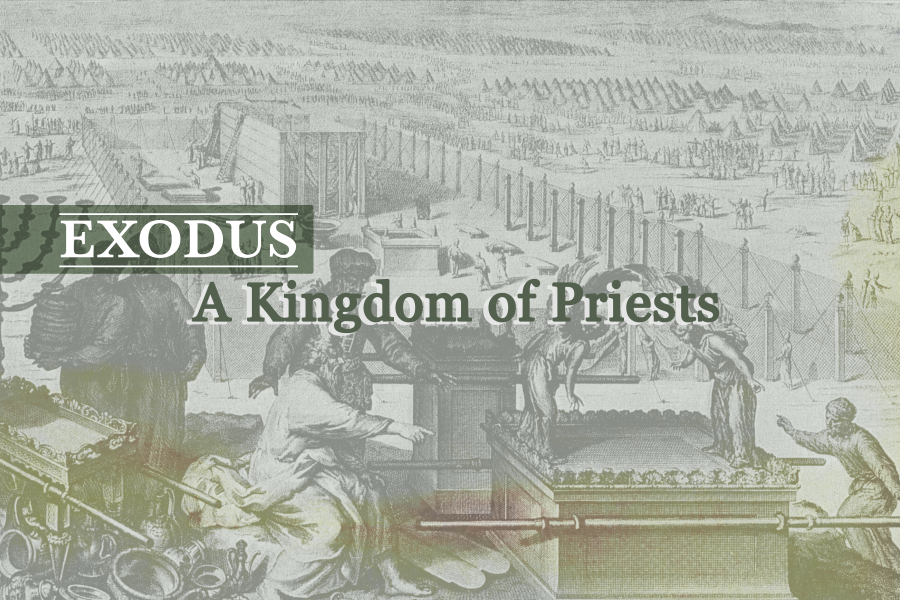
Exodus is the narrative heart of the Old Testament. Genesis, of course, is a book of roots. Chapters 1-11 show us the roots of humanity and all of creation, while chapters 12-50 give us the roots of God’s chosen people, the descendants of Abraham. Exodus, however, gives us the central story of God rescuing and making Israel into His holy nation.
For more than four hundred years, the Hebrews were slaves in the land of Egypt, yet Yahweh, the God of their ancestors, heard their cry and came down to the redeem them. Using Moses as His instrument, the LORD sent plagues upon the Egyptians until they were actually begging the Israelites to take their wealth and leave. But even as they left, Pharaoh assembled his chariots and pursued them until God brought Israel across the sea and drowned the wicked king within it.
Yahweh then led His people through wilderness like a shepherd leads sheep. Where water was bitter, He made it sweet. Where there was no food, He gave the bread of the angels to eat. Where there was no water, He brought streams from a rock. When their enemies assailed them, He gave them victory. The LORD provided and protected Israel.
Finally, Yahweh brought them to Mount Sinai, where He made His covenant with them. Descending in glory upon the mountain, He spoke the Ten Commandments audible for all the people to hear and then wrote them down upon tablets of stone with His own finger. Moses read to them the Book of the Covenant, and all the people committed themselves to the LORD alone. However, while Moses was upon the mountain receiving the instructions for the tabernacle, the people broke the covenant by worshiping a golden calf. But through the intercession of Moses, Yahweh forgave their sin, renewed His covenant with them, and the people built the tabernacle exactly as the LORD had commanded Moses.
The remainder of the Old Testament is built upon this foundational story. Through His prophets, the LORD continually reminds Israel that He brought them out of the land of Egypt. They were a nation of slaves, but God redeemed them. They were an insignificant people, but God provided and defended them. They were a rebellious and sinful people, but God heaped His steadfast love upon them again and again. Their hearts were prone to turn to other gods, but God graciously chose to dwell in the midst of His people.
That is why the tabernacle is the culmination of the story of Exodus. Yahweh redeemed and delivered Israel so that they could be His people, He could be their God, and He could dwell in their midst. God’s presence was what would mark Israel as being distinct from every other nation upon the earth, and the tabernacle would be the place of God’s presence in the midst of His people.
FINISHING THE WORK // VERSES 1-33
Now that all of the various pieces and furnishings of the tabernacle have been built and been approved by Moses as reflecting the instructions and pattern that he was given upon the mountain, the final chapter of Exodus begins with Yahweh commanding Moses to erect the tabernacle and put everything in its place. Although we do not know how long it took the Israelites to build everything nor do we know exactly when Moses was given this command, the LORD does give Moses a specific date for assembling the tent of meeting: on the first day of the first month. Ryken notes the significance of this date:
In other words, God told Moses to set up the tabernacle on the anniversary of Israel’s exodus from Egypt—one year to the very day. This made a clear connection between what happened at the Red Sea and what happened at the tabernacle. The erection of the tabernacle was the culmination of everything that God had been working for since he first brought his people out of Egypt. (1098)
The fact that the tabernacle would be erected at the start of the new year and the one-year anniversary of their exodus from Egypt was a way of emphasizing that this was the moment that the entire exodus was building toward. Yahweh did not liberate Israel from their slavery simply to do a divine good deed and then set them loose to do whatever they wanted. He freed them in order to dwell with them, to give them a glimpse of Eden again.
Also, the fact that the tabernacle could be erected entirely in the span of a day emphasizes the portability that was necessary for this period of Israel’s history. They had not yet left the wilderness and entered the land of Canaan. They were still nomads, living in tents like their father Abraham before them. Thus, God dwelling in their midst meant dwelling in a tent as well.
But whenever they did leave Sinai, the tabernacle was also intended to carry that encounter with God with them:
It seems most likely that the tabernacle was conceived to be a portable Mount Sinai; it was to serve as a movable reminder of the nation’s experience with God at the mountain. The tabernacle would duplicate the gradations of holiness evident as Sinai. As the people remained at the base of Sinai, they would enter only the courtyard of the tabernacle. Priests could venture into the Holy Place at appropriate times, just as select elders of Israel were able to scale partway up Sinai. And just as Moses alone could reach the top of Sinai, so only the high priest could enter the Holy of Holies. The tabernacle would also duplicate the theophanic phenomena of Sinai. As YHWH had descended upon Sinai in cloud and fire, his cloud and fire would remain on the tabernacle and even be matched by the smoke and fire of Israel’s sacrifices. The tabernacle would place at is symbolic center, inside the ark of the covenant, the tablets of the Ten Commandments; these Ten Commandments were, of course, the symbolic center of the Sinai ceremony begun in Exodus 19 and concluded in ch. 24. (Exodus 15:22-40:38, 382-383)
In verses 1-33, we find a miniature reflection of chapters 25-31 and 35-39. Verses 1-15, like chapters 25-31, give instructions for Moses to follow, while verses 16-33, like chapters 35-39, recount how Moses followed those instructions, punctuating the process with the phrase, as the LORD had commanded Moses (vv. 19, 21, 23, 25, 27, 29, 32). This kind of poetic repetition is designed to draw our attention to the greatness of the work being done. We should read each instruction and each piece of obedience imagining the great sense of anticipation that must have been building among the Israelites. Would the almighty Creator actually come down to live with them, even after their breaking of His covenant? Surely it was too good to be true.
The Bible summarizes by saying, “And so Moses finished the work” (v. 33). The prophet did everything right. Over and over again the Bible says that he set up the tabernacle just the way God told him to. Everything was in place. The only thing missing was the one thing that everyone was waiting to see: the glorious presence of God. This was not something that Moses could set in place. With the right instructions, he could put the tabernacle together, but only God could fill it with glory.
That is certainly a principle that applies to virtually all of the Christian life. We are called to be obedient to the LORD and to do so exactly as He commands us. Blessing certainly follows faithful obedience, but it comes in the manner and timing of the God’s choosing.
THEN THE CLOUD COVERED THE TENT OF MEETING // VERSES 34-38
With the completion of the tabernacle, we then read the final words of Exodus:
Then the cloud covered the tent of meeting, and the glory of the LORD filled the tabernacle. And Moses was not able to enter the tent of meeting because the cloud settled on it, and the glory of the LORD filled the tabernacle. Throughout all their journeys, whenever the cloud was taken up from over the tabernacle, the people of Israel would set out. But if the cloud was not taken up, then they did not set out till the day that it was taken up. For the cloud of the LORD was on the tabernacle by day, and fire was in it by night, in the sight of all the house of Israel throughout all their journeys.
Throughout the book of Exodus, Yahweh has displayed His glory. We first glimpsed it whenever Moses encountered the LORD in the burning bush. Moses was then able to participate displaying God’s glory as each plague was delivered through the use of Moses’ staff. All of Israel beheld God’s glory whenever they walked across the sea on dry ground and Pharoah and his chariots were crushed under the waters. They again beheld God’s glory whenever He descended in fire, smoke, thunder, lightning, and trumpets upon Mount Sinai and spoke His law to them. Moses, Aaron, and the elders of Israel saw God’s glory as they shared a covenant meal in His presence. After the golden calf, the cloud of Yahweh’s glory moved from Sinai to a temporary tent of meeting that Moses erected far away from Israel’s camp. Finally, Moses saw another tremendous display of God’s glory whenever Yahweh passed before him and declared His name to the prophet.
Thus, Exodus is marked these episodes of escalating glory, which Paul may have had in mind whenever he wrote that, in Christ, we “are being transformed from one degree of glory to another” (2 Corinthians 3:18). For just as each display of God’s glory is greater than the last, so too is the eternal life of all who belong to Christ. Lewis captures a glimpse of this reality in the final paragraph of The Last Battle:
And as He spoke, He no longer looked to them like a lion; but the things that began to happen after that were so great and beautiful that I cannot write them. And for us this the end of all the stories, and we can most truly say that they all lived happily ever after. But for them it was only the beginning of the real story. All their life in this world and all their adventures in Narnia had only been the cover and the title page: now at last they were beginning Chapter One of the Great Story which no one on earth has read: which goes on for ever: in which every chapter is better than the one before. (228)
But how do we know that this manifestation of God’s glory is greater than the ones before it? First, it is greater because of its location. The cloud of God’s glory has been with the Israelites since they left Egypt, leading them through the wilderness and even defending them from Pharaoh. The cloud was most often before, sometimes behind them, at Sinai it was above them, and in the temporary tent of meeting it was away from them. Here it came down in the middle of them. Just as Yahweh promised, He came down to dwell in the midst of His people.
Second, notice what verses 35 says: And Moses was not able to enter the tent of meeting because the cloud settled on it, and the glory of the LORD filled the tabernacle. The same Moses who had spent at least two periods of forty days and nights in the presence of Yahweh and whose own face was still radiated with God’s glory could not enter the tabernacle. Ryken gives two reasons for this:
From this we learn how necessary it is for anyone who wants to meet with God to come with a blood sacrifice for sin. Exodus leads right into Leviticus, which begins with God giving Moses a long list of instructions for making sacrifices at the tabernacle. The only way to approach the God of all glory is to come with a sacrifice of blood. By initially denying Moses entrance, God once again taught his people the necessity of atonement.
We also learn that God is infinitely more glorious than we could ever expect or imagine. After a while we start to get used to God. We become familiar with the vocabulary used to describe his divine attributes. We have heard of his holiness, justice, mercy, and love. We are able to list these terms, and perhaps even to define them, but do we have any idea how glorious God is in the majesty of his triune being? Are we aware of the mortally dangerous perfection of his holiness? Do we sense how overwhelming it is to come into the presence of his glory? Moses knew God better than any man alive; yet when the glory came down, he was not able to enter. Neither can we penetrate God’s infinite glory; we can only stand back and worship with reverence and awe.
This had to be a somewhat bitter-sweet moment for Israel. It really happened. God really had come down to dwell in their midst, just as He promised to do. But now that His presence and glory were among them, they could not enter the tent of meeting. Even their mediator, Moses, was prevented from entering in a meeting with Yahweh. The LORD was closer than ever and yet still so separate from them.
Indeed, as Ryken alluded to, Exodus moves directly into Leviticus, which focuses heavily upon the sacrifices necessary for God to continue dwelling among a sinful people. But after Leviticus, Numbers 1:1 says, “The LORD spoke to Moses in the wilderness of Sinai, in the tent of meeting…” As great as Moses was as a servant of God, he was still a sinner who needed his own sins forgiven just as much as any other Israelite.
Matthew Henry makes a marvelous comment, saying:
But what Moses could not do, in that he was weak through the flesh, has been done by our Lord Jesus, whom God caused to draw near and approach, and who, as the forerunner, has for us entered, and has invited us to come boldly even to the mercy-seat. He was able to enter into the holy place not made with hands (Heb. ix. 24); nay, he is himself the true tabernacle, filled with the glory of God (John 1:14), even with the divine grace and truth prefigured by this fire and light. In him the shechinah took up its rest for ever, for in him dwells all the fulness of the godhead bodily, Blessed be God for Jesus Christ! (447-448)
If the Israelites would have had a difficult time believing the greatness of God’s promise to dwell in a tent among them, we ought to tremble in amazement each time we read John 1:14: “And the Word become flesh and dwelt [or tabernacled] among us, and we have seen his glory, glory as of the only Son from the Father, full of grace and truth.” That is the glorious wonder of the incarnation. More than dwelling in a tent with us, Jesus is the Holy One taking on flesh and becoming as human as one of us. Paul speaks of it in Philippians 2:5-7, saying:
Have this mind among yourselves, which is yours in Christ Jesus, who, though he was in the form of God, did not count equality with God a thing to be grasped, but emptied himself, by taking the form of a servant, being born in the likeness of men.
Like the tabernacle that was filled with gold and silver but covered on the outside with leather, so the majesty and divinity was largely concealed from view during His earthly life. I say largely because His transfiguration is a very deliberate unveiling of His majesty and divinity. Consider Luke’s account:
Now about eight days after these sayings he took with him Peter and John and James and went up on the mountain to pray. And as he was praying, the appearance of his face was altered, and his clothing became dazzling white. And behold, two men were talking with him, Moses and Elijah, who appeared in glory and spoke of his departure, which he was about to accomplish at Jerusalem. Now Peter and those who were with him were heavy with sleep, but when they became fully awake they saw his glory and the two men who stood with him. And as the men were parting from him, Peter said to Jesus, “Master, it is good that we are here. Let us make three tents, one for you and one for Moses and one for Elijah”—not knowing what he said. As he was saying these things, a cloud came and overshadowed them, and they were afraid as they entered the cloud. And a voice came out of the cloud, saying, “This is my Son, my Chosen One; listen to him!” And when the voice had spoken, Jesus was found alone. And they kept silent and told no one in those days anything of what they had seen. (Luke 9:28–36)
Luke is clearly intending for us to connect Christ’s transfiguration with God’s glory filling the tabernacle in Exodus 40. In verse 31, Moses and Elijah speak to Jesus about His departure, but as the ESV footnote says, the Greek word is literally exodus. They were speaking about Jesus’ own exodus, the true and better exodus, where He Himself would drown under the flood of God’s wrath in our place to slay the Pharoah within our own hearts.
But after suggesting three tabernacles for Jesus, Moses, and Elijah, verse 34 says that they were overshadowed by a cloud. Tom Schreiner notes:
This is a clear allusion to Exodus 40:35, in which, after the tabernacle is built and erected, “Moses was not able to enter the tent of meeting because the cloud settled on it, and the glory of the LORD filled the tabernacle.” “Settled” in the LXX of Exodus 40:35 is the same verb translated “overshadowed” (Gk. epeskiazen) here. We can see why Peter, James, and John feared to enter the cloud, since Moses could not enter the tent of meeting when the cloud overshadowed it (cf. 1 Kings 8:10-11; 2 Chron. 5:14; 7:2).
But because of Christ’s greater exodus, we are now boldly commanded to behold an even greater glory than Moses saw fill the tabernacle. That is why the author of Hebrews repeatedly tells us to draw near rather than stay away. Christ has ended the come-but-stay-away covenant of Sinai, and through His death and resurrection, He has given us the new covenant of Mount Zion. Again, this is why Paul calls the new covenant much more glorious than the old, saying, “And we all, with unveiled face, beholding the glory of the Lord, are being transformed into the same image from one degree of glory to another. For this comes from the Lord who is the Spirit” (2 Corinthians 3:18).
Indeed, while we ought to be staggered by the incarnation of Christ as the true tabernacle in our midst, the glory of this good news keeps getting better. Before His death, Jesus told His disciples that His ascension back to the Father would actually be for their benefit because He would send the Holy Spirit to them. And that is precisely what happened in Acts 2. In Exodus 3, Yahweh revealed Himself to Moses in a bush that was burning yet unconsumed. That holy fire of His Spirit then revealed Himself to all of Israel by descending upon Mount Sinai for all to see. In our passage, that cloud and fire came down and filled the tabernacle with glory, and later the same would happen with the temple (1 Kings 8:10-11). But on the day of Pentecost, it was not a building that God filled with His glory; it was His people:
When the day of Pentecost arrived, they were all together in one place. And suddenly there came from heaven a sound like a mighty rushing wind, and it filled the entire house where they were sitting. And divided tongues of fire appeared to them and rested on each one of them. And they were all filled with the Holy Spirit and began to speak in other tongues as the Spirit gave them utterance. (Acts 2:1-4)
Like the tabernacle and the temple, this was Yahweh’s grand inauguration of His new dwelling place upon the earth. Because Christ’s death as redeemed us from all our sins, fully and finally, the glory of God is now able dwell within us rather than simply amongst us. But while there were gradations of holiness at Sinai, the tabernacle, and the temple, all of God’s people are now brought into the inner sanctuary. The ordinary Israelite could only stand at the foot of Sinai and could only the courts of the tabernacle and temple.
In Greek, there are two words that can be translated as temple. The first ἱερόν refers to the whole temple complex, including the courtyards. Thus, when Jesus cleansed the temple, that word is used, for He was clearing the court of the Gentiles. The second ναός refers to the sanctuary itself, the building that was divided into the Holy Place and the Most Holy Place. That is the word that Paul uses for us in both 2 Corinthians 6:19 and Ephesians 2:21. Significantly, this means that there are no courtyard Christians. Saints are not the super-holy Christians, as Catholics teach. Every believer is now filled the Spirit as a living tabernacle and temple of God’s presence on earth. Therefore, what Moses could not enter is now what you and I are. Is that because we are greater than Moses? By no means! Rather, as the hymn rightly says, “Naught of good that I have done; nothing but the blood of Jesus.”
So, brothers and sisters, as we come the Table of our King, let us rejoice in the greater glory that we now behold through Jesus Christ our Lord. Through His broken body and His shed blood, we have now been delivered from all of our sins and made into the dwelling place of God on earth. Let us, therefore, taste and see the goodness of Yahweh through this simple bread and cup, who saves us for His glory and that we may dwell with Him forevermore.
 B. C. Newton