

Martin Luther once wrote of theological education, saying:
And further, if I could bring it to pass among you I should like to ask that you do not neglect the languages but, since it would not be too difficult for you, that you have your preachers and some of your gifted boys learn Latin, Greek, and Hebrew well. I know for a fact that one who has to preach and expound the Scriptures and has no help from the Latin, Greek, and Hebrew languages, but must do it entirely on the basis of his mother tongue, will make may a pretty mistake. For it has been my experience that the languages are extraordinarily helpful for a clear understanding of the divine Scriptures.
For the first eight years of my time as a pastor, I neglected such counsel, telling myself that I might go to seminary some day and learn the biblical languages then. However, a discovery of Christian Classical Education opened my eyes to value of the three classical languages: Latin, Greek, and Hebrew. Thus, for the past year and a half, the bulk of my free time has been committed to learning those ancient tongues.
Thankfully, I discovered that the advent of the Internet has made learning Latin, Greek, and Hebrew far more attainable than ever before; no seminary classroom required! With the necessary self-discipline and motivation, these languages are now accessible to anyone. So, if you have any desire to be able to read the Bible in the original Greek and Hebrew or to learn Latin, the language of theology for much of church history, below are some great resources that I have been using to learn Biblical Hebrew. You can read my post about Greek here, and post regarding Latin will be posted soon.
RESOURCES FOR BIBLICAL HEBREW
Biblingo
If you only use one resource on this list, let it be Biblingo.
You can read my full thoughts on Biblingo here, but my elevator pitch for Biblingo is that it is essentially Duolingo for learning Biblical Greek and Hebrew, except far better than Duolingo and very much worth the paid subscription.
The overall philosophy of Biblingo’s creators is that the biblical languages ought to be learned as languages rather than as linguistic puzzles to be solved. Thus, their goal is to help people be able to read the Bible in Greek and Hebrew rather than simply being able to decode sentence after sentence. That happens to be my goal as well, which is why I gave Biblingo a try in the first place.
You may also consider other programs like the Biblical Mastery Academy or the Ancient Languages Institute.
The First Hebrew Primer
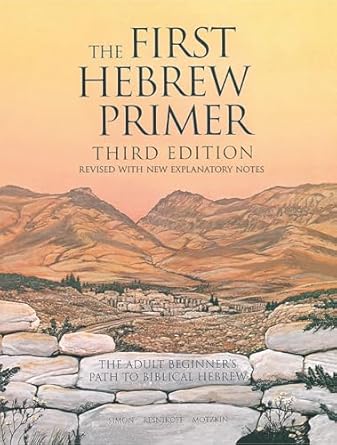
I found this book relatively recently, and I have been using it alongside Biblingo. In fact, many of the strengths of Biblingo are here in book form. The grammar instruction is quick and to-the-point. There are plenty of exercises to practice vocabulary and forms. (sidenote: DO THE EXERCISES! Repetition is essential for learning a language.) And beginning in lesson 8, you get to read Tall Tales in Hebrew, which are familiar to stories like The Boy Who Cried Wolf. These readings give you are great sense of accomplishment.
Aleph with Beth
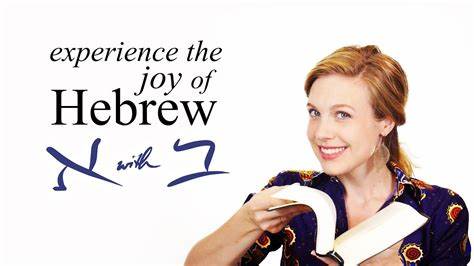
Like Alpha with Angela, these free YouTube videos are fantastic for teaching biblical Hebrew as an actual language. Each video’s content is exclusively given in Hebrew, which makes for excellent comprehensible input.
Learn Biblical Hebrew

As with his book for Biblical Greek, Dobson’s book briskly gives you the Hebrew alphabet and vowel points and then throws you into reading Hebrew, explaining the grammar later in the book. If grammar is one of your major hang-ups to learning Hebrew, try this book.
A Proverb a Day in Biblical Hebrew

I am using this book as daily devotional Hebrew practice and will likely go through it again next year to gauge how my Hebrew has improved. As the name suggests, a proverb is presented each day in Hebrew. The gloss for each word is given below, as well as the parsing for each verb. Finally, Kline’s own translation of the proverb from two days earlier is given at the bottom of the page. It is a wonderful resource for practicing Hebrew, building vocabulary, and most importantly meditating on Proverbs.
GENERAL TIPS
In putting any of the resources above to use, here are a few general tips for learning the classical languages.
Be consistent
15 minutes every day is far better than one two-hour block per week. Of course, the more time you can give to studying, the more quickly you will see progress. In learning anything new, periods of intensity wax and wane. Capitalize on seasons of enthusiasm by studying for longer periods of time, but keep doing something even in the dry seasons when motivation dwindles. For example, I read something in Greek, Latin, and Hebrew everyday, even when I don’t necessarily feel like it.
Read, read, read, and read some more
Read everything you can, as often as you can. Although some methodologies are better for language learning than others, there are no shortcuts. Fluency requires time and effort with the language. With the classical languages, that comes through reading, so read as much as you can.
Speak and write as well
I would highly recommend practicing shadowing and scriptorium, which you can find explained by Alexander Arguelles here.
Have appropriate goals
Big picture goals are crucial. For Greek and Hebrew, that is fairly simple: I want to be able to read the Bible in the original languages as fluently as possible. Reading the Vulgate, Calvin’s Institutes, and The Aeneid are my goals for Latin. But it is also important to have smaller, milestone goals. Those goals can be finishing a certain book, reaching a certain chapter, or fully understanding a particular passage. Keep the big goals in front of you, while celebrating each milestone goal that you achieve.
Press on through discouragement
Mounce talks about working through the mental fog while learning a language, and that is all too true. Don’t expect to understand everything the first time you encounter it; keep going and clarity will eventually come. When I first started, I would often read a new grammar lesson in bed, even though I knew that I probably wouldn’t understand it. That was for two reasons. First, the mental work put me to sleep. Second, even though I didn’t fully grasp what I read, it was a preliminary exposure that I believe made learning easier the next day.
You really can do it
You do not have to be a pastor or great theologian to learn the classical languages. If you put in the time and the effort, you can learn any one of these languages or even all three. And especially reading God’s Word in the original languages is well worth both the time and the effort.
 B. C. Newton