
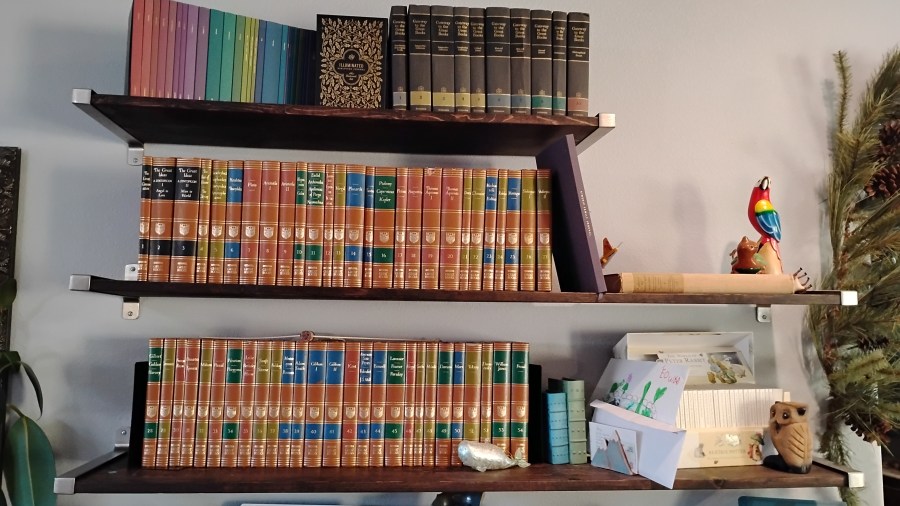
I recently finished reading War and Peace (here is a great three-volume edition), which I picked up this year after coming across a full set of The Great Books of the Western World at a bookstore. It was the original 54-volumed edition and in great condition. So, we bought it.
I began looking at reading plans for working through the set. One of them, a ten-year plan, said to read the first three of War and Peace’s fifteen books for the first year. Since I had already purchased the complete works of Tolstoy on Audible, I decided to start there. But once I reached Book Three, I was hooked.
To my surprise, War and Peace has become one of my favorite books. It is extraordinary. Of course, as with any work of its size, there are moments where it drags, but overall it is a captivating and profound piece of literature, certainly worthy of being called a great book.
Indeed, one of the major differences between a good book and a great one is the sheer density of ideas. Plenty of good books wrestle with meaningful concepts and are certainly worth reading. In fact, a wide range of good books prepares you to truly profit from the great ones. But the great books take on the biggest questions (theology, human nature, morality, history, civilization, meaning, etc.), and they do so at great depth.
Consider this analogy used by Tolstoy in chapter 4 of the first epilogue (yes, there are two epilogues to the story):
As the sun and each atom of ether is a sphere complete in itself, and yet at the same time only a part of a whole too immense for man to comprehend, so each individual bears within himself his own aims and yet bears them to serve a general purpose incomprehensible to man.
A bee settling on a flower has stung a child. And the child is afraid of bees and declares that bees exist to sting people. A poet admires the bee sucking from the chalice of a flower, and says it exists to suck the fragrance of flowers. A beekeeper, seeing the bee collect pollen from flowers and carry it to the hive, says that it exists to gather honey. Another beekeeper who has studied the life of the hive more closely, says that the bee gathers pollen-dust to feed the young bees and rear a queen, and that it exists to perpetuate its race. A botanist notices that the bee flying with the pollen of a male flower to a pistil fertilizes the latter, and sees in this the purpose of the bee’s existence. Another, observing the migration of plants, notices that the bee helps in this work, and may say that in this lies the purpose of the bee. But the ultimate purpose of the bee is not exhausted by the first, the second, or any of the processes the human mind can discern. The higher the human intellect rises in the discovery of these purposes, the more obvious it becomes that the ultimate purpose is beyond our comprehension.
All that is accessible to man is the relation of the life of the bee to other manifestations of life. And so it is with the purpose of historic characters and nations.
Tolstoy uses that extended analogy to illustrate how history works: we can perceive real causes and effects, but we can never comprehend the whole of the matter. There are simply too many variables for our finite minds to grasp, too many individual actions and motivations. History is too big.
I find that honesty refreshing. Tolstoy acknowledges the limits of human understanding without surrendering meaning altogether.
And that is just one example.
Here is my simple encouragement for the new year: read the great books. They require effort (I’ll give some brief advice below) but they are great precisely because they repay that effort. You might read War and Peace and decide never to read it again, but the point is not that every great book will become your favorite. The point is that great books offer something worth struggling through.
When you read the Iliad, you face Achilles’ choice between a long life of obscurity or a short life of glory. In the Odyssey, you are confronted with questions about civilization, hospitality, and the nature of home. In the Aeneid, you meet the ideal of piety, proper and costly devotion to the gods and to one’s people. The list goes on. Those are just some of my own favorites.
As we approach a new year, consider making it a goal to begin exploring the great books. Start anywhere. The Iliad is a classic entry point as the beginning of Western literature. Or start with Shakespeare. Or plunge straight into Tolstoy and Russian literature.
Wherever you decide, just start reading. Pick up a great book. Open it. Sit with it. Let it slow you down. Let it lead you into big questions. And here is the beautiful part: if you give these books the time they require, you won’t come out the same. They will shape you. They will stay with you. They will change you.
That’s what makes them great.
Here are a few pieces of advice for reading through the great books:
- Take your time. It is more advantageous to spend much time in great books than a little bit of time in lesser books.
- Don’t expect to understand everything. Milton’s Paradise Lost is a great example. He throws in references to people, places, and events seemingly every line. If you stop to look up each one, you will never grasp the overall meaning of the poem. Be content to let some references simply add to the epic atmosphere of what you are reading.
- Audiobooks are not cheating. I do like to have a physical edition of whatever I am listening to. For example, I mostly listened to War and Peace, but I had two copies (one at home and one at my study) so I could reread sections that stood out.
- Read in a community, physical or digital. A physical reading group is almost always preferable. When that is not available, create your own digital reading group by reading thought-pieces or listening to lectures or podcasts discussing what you are reading. Whenever I preach through a book of the Bible, I call my assembled commentaries my ‘preaching cohort.’ Do something similar with the great books. If you start with Homer and Virgil, I cannot recommend highly enough Elizabeth Vandiver‘s lectures.
- Buy a beautiful edition. A difficult hike is made more pleasant when the scenery is beautiful. Similarly, find an edition that does the journey justice.
 B. C. Newton