
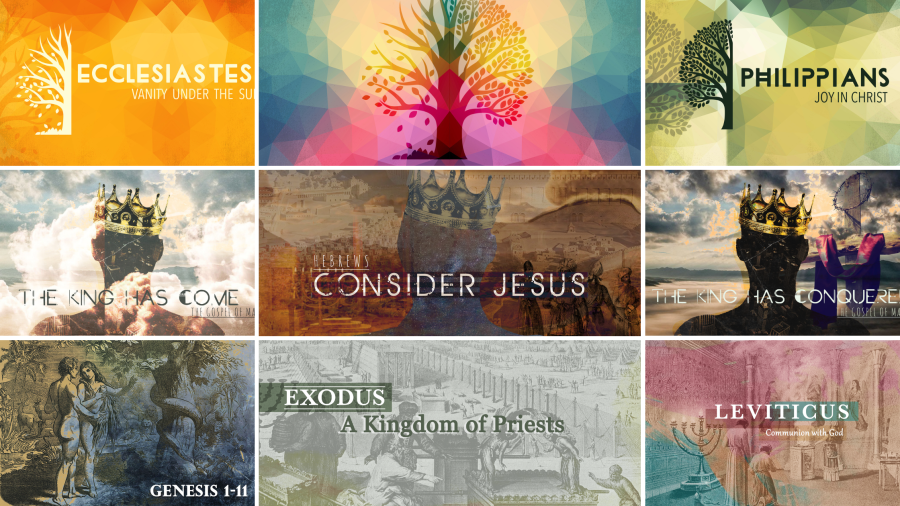
When it comes to sermon preparation, pastors often think of sermons primarily as individual units of study or, perhaps more broadly, as parts of a sermon series, often on a particular topic or book of Scripture. Of course, that is a proper impulse. Each sermon must stand on its own. You never know who will visit on any given Sunday. The gospel should always be clearly communicated, and you cannot assume that people remember everything you said the week before. Each sermon must be a complete, standalone unit.
However, for regular preaching pastors, those who stand in the pulpit week after week, we should also think deeply beyond the shape of individual sermons and even each sermon series. We should consider how sermons, over time, can be strung together to form a greater theological vision for the congregation than any single sermon can ever hope to accomplish.
When I plan sermons for the year, I begin by thinking through the major texts or series that I want to preach. Often that is a full book of the Bible; sometimes, though, it is a beloved text. For example, last year I preached through the Beatitudes, which is not a book but is, nevertheless, a unified biblical text that lends itself to being preached as a series.
I then think through which texts should surround those series, which should lead up them and which should follow them. These individual sermons are meant to prepare the congregation to receive the main series more deeply or to press its truths more further into their hearts afterwards.
Here is an example. In 2026, Lord willing, I intend to preach through three main series: Song of Songs, Numbers 1-10, and Hosea. I am shaping the entire year around those series. Once those large anchors are in place, I then ask what other sermons might help to frame them theologically and pastorally.
In 2025, I did this by connecting Proverbs 31 and Ruth. You see, I begin each year with a sermon from Psalms and from Proverbs. For the Proverbs sermon, I preached Proverbs 31 in two parts: The Kingly Man and The Excellent Woman. In the Hebrew order of the Old Testament, Proverbs is followed by Ruth, which a word from Proverbs 31 (chayil) to describe both Ruth and Boaz. Thus, the sermons on Proverbs 31 became a theological lens for reading Ruth. Boaz is a living example of Proverbs 31:1-9, and Ruth is the excellent woman (31:10-31).
From there, the Lord led us into the Beatitudes, which pressed the theme of character formation even further. While Ruth and Boaz are wonderful examples of godly character, Jesus gives us a powerful description of what the citizens of His kingdom are to look like under the new covenant.
As I look ahead to beginning the Song of Songs, I am carefully considering how to best establish our theological vision for entering such an enigmatic book. My final sermon of the 2025 attempted to answer the question: Why did God write so much poetry? Like roughly one-third of Scripture, the Song of Songs is poetry. If we do not know why God speaks to us in poetry, we will never understand why this book exists at all. Not to mention why we should even bother trying to understand it!
The psalm for the year will be Psalm 45, a royal love song that celebrates a king’s marriage to his bride. That psalm provides a glimpse at the theological vision that undergirds the Song of Songs. It speaks how many assume the Song is speaking.
The proverb for the year will be Proverbs 30:18-20. That text will give a powerful lens for understanding how we approach the Song and sexuality in general. It contrasts two fundamentally different ways of viewing sex: a mystery to be received with awe and humility from our Creator or a mere appetite to be satisfied and then dismissed.
Those sermons are meant to help my congregation approach the Song of Songs with reverence for its beauty, poetry, and mystery, rather than treating it as a just another text to be dissected.
All of this is simply to say that while every sermon must stand on its own, pastors should think carefully about the those whom they preach to week after week. For your congregation, your flock, consider how your sermons are connecting together to communicate larger theological visions of God. Use your preaching calendar to help your people see how the Bible fits together, how different books and passages interact and illuminate one another. If you have the calling and privilege of preaching on a weekly basis, strive to imbue your long-term ministry with long-term theological vision. Develop themes that unfold over time. Show your congregation how Scripture speaks with one voice across its many parts. Give thought, time, and are to sermon planning. You and your people will be blessed by the depth that emerges.
 B. C. Newton