

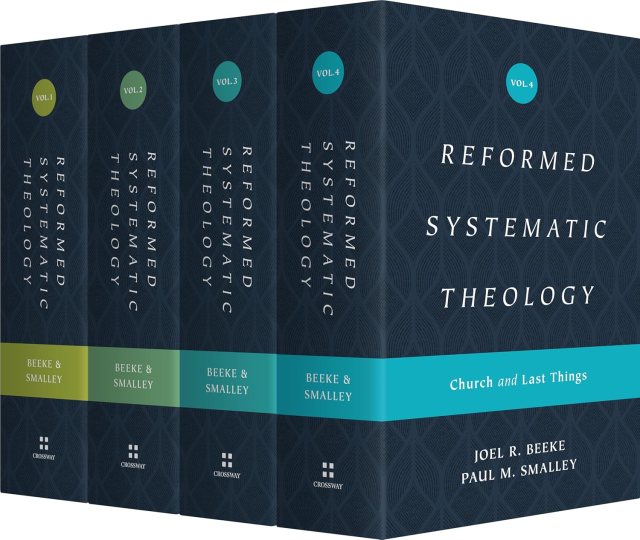
The four-volume Reformed Systematic Theology by Joel Beeke and Paul Smalley is a massive work. Reading it cover to cover is quite a journey to embark upon but also a satisfying accomplishment to complete. Indeed, that is one of the reasons why our church has recently used this set as the primary reading of our elder candidacy. It is a great display of discipline because it reveals whether a man has the diligence, consistency, and perseverance to carefully work through these thousands of pages. Also, by reading these volumes together, we are able to discuss virtually every major doctrine and ensure that we are aligned as men who are called to guard the doctrine of the church and labor together in ministry.
There is now a condensed, single-volume edition of Reformed Systematic Theology. I have not read it, but for those who would prefer one book to read straight through, that would be an excellent option. Even so, I strongly recommend owning the full four-volumes if possible. Even if you never read all four cover to cover, they are invaluable as reference works. These are the kind of books that are worth having on the shelf and used as needed.
Each volume covers two major loci of theology:
- Volume 1: Bibliology and Theology Proper
- Volume 2: Anthropology and Christology
- Volume 3: Soteriology and Pneumatology
- Volume 4: Ecclesiology and Eschatology
Before each major section, there is a detailed outline, which makes it easy to locate specific doctrines or topics. Combined with the extensive indices at the back of the each volume, these are extreme beneficial books for pastors, elders, or serious students of theology to have on hand.
If you are interested in building a theological library, this set should be included.
But what exactly makes Beeke and Smalley’s systematic so great?
First and most importantly, it is rooted in God’s Word. All systematic theologies must necessarily make theological claims and judgments, but the crucial question is whether those claims are saturated in Scripture or not. Beeke and Smalley are constantly interacting with the Scriptures, not as an afterthought or simply for proof-texts but as the foundation of the work.
Second, it is richly informed by the history of the church. I greatly appreciate the breadth of the citations. They are drawn from across the centuries, quoting the Church Fathers, Medieval theologians, Reformers, Puritans, and modern theologians alike.
As Protestants, we are sometimes (and sometimes rightly) accused of neglecting the early church writers. This work certainly does not. Indeed, it reflects the Reformers’ conviction that the Reformation was not a departure from historic Christianity but a return to it. Beeke and Smalley gladly lay claim to the wisdom of earlier generations as part of our shared heritage in Christ.
Third, the books are both intellectually rigorous and deeply practical. They engage in doctrinal issues carefully and thoughtfully, which requires attention and effort while reading. At the same time, it is also very readable. It is not written in a dense academic style. Any thoughtful Christian willing to work carefully through the material should be able to do so.
Crucially, it is not abstract. Drawing heavily from the Puritan tradition, Beeke and Smalley repeatedly press doctrine into real life. Every chapter (sometimes multiple times in each chapter) ends in practical application. Read rightly, this systematic theology will not only inform your mind; it will shape your spiritual life as well. Theology, after all, is meant to be lived out.
Fourth, it is doxological, that is, it is aimed at the glory of God. The word doxology comes from two Greek words: doxa (glory) and logos (word). Theology, rightly done, is a word about God that leads to worshiping Him. That is clearly Beeke and Smalley’s aim. One of my favorite features is that each chapter concludes with a suggested hymn. Even when the hymn is unfamiliar, the point is unmistakable: theology exists for worship. Study should always end in praise. This constant reminder keeps theology from becoming cold or merely academic. The goal is not mastery of ideas but adoration of the living God.
Finally, it is marked by a rare combination of firmness and charity. Beeke and Smalley take clear theological positions. They then argue against opposing views, not shying away from rebuking false teachings and counterfeit worldviews. But they always do so with charity and restraint. They model how to disagree without slander and how to contend for truth without contempt. This is especially evident in their treatment of other Christians, but it also extends to their engagement with the views of other religions and philosophies.
A particularly striking example appears in Volume 4. Beeke is a paedobaptist; Smalley is a credobaptist. The paedobaptist position is presented in the main body of the text since they were originally developed from Beeke’s teaching lectures. Yet Smalley was given space too write an appendix articulating the Reformed Baptist view on baptism. That kind of collaboration (firm conviction paired with genuine respect) is rare and ought to be instructive to us.
In the end, these books are a model for how theology should be done: grounded and saturated in Scripture, informed by history, applicable to everyday life, aimed at the glory of God, and marked by charity.
 B. C. Newton
Thank you for this book review. This is very helpful as I consider buying these volumes.