
The New Year is here.
Have you already started a new devotional?
A devotional is book of sort, often daily, readings. Many have 365 readings for the whole year. They are usually written to be relatable and encouraging. The more theologically robust ones typically reflect on a particular verse or passage of Scripture, sometimes encouraging further Bible readings.
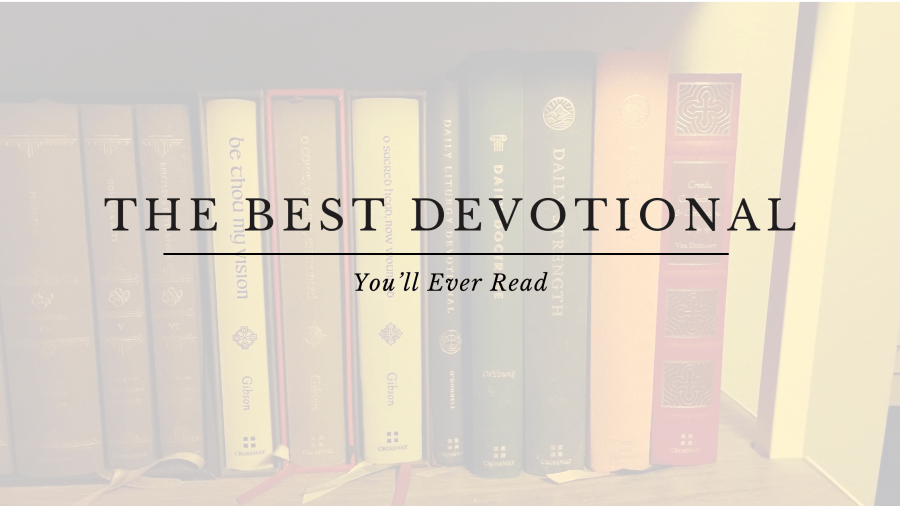
I love a well-written, theologically-rich devotional. Spurgeon’s Morning and Evening or Paul Tripp’s New Morning Mercies are two of my favorites. Crossway has also produced a number of excellent ones. My wife and I have enjoyed their men’s and women’s devotionals that are designed accompany a read of reading through the Bible: Daily Strength and Daily Joy. Kevin DeYoung’s Daily Doctrine is a devotional systematic theology that is a delight to read.
But as much as I love a good devotional and would encourage anyone to work them into their daily time of reading, prayer, and meditation, we should not do so to the neglect of the greatest devotional ever written. I use that title without hyperbole because this devotional was authored by the Holy Spirit.
That devotional is the book of Psalms.
Why the Psalms Are the Best Devotional
The Psalms are deeply devotional in nature, and they are, without doubt, the greatest devotional ever written. In his little book on the Psalms, Bonhoeffer says that God has inspired the Psalms to be prayers that He Himself puts in our mouths. Just as a child learns to speak by repeating the words that his parents speak, God teaches us how to pray to Him by giving us the Psalms as prayers.
While most devotionals strive to be relatable, the Psalms are infinitely so. And they cover the full range of human emotion: joy, rage, grief, confusion, praise, etc. There is no emotional censorship in the Psalms. Indeed, the Psalms give us a wonderful for how we ought to work through our emotions as we take them to rest in God.
Besides being prayers, the Psalms are also songs. Thus, this is not only a prayerbook with Scripture but also a hymnal. As I mentioned in my last sermon, poetry (especially through music) shapes our minds and our hearts. And God has given us a whole collection of songs to sing as we strive to renew our minds in Christ (Romans 12:2).
The Psalms are robustly theological, as well. Alongside Deuteronomy and Isaiah, the Psalms are one of the most frequently quoted Old Testament books in the New Testament, which testifies to their theological contribution. They also cover every major theological doctrine.
Furthermore, while the Psalms can feel deeply personal, they nevertheless keep us connected to the overall community of believers. Bonhoeffer believed that the essence of the Psalms is contained in the Lord’s Prayer, and it explicitly teaches us to pray with plural pronouns (we and us). Even as we pray the Lord’s Prayer alone, the plural wording should remind us that we belong to the whole body of Christ, the church. The Psalms do this as well.
Beyond all of that, the greatest reason to use the Psalms devotionally is that Jesus Himself clearly did. Jesus frequently quoted from the Psalms, even doing so as one of His final statements from the cross. And He did so because, like all of Scripture, the Psalms are ultimately about Jesus.
Devotionals for Understanding the Psalms
But maybe we are more comfortable with modern devotionals because they are easier to understand than the Psalms. Thankfully, there are many resources to help. Tim Keller has an excellent devotional that walks readers through the Psalms over the course of a year. Dane Ortlund has a devotional that gives a brief meditation over each Psalm called In the Lord I Take Refuge. I have also benefitted from Prayers of the Psalms, which the Banner of Truth published as a little book from the 1595 Scottish Psalter. And there are likely many more resources that will help you dive into and understand more clearly the Psalms.
Practical Suggestions
Now, practically speaking, how might you use the Psalms devotionally? Perhaps the simplest answer would be to read a Psalm each day. Or you might choose to read and meditate on one Psalm each week. Or you could follow Don Whitney’s suggestion of praying through five Psalms a day. Choose whatever fits your season of life.
I would also encourage you, as much as possible, to sing the Psalms. There are many wonderful resources for this as well. I have a Spotify playlist that I am constantly adding to, which you can use as well. The Corner Room has three albums of Psalms that are set to music word for word in the ESV translation.
Again, as much as I love devotionals, I pray that God’s people will use the Psalms most of all. This year, make use of the greatest devotional ever written. Read, pray, and sing the Psalms.
 B. C. Newton
This was a really thoughtful post. I appreciate how you highlighted the value of daily devotionals and how they help people slow down, reflect on Scripture, and strengthen their relationship with God. Devotional reading can truly transform how we approach everyday life and faith. Classic devotionals like My Utmost for His Highest have inspired Christians for many years by offering daily reflections that help readers grow closer to God.
If you’re interested: Best Daily Devotional Book for Christians Seeking Daily Peace and Spiritual Growth By Louise S. Sherman.