


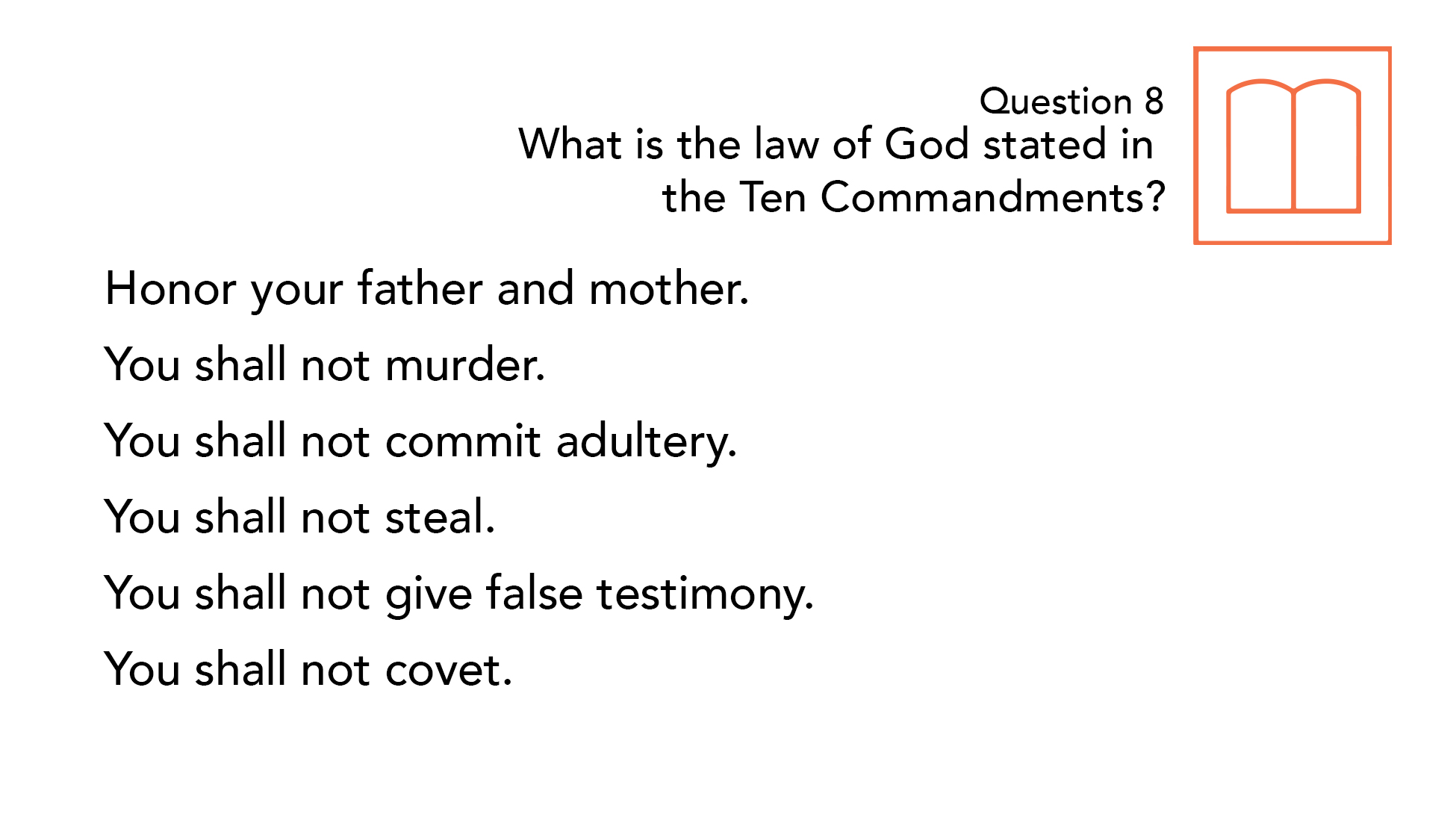
To understand the significance of the Ten Commandments, we must understand something of their context. After leaving the land Egypt, the Israelites set up camp in the Sinai wilderness; there God called Moses to ascend the mountain and receive His words, saying,
Thus you shall say to the house of Jacob, and tell the people of Israel: ‘You yourselves have seen what I did to the Egyptians, and how I bore you on eagles’ wings and brought you to myself. Now therefore, if you will indeed obey my voice and keep my covenant, you shall be my treasured possession among all peoples, for all the earth is mine; and you shall be to me a kingdom of priests and a holy nation.’ These are the words that you shall speak to the people of Israel.
Exodus 19:3–6
God rescued the Israelites from slavery in order to make them His treasured possession, a kingdom of priest, and a holy nation. They were saved by God so that they could then live as God’s people. But they were also rescued to become a kingdom of priests. Priests, after all, were called to stand as mediators between God and His people. The LORD did not lay claim only over the nation of Israel but rather the entire earth. He chose Israel as a holy nation in order to also make them “a light for the nations, that my salvation may reach to the end of the earth” (Isaiah 49:6).
After declaring His purpose for their deliverance from that very mountain, God gave to His people the Ten Commandments. Although the LORD gave many more laws and commands to the Israelites, these ten were especially significant, which is testified by God speaking them directly to the people rather than through Moses and by their being etched into stone and kept in the ark. They received this special treatment because the Ten Commandments serve as a succinct summary of God’s expectations for His people. In many ways, the remainder of the laws served to provide specific application and explanation to these ten. Furthermore, God carefully notes that obedience to His commands will result in blessing, while disobedience will be met with a curse.
Thus, whenever we speak about God’s law and about how He expects His people to act, we can turn to the Ten Commandments. They served as a sort of constitution for what life among the community of God’s holy nation was meant to be. The beauty of this vision only requires a moment’s imagination to grasp. We would rightly call that place a heavenly utopia where people served the LORD with all their heart, soul, and might, where they exalted His name instead of their own, where they worked hard for six days but rested in God and one another on the seventh day, where parents and the family unit were held in honor, where life was sacred, where spouses were always faithful in both body and heart, where falsehood was unthinkable, and where everyone rejoiced in the possessions of others as much as they would their own. Indeed, obedience to the Ten Commandments is heavenly because in heaven all submit perfectly to God’s will. On the other hand, the breaking of these laws both leads to hell itself and to a hellish existence here. Sin, after all, is lawlessness, and a lawless society is a dystopic society.
Through obeying God’s law, Israel was meant to display a savor and aroma of heaven to the rest of the nations on earth. The Old Testament narratives, however, repeated accounts of the Israelites falling into disobedience, of their constant failures to measure up to God’s standard. Indeed, the New Testament writers confirm that such obedience is utterly impossible. No one can fulfill the Ten Commandments perfectly, perpetually, and personally. As Moses, the giver of the law, died before entering the Promised Land, so too will all perish who attempt to enter eternal life through their own obedience.
What then is the purpose of the Ten Commandments today?
Do they serve no other purpose other than to heap condemnation upon our heads as we continue to disobey them?
For those who hope to reach heaven by means of obedience to the law, they do indeed serve as their condemnation. However, hundreds of years before Moses died without setting foot in Canaan, Abraham entered the Promised Land, and he did so by faith. Like Abraham, we are breakers of God’s law and have no sufficiency in and of ourselves to rightfully dwell with God. Instead, also like Abraham, we place our faith in the work of another. Abraham’s faith was simply that God would save him, although he knew not how. For us, however, the mystery of the good news has been revealed. We know that Jesus has “redeemed us from the curse of the law by becoming a curse for us” (Galatians 3:13). Through the substitutionary atonement of Christ, the righteousness of His sinless obedience is imputed upon us, while our curse of death was placed upon Him. We, therefore, enter communion with God not because of our own works but because of our faith in the work of Jesus on our behalf. This is the good news, the gospel.
Under the banner of this gospel, God is again forming a people for Himself, a kingdom of priests, His Church. Composed of both Jew and Gentile and having no earthly territory, these saints of God are saved from slavery of sin for the same purpose that God rescued Israel from Egypt: “But you are a chosen race, a royal priesthood, a holy nation, a people for his own possession, that you may proclaim the excellencies of him who called you out of darkness into his marvelous light” (1 Peter 2:9). We too are a light for the nations, especially as we go forth to make disciples of them.
As the people of God, we look upon the Ten Commandments not as abolished but rather fulfilled in Christ. Jesus summarized the essence of God’s commands down to loving God and loving others. Obedience to these two commands results in obedience to the entire law of God. Therefore, Jesus still teaches us to walk in obedience. Indeed, our faith in the work of Jesus does not negate our obedience but emboldens it. Now that we no longer have dread of the law’s consequences, Christ has freed us to see the beauty of obeying. In Him, we now see that God’s commandments are the rules of a loving Father for our joy and flourishment rather than viewing them as the arbitrary confinements of a megalomaniacal God. We see them as the path of wisdom, the road which God Himself has paved for us.

