

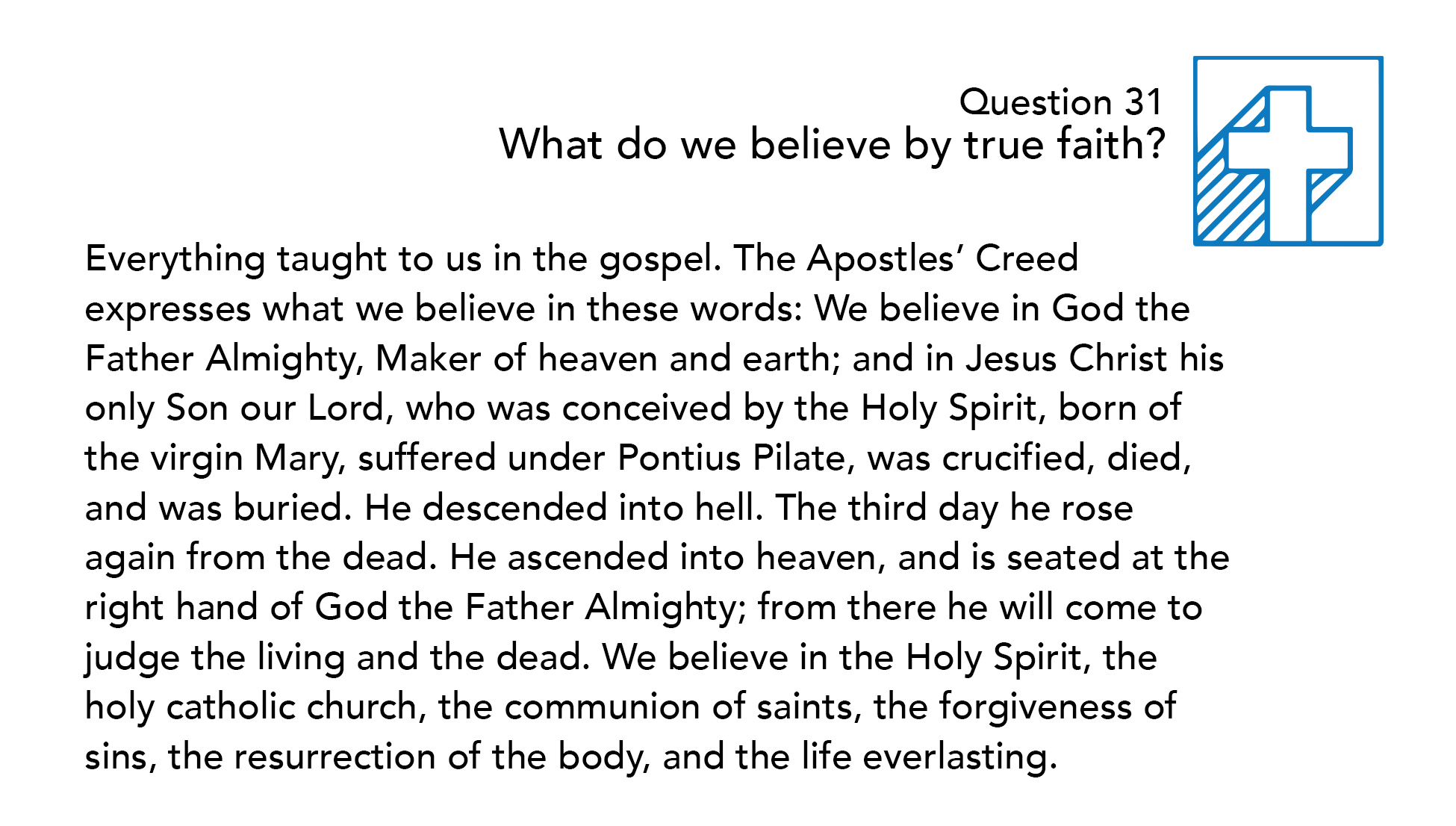
Having answered what it means to have faith in Christ, the New City Catechism now takes us into doctrinal substance of our faith, which is summarized in the Apostles’ Creed. The main reason that we should affirm the Apostles’ Creed is that it is a faithful summary of essential Christian doctrine; it is a snapshot of the core teachings of Christianity. This is crucial because the Bible repeatedly commands us to stand firm in sound doctrine. Acts 2:42, for example, tells us that the fledgling church devoted (or immersed and saturated) themselves in the apostles’ teaching, which is revealed in the Scriptures. Through the prophets in the Old Testament and apostles in the New Testament, God has made Himself known to humanity. The Scriptures alone, therefore, define the basics of our belief. They teach us the faith for which we must be ready to contend.
The Apostles’ Creed, like all creeds and confessions, is not Scripture. It does, however, provide us with a lens for understanding the overall message of the Bible. Creeds, therefore, are not ends unto themselves; rather, they are a means by which we are able to better know God’s Word.
But if the Bible itself is the only authoritative revelation of God, wouldn’t creeds and confessions just distract from the Bible itself? Or to put it another way, should we believe in “no creed but the Bible?” The problem with rejecting all creeds, confessions, and statements of faith as undermining the authority of the Bible is that the idea is almost entirely fallacious in logic. Because creeds are statements of belief, the phrase “no creed but the Bible” is itself a creed, which means that its meaning falls apart as quickly as arguing that there are absolutely no absolutes. The very premise is self-defeating as even summarizing and paraphrasing the message of the Bible would necessarily be a kind of informal creedal statement.
In fact, creeds are helpful and even necessary for understanding the Bible. Christians, furthermore, have long looked to the Apostles’ Creed as a guide for understanding the essential doctrines of the faith. The Bible certainly contains many issues and topics but not all of them are essential, and we don’t have to agree exactly about interpreting these things. For example, many believers disagree on whether the supernatural gifts of the Spirit continue today or have ceased. Both cases can be reasonably made from Scripture, and since it is a secondary issue, we don’t lob heresy grenade at one another. We disagree and remain united around the core truths that make us disciples of Christ.
The Apostles’ Creed is a great tool for reminding ourselves what exactly those essentials are. Albert Mohler states, “All Christians believe more than is contained in the Apostles’ Creed, but none can believe less” (xvi). If our beliefs and convictions do not go beyond the creed then we don’t have any familiarity with the Bible, so we must go further than the creed in our walk with Christ. But also, each statement of the creed represents an essential doctrine that if denied removes a person from the historical stream of orthodoxy.
The very structure of the Apostles’ Creed reflects the structure of the gospel. It begins with God the Father almighty, creator of heaven and earth. He built the cosmos out of nothing, giving to humanity the distinct privilege of reflecting His image. But we rebelled. Discontented with being like God, we tried to become gods, and, as a result, our sin broke us and the world under our dominion, ushering in death. But God did not leave us to perish in our sin; instead, He sent His only Son, who is the eternal Word by whom and through whom the world was made. So God’s Son, Jesus Christ, was conceived by the Holy Spirit and born of the virgin Mary, entering our world as one of us. The God-man, truly human and truly divine, lived a life of perfection and rejection that culminated in His willing crucifixion as a substitute for us. Upon that cross, the only person to never deserve death died, and His body was placed in a grave for three days. On the third day, He rose to life, becoming the firstborn of the resurrection. He then ascended into heaven to sit at the Father’s right hand until the day that He will return to judge every soul that has ever lived with righteousness and equity. Until then, He has poured upon His people the Holy Spirit, the third person of the Godhead, who dwells within us so that we are empowered to continue Jesus’ earthly ministry. As such, we join every disciple of Jesus in the mission of calling upon all people to repent and believe the good news, to become disciples of Jesus as well. As they do, they too join the fellowship of God’s people, rejoice in the forgiveness of their sins, and fix their hope upon our eternal life with Christ in resurrected bodies like His.
It is fitting that the Apostles’ Creed traditionally ends with Amen because those who believe these things can scarcely say anything else. The reminder of this good news should elicit a joyous declaration of “May it be so!” from our lips! These must be living truths within our breasts, not dead pieces of knowledge or trivia.

 B. C. Newton