
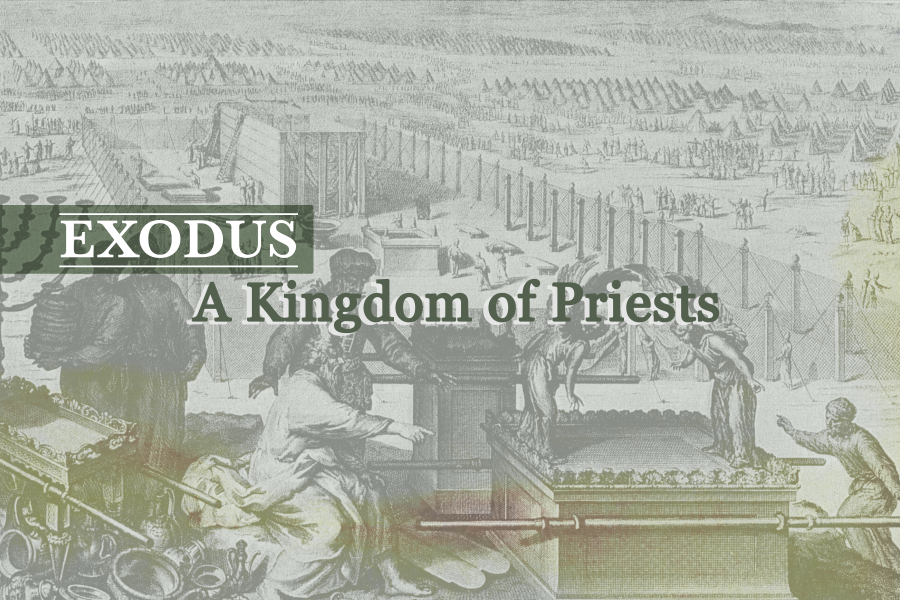
As we should remember by now, the context for our present chapter is that Moses is at the summit of Mount Sinai in the presence of Yahweh, who is giving to the prophet instructions and showing him the patterns for the building of the tabernacle. The tabernacle would also be called the tent of meeting because it was a royal tent where God would dwell in the midst of His people. So far, we have considered the instructions for the ark of the testimony, the table for the bread of the Presence and golden lampstand, the tabernacle itself, the bronze altar and the courtyard, and the garments and consecration of the priests.
In our present chapter, we find what appears to be a miscellaneous group of instructions for other various other items. Two pieces of furniture are commanded: the altar of incense and the bronze basin. The basin would belong to the courtyard, whereas the altar of incense would stand immediately before veil that enclosed the Most Holy Place. Instructions are also given for the incense that would be used upon the altar of incense as well as for the anointing oil with which the priests and the tabernacle were to be anointed as holy. And for good measures, instructions for a census tax are also thrown in.
Given that chapters 25-29 moved methodically through the structure of the tabernacle, beginning with the innermost item and ending with the priests who were consecrated into the tabernacle complex, what is the purpose behind grouping these (seemingly) eclectic instructions together towards the end? Is this simply an odds and ends collection of remaining instructions?
No, the very structure of this chapter testifies that these instructions are not afterthoughts. Note that the chapter is bookended by the altar of incense and the incense itself. Moving inward, we then find instructions for the census tax and the anointing oil, which as we will see are both means of being marked as belonging to Yahweh, and in the center, we have the bronze basin. In some ways, this layout is a miniature version of the pattern from the ark to the consecration of the priests in chapters 25-29, which is perhaps meant to call our attention to the big picture for the tabernacle as stated in 29:42-46, to be place where God dwells with His people and where they can meet with Him.
THE ALTAR OF INCENSE // VERSES 1-10; 34-38
Since this chapter has a chiastic structure, we will structure our study accordingly, beginning with the bookends and moving toward the center. Again, chapter 30 begins with the instructions for the altar of incense and ends with the instructions for the incense itself. Structurally, the instructions for the altar of incense are the conclusion to the unit of thought that has run continuously since 25:1, which began with the words, “The LORD said to Moses…” That phrase will be used six more times in this chapter and the next, and we will defer our discussion of that sevenfold significance until next week. For the present, it is worth pointing out that the first piece of furniture in that section was the ark of the testimony, which was placed with the Most Holy Place, and now the final piece of furniture in this section is the altar of incense, which stood immediately before the veil that barred entrance into the Most Holy Place. Indeed, even though the altar belonged to the Holy Place, it was so closely associate with the Most Holy Place that the author of Hebrews lists it alongside the ark:
For a tent was prepared, the first section, in which were the lampstand and the table and the bread of the Presence. It is called the Holy Place. Behind the second curtain was a second section called the Most Holy Place, having the golden altar of incense and the ark of the covenant covered on all sides with gold, in which was a golden urn holding the manna, and Aaron’s staff that budded, and the tablets of the covenant. (Hebrews 9:2–4)
This association is also noted in Leviticus 16’s instructions regarding the Day of Atonement. On that most important day of the year, the high priest was commanded to go into the Most Holy Place with blood from a sacrifice to make atonement for the sins of God’s people. As he prepared to go behind the veil, he first needed to go the altar of incense, where, as verses 12-13 describe: “he shall take a censer full of coals of fire from the altar before the LORD, and two handfuls of sweet incense beaten small, and he shall bring it inside the veil and put the incense on the fire before the LORD, that the cloud of the incense may cover the mercy seat that is over the testimony, so that he does not die.” Even as he went behind the veil, the smoke of incense was to act as a kind of veil, shrouding him from the unfiltered presence of God.
Of course, the altar of incense was used beyond that once-a-year function. Although we do not know precisely what spices and herbs were used for the particular blend, it was clearly designed to be aromatic, which would have been quite practical given the continuous smell of burnt flesh that would have filled the court of the tabernacle. Of course, the smoke of the incense was also likely intended to invoke the cloud of God’s glory that rested upon Sinai, symbolizing that the tabernacle was a mobile Mount Sinai, that God had indeed come down to dwell with His people.
Yet I agree with Philip Ryken that the primary purpose of the altar of incense was to be an altar of prayer. He cites three texts that connect incense with prayer. In Psalm 141:2, David prays, “May my prayer be set before you like incense; may the lifting of my hands be like the evening sacrifice.” Then in Luke 1, Zechariah goes into the temple to burn incense. while the people pray outside. Zechariah was clearly praying as well, since the angel that appears to him immediately says, “your prayer has been heard” (1:13). Lastly, in Revelation 5:8, John sees a vision of the twenty-four elders around God’s throne who “were holding golden bowls full of incense, which are the prayers of the saints.” Ryken then goes on to conclude:
These passages all connect the offering of incense with the life of prayer. They help us understand what the priests did at the golden altar. Prayer was an important part of their ministry. The priests offered prayers for God’s people every day, and this was symbolized by the smoking incense. According to David Levy, “The priest took a censer full of burning coals from the brazen altar in one hand and specially prepared sweet incense in the other hand and ignited the incense by sprinkling it over the burning coals. A thick cloud of smoke curled upward filling the Tabernacle, symbolic of Israel’s prayers to God.”
Of course, since the most basic function of a priest is to mediate between God and men, praying on behalf of the people was a foundational responsibility. Every Israelite both could and should have prayed regularly to Yahweh, and He would hear them because He is both omniscient and omnipresent. However, His presence was specially located in the Most Holy Place of the tabernacle, and the priests alone had the privilege of standing at the altar of incense just on the other side of veil to pray.
Yet as with any access to God, that privilege only came through blood. As verse 10 says, Aaron shall make atonement on its horns once a year. With the blood of the sin offering of atonement he shall make atonement for it once in the year throughout your generations. It is most holy to the LORD. Each year on the Day of Atonement, the altar of incense needed to be sprinkled with the blood of the sin offering because we can only have access to God once our sins are dealt with. Without a sacrifice for our sins, we have no confidence that God will turn His ears to our pleas; instead, we have every reason to believe that He should not!
Since God’s people today are a royal priesthood, though we no longer have an altar of incense, we do have a duty and responsibility to pray for one another and for the world around us. However, even though prayer is a duty that will often require diligence and perseverance, we should constantly remind ourselves that prayer is more fundamentally a privilege. Unlike the ordinary Israelites or even the priests, we have no veil separating us from the presence of God. Our Lord has offered Himself as the perfect and final sacrifice for sins, and His crucifixion was the true and ultimate Day of Atonement. Through Christ, we have greater access to the presence of God than even the high priest of Israel in the Old Testament.
THE CENSUS TAX & OIL FOR ANOINTING // VERSES 11-16; 22-33
The second and fourth instructions are for the census tax and the anointing oil. Since we have already read about a particular usage of the anointing oil in the previous chapter, let us begin with it. First, we are given the recipe, then its uses, and finally a warning. Just as the priests were to be anointed with this oil during their consecration ceremony, the rest of the tabernacle and its parts were to be similarly anointed. As we read in verses 29 and 32, the purpose of this anointing is to mark what is anointed as holy. Upon being consecrated to the Yahweh, the priests became holy to Him. The same was true of the tabernacle, the ark, the basin, the altar, etc.
Of course, this holiness is secondhand. God alone is truly and perfectly holy, for there is none like Him. The holiness is anything that is not God means that specially set apart as belonging to God. That is why God called Israel a holy nation. In bringing them out of Egypt to make them His people, He set them apart from any other nation. And what was shadowed in the Old Testament is not fulfilled in the New. Drawing on God’s language to Israel in Exodus 19, 1 Peter 2:9 says about all who follow Christ: “But you are a chosen race, a royal priesthood, a holy nation, a people for his own possession…” Like Paul, in Titus 2:14 calls us “a people for his own possession.”
Our consecration to God did not use this anointing oil; rather, upon calling upon the name of Jesus for salvation, we were anointed with the Holy Spirit, who now dwells within God’s people. And just as with the priests and the tabernacle, we are now holy to Yahweh, belonging exclusively to Him. Therefore, we should regularly ask ourselves whether or not we are living as if that were a reality. Do we strive to live as though we belong body and soul, both in life and death, to God our Savior? Or do we confess Him with our lips, while practically living out the prayer “my will be done”?
The census tax makes a similar point of possession to Yahweh. As verses 11-16 describe, Moses was to take a census of everyone over the age of twenty in Israel. While doing so, each person was to give a census tax of half a shekel. Whenever we read that the rich would not pay more and the poor would not pay less, we might long for the IRS to adopt such a simple, equitable, and comprehensible regulation on taxes. Even so, as the language of these instructions make clear, taking a census of God’s people was a serious affair. Indeed, one of King David’s great sins was calling for a census without being authorized to do so by God.
But why was a census so serious? Ryken explains:
To understand Israel’s peril, it helps to understand that numbering things is an act of authority. Who has the right to take inventory? Only the person who owns whatever is being counted. We only have the authority to count things that are rightfully ours. We can’t put our numbers on other people’s stuff. So who had the right to number the Israelites? Only God. They were his people; so he alone had the authority to count them. A. W. Pink comments: “When God numbers or orders anything to be numbered, taking the sum of them denotes that they belong to Him, and that He has the sovereign right to do with them as He pleases. The action itself says of the things numbered, ‘These are Mine, and I assign them their place as I will.’ ” Therefore, the only proper way to count the Israelites was for the glory of God alone.
Thus, the census tax and the anointing oil go hand-in-hand, since they both were used to by Yahweh to establish what is rightfully His. Indeed, several times the Scriptures refer to the LORD’s book of life, wherein the names of all who belong to Him are written. In his vision of the day of judgment, John wrote: “And if anyone’s name was not found written in the book of life, he was thrown into the lake of fire” (Revelation 20:15). Only those who are numbered by God as belonging to Him will spend eternity with Him.
THE BRONZE BASIN // VERSES 17-21
The central and third of the five instructions given is for the making of the bronze basin, which we read in verses 17-21:
The LORD said to Moses, “You shall also make a basin of bronze, with its stand of bronze, for washing. You shall put it between the tent of meeting and the altar, and you shall put water in it, with which Aaron and his sons shall wash their hands and their feet. When they go into the tent of meeting, or when they come near the altar to minister, to burn a food offering to the LORD, they shall wash with water, so that they may not die. They shall wash their hands and their feet, so that they may not die. It shall be a statute forever to them, even to him and to his offspring throughout their generations.”
Let us begin by noticing what is not given in these instructions: dimensions. Unlike almost everything else in the tabernacle, the bronze basin did not have direct dimensions telling us how big or how small it ought to be. As with the rest of the tabernacle, it needed to be mobile, so we can assume that it was not massive, but it did need to be large enough for the priests to wash their hands and feet regularly. Interestingly, in 38:8 we find that it was not built from the regular gathering material, as with the rest of the tabernacle; instead, it was made “from the mirrors of the ministering women who ministered in the entrance of the tent of meeting.”
The location of the bronze basin is significant. It stood in the court of the tabernacle between the tent and the altar. So, upon entering the court of the tabernacle, you would immediately find the bronze altar where sacrifices were made, beyond that stood the bronze basin, and then there was the tabernacle itself. This was perhaps the most frequently used item in the whole tabernacle structure, since the priest would need to wash before and after making a sacrifice upon the bronze altar and would also need to wash before entering the tabernacle. Douglas Stuart notes why this constant washing was so important:
But the cleansing of priests’ hands and feet required by this law had for them its greatest value in teaching the importance of purity. Dirt represents a visible indication of adulteration of a clean thing. Dirt on food mars the taste; dirt on clothing changes both the appearance and potentially even the comfort of the clothing. Dirt looks bad/wrong/out of place on any surface where it does not normally belong, and most people do not regard the feel of dirt (when there is enough of it to feel) as objectionable. From this common sense about dirt, God taught his people, through these commands that related directly to the priests who served in the tabernacle and/or its courtyard, that his holiness demands purity. Things and people brought close to his presence could not be sloppy, imperfect, common, adulterated, or otherwise “dirty.” Accordingly, the hands that touched the sacrifices or the feet that walked into the tabernacle has to be washed to remove dirt and to make the priest of Yahweh symbolically pure before him so as to be able to serve worthily in his house. (641)
And as verse 21 plainly notes, if the priests failed diligently keep themselves washed while ministering before the presence of Yahweh, they could very well have been stricken dead by Him. This was no lighthearted or trivial matter. To come into Yahweh’s presence dirty and unclean was deadly. Yet we should note that only the hands and feet were washed. During the consecration ceremony for the priests, their whole bodies were presumably washed; however, over the course of their daily work, only their hands and feet needed to be washed. While washing His disciples’ feet in John 13, Jesus makes a similar distinction. In verses 6-11, we read:
He came to Simon Peter, who said to him, “Lord, do you wash my feet?” Jesus answered him, “What I am doing you do not understand now, but afterward you will understand.” Peter said to him, “You shall never wash my feet.” Jesus answered him, “If I do not wash you, you have no share with me.” Simon Peter said to him, “Lord, not my feet only but also my hands and my head!” Jesus said to him, “The one who has bathed does not need to wash, except for his feet, but is completely clean. And you are clean, but not every one of you.” For he knew who was to betray him; that was why he said, “Not all of you are clean.”
Philip Ryken notes that Jesus is distinguishing between two kinds of cleansing:
One is the total cleansing that comes at the beginning of the Christian life and washes away the guilt of our sin. Another is the ongoing cleansing that is needed throughout the Christian life. This cleansing washes away the corruption of sin and purifies us for service to God. And this is what Peter needed—not the kind of cleansing that would save him, but the kind that would purify him for the service of God. David Levy comments: “By washing the disciples’ feet, the Lord taught that we who have been thoroughly cleansed through His blood must still be cleansed in our daily walk with Him. Daily sins must be confessed to God in order to maintain an unbroken communion and fellowship with Him.”
This is important for us to remember throughout own lives as well. Whenever we first come to believe in Christ, He cleanses us through the Holy Spirit, brings us from being dead in our sins to being alive in Him, and forgives all of our sin. Baptism is a visible sign representing that one-time moment of justification.
Yet after being justified in Christ, our sin and need to repent and be forgiven do not go away. Just as the priests became unclean from the grit and grime of each day’s work, we too still war against the uncleanness of our sins and still need Christ to daily (even hourly) wash us clean. But just as the priest was not re-consecrated each time he sinned or got dirty, neither are we re-justified each time we repent of our sin and cling to Christ. Upon being saved, we are marked as being “Holy to Yahweh,” and the rest of our lives are spent growing in that holiness, progressively killing our sin and walking in great love and obedience to our Lord.
That process is called sanctification, and the Lord’s Supper is a marvelous visible parable of it. We are only baptized once because it represents our new birth in Christ, which only happens once, but the Lord’s Supper represents our continual need of Christ. Just as we need food and drink daily to be sustained, so do we need to repent of our sins and receive grace from our Lord each day.
Thus, if you trust in Christ and have been baptized into Him, then come to the Table today to remind you again that you still need Christ. As you come, confess your sin and cling to Christ. We do not need a special altar for prayer, for Christ Himself is the altar upon which we pray. As you come, rejoice in being God’s treasured possession and in having your name written in the book of life. As we eat of this bread and drink of this cup, may we taste and see the goodness of our God in the face of Jesus Christ, who redeems us and sustains us until the day we stand glorified in Him.
 B. C. Newton
Beware of Anything Beyond Scripture | Ecclesiastes 12:9-12
ON BY COLE NEWTON
I read one of your work today that you wrote in 2018 and I was truly blessed and glad I can across it.
It is my first time of reading your work.
May The LORD bless you and give you more wisdom IJMN 🙏
looking forward to reading some other articles from you.
More anointing and more auction to function Sir IJMN 🙏