
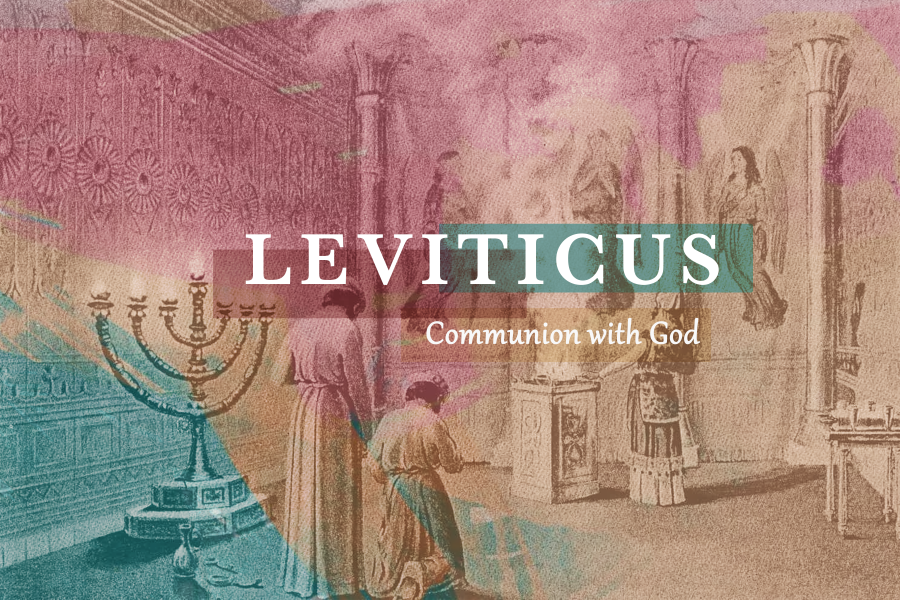
Leviticus 9 is a highly significant text because it presents the resolution of the problem that has been haunting these opening chapters of the book. Remember that Leviticus cannot be properly understood alone. It is the third and central volume of the Pentateuch (the ‘five volumes’ of Moses), so even though it is a complete book in its own right, it must also be read in the context of the whole Torah.
Specifically, Leviticus picks up where Exodus leaves off. Exodus concluded with Moses receiving the instructions for the tabernacle, and the people then building it. In those final chapters, the refrain was: “As the LORD commanded Moses…” Then in Exodus 40:16 we read: “This Moses did; according to all that the LORD commanded him, so he did.” And with the tabernacle completed, we read this in 40:34-35:
Then the cloud covered the tent of meeting, and the glory of the LORD filled the tabernacle. And Moses was not able to enter the tent of meeting because the cloud settled on it, and the glory of the LORD filled the tabernacle.
Can you see the problem? Moses, who was able to go to the very peak of Sinai and speak with God face to face, could not enter the tabernacle. Recall from our first sermon in this study that the tabernacle is called two things. It is called the tabernacle, which means ‘dwelling place,’ for it was to be God’s dwelling place in the midst of His people. But it was also called the tent of meeting, which emphasizes that this was where God’s people could meet with Him. Though exiled from Eden by sin, cast out of God’s presence, the tabernacle worship system made it possible to have fellowship and peace with God once more. Even if it was for just a moment, it was like being in Eden again.
But Moses couldn’t enter, which meant that the ordinary Israelite definitely couldn’t enter. So, the question that has been lurking in the background of our study is this: How can the tabernacle also become the tent of meeting? How can God’s people draw near to Him for worship and not die?
Leviticus’ answer is through the prescribed offerings. Indeed, the word ‘offering’ shares the same root as the verb ‘to draw near.’ You draw near to God with what you bring near to God as an offering. Thus, all the offerings and the priests who needed to make them were about drawing near to Yahweh.
While Leviticus 8 gave us the ordination ceremony of the priests, chapter 9 presents the first tabernacle worship service, the inauguration of the tabernacle cultus. And by the end of the chapter, the tabernacle becomes the tent of meeting.
Leviticus 9 can easily break down into three sections: verses 1-7 give us the preparation for worship, verses 8-22 describe the worship service itself, and verses 23-24 show the results of that worship.
PREPARING TO WORSHIP // VERSES 1-7
On the eighth day Moses called Aaron and his sons and the elders of Israel, and he said to Aaron… This is not Yahweh speaking directly, as has been the case for most of Leviticus so far. Instead, Moses as Yahweh’s prophet is speaking to Aaron in the presence of Aaron’s sons and the elders of Israel, who were gathered into the courtyard of the tabernacle to represent the people of Israel.
The phrase on the eighth day is significant. Matthew Henry notes that the priests did not have any time away from their duty. Following the seven-day ordination period they were immediately thrust into their priestly work. Of course, this is a picture of the Levitical system itself. Because the sacrifices were not perfect, they could never end but must be made continually. Indeed, that is the problem with the OT sacrifices. They were insufficient but not inherently legalistic. This was, after all, a system of grace. It was grace that God allowed His people to come into His presence at all, and they could only come through faith in Him. The prophets would later decry the worthlessness of their legalistic offerings. The God-fearing Israel only made his or her offerings by the grace of God and through faith in God.
Thus, the flaw with the OT system was not legalism per se; rather, it was incomplete and insufficient. The priests never had a day off because their work never truly finished. None of their offerings actually atoned for sin. They all simply pointed ahead to Christ, the better priest and better offering. In contrast to the priests, Jesus sat down after making His sacrifice, indicating that His work was done. He Himself declared it so from the cross, crying, “It is finished!”
In fact, along those lines of thought, Kenneth Mathews writes:
It is striking that the traditional Christian day set aside for worship has been the first day of the week, that is, the eighth day following a seven-day segment of time (Acts 20:7; 1 Corinthians 16:2). It was the day of our Lord’s resurrection (Luke 24:1-3), the initiation of the new creation that displaced the old seven-day creation. (88)
We should also notice the goal of worship that these verses present to us, which is to draw near to God and to see His glory. In verse 5, we read: They brought what Moses commanded in front of the tent of meeting, and all the congregation drew near and stood before the LORD. Do you see what happened there? To stand in front of the tent of meeting was the same thing as standing before Yahweh. Verse 6: And Moses said, “This is the thing that the LORD commanded you to do, that the glory of the LORD may appear to you.”
First, God wants His people to be near Him, and we see that in the story of the whole Bible. God created us to dwell with Him, but we rebelled. We were not content with bearing his image and being like Him; we wanted to be gods ourselves. In response to our attempt to become divine by taking knowledge that was forbidden to us, we have been cast from the paradise of His presence and down from His holy mountain–further down, further out.
Yet the Bible is the story of God restoring our communion with Him. He certainly cannot ignore our sin. His justice and righteousness demand satisfaction. Thus, He makes atonement for our sin so that we can draw near to Him again, which is accomplished through the death of Jesus Christ. There, justice and love flow in equal measure. Justice because the penalty for our sin is paid in full. Love because that penalty is placed on Christ and we go free.
While we always have the lie playing through our heads that God doesn’t love us, Scripture screams the very opposite. Though our sin separates us from God, once we confess it, God forgives and welcomes us back into His presence. The truth is: God wants us to be near Him far more than we want to be near Him. Indeed, that is the same as saying: God wants us to be happy far more than we actually want to be happy.
Is that how you think of worship? Do you long to be near God? But how do we come near to God today? Here in Leviticus, an Israelite needed to stand before the tabernacle. We don’t have that physical tent anymore. But that should not cause us sorrow but joy. Even though Jesus came to earth as the true and better tabernacle, God dwelling with us, He nevertheless said that it was better for Him to go back to the Father because after His ascension the Spirit would come to us. Now, instead of one physical location, God’s Spirit dwells within His people. Any place can be a place of meeting with God.
That is why I have emphasized before and will continue to do so the three key ways that we draw near to God today: hearing His Word, speaking to Him in prayer, and communing with His people. Those are the basics of living as a Christian, of following Christ. Reading the Bible without prayer is incomplete. Prayer without the Bible is incomplete. When Spurgeon was asked which was more important, he asked which was more important for breathing: breathing in or breathing out?
And we also need the fellowship of God’s people, which is where the Holy Spirit dwells. None of us reflects Christ perfectly, least of all me to myself. We need each other. Although we cannot ever display Christ fully, together we strive to display Him truly as His body here on earth.
But the goal of worship is also to see God’s glory. Perhaps we should begin by asking simply: What is God’s glory?
At Classical Conversations, which started back this past week, I always begin by asking my class six questions. The first four are:
Who made you? God made me.
What else did God make? All things.
Why did God make you and all things? For His own glory.
What does it mean that God made you and all things for His own glory? To show how good and great He is.
God’s glory is the radiance of who He is, His goodness and His greatness. Every attribute of God reveals that He is both good and great. To see God’s glory is to see a glimpse of how good and great He really is.
That is the goal of true worship: to draw near to God and behold His glory.
The final observation that we will make from these opening verses is that worship requires obedience. We see this in verse 2. Worship begins with commands that must be obeyed: Take for yourself a bull calf for a sin offering and a ram for a burnt offering, both without blemish, and offer them before the LORD. In verse 3, Aaron is told to gather the people’s offerings.
The fifth question that I ask in that catechism is: How can we glorify God? By loving Him and doing what He commands. The way we give glory to God, that we acknowledge Him as all good and all great, is by doing what He says. We cannot say that we love and honor God if we ignore His commands, following after our own desires. No, loving God requires obedience. Obedience is the backbone of true worship. Samuel told Saul as much whenever the king thought that he could bribe God with his sacrifice: “Has the LORD as great delight in burnt offerings and sacrifices, as in obeying the voice of the LORD? Behold, to obey is better than sacrifice, and to listen than the fat of rams” (1 Samuel 15:21).
THE INAUGURAL SERVICE // VERSES 8-22
With the preparations made, we come now to the worship service itself. This section can be divided into three parts. First, we have the priestly offerings in verses 8-14. Second, the people’s offerings are made in verses 15-21. Finally, verse 22 records the priestly blessing of the people.
Aaron must first make offerings for him and his sons. Again, we see here the necessity of the priests making atonement for their own sins first, which was the great problem with the Levitical priesthood: they were just as sinful as the rest of Israel. Aaron needed to be atoned before he could make atonement for the people of God.
As in chapter eight, the purification offering is made first. It is not being given in response to a specific sin, as commanded in chapter four, which would have required a ram. It is, instead, purifying the altar so that Aaron can make the other offerings. Wenham does note, however, that “Jewish commentators have long noted the irony of this command to Aaron. The first sacrifice he has to offer is a calf, as if to atone for his sin in making the golden calf (Exod. 32)” (148).
After Aaron’s two offerings, the people’s offerings were then made, of which there were four: the purification offering, the burnt offering, the grain offering, and the peace offering.
Notice which of the five basic offerings is missing: the guilt offering. That makes sense, if you remember the purpose of the guilt offering. It was made in response to specific sins, and unlike the purification offering, it was not used for other circumstances. It was made in response to trespassing against the holy, which was difficult to do since the tabernacle system was just being inaugurated, or it was made in response to trespassing a neighbor’s property, which wouldn’t be addressed during this communal service.
Notice that the purification offering for the whole congregation here is a goat, not a bull as commanded in chapter four. This is probably because it was not being offered in response to a specific sin of the people but for their purification generally. They had not committed a particular sin, but Yahweh could not come into their midst without them addressing even their general sins. On this point, Sklar notes that the offerings here are essentially saying:
In other words, “Because the most holy King is coming to dwell in your midst, you must deal properly with your sin and impurity by offering sacrifices that cleanse them away and make atonement for you.” Stated negatively, “If you do not deal with your sin and impurity, it shows you think little of the LORD’s holiness and underestimate his hatred for these things that mar his good creation.” (279)
Notice also the pattern of the four offerings. The purification offering comes first because the altar must be purified in order for the burnt offering to be made. The burnt offering represents atonement. The entire animal was consumed with fire and sent as smoke up to Yahweh, symbolizing both our sins being completely consumed and our complete devotion to Him. Then comes the grain, or tribute, offering, which represented the people’s dedication to God, acknowledging Him as both God and King. Finally, the peace or fellowship offering was made. Purification, atonement, and tribute are all about establishing peace and fellowship with God. The final offering is a picture that communion has been restored, that sin has been dealt with, and that now God’s people can come into His blessed presence.
As a further picture of that blessedness, we come to the third part of the service in verse 22: And then Aaron lifted up his hands toward the people and blessed them, and he came down from offering the sin offering and the burnt offering and the peace offerings. This may have been the priestly blessing recorded for us in Numbers 6:22-26:
The LORD spoke to Moses, saying, ‘Speak to Aaron and his sons, saying, Thus you shall bless the people of Israel: you shall say to them, The LORD bless you and keep you; the LORD make his face to shine upon you and be gracious to you; the LORD lift up his countenance upon you and give you peace.’ So shall they put my name upon the people of Israel, and I will bless them.
Or it may have been something else. If it wasn’t that blessing, it was probably similar. Another blessing in the Bible is Psalm 20:
May the LORD answer you in the day of trouble! May the name of the God of Jacob protect you! May he send you help from the sanctuary and give you support from Zion! May he regard all your offerings and regard with favor your burnt sacrifices!
So there are many blessings in Scripture, but they are all prayers for Yahweh to bless His people. Now, some commentators argue that Aaron, in his priestly office, was giving an actual blessing to the people, not simply a prayer or wish, but an actual pronouncement that became a reality. Blessings like what we observed in Ruth 2:4 are simply wishes, but Aaron’s blessing is effectual.
I do not think that is the case. The appeal to God’s name is exactly what Sklar says: “What is clear is that the LORD, not the priest, is the ultimate source of blessing” (282). Obviously, this blessing would have been far more meaningful than a passing greeting, but even so, the priests are not dispensing blessings themselves.
The prophets support this thought because they dismantle the idea that a blessing automatically rests upon those who offer sacrifices. They repeatedly warn against offering sacrifices in vain, that is, without faith and love. In that case, the priestly blessing does not secure a blessing for a sacrilegious sinner who refuses to truly repent. The blessing ultimately comes from God Himself.
THE RESULT OF WORSHIP // VERSES 23-24
With the final two verses of our text, we now see the results of worship. Let us note three things here. First, in verse 23: And Moses and Aaron went into the tent of meeting. And when they came out, they blessed the people. This is the answer to the problem of Exodus 40. Moses could not enter the tabernacle. But now that the sacrificial system is put into place and offerings can be made, Moses and Aaron together enter the tent of meeting. They are able to come into the presence of God. The tabernacle is now rightly a tent of meeting, where God’s people can meet with Him.
Of course, this is confirmed by Moses and Aaron leaving the tabernacle alive. Theoretically, they could have entered the tabernacle at any point, but they would not have been accepted by God and would have died (as chapter ten will show). So, their leaving the tent of meeting alive to bless the people was a sign of their acceptance by Yahweh.
Second, notice the end of 23 and beginning of 24: And the glory of the LORD appeared to all the people. And fire came out from before the LORD and consumed the burnt offering and the pieces of fat on the altar. God’s glory comes down and is evidenced by fire, which comes out of the tabernacle to the bronze altar.
This chapter brings out very clearly the purpose and character of OT worship. All the pomp and ceremony served one end: the appearance of the glory of God. (151)
All of the ritual comes down to one thing: God appearing to reveal His glory to His people. That is the point. So, while it is easy to get lost in the details of Leviticus, let this be our focal point.
Finally, the last two phrases of verse 24 show the people’s response: And when all the people saw it, they shouted and fell on their faces. That is their reaction to the appearance of God’s glory. The same thing happened as the dedication of the temple in Solomon’s day, as recorded in 2 Chronicles 7:1-3:
As soon as Solomon finished his prayer, fire came down from heaven and consumed the burnt offering and the sacrifices, and the glory of the LORD filled the temple. The priests could not enter the house of the LORD because the glory of the LORD filled the LORD’s house. When all the people of Israel saw the fire down and the glory of the LORD on the temple, they bowed down with their faces to the ground and on the pavement and worshiped and gave thanks to the LORD, saying, “For he is good, for his steadfast love endures forever.”
Notice the mixture of joy and fear in both passages. They shout for joy. 2 Chronicles even tells us what they shouted. Yet they also fall on their faces in awe. They are prostrate on the ground before the Holy One.
That ought to still be the case today. Hebrews 12:28-29 says, “let us offer to God acceptable worship, with reverence and awe, for our God is a consuming fire.” And Hebrews 13:15 says, “Through him then let us continually offer up a sacrifice of praise to God, that is, the fruit of lips that acknowledge his name.”
Lewis rightly said that praise is almost a person’s inner health made audible. You see, he noticed that praise naturally comes from what we find delightful. If we have seen a great film or read a great book, we will long to talk about it, to share our joy with others. If we find nothing to praise, it is because we are blind to the beauty that is around us. And if we do not praise God, it is because we have not yet seen His goodness and greatness. Even a glimpse of His glory elicits praise from the lips of His people.
That is one of my prayers for this study of Leviticus. The glory of God radiates from these words. Leviticus, like all Scripture, is shouting for us to see how good and great our God is. If the Spirit gives us ears to hear and eyes to see, our response will be the same: to cry out, “For He is good, for His steadfast love endures forever!”
Indeed, we should pray for a glimpse of God’s glory every time we open His Word, go to Him in prayer, and gather together with His people. If we don’t, then what’s the point of worship?
But, you might say, our worship is different. There is no heavenly fire appearing to us today. That is correct. But our worship is not less glorious but more. You see, everything in this chapter points to Jesus. He is the true and better offering. He is the true and better Moses and the true and better Aaron. He is our high priest who will never die, who will never end, who lives to make eternal intercession for us after making the once-for-all offering for our sins.
He is the true and better tabernacle. He is the Word made flesh to tabernacle among us. God dwelling with us as one of us. Now after His ascension He has sent His Spirit to make us into His tabernacles.
While studying Exodus last year, the Lord allowed me to behold a beautiful insight. In Greek, there are two words for temple. ‘Ιερόν refers to the whole temple complex, the building and courtyards, while ναὸς refers to the temple building itself, the sanctuary. When the NT calls us the temple of God, Paul uses the word ναὸς, which means that there are no courtyard Christians. All of us are now the holy place, even the holy of holies, for God because of His Spirit within us. We have a far greater honor today than going near the tabernacle or even inside the tabernacle as the priests were permitted to do. We are Yahweh’s tabernacles.
And of course, Jesus is the perfect display of God’s glory. We see this in Hebrews 1:1-3, which begins by saying, “Long ago, at many times and in many ways, God spoke to our fathers by the prophets… That “many ways” includes our text, where God spoke through fire. But notice what comes next: “but in these last days he has spoken to us by his Son, whom he appointed the heir of all things, through whom also he created the world. He is the radiance of the glory of God and the exact imprint of his nature…”
Jesus is the perfect display of God’s glory. There is no better vision of who God is, of how good and great He is, than to look at Jesus. Did Jesus not tell His disciples, “If you have seen me, you have seen the Father” (John 14:9)?
Do you believe that? Do you believe that in seeing Jesus through His holy Word, you have a greater vision of God’s glory than what we just read about in our text?
As we draw near to the Table set before us, let us do so as the Israelites did, with joy and fear. Let us consider the cross of our Lord. Let us worship with awe and reverence, knowing that our God is a consuming fire but rejoicing that His fire fell upon Christ in our place, the perfect burnt offering, completely consumed.
But let us also come with joy unspeakable and filled with glory, for this Table proclaims Christ’s cry from the cross: “it is finished.” Thus, this is not a sacrifice but a remembrance of His perfect offering. Let us therefore eat and drink in joy and awe of the great fellowship that we have with God through Jesus Christ our Savior.
 B. C. Newton