
And the LORD spoke to Moses and Aaron, saying… The previous two chapters did not begin with this phrase, so we have paused our glance at Psalm 19. But here it is again, so let us pick up where we left off with the second half of verse 8: “The commandment of the LORD is pure, enlightening the eyes.”
The commandment of Yahweh, which are His rules and laws for us, are pure. Just like the finest silver refined seven times, as Psalm 12 says, there is no mixture of error in them. We can trust them wholly. They are pure, and they enlighten the eyes. As Psalm 36:9 says, “For with you is the fountain of life; in your light do we see light.”
So, as we come to this text, especially a text full of rules and regulations, may we remember that these are the commandments of God, and it is in their pure light that we see light.
THE PURPOSE OF THE LAW
With chapter 11, we are moving into a new section of the book, the third major section. We have left the consecration of the priests, and now enter the purity laws. Last week’s text gave us the context for these laws with the death of Nadab and Abihu. Recall that the first great tension of Leviticus was about how God’s people could enter the tabernacle. God’s presence was in the tabernacle, but Moses could not enter. And if Moses couldn’t enter, no one could enter. It was not yet truly a tent of meeting.
But at the end of chapter 9, Moses and Aaron both entered. Yet as soon as that happened, Nadab and Abihu sinned. They brought an unauthorized fire into the tabernacle, which God had not commanded them to do. Yahweh consumed them with fire. Thus, the question going forward is now: How can the tent of meeting remain a tent of meeting? How can it stay pure and undefiled, even when defiled people like the priests are entering it?
As we enter chapter 11, we have a multitude of rules before us. Next week, we will study even more laws on impurity as we go through 12-15. We ought to remember that chapter 10 set up these laws. At the end of that chapter, Aaron’s two younger son, Eleazar and Ithamar, disobeyed God’s command by failing to eat meat that they were commanded to eat. Instead, they burned the whole offering up. After Nadab and Abihu’s sin, we were right to ask why God did not also strike Eleazer and Ithamar dead. What was the difference between these two acts of disobedience?
Eleazer and Ithamar considered their actions carefully. They decided it was not the proper time to eat the sacrifice. Given the sins of Nadab and Abihu, they believed it was better to burn up the sacrifice rather than eat from it, and that decision came from a fear of Yahweh. Even though they did not follow the exact procedure God had commanded them, they aimed to uphold His holiness and give Him glory, living out what Moses said in 10:3.
That’s the difference. Indeed, Aaron’s explanation to Moses shows that he had begun to understand the purpose of these laws. He was not giving legal procedures for their own sake. Rather, the procedures were to remind Israel that God is holy and that He will be glorified among His people. Aaron upheld the principle of the law rather than the exact procedure, and God accepted it.
This ought to guide in these next two studies, particularly. Let us not get lost in the weeds of all the details but focus instead on the larger purpose behind these laws: God will be sanctified and glorified among His people.
Three questions will guide our study of chapter 11. First, what does clean/unclean mean here? Second, why are some animals clean and others unclean? Third, what do these laws mean for us?
WHAT DOES CLEAN/UNCLEAN MEAN?
First of all, we cannot understand anything in this chapter if we do not answer this question: what does clean and unclean mean?
Obviously, this is not about cleanliness in the modern sense of the word. Dirt and grime have little to do with being ritually clean or unclean.
Let’s begin here. An Israelite could be in one of three states at any given time: unclean, clean, or holy. Uncleanness cannot come into contact with what is holy. To do so is sin, a transgression against God’s holiness. The unclean and the holy can never touch, so they are buffered by the clean state. To be unclean is to be unfit for the presence of God. To be clean means being able to come into the presence of God. To be holy means being set apart for God, belonging wholly to Him.
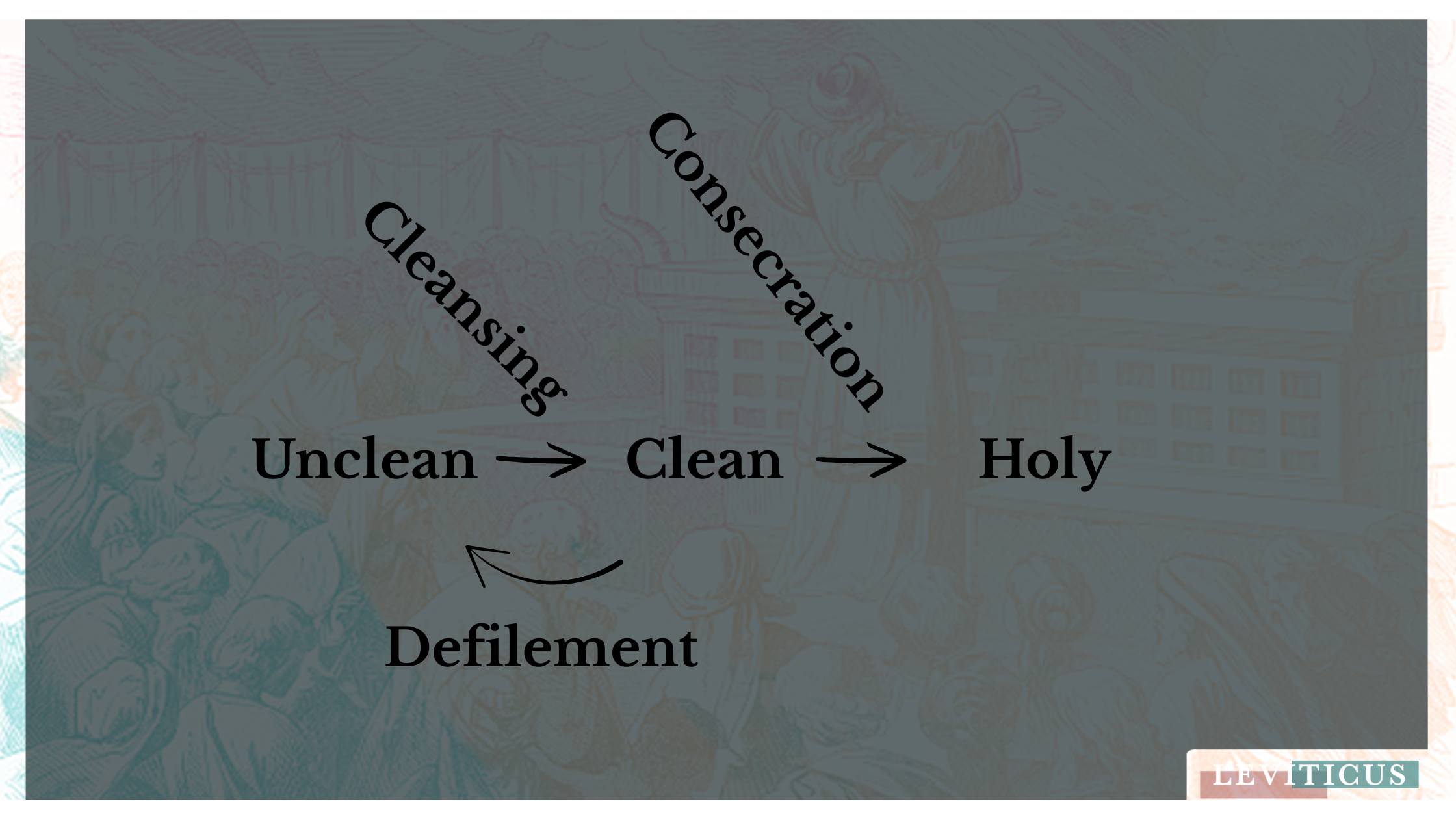
So, for a priest to be consecrated as holy, he first had to be clean. He had to move from the unclean state to the clean state. He could also come into contact with something unclean and become unclean again himself. Of course, all of Israel was holy to God in a general sense as a nation, but the priests were consecrated as holy in a special sense to work in the tabernacle.
But why is uncleanness unfit for God’s presence? The short answer is because it represents the effects of sin in the world. Even though they are not necessarily sinful themselves, unclean and impure things are linked to sin’s effects all around us. For example, in chapter 12, childbirth is absolutely not sinful. After all, God commanded humanity to be fruitful and multiply! Yet the pain of childbearing has been multiplied because of sin, as is therefore a constant reminder of sin.
Again, uncleanness is not sinful in itself, unless it comes into contact with what is holy. Because it reflects the broken reality of sin, it is not fit to enter the presence of the Holy One.
We should also comment on the word defilement. Defilement happens whenever a person becomes ritually unclean. Verses 24-40 talk specifically about contact with animal carcasses, but verse 43 sums it up: You shall not make yourselves detestable with any swarming thing that swarms, and you shall not defile yourselves with them and become unclean through them. Just like cleansing is how you become clean and consecration is how you become holy, defilement is how you become unclean.
Uncleanness, like impurity, is contagious. If you touch something unclean, you become unclean. That’s why a leper had to shout “Unclean! Unclean!” whenever he approached people, to keep them from accidentally coming into contact with him.
Touching an unclean animal was not a sinful action, but by making someone unclean, God was giving His people a real-world picture of how sin works. Sin spreads like leaven in dough. It contaminates everything unless it is cut off and contained.
WHY ARE SOME ANIMALS CLEAN AND OTHERS UNCLEAN?
Now that we have an idea of the biblical meaning of clean and unclean, here is the big question: why are some animals considered clean and others unclean? What is the rationale behind these distinctions?
Gordon Wenham gives four common theories and then adds a fifth that I agree is much better. The four are: arbitrary, cultic, hygienic, and symbolic. And it is worth noting from the beginning that these each have an element of truth to them, which is why people have proposed them.
First is the arbitrary theory, which simply says that we can never know why. God made some animals clean and others unclean. God said it, and that is the way it is. Again, this is somewhat true. God is the arbiter of holiness because He is the Holy One. However, I do not think that is the whole explanation. It seems that we can glimpse God’s rationale in these laws.
The second is the cultic theory, which says that unclean animals were associated with pagan practices, and that’s why they were forbidden. That is quite possibly true in many cases. For example, pigs had a strong connection with the underworld in ancient pagan religions. Even when people point out that Noah already knew the distinction between clean and unclean (remember that he took seven of every clean animal and then made burnt offerings with them to Yahweh after the flood), we could still argue that the unclean animals were used for pagan sacrifices before the flood. So, it is possible, and with some animals, it is clearly true. Yet pagans also sacrificed clean animals, so I do not think that is the whole picture either.
Third, the hygienic theory argues that unclean animals were harmful or at least not beneficial for human consumption. This seems to appeal the most to us today. Again, there may be some truth to the theory, but even if Leviticus 11 describes the healthiest human diet, I still think that health would only be a secondary effect of obedience. Similarly, researchers continue to discover benefits of prayer, fasting, and meditation, but the physical and mental benefits are not the main point. They are a gracious bonus. “Seek first the kingdom of God and his righteousness, and all these things will be added to you.” The same is true here. God is not primarily interested in physical health.
The fourth theory is the symbolic view, which says that clean and unclean animals carry a symbolic meaning. With the unclean animals, this overlaps with the cultic theory. But with the clean animals, Bonar suggests, for example, that sheep were considered clean so that Israel would always remember that God is their shepherd. Again, there is probably truth there, but it does not capture the overall point of what is happening here in Leviticus.
Instead, I agree with Wenham that wholeness is probably the best wholistic explanation. Indeed, Wenham makes the case well, so I’ll let him speak:
The priests, for example, had to be free from physical deformity (21:5-6, 17ff). Mixed crops, mixed clothing, and mixed marriages are incompatible with holiness (18:23; 19:19). The same insistence on wholeness underlies the uncleanness laws in this chapter. The animal world is divided into three spheres: those that fly in the air, those that walk on the land, and those that swim in the seas (cf. Gen. 1:20-30). Each sphere has a particular mode of motion associated with it. Birds have two wings with which to fly, and two feet for walking; fish have fins and scales with which to swim; land animals have hoofs to run with. The clean animals are those that conform to these standard pure types. Those creatures which in some way transgress the boundaries are unclean. Thus fish without fins and scales are unclean (Lev. 11:10; Deut. 14:10). Insects which fly but which have many legs are unclean, whereas locusts which have wings and only two hopping legs are clean (Lev. 11:20-23). Animals with an indeterminate form of motion, i.e., which “swarm,” are unclean (Lev. 11:41-44). “Holiness requires that individuals shall conform to the class to which they belong.” Insofar as some animals do not conform, they are unclean. (169)
I think that is probably the best explanation. The unclean animals are those that do not conform to the class they belong to. There is something incomplete about them; therefore, they are not fit for the people of God. The same is likely at play in the impurity laws. For example, with bodily discharges, a part of you leaves, and for a time you are ritually unwhole. You are incomplete. That is why priests could not serve with physical deformities. Nehemiah may have been an example of this. Though he was not a priest, many people sought refuge in the temple while fearing for their lives. Nehemiah’s enemies tried to get him to do so, but he refused. This was likely because he was a eunuch.
So, this principle of wholeness may also make sense of these animal laws. The unclean animals reflect a disordered world. They are not sinful in themselves, but they symbolize that things are not as they should be.
Even so, Sklar is correct to say:
Whatever the possible rationale(s), the LORD’s purpose in giving these laws is very clear: he wanted to set the Israelites apart as distinct from the nations and to teach them important aspects of covenant living. (323)
Indeed, in verses 44-45, we find exactly why God wanted Israel to uphold these distinctions:
For I am the LORD your God. Consecrate yourselves therefore, and be holy, for I am holy. You shall not defile yourselves with any swarming thing that crawls on the ground. For I am the LORD who brought you up out of the land of Egypt to be your God. You shall therefore be holy, for I am holy.
Twice God says, “You shall be holy, for I am holy.” That’s the reason for these laws. God redeemed Israel from Egypt, made them His people, and now calls them to reflect what He is like. We also see this in Deuteronomy 14:2, just before it also gives laws on clean and unclean animals:
For you are a people holy to the LORD your God, and the LORD has chosen you to be a people for his treasured possession, out of all the peoples who are on the face of the earth.
God is essentially saying, “You are mine. I redeemed you. I saved you. You belong to me. Therefore, you will look like me. You will be holy as I am holy.” Of course, this isn’t possessive or needy on God’s part. This is creation returning to its Creator. To belong to God is the very purpose for which we were made. A coffee mug can be used as a paper weight, but it was made to hold coffee. We were made for communion and fellowship with God. To belong to Him is our true wholeness and peace.
We find this in the New Testament as well. Titus 2:11-14 says:
For the grace of God has appeared, bringing salvation for all people, training us to renounce ungodliness and worldly passions, and to live self-controlled, upright, and godly lives in this present age, waiting for our blessed hope, the appearing of the glory of our great God and Savior Jesus Christ, who gave himself for us to redeem us from all lawlessness and to purify for himself a people for his own possession who are zealous for good works.
Notice the same kind of language. Just as God redeemed Israel from Egypt, Christ has redeemed us from sin. Just as Israel was called to be God’s treasured possession, so now we, the church, are purified to be His people.
But how do we show that we belong to God? Not by food laws anymore, but by our good works, by living distinct and godly lives before the world. We demonstrate that we are His by obeying His word, by walking in holiness, and by shining the light of Christ in the darkness around us.
WHAT DO THESE LAWS MEAN FOR US TODAY?
Now we come to our final question: What do these laws mean for us today in Christ? First, let us be clear that we are no longer under the exact letter of these laws. Christ has fulfilled the law for us. He has not abolished it, so we must still obey them. But we are no longer bound by the exact regulations that we read here.
Paul makes this explicit in Colossians 2:16-17:
Therefore, let no one pass judgment on you in questions of food or drink, or with regard to a festival or a new moon or a Sabbath. These are a shadow of the things to come, but the substance belongs to Christ.
It is not sinful to observe a particular diet or a particular celebration or holiday, but we cannot pass judgment on those who do not. Don’t condemn a person for keeping a practice that you don’t keep, and don’t condemn someone for not keeping a practice that you do keep. These are shadows; Christ is the reality. What matters is belonging to Him, living in holiness, and walking in love toward one another.
In fact, in Romans 14, Paul writes:
Therefore let us not pass judgment on one another any longer, but rather decide never to put a stumbling block or hindrance in the way of a brother. I know and am persuaded in the Lord Jesus that nothing is unclean in itself, but it is unclean for anyone who thinks it unclean. For if your brother is grieved by what you eat, you are no longer walking in love. By what you eat, do not destroy the one for whom Christ died.
Paul is clear. There is no ritual uncleanness in food for Christians. Nothing is unclean in and of itself. Pork, reptiles, and shellfish are all permitted. You are free to eat it. But if your conscience forbids it, then don’t eat. If you think it is unclean, then it is unclean for you.
The same applies to alcohol. Scripture never forbids drinking alcohol, only drunkenness. Drinking is not a sin. Yet, if taking a sip of alcohol goes against one’s conscience, then it is a sin for you. And if it is sin for brother or sister in Christ, there is to be no mocking. We do not belittle the convictions of others. If you are consuming something that you know a brother would find sinful, you are pulling them into greater Christian freedom by encouraging them to partake; you are tempting them to sin against their conscience. Like Paul, we should gladly lay aside our own freedom for the sake of others.
Having stricter convictions does not make a person a greater Christian, nor does having a greater sense of Christian freedom.
Of course, there are still consumption-related sins that still apply to all of us, like drunkenness and gluttony. Of which, Allan Moseley writes:
This is the principle: helping people know and follow Jesus is more important than whether we get to eat what we want, even if what we want is as great as a chocolate donut. People are more important. We do not want to bruise their faith or cause them to stumble. Therefore, we force ourselves to ask hard questions about our eating habits. Do we eat too much? When others see the extra pounds we are carrying, how does that reflect on Jesus and His power in our lives? Could they say, “Does Jesus have the power to deliver His people from gluttony? Evidently not.” How does our over-eating reflect our discipline? Many church leaders are overweight, and some badly so. Shouldn’t spiritual leaders be disciplined in their personal lives? Obesity is an advertisement for lack of discipline in eating. I write such words with great humility, realizing that I fail in my eating habits regularly. Still, thinking of how our eating affects others should cause us to restrain and discipline ourselves for God’s glory. We stop consumption that causes stumbling.
Now, from all of this, we know that we are not under the letter of the law anymore. Christ is the substance. How then can we be holy as God is holy even in something as simple as food? Here are two big principles to remember.
First, true defilement comes from within, not from without. In Mark 7, Jesus tells us that there is nothing outside that defiles a person:
And he called the people to him again and said to them, “Hear me, all of you, and understand: There is nothing outside a person that by going into him can defile him, but the things that come out of a person are what defile him.” And when he had entered the house and left the people, his disciples asked him about the parable. And he said to them, “Then are you also without understanding? Do you not see that whatever goes into a person from outside cannot defile him, since it enters not his heart but his stomach, and is expelled?” (Thus he declared all foods clean.) And he said, “What comes out of a person is what defiles him. For from within, out of the heart of man, come evil thoughts, sexual immorality, theft, murder, adultery, coveting, wickedness, deceit, sensuality, envy, slander, pride, foolishness. All these evil things come from within, and they defile a person.”
The real problem is not what goes into us, but what comes out of us. Whenever we read Leviticus 11, we should see how contagious defilement was in Israel, and then ask: How contagious is my gossip? How contagious is my bitterness? Or greed? Or grumbling? Defilement comes from within, from who we are.
And while that is some of the worse news that we can possibly hear, good news comes alongside it: Christ is able to cleanse us fully. No ritual observance, no diet, no discipline can make us pure before God. The problem of sin is not just what we do, but who we are. We need new hearts. And this is exactly what God has promised in the new covenant—that He will give His people clean hearts and a new Spirit. In Christ, that promise is fulfilled. By His Spirit, we are made new creations.
Second, since we are new creations in Christ, whatever we do, even eating and drinking, must be done for the glory of God. As Paul says in 1 Corinthians 10:31, “So, whether you eat or drink, or whatever you do, do all to the glory of God.” That means we should examine not only what we eat, but why we eat it. Do our eating habits honor God? Do we treat food as an idol, running to it for comfort instead of to Christ? Or do we receive it with thanksgiving, using even our diet to glorify Him?
So now we live as those who belong to Him. We are holy, not because of what we eat, or what we avoid, but because Christ has made us His own. Therefore, let us live as those who have been cleansed, set apart, and called to glorify God with our bodies. Amen.
 B. C. Newton