
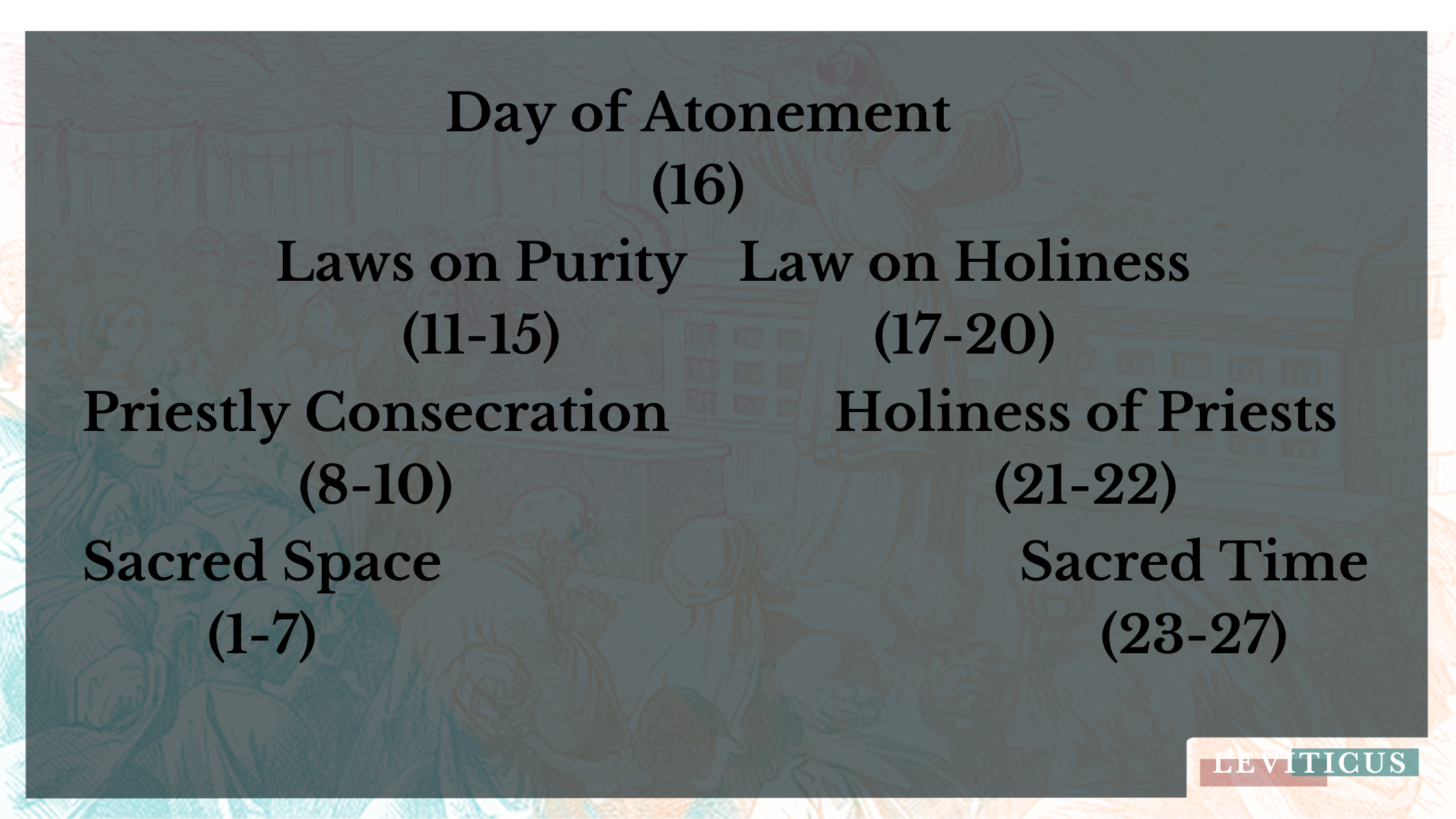
Leviticus 21-22 are now before us, which brings us to a new section in the chiastic structure of Leviticus. Chapters 17-20 gave us laws of holiness following the Day of Atonement in chapter 16. These correspond to the laws of purity in chapters 11-15, which preceded the Day of Atonement. Before the purity laws, we read instructions for how the priests were to conduct offerings. The two chapters before us correspond to that earlier section. They relate specifically to the priests’ life of holiness.
Before we dive into these two chapters, we should first remind ourselves what the role of the priests was under the Levitical system, as well as establish how this text can be applied to us today.
So, what was the role and responsibility of the priest in Israel? The simple answer is that they were mediators between God and man. There were three main offices of leadership in Israel: prophets, priests, and kings. Moses is the chief example of the prophet, the one who speaks God’s word to God’s people. We see this four times in our text: And the LORD said/spoke to Moses, saying… (21:1, 16; 22:1, 17). And Moses is then told to speak to others, as he does to the sons of Aaron here. That is the prophetic role: God speaks to the prophet, and the prophet delivers that message to the people.
In Leviticus, Israel did not yet have a human king. But one day they would have a king to rule over them, to ensure justice, to maintain order in society, and to defend them from their enemies.
The priest, however, was the one who stood between Yahweh and His people. The priest prayed on behalf of the people. Since the ordinary Israelite could not enter the tabernacle, the priest bore Israel on his shoulders with stones that represented the twelve tribes into the tent of meeting. He lived and served in the tabernacle, dressed in holy garments that were of the same design as the holy tent. When Israelites came to worship Yahweh, they did so through the ministry of the priests.
So, when we come to laws like these, we should rightly ask: What do we do with these commands? We do not have priests and are no longer under the Levitical system, so how do we apply this text today?
There are two realms of applications. First, we do not have priests today because all of God’s people are now priests. In Numbers, Moses yearned for the day when God’s Spirit would be poured out on all His people, when everyone would have God’s Spirit dwelling in them and be able to discern His will. That glorious day became a reality in Acts 2. All Christians belong to the royal priesthood, as 1 Peter 2:9 says. Because every Christian is filled with the Holy Spirit, we can all speak directly to God, pray for one another, and exhort and encourage one another according to the Scriptures.
Second, these chapters can also apply to church leaders, to elders and deacons, who are today responsible for serving and leading God’s people.
The main theme of these two chapters is the higher standard of holiness that the priests were called to live out because they ministered in God’s presence. All of Israel was to be holy, but the priests had an even higher calling. There were things that the ordinary Israelite could do that were forbidden to the priests because they served in the tabernacle.
In the New Testament, this finds a parallel in the qualifications for elders and deacons. Passages like Titus 1 and 1 Timothy 3 list qualities for those offices. But of course, in the New Covenant, those are not characteristics that are meant to be exclusive to church leaders; rather, elders and deacons are meant to model what every Christian should strive to become.
We will spend most of our time on the first realm of application, though we will also touch on the second.
Here is the division of our text. Chapter 21 deals with the priest’s holy life. It can be split into two sections: verses 1-15 describe his holy conduct, and verses 16-24 describe the holy body of the priests, how he must be unblemished. Chapter 22 then discusses the priest’s holy discernment, which was one of his primary responsibilities. It also divides into two parts: verses 1-16 are about discerning acceptable worshipers, even within the priesthood, and verses 17-33 are about discerning acceptable offerings. We will then conclude by setting our eyes upon Christ, our great high priest.
THE HOLY LIFE OF THE PRIEST // LEVITICUS 21
And the LORD said to Moses, ‘Speak to the priests, to the sons of Aaron, and say to them: No one shall make himself unclean for the dead among his people, except for his closest relatives, his mother, his father, his son, his daughter, his brother, or his virgin sister who is near to him because she has no husband.
So, the priest who had a loved one die was not allowed to bury any of his relatives except for those closest to him. He could not defile himself from someone that was related to him by marriage or even more distant blood relations. The priest could only become ritually unclean by caring for the dead in these limited cases. Remember, of course, that ritual defilement was only sinful if the unclean person entered God’s presence. A priest needed to be even more careful about such uncleanness because his vocation took place inside the tabernacle.
But even more than that, the priests were called to represent the living God, the God of life, to the people, so their contact with death needed to be limited. They were called to a higher standard of holiness.
They were also forbidden from making bald patches on their heads, shaving their beards, or cutting themselves, which were very likely pagan practices around them. The Egyptians, of course, were known for their elaborate burial rituals. Indeed, death was central to their culture. The Canaanites also gave significant religious meaning to death. But here, God is setting His people apart. In effect, He is saying, “You will not be a people of death but a people of life.”
God’s people were not to defile themselves by how they cared for the dead but by the care that they showed to the living, to their neighbors. They were not to imitate the Egyptians who spent more time preserving dead bodies than caring for living people around them.
God calls His people to be distinct. We certainly honor the dead and show respect to the body, especially since we believe in the resurrection of the body. But we do not orient our lives around death.
For the pagans, death was inevitable and terrifying, so they tried to control or even worship it. But in Christ, we respond to death in an entirely different way. “We do not grieve as those who have no hope.”
That is the present-day application of this command. Every Christian funeral is an opportunity to demonstrate our hope in Christ, to show that our grief is not hopeless despair. The world typically has two responses to death. Some mourn with deep despair, while others respond with apathy, pretending that it does not matter. We reject both. We grieve. We do not pretend that death is not a tragedy and an enemy. But we grieve with hope. Every funeral should be a reminder that we belong to Christ and that we believe that He is the resurrection and the life and that “whoever believes in [Him] shall never die.”
We do not ignore death. We do not celebrate it. And we do not grow numb to it. We face it with hope and with tears, trusting that death’s Conqueror will one day wipe every tear from our eyes.
Now, after addressing funerals, the passage turns to marriage:
They shall not marry a prostitute or a woman who has been defiled, neither shall they marry divorced from her husband, for the priest is holy to his God. You shall sanctify him, for he offers the bread of your God. He shall be holy to you, for I, the LORD, who sanctify you, am holy. And the daughter of any priest, if she profanes herself by whoring, profanes her father; she shall be burned with fire.
A priest could not marry a woman who had given herself to prostitution or whoredom, nor could he marry a divorced woman. The priest was to represent purity and holiness before God. For an ordinary Israelite, marry a divorced woman was permissible but not the priest.
Now, Hosea was a prophet rather than a priest, but this law still helps us to understand how shocking it must have been when God commanded him to marry a prostitute. Of course, God commanded Hosea to do what was forbidden to priests to dramatically picture His own covenant faithfulness—He bound Himself to unfaithful Israel just as Hosea bound himself to Gomer.
Today, of course, we do not live under these same prohibitions, but the New Testament does still give us clear instructions for marriage. We are not to be unequally yoked. That principle goes beyond marriage, but it is clearly lived out in marriage. A believer should marry a fellow believer; otherwise, the union will pull in opposite directions.
Notice also that a priest’s daughter was put to death for whoredom because she profaned her father, who represented God. Because the priest is set apart as holy, such behavior was a defilement against both earthly and heavenly authority.
Verses 10-15 then repeat these commands but with even greater strictness for the high priest:
The priest who is chief among his brothers, on whose head the anointing oil is poured and who has been consecrated to wear the garments, shall not let the hair of his head hang loose nor tear his clothes. He shall not go in to any dead bodies nor make himself unclean, even for his father or for his mother. He shall not go out of the sanctuary, lest he profane the sanctuary of his God, for the consecration of the anointing oil of his God is on him: I am the LORD. And he shall take a wife in her virginity. A widow, or a divorced woman, or a woman who has been defiled, or a prostitute, these he shall not marry. But he shall take as his wife a virgin of his own people, that he may not profane his offspring among his people, for I am the LORD who sanctifies him.
Only the high priest was permitted to enter the Most Holy Place, so it is fitting that his holiness would have the highest standard in Israel. He could not touch any dead body, not even those of his parents. Some commentators speculate that his wife may be the only exception, since she would be considered his own flesh, but the text does not say. His life was to symbolize purity and life, completely set apart from death. And while a regular priest could apparently marry a widow, the high priest could not.
Notice that marriage and death are what is highlighted here. I think this is because marriage and funerals encompass life and death. Even today, those are the two events that bring extended families together. They mark the great transitions of human life: one as the end of earthly life and the other as the beginning, since new life will normally come from that union. God’s priests were to reflect His holiness in both areas of life.
And for us today, as a royal priesthood in Christ, we should also look distinct from the world. Our marriages should display the love between Christ and the church. They should display faithfulness, loving sacrifice, and grace to the world that only knows the opposite.
Then in verses 16-24, we read:
And the LORD spoke to Moses, saying, ‘Speak to Aaron, saying, None of your offspring throughout their generations who has any blemish may approach to offer the bread of his God. For no one who has a blemish shall draw near: a man blind or lame, or who has a mutilated face or a limb too long, or a man who has an injured foot or hand, or a hunchback or a dwarf, or a man with a defect in his sight, or an itching disease or scabs or crushed testicles. No man of the offspring of Aaron the priest who has a blemish shall come near to offer the LORD’s food offerings, since he has a blemish; he shall not come near to offer the bread of his God, both of the most holy and of the holy things, but he shall not go through the veil or approach the altar, because he has a blemish, that he may not profane my sanctuaries; for I am the LORD who sanctifies them.’ So Moses spoke to Aaron and to his sons and to all the people of Israel.
At first glance, this seems harsh. But we need to step back and remember the purpose of these laws. Just like the purity laws in chapters 11-15, these physical defects were not sins. Notice that Yahweh is still called his God. So, they were not moral failures. Rather, they served as visible symbols of purity and perfection. No condemnation is pronounced upon these bodily defects, but they could not come into the presence of the perfect and spotless Holy One.
In fact, they apparently were not classified as unclean because they were still permitted to eat from the offerings, which could only have been done in the courtyard. They were only prohibited from entering the tabernacle itself. Sklar writes:
The fact that these descendants of Aaron could eat from either type of offering indicates not only that they were ritually holy, but that they were welcome in the courtyard, at the table of the heavenly King, and thus counted among his royal servants. (592)
Indeed, Scripture makes it clear that God cares deeply for the those who suffer physical infirmities. In Leviticus 19, we saw God’s command against cursing the deaf or setting a stumbling block for the blind. So, we should not think that God despised the disabled. The point is simply to show that sin and even the brokenness that it leaves behind have no place in God’s presence.
Allen Ross applies this to church leadership today:
Churches today have no ruling corresponding to the physical defects listed here. The church is primarily concerned that ministers meet the spiritual qualifications for leadership taught elsewhere in Scripture, and that they have the proper spiritual gifts expected of those who lead the congregation. Many who aspire to such positions must be put on hold until they meet those requirements, and sad to say, many who are in such positions probably should withdraw until they get their spiritual lives in order.
That is exactly right. In the church today, the concern is not with physical defects in leadership but with spiritual character. Elders and deacons must be men who are above reproach, faithful to their wives, self-controlled, hospitable, etc. The focus is not upon outward wholeness but upon inward holiness.
THE DISCERNMENT OF THE PRIESTS // LEVITICUS 22
While we could certainly say more about the pure and set part lifestyle of the priests, we must move on to chapter 22, which deals with their call for discernment, knowing what pleases God. Verses 1-16 speak the priests need to guard the holy things from contamination. The priests themselves had to be clean. No one with a disease or who had touched something unclean could enter the tabernacle. Holiness began among the priests themselves.
Verses 17-33 concern acceptable offerings. God commanded that the sacrifices brought before Him be without blemish, not blind, lame, or sick. The priests were to maintain that high standard for Yahweh’s offerings. And this was no hypothetical set of commands. During the time of Malachi, the priests were flagrantly violating these commands, saying:
You bring what has been taken by violence or is lame or sick, and this you bring as your offering! Shall I accept that from your hand? says the LORD. Cursed be the cheat who has a male in his flock, and vows it, and yet sacrifices to the Lord what is blemished. For I am a great King, says the LORD of hosts, and my name will be feared among the nations.
That is the heart of this chapter: discernment is ultimately about giving God the best we have. Worship means offering to God the best of our obedience and of ourselves. For the Levitical priests, that meant ensuring only clean people and unblemished offerings entered God’s presence.
This was one of the priests’ primary duties. After the death of Nadab and Abihu, God spoke directly to Aaron, saying:
Drink no wine or strong drink, you or your sons with you, when you go into the tent of meeting, lest you die. It shall be a statute forever throughout your generations. You are to distinguish between the holy and the common, between the unclean and the clean, and you are to teach the people of Israel all the statutes that the LORD has spoken to them by Moses. (Leviticus 10:8-11)
The priests did not simply help the Israelites offer their sacrifices; they also taught the people how to discern and distinguish between the holy and common, between the clean and the unclean. And that is still one of the chief tasks of every believer today.
One of the key differences between life under the Old Covenant and under the New Covenant is that God’s people did not have the Holy Spirit dwelling within them. God lived among His people but not within them. They depended upon the priests to guide them and serve as the spiritual authority over them.
Today, however, every Christian has the Holy Spirit dwelling within, which is why Paul commands every Christian to practice discernment in Romans 12:2: “Do not be conformed to this world, but be transformed by the renewal of your mind, that by testing you may discern what is the will of God, what is good and acceptable and perfect.” We learn God’s will through testing, through discernment, through seeking to obey His Word in everyday circumstances of life.
This is what I meant last week when I said that life under the New Covenant is not as black and white as it was under the Old. The Ten Commandments certainly still remain, but many the many civil and ceremonial laws that God gave to Israel have been replaced by broader, heart-level commands.
Old Testament commands were very concrete. Don’t trip a blind man. If you leave a pit uncovered and an ox falls in, you are responsible. Don’t boil a young goat in its mother’s milk. But in the New Testament, commands take the form of broader principles. Listen to just a few from Romans 12:
Let love be genuine. Abhor what is evil; hold fast to what is good. Love one another with brotherly affection. Outdo one another in showing honor. Do not be slothful in zeal; be fervent in spirit; serve the Lord. Rejoice in hope; be patient in tribulation; be constant in prayer. Contribute to the needs of the saints and seek to show hospitality.
Those are all commands that are real and binding upon us, but notice how they require wisdom. What does it look like for love to be genuine? How do we practically outdo one another in showing honor? How do we know which of the saints we should contribute toward, and how much?
Those questions require discernment to answer. What obedience looks like will vary from person to person and from situation to situation.
In that sense, life under the New Covenant operates under the same wisdom that we see throughout the wisdom literature of the Old Testament. Here is an example of two proverbs that are back-to-back:
Answer a fool according to this folly, lest he be wise in his own eyes. Do not answer a fool according to his folly, lest you be like him yourself. (Proverbs 26:4-5)
Which one do you follow? Whichever a particular situation requires.
That is the essence of wisdom: knowing which principle to properly apply to any given circumstance. Sometimes it is best to correct a fool, to confront foolishness head-on. Other times, it is far wiser to remain silent because the person will not receive wisdom.
That wisdom comes through discernment, through testing, through walking with the Spirit in submission to God’s Word to do what is good, acceptable, and perfect.
I also think that this is what Hebrews 5:12-14 refers to when it says:
By this time you ought to be teachers, but you need someone to teach you again the basic principles of the oracles of God. You need milk, not solid food. For everyone who lives on milk is unskilled in the word of righteousness, since he is a child. But solid food is for the mature, for those who have their powers of discernment trained by constant practice to distinguish good from evil.
The Christian life requires constant discernment between good and evil. For example, is it a sin to drink alcohol? Maybe. It depends. If you conscience is against it, then it is sin for you. If you conscience permits it, there may still be some circumstances where it would still be wrong. We must keep rooted int he basic principles of God’s Word and train our discernment.
This applies to countless areas of life. Take our use of technology. There are guiding principles from Scripture, but how they apply varies from person to person. We each have different consciences, personalities, and weaknesses. What one person can use without conviction may prove to be a temptation for another.
In the Old Testament, discernment was the duty of the priests. In the New Testament, it is the calling of every believer. As a pastor, I am called to teach God’s Word so that we all can grow in discernment. I can also offer counsel and guidance from the Scriptures. But the ultimate responsibility lies with each of us.
Again, there certainly are black-and-white sins, like adultery, that are plainly sinful, but much of the Christian life requires saturation in God’s Word and sensitivity to the Holy Spirit.
CHRIST, OUR HIGH PRIEST
Now that we have taken a brisk look at these two chapters, let us now consider how they point us to Christ. The book of Hebrews speaks most clearly about the priesthood of Jesus. One of the beautiful things that we see about Christ is that He alone was truly without blemish. He had no moral defect nor spiritual imperfection. Even though Isaiah says that He had no beauty that we should desire Him, He had no physical blemish either. He was the perfect high priest for us. Even in His death, as He hung upon the cross, not one of His bones was broken. Even in death, He fulfilled the law perfectly.
In the Old Testament, the high priest was the mediator between God and man. He was able to sympathize with those he served, but the problem was that he sympathized too much with them, for he was just as sinful as they were. He had to offer sacrifices for his own sins before he could offer the sacrifices of other people. They were sinners standing between sinners and a holy God.
But Christ is different. The beauty and necessity of His hypostatic union, His full humanity and divinity, is that He alone can perfectly mediate between God and man. As God, He fully represents God to us. As man, He fully represents us to God. That is the wonder of the incarnation.
That is why Hebrews 4 says:
Since then we have a great high priest who has passed through the heavens, Jesus the Son of God, let us hold fast our confession. For we do not have a high priest who is unable to sympathize with our weaknesses, but one who in every respect has been tempted as we are, yet without sin.
Christ faced every temptation we face. He walked among us, lived as one of us, and endured every test, yet remained without sin.
We cannot even begin to understand what Christ endured. We are so immersed in sin that we often do not even recognize it. Like fish swimming in water, sin surrounds us constantly. But Christ, the only truly pure and unblemished one, entered our world of corruption. Imagine how glaring even the smallest of sins must have been to Him. A plumber who works in sewage all day will not think much about a little mud. But a bride dressed in her wedding gown on her wedding day will notice every speck of dirt around her.
Yet Christ’s purity triumphed over the grime of our sin. He succeeded where every priest before Him failed. He fulfilled every command. We, therefore, no longer come to earthly priests. We come to Jesus, who has made the final offering for our sins.
And the beauty of the gospel is that Christ imputes His cleanness onto us. When we read these commands in Leviticus, we realize that none of us are pure and unblemished enough to come near God. God is holy, and we are not.
Thus, as we come to the Lord’s Table, representing the body and blood of Christ, we can ask ourselves: Have we been holy enough to this week to come? Have we been unblemished enough to be worthy of eating at God’s table?
The answer is no. None of us are. We have deeper defects than blindness or lameness. Our very hearts are corrupt. We have been commanded to bring ourselves as offerings, yet our offerings are deeply blemished!
Here is the good news: our worthiness to come to God and to come to His Table does not rest on us. It rests on Christ. Though we are unworthy, Christ has forgiven us and clothed us in His righteousness. If you trust in Christ, you are wrapped in His purity.
Yes, we still wrestle against sin. But our right to come into God’s presence does not depend on our own moral perfection. It depends entirely upon Jesus.
The Father mercifully does not look at our own filthy rags of so-called righteousness; He looks upon the perfect righteousness of His Son. So, as we come to the Lord’s Supper this morning, let us hear the final words of Hebrews 4: “Let us then with confidence draw near to the throne of grace, that we may receive mercy and find grace to help in time of need.” This Table is for those who need mercy and grace. The only worthy way to come is to recognize that we are unworthy and to come as beggars in need of God’s grace. If you need mercy, if you need grace, the table is open. Let us draw near to His throne together. Let us receive His mercy together. Let us find the amazing grace of Jesus together.
 B. C. Newton