
When we think of the Reformation, justification by faith alone or the authority of Scripture alone are typically the first theological thoughts. And those were truly central to the movement. But one of the key Reformers, John Calvin, wrote a short treatise called The Necessity of Reforming the Church, where he makes a striking comment about what was the most important matter of the church during the Reformation. He wrote:
The Christian religion has a standing existence among us in a knowledge, first, of the mode in which God is duly worshiped, and secondly, of the source from which salvation is obtained.
For Calvin, the first and more important matter in the church was not the doctrine of salvation, as important as that is. The first issue is the mode of duly or rightly worshiping God. The Reformation was necessary not only because of the battle for justification by faith alone nor only because Scripture must triumph over the traditions of the church. The primary issue, according to Calvin, was that God was not being worshiped as He commanded. The church had deviated from Scripture, and God is worthy of being worshiped according to His Word. Thus, Calvin insisted that the primary reason for the Reformation was the restoration of true, biblical worship.
I begin there because throughout our study of Leviticus the same theme has been running quietly underneath each text. Whenever I first began reading Michael Morales’ book Who Shall Ascend the Mountain of the Lord?, I noticed that he consistently used a more technical word to describe Israel’s worship: cultus.
Because we do not use that word often, we tend to associate it with the negative word: cult. But cultus simply refers to a formalized system of worship. Leviticus, therefore, describes Israel’s cultus, their formal worship of Yahweh as their God. Of course, Leviticus is not exhaustive. The Psalms, for example, provide songs and prayers for God’s people to use in worship. Even so, Leviticus is the official handbook for Israel’s worship.
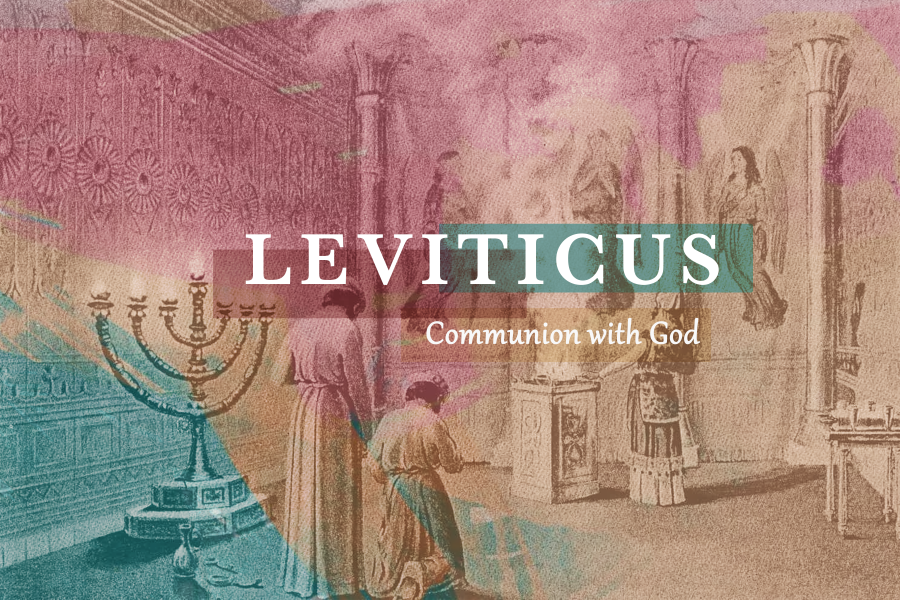
As we noted many times, that is why Leviticus is placed at the center of the Pentateuch. Genesis and Exodus built up to it, while Numbers and Deuteronomy flow from it. In Genesis 1-11, we find humanity exiled from God’s presence in the mountain garden of Eden, and they continue to spiral further down and further out. Then, when the tabernacle was constructed in Exodus, God provided a way for His people to return from exile. Adam and Eve were exiled east, and the tabernacle faced east, meaning that worshiping Israelites were walking from east to west as they entered the courtyard.
Indeed, the tabernacle was filled with garden imagery because it was intended to be “Eden remixed”, as G. K. Beale puts so well. It was also a portable Mount Sinai, where God came down to meet with His people. The tabernacle represented God restoring communion with His exiled people.
Thus, Leviticus stands as the cultural and spiritual heart of ancient Israel. It describes how they were to live as a kingdom of priests, a people meant to reflect God’s holiness to the nations around them.
All of this has brought three English words to my mind. They all share the same Latin root, colere, which means to cause something to grow. These words are cultus, cultivate, and culture. I believe that we can connect those words to make the central argument of this sermon: cultus cultivates culture. In other words, how a people worship shapes what they become. Worship is the root, while culture is the fruit.
This is why A. W. Tozer correctly said that “What comes into our minds when we think about God is the most important thing about us.” Now that statement is true in more ways than we have time to unpack, but one of the most important is this: we cannot rise higher than our thoughts of God. That is true for both individuals and for whole societies. A society cannot rise higher than its conception of God.
Part of the reason we see such cultural confusion and decay today is because our society has rejected God as the eternal Creator and has instead embraced the idea that we are cosmic accidents. Of course, that does not stop us from treating ourselves as gods. But if we are accidental, self-made gods, how can our conception of humanity ever rise higher than that? Humanity cannot ascend higher than the god we worship.
All of this brings me to what I hope to explore this morning, a theme that has been quietly shaping our whole study of Leviticus, though we have not addressed it directly nor at length. How does worship shape us? How does worship shape our loves? How does cultus cultivate culture?
To explore this, we will look at two psalms: Psalm 15 and Psalm 115. These two psalms give us a beautiful and sobering picture of what worship does to the soul. In Psalm 15, we see what the worshiper becomes when the living God is the object of worship. In Psalm 115, we see what the worshiper becomes when he worships lifeless idols. So, here is the question before us today: What does worship produce? True worship produces a true people for the Lord. False worship produces a false people.
THE CHARACTER OF THOSE WHO DWELL WITH GOD // PSALM 15
The psalm opens with a single question expressed through Hebrew parallelism. Who shall sojourn in your tent? and Who shall dwell on your holy hill? are two ways of asking the same question: Who may enter God’s presence? Who may come near to Him in His sanctuary?
The tent is the tabernacle, and every Israelite who went to the tabernacle to worship was a sojourner there. They entered as guests, not permanent residents. Indeed, Psalm 84 speaks about longing to stay in God’s presence, envying even the birds who are allowed to make their nests there. He cries out that “a day in your courts is better than a thousand elsewhere.” Likewise, Psalm 100 urges God’s people to enter God’s gates with thanksgiving and His courts with praise.
That gate was to the courtyard that surrounded the tabernacle. And remember what worship in the courtyard looked like in Leviticus. A person could only enter the courtyard by bringing an offering. Israelites walked through the gate and into the courtyard leading a bull or goat or carrying pigeons that they would soon slaughter and burn on the altar. Yet for the faithful, there was no better place to be because it was the dwelling place of God.
Psalm 15, therefore, asks who is allowed to enter? Leviticus gave us an answer: only those who are ritually clean. But Psalm 15 gives us a doxological commentary on that idea. It reveals the deeper truth that the laws of Leviticus were intended to cultivate: ritual cleanness pointed toward moral and spiritual holiness.
Indeed, I say that Psalm 15 is a doxological commentary on Leviticus because David clearly has the laws of that book in mind as he writes this psalm, and it shows that he understood that the commands were ultimately about shaping a people who imitate their holy God. “You shall be holy, for I am holy.”
Each of the qualities listed in verses 2-4 correspond to specific laws in Leviticus.
He who walks blamelessly… The word from blamelessly (tamim) is the same word used for the offerings, which were to be without blemish. The offering was supposed to reflect the moral character of the worshiper. Yahweh is pure, so His people too must be pure.
…and speaks truth in his heart. Leviticus 19:11 commands, “You shall not lie to one another.” Notice that David presses the command even deeper. Truthfulness should not simply be external but internal. God’s people should be honest even in their own thoughts. Yahweh is true, so His people too must speak the truth.
who does not slander… does no evil to his neighbor… nor takes up a reproach against his friend. Leviticus 19:16 forbids slander, and verses 17-18 call Israel to love their neighbors, refuse revenge, and reject holding grudges. Yahweh loves others, so His people must love one another as well.
In whose eyes a vile person is despised, but who honors those who fear the LORD. This is the same kind of discernment that we have seen in Leviticus between the holy and the unholy, the clean and the unclean, the pure and impure. Yet, again, David goes to the heart of the matter and applies the principle to discerning those who fear Yahweh and those who do not. Yahweh is discerning, so they too must be discerning.
Who swears to his own hurt and does not change… Leviticus 27 taught in importance of keeping vows and being honest. Even when costly, vows matter to God, and they were to be kept. Yahweh is faithful, so they too must be faithful.
Who does not put out his money at interest and does not take a bribe against the innocent. Leviticus 25:35-37 forbids charging interest to fellow Israelites. Leviticus 19:15 forbids unjust judgments, like bribes. The worshiper who draws near to the God of justice must also practice justice. Yahweh is just, so they too must be just.
Taken together, Psalm 15 is a picture of what a worshiper of Yahweh must look like as well as what worship of Yahweh produces, a life marked by holiness, truth, purity, faithfulness, and justice. These qualities mirror God’s own character because the law reflects the Lawgiver. And the laws are meant to shape us into looking more like the Lawgiver. Or as God said in Leviticus, “You shall be holy, for I am holy.”
A desire to sojourn in God’s tent, to worship in the tabernacle, would create a desire in God’s people to look more like Him. To be holy as He is holy, truthful as He is true, just as He is just, faithful as He is faithful. They would become like the God they beheld.
THOSE WHO MAKE THEM BECOME LIKE THEM // PSALM 115:4-8
But what about the opposite? What about those do not worship the true and living God but worship idols? Psalm 115 gives us the answer. Verses 4-8 say:
Their idols are silver and gold,
the work of human hands.
They have mouths, but do not speak;
eyes, but do not see.
They have ears, but do not hear;
noses, but do not smell.
They have hands, but do not feel;
feet, but do not walk;
and they do not make a sound in their throat.
Those who make them become like them;
so do all who trust in them.
Psalm 115 critiques idolatry not only because it is false but because it deforms the worshiper. Again, cultus cultivates culture. You become like what you worship.
Idols are lifeless and powerless. They have eyes but cannot see, ears that cannot hear. Isaiah 44 mocks the absurdity of idolatry. There a man is described who chops down a tree, uses half of it for a fire to bake bread and keep himself warm. He then takes the other half, carves it into a statue, and bows down before it, saying, “You are my god!”
Most of us today do not have physical idols, but as John Calvin rightly said, “The human heart is a perpetual factory of idols.” We can make anything into an idol, money, cars, food, comfort, screens. We are not any less idolatrous than the ancients. Our idolatry has only become more subtle, respectable, and harder to identify.
Verse 8 is the key: Those who make them become like them. Here is where we see our main principle that cultus cultivates culture. How and what you worship forms the kind of person you become. If worshiping the true and living God produces people who are alive and true, worshiping blind, deaf, dumb idols produce people who are increasingly blind, deaf, dumb, and ultimately hard hearted.
We see this societally. Especially after the sexual revolution, think of how many things that many Christians now tolerate or even endorse that nearly everyone, including non-Christians, would have condemned even a century ago. Yes, earlier generations had grave sins of their own. But they hadn’t yet become numb to the dissolution of marriage, the normalization of sexual immorality, or the affirming of lifestyles Scripture clearly forbids. Not mention the kind of entertainment that many Christians consume.
Idolatry, of course, also produces individual desensitization. We can see it rather clearly in more blatant and “harder” sins like drugs and pornography. However, “smaller” sins still leave us numb and heading toward death, but the drift is far less noticeable. That is Lewis gives us this warning from the mouth of Screwtape:
Murder is not better than cards if cards can do the trick. Indeed the safest road to Hell is the gradual one–the gentle slope, soft underfoot, without sudden turnings, without milestones, without signposts.
THE PSALM 15 MAN
Psalm 15 and Psalm 115 provide us with the same kind decision that we saw in Leviticus 26. Psalm 15 shows that worship of the true God forms life, character, virtue, and fortitude, while Psalm 115 warns that false worship forms death, corruption, and numbness. Worship determines the direction of one’s life.
Of course, whenever we look at Psalm 15, it is easy to become discouraged, thinking: “I’m not this. Can I not dwell with God?” The truth is that only Jesus is the true Psalm 15 man. He is the only person who fits this description perfectly. Even David himself did not meet this standard. Only Jesus walked blamelessly, spoke truthfully, never slandered, kept covenant, opposed wickedness, honored those who fear the Lord, and judged with perfect righteousness. And He continues to do so as our ever-living King.
Yet notice this, although Jesus has the inherent right to sojourn in God’s tent and dwell on His holy hill, He lived His entire earthly life outside the physical place of God’s presence. As a son of Judah, rather than Levi, He was not permitted to enter the temple. And at His death, He was taken outside the camp altogether, outside the gates of Jerusalem, and executed at Golgotha.
Why was He rejected outside the tent? Because He was the true tabernacle, God with us, who came to make it possible for us to dwell with God, even becoming His temple.
Through union with Christ, Psalm 15 is transformed from a standard we fail to meet; it is now a gift that Christ has placed upon us. Psalm 15 describes the righteousness required for communion with God, a righteousness we can never achieve. Yet Christ did so in our place.
Salvation is an act of double imputation. First, our sin is imputed onto Christ, bearing it in His death. But He also imputes His righteousness onto us. His character is imparted to us by the Spirit. That is why Paul says that if we live by the Spirit, we must also walk by the Spirit, and we know that we are walking in the Spirit whenever His fruit is seen in our lives: love, joy, peace, patience, kindness, goodness, faithfulness, meekness, and self-control.
Now, we do not embody these perfectly in this life. We never walk in perfect patience, perfect love, perfect meekness, etc. But the righteousness of Christ is given to us in justification, and in sanctification the Spirit is continually forming us into the image of Christ. He is shaping us into Psalm 15 men and women. We do not yet meet that standard, but one day we will.
Of course, the Father already sees us as clothed in the righteousness of Christ. In His sight, we are holy, truthful, pure, faithful, and just because He sees Christ’s righteousness upon us. When Christ returns and we receive glorified bodies, what is true of us in justification will also become fully true in our resurrected and eternal life. The inner war between Psalm 15 and Psalm 115 will be won, fully and finally. For eternity, we will embody the qualities of Psalm 15 perfectly.
HOW THEN SHALL WE LIVE?
But for now, we still have both paths before us. Will we worship God rightly, or give our worship to idols? The worship war continues within each of us. Let us end then by considering how our worship shapes us today.
Worship is not merely a habit; it shapes and transforms. Daily and weekly rhythms of worship are forming us. Neglecting them also forms us, only for the worse rather than the better.
Where should we begin? If you do not have a regular pattern of Scripture intake, start there. And start today. Morning, evening, during lunch, or whatever time works for you, read the Bible. Fill your life with God’s Word.
The same is also true of corporate worship. Our weekly gathering is shaping our souls, week by week. Indeed, I purposely weave certain repetitions into our worship because repetition is formative.
I pray the same prayer of illumination, which is a string of Bible verses about Scripture, because I want those words to become second nature to us. I want our first response to opening the Bible to be: “Give me ear to hear and eyes to see. May Your holy Word be more desirable to us than gold, even much fine gold and sweeter on our tongues than honey and the drippings of the honeycomb.”
I choose songs based on their singability as well as their words. I want us to sing songs on Sunday that can also be sung at Community Group or while doing the dishes.
I end the prayer after the Lord’s Supper with the same prayer that concludes the Bible: “Come, Lord Jesus. Come quickly.” This sets our eyes, at least once every service, on our blessed hope. The Lord’s Supper is where we proclaim Christ’s death “until he comes” (1 Corinthians 11:26), which should be forming us into a people who are eager and ready for His return.
Focus on those habits: daily Scripture and prayer, weekly gathering. Then add fasting, memorization, and meditation. These patterns of worship will increasingly shape a people who reflect God’s character.
But we must also forsake idols. What we consume shapes us. While there may be some truth to the statement that you are what you eat, there is definitely truth in saying that you are what you listen to, watch, or read. Much of what we consume may not be overtly sinful, yet if the bulk of it is secular and worldly, then our affections will be shaped accordingly.
Even constant news intake can be deforming. We have more information in a month than the ancients would have experienced in their whole lifetime. The internet gives us a kind of digital omniscience that we were never meant to carry, and it too can deform us. C. S. Lewis had an almost prophetic understanding of where our society was heading, and he purposely never read the newspaper nor kept up with current events. He read history and good books of the past. He nourished his imagination with truth and wisdom, which enabled him to see reality more clearly than most people. So, consider replacing much of your news consumption with Scripture, sermons, good books, and learning history.
But most importantly, pray. Pray as a member of the one, holy, catholic Church, the global family of believers. You do not need to know every detail of every crisis in the world. God knows. You will do far more good by spending time in prayer.
Indeed, everything that we take in is forming us. Ask yourself then: Is what I am consuming glorifying God? Does it direct my heart upward, or does it simply distract? We are always worshiping in some fashion. We can do no less. When you browse Instagram, you are worshiping. When you are on YouTube, you are worshiping. When you are surrounded by friends, family, or coworkers, you are worshiping. The question is: whom are you worshiping?
We often hear about the culture wars and the need to stand for the truth. But this is, I believe, the best means of battling for the direction of our culture. Again, hear the final verse of Psalm 15: He who does these things shall never be moved.
Let us focus the best of our efforts and attention on worshiping God, on presenting our bodies as living sacrifices to Him, on being people who worship in spirit and in truth. And let us be like John Bunyan, of whom Spurgeon said that if you cut him, his blood would be ‘bibline’, that is, full of the Bible.
Those people, who delight in God’s law and meditate on it day and night, will be like trees planted by streams of water, yielding fruit in season, with unwithering leaves. In all that they do, they prosper. Or again, the one who does these things shall never be moved.
Worship of the Almighty forms a people who are immovable in collapsing times. And here is the not-so-secret secret of history: the times are always collapsing. The apocalypse is always here. These are the last days, and they have been for two thousand years. There is always a crisis, and it always reveals who truly trusts in the Lord and who does not. The church and each of its members becomes what it worships. Cultus cultivates culture.
From this angle, I hope that we can now appreciate the graciousness of God in Leviticus. All of God’s detailed commands are not only because He is holy and sovereign. They are also for our good. They were meant to shape Israel into a people who reflected their God in holiness, truth, justice, and purity.
Psalm 15 summons us up God’s holy hill, while Psalm 115 warns us to turn away from worthless idols. Leviticus did both as well.
So, as we come to the Table, let us come to ascend the mountain of the Lord. In this bread and cup, let us behold the perfect righteousness and perfect obedience of our Savior. And this act of cultus (of worship), may the Spirit cultivate us into Christ’s likeness. May we behold His broken body and shed blood, looking upon the Son of Man who came not to be served but to serve, and to give his life as a ransom for many. And as we look upon Him by faith, may we be conformed more and more into His image.
May we here taste and see the goodness of our God, now by faith, but one day by sight. On that day, when we see our Savior face to face, we will be fully known and will know as we have been known. We will no longer be moving further down and further out, but for all eternity we will hear the call of our Lord to come further up and further in. Ever deeper into communion and fellowship with our God, knowing ever more of the pleasures at His right hand forevermore.
 B. C. Newton