
After addressing baptism over the past two questions, we now come to the second ordinance: the Lord’s Supper. The catechism’s answer begins by grounding the Supper in Christ’s command, which again is what makes it an ordinance. Just as baptism is commanded by Christ in the Great Commission, so the Lord’s Supper was instituted at the last supper.
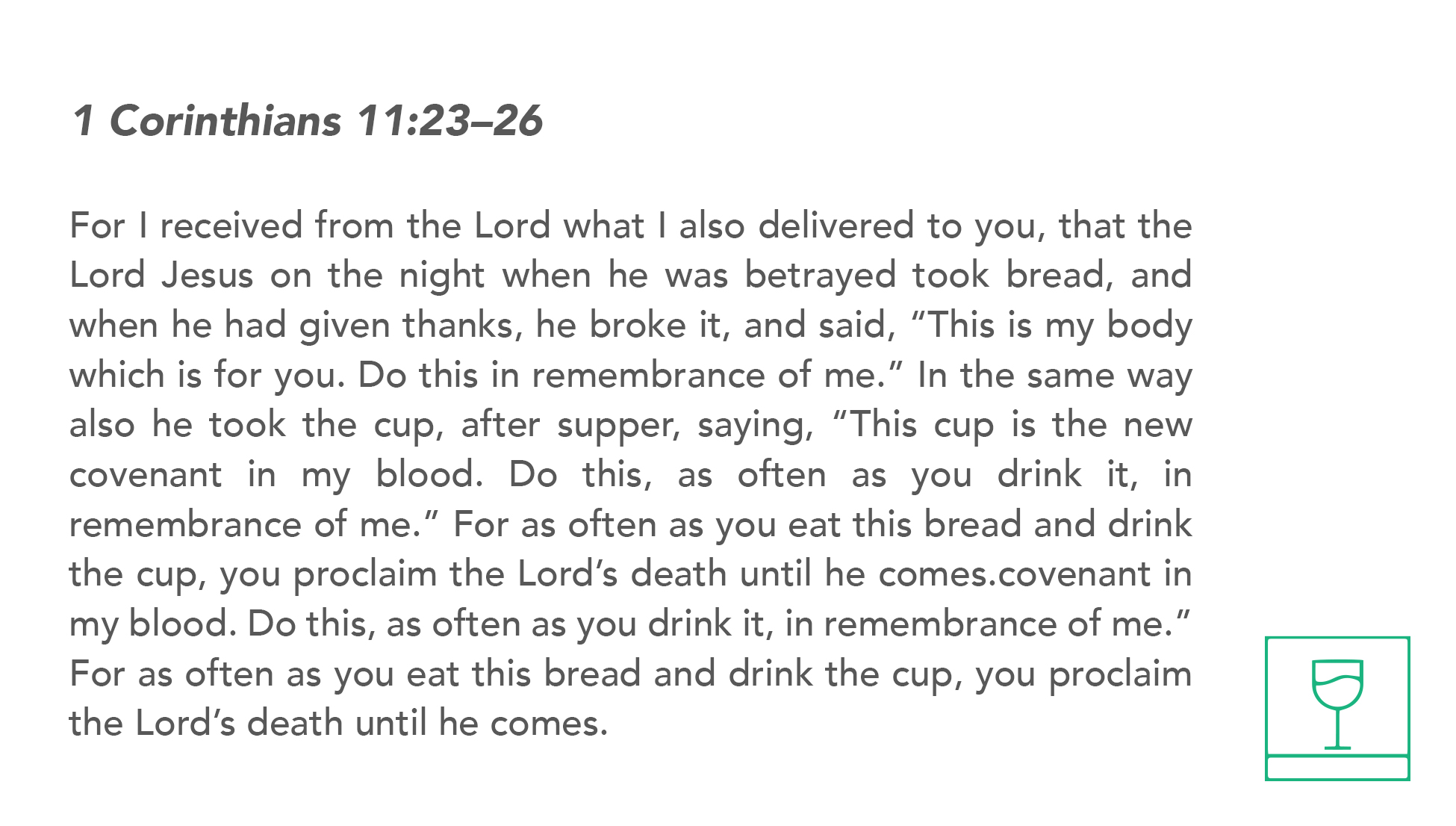
All Christians are commanded to eat the bread and drink the cup in thankful remembrance. 1 Corinthians 1:26 tells this explicitly: “For as often as you eat this bread and drink the cup, you proclaim the Lord’s death until he comes.” The Supper is a remembrance of Christ Himself but also specifically of his atoning death on the cross.
The second sentence explains that the Lord’s Supper is also a celebration of the presence of God in our midst. Thus, it is not merely a remembrance of what Christ accomplished in the past; it is also a sign of our present and active communion with God in Christ.
In Scripture, a meal is often used to seal a covenant and testify of the communion established. In Exodus 24, after the LORD establishes His covenant with Israel, Moses, Aaron, and the elders of Israel are invited to ascend Sinai to eat and drink with God. Of course, in the Gospels, Jesus is often criticized by the Pharisees for eating with sinners precisely because table fellowship signified communion. Thus, when Christ extends the bread and the cup to us, He affirms that we are in covenant with Him.
But notice that the Supper brings us into communion with God and with one another. The bread and the cup picture both the vertical and horizontal reconciliation that the gospel accomplishes. The cup, representing the blood of Christ, testifies to our reconciliation with God, for it is only through the blood of Christ that we are able to draw near to God. The bread, which represents the body of Christ, reminds us that His body was broken in order to make us into his body on earth. We are members of one body in Him.
The Lord’s Supper also feeds and nourishes our souls. While we call it a supper or meal, physically speaking, it is very small, only a bite of bread and a sip of the cup. Hardly a meal in the ordinary sense. But there is something fitting in the smallness. Though it only offers a taste, that is largely what we receive in this life: foretastes of what is still to come. We do receive real blessings from Christ now, but the fullness of our blessings are still to come. The Lord’s Supper does not nourish our bodies in any significant way, but it does nourish our souls by faith.
Indeed, the Lord’s Supper anticipates the day when we will eat and drink with Christ in his Father’s kingdom. Again, this comes straight from Paul, for we proclaim the Lord’s death “until he comes.” The Lord’s Supper is a perpetual reminder that Christ will come again to judge the living and dead, to make all things new, and to give us resurrected bodies like His own. On that day, we will no longer receive only a bite of bread and a sip of the cup; instead, we will gather with Christ our King and feast with Him at the wedding supper of the Lamb.
So, every time we come to the Lord’s Table, we are looking in multiple directions at once: back to Christ’s death, up to our reconciliation with God, across to our reconciliation with one another, and forward to the day when sin will be defeated forever and we will dwell with God in everlasting joy.
 B. C. Newton