
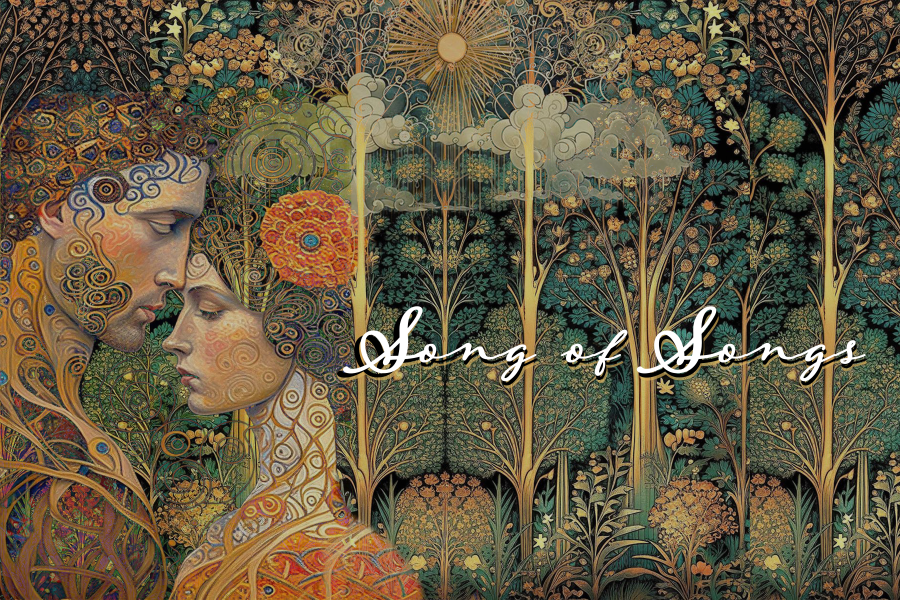
The Song of Songs, which is Solomon’s.
Song of Songs 1:1
Song of Songs has a complicated place in church history.
On one hand, God’s people have treasured it as though it were a first among equals. Jewish Rabbi Akiva is famous for saying that all the ages are not worth the day that God gave the Song of Songs to Israel. He says that all Scripture is holy, but the Song of Songs is the holy of holies. Spurgeon shared that view, calling it a “matchless song’ and saying, “It stands in the middle of the Bible. It is the holy of holies–the central point of all.” Hudson Taylor said that there is no song like this one and that there is a grace that only it can teach. Bernard of Clairvaux preached 86 sermons on just the first two chapters. Richard Sibbes taught 20 sermons largely on chapter 5.
And yet, there was also a tradition among certain Jewish sects to discourage men from reading this book until they were 30 years old. Today, many pastors avoid it, meaning that many Christians have never heard a sermon from the Song. Some today and throughout history have wondered whether it even belongs in the Bible at all.
So which is it? Essential or embarrassing? A profound treasure or just plain trouble?
And beyond the perception of God’s people, we have the matter of interpretation. R. A. Redford writes that “there is no book of Scripture on which more commentaries have been written and more diversities of opinion expressed than this short poem of eight chapters.” Indeed, O’Donnell notes that:
There were over one hundred Latin commentaries written on the Song from the second through the sixteenth centuries. Compare that number to six commentaries on Galatians, nine on Romans, thirteen on Mark, and sixteen on John! (97)
Yet for all of those diversities, there are three broad ways of understanding the Song. The first is as allegory, which has been the primary view for most of church history. This view spiritualizes every image into spiritual lessons. The second is plainly literal. The Song is ancient love poetry, written to celebrate God’s design for marriage and intimacy.
The third approach is typological. Literally and literarily, the Song is about love, marriage, and very physical desires. But typologically, it points beyond itself to Christ and His bride, the church.
To help us navigate this short but difficult book, we will consider six rules for reading the Bible’s greatest song. I call them rules in the biblical sense of being guidelines to keep us from wandering into misreadings of the text. These are biblical principles that are not presented to be superimposed on the text; rather, they are drawn from Scripture itself to help us rightly read God’s Word. While this sermon is explicitly focused on the Song of Songs, I pray that it will serve as a model for how to approach any text of Scripture rightly. The six rules are:
1. Read within the canon.
2. Don’t neglect the original audience.
3. Don’t break the poetry.
4. Don’t call what God has made unclean.
5. Don’t rip the veil.
6. Behold Christ.
RULE 1: READ IT WITHIN THE CANON
Even though the Song is clearly love poetry (even an erotic poem), it is not a marriage manual, nor is it a guide to marital intimacy. It is most certainly not a secular love poem that just so happened to slide into the canon of Scripture.
The Song of Songs is Scripture and, therefore, God-breathed. And like every book of the Bible, the Song must be understood in relation to the rest of Scripture. We will address how the Song relates to the whole Bible whenever we consider how it displays Christ to us. For now, let us consider it’s immediate context within the canon.
In our Bibles, the Song is the fifth of five wisdom books: Job, Psalms, Proverbs, Ecclesiastes, and Song of Songs. In this order, the Song is a counter-balance to Proverbs and Ecclesiastes. Proverbs repeatedly warns against the danger of sexual immorality, which is personified as the adulteress, but the Song of Songs gives us a modest, though passionate, glimpse of sexual morality. While the way of the adulteress is death, steadfast love within the marriage covenant is a small remembrance of life in the garden of God.
Ecclesiastes wrestles with the futility and toil of life. Most take it to be a depressing book, but its refrain gives the exact opposite message, counseling us to “enjoy life with the wife whom you love” (9:9). The Song shows us what that enjoyment looks like, how it eases the vanity of life, and ultimately, how it is as strong as death itself.
But it is also worth noting the book’s placement in the Hebrew ordering. There it was collected onto one scroll with four other books: Ruth, Lamentations, Ecclesiastes, and Esther. These five books were read each year at Israel’s feasts and festivals. Song of Songs, for instance, was read at Passover. These five books are united by their complex treatment of life’s most complicated moments.
The first verse, which gives us the poem’s title, places it soundly within wisdom literature: The Song of Songs, which is Solomon’s. Most evangelical theologians have assumed and defended Solomon as the poem’s author. And that may very well be the case. An ancient tradition said that Solomon wrote the Song early in his life, Proverbs mid-life, and Ecclesiastes in his last days. Some also argue that Solomon wrote this Song toward the end of his life in repentance.
As much as I hope that is true, it does not seem to be the case to me. Instead, the opening verse could just as easily be translated as “concerning Solomon” or “to Solomon.” And I think the latter makes the most sense. “The Song of Songs which is to (or for) Solomon.” I do not believe that the Song of Songs was written by Solomon or about Solomon but to Solomon, as a poetic rebuke.
Remember that Solomon had 700 wives and 300 concubines, and they led him into idolatry. The Song celebrates the exact opposite of that lifestyle by setting before us the love of a simple shepherd and his poor but beautiful bride. Throughout the Song, we will see their simple but faithful and passionate love contrasted against the luxurious but empty polygamy of Solomon.
Thus, the Song does what all wisdom literature does: contrast the ways of wisdom and folly.
RULE 2: DON’T NEGLECT THE ORIGINAL AUDIENCE
This is a rule that applies to all proper reading of Scripture, and no less here. Because the Song of Songs celebrates marital love, many assume that it primarily for those who are married, and that is not altogether incorrect. Twice we hear the refrain, “My beloved is mine, and I am his; he grazes among the lilies” (2:16; 6:3). 7:10 has similar statement: “I am my beloved’s, and his desire is for me.” Clearly this Song is for those who are married.
But that is not the full picture.
Throughout the Song, there is a refrain that is repeated three times in 2:7, 3:5, and 8:4, and it gives us the explicit teaching of the poem:
I adjure you, O daughters of Jerusalem, by the gazelles or the does of the field, that you do not stir up or awaken love until it pleases.
Indeed, these daughters of Jerusalem are addressed beyond this and seem to be the primary audience for the Song. So, who are these women? O’Donnell answers:
These “daughters” are the “virgins” mentioned in 1:3 or “the young women” in 2:2. They might be viewed as “bridesmaids,” but they certainly should be understood as young Israelite women (of Jerusalem–Israel’s city girls and “local lasses”). It addresses women of marriageable age, whose bodies are ripe for sexual love (ages ten to fifteen), who desire marital intimacy but are still unmarried. (24)
Since the Song was almost certainly written to be sung at weddings (and later sung during Passover), Israel’s young women were intended to hear its lyrics over and over again, exhorting them of the goodness and pleasure of marital love and the importance of enjoying that love only within the covenant of marriage. We should read the Song of Songs as a wedding song that instructs the guests (especially the unmarried ones) about what they are witnessing and what they should long for.
This is important to mention because it runs contrary to how most of us probably think about the Song, thinking it should be locked away from youth until they are engaged or married.
Many give their teenagers smartphones with unlimited access to the internet’s content but feel uneasy about them reading or studying this book.
Here’s the problem: culture will disciple teenagers, especially about sexuality. Even if you limit their access to films, television, books, and social media, music shapes us at the deepest level imaginable.
Give them the Song of Songs instead. Give them God’s Song on love and sexuality, which teaches them that attraction is good but must be guarded, that desire is powerful and pleasant but must be rightly ordered, that the most intimate parts of our bodies are exclusive not shameful, that covenant is the only solid foundation of true intimacy.
Deuteronomy 6 commands parents to teach our children God’s Word.
That includes this Song.
By implication, this also means that those who are single should not tune out of this study as if it has nothing to say to you. This book is designed to prepare you for marriage, if that is what God prepares for you, and to better understand and enjoy the perfect and eternal Marriage.
RULE 3: DON’T BREAK THE POETRY
The Song of Songs is poetry. Indeed, it is one poem. The title is Song (singular) of Songs. The Greatest of All Songs. It is one unified poem, not a collection of smaller poems that have been edited together as most modern commentators now think.
Because of the various characters that appear in the Song, many have attempted to view this as a dramatic poem that is telling a story, so they tend to read the Song linearly or chronologically. Most commonly, chapters 1-2 are the couple’s courtship, 3-4 are their wedding, and the 5-8 describe their married life.
This creates a problem, however, since the opening chapters are clearly, though euphemistically, describing sexual intimacy. Thus, I take the whole poem to set within the couple’s marriage. Their wedding is described at the center of the poem because it is the beginning of their covenant. 5:1, which is the very heart of the Song, is the wedding night, the way of the man in a virgin that began their life together.
As noted earlier, I do not think that the lovers are Solomon and one of his brides. Rather, it is an ordinary shepherd and his simple but lovely bride. As we will see next week, she often refers to him as her king. But we should not take that literally. It is title of affection and respect. He is her king and lord.
In other words, this is not a royal fantasy or lavish romance. It is a ordinary man and woman delighting in God’s design of marriage. The poetic imagery helps us to see the wonder and majesty that is so often disguised by the everyday.
And because the Song is poetry, it is not designed primarily to be dissected but felt and meditated upon. Though done with the best of intentions, the allegorical approach very often broke the beauty of the poetry. One commentator cites the following examples:
the hair of the bride like goats represents the mass of nations converted to Christianity; the navel of the Shulamith denotes the cup from which the Church refreshes those that thirst for salvation with a noble and refreshing draught; the sixty and eighty wives of Solomon, the admission of the original Gentile nations into the Church, 140 being 7 multiplied by 2 and by 10–the “signatures of the covenant,” the kingdom of Christ being prefigured by the diverse nations introduced into Solomon’s harem!
That is breaking the poetry. Recall that poetry shapes our affections through its imagery. That is the purpose of the Song. Don’t rush to decode every line. Barry Webb gives us this counsel:
The lines are short and rhythmical, and deal more with feelings than with rationally presented objective truth, and this requires a special kind of sensitivity from us. When the woman says that the love of her man is “better than wine”, it would of course be absurd for us to want to know whether it really is better than wine in any way that could be empirically or rationally established. It is simply not that kind of statement. The words are a true expression of how the woman feels about his love, and that is all that matters. We will need to maintain this kind of sensitivity, even when the need for it may be less obvious. The Song is love poetry from beginning to end. (Five Festal Garments, 18)
RULE 4: DON’T CALL WHAT GOD HAS MADE UNCLEAN
It is understandable why the church has tended to overly spiritualize the Song of Songs. Without being graphic or obscene, it boldly celebrates marital desire, intimacy, and the human body.
Like Proverbs 30:18-19 or Leviticus’ laws on bodily emissions, the Song functions as a kind of litmus test for our hearts. As Spurgeon once wrote, “If you dislike certain portions of the Bible, rest assured your taste is corrupt.”
Or remember Paul’s words in Titus 1:15, “To the pure, all things are pure, but the defiled and unbelieving, nothing is pure.” If we are embarrassed or scandalized by the Song of Songs, then our defiled minds are calling unclean what God has made clean.
Out of all creation God only formed the bodies of Adam and Eve with His own hands. Our bodies are literally hand-crafted by our Maker. Of course, they are now broken, like the rest of creation, after our fall into sin. But they are not inherently evil or sinful. That belief is Gnosticism, not Christianity. Our bodies are good but marred by sin, and they will be redeemed entirely at the resurrection of the dead.
The Song of Songs confronts the gnostic impulse within us head-on. Indeed, in 5:14 and 7:2, the lovers are mostly likely delighting in each other’s most intimate body part. By way of contrast, the sexually ‘free’ society of Rome referred to those parts as pudenda, the shameful things. The Song corrects that reaction. We do not cover those parts because they are shameful things but because they are intimate and exclusive.
God made the body, male and female. Sexuality was His idea. In 1 Timothy 4:4-5, Paul wrote against those who forbid marriage and certain foods, saying that “everything created by God is good, and nothing is to be rejected if it is received with thanksgiving, for it is made holy by the word of God and prayer.”
Let us receive this Song with thanksgiving, and may it teach us how to properly view our bodies.
RULE 5: DON’T RIP THE VEIL
Intimacy is not hidden because it is shameful. It is veiled because it is holy. The holy is veiled not because it is bad but because it is both glorious and dangerous.
We said this last year. In Leviticus 9, God’s presence filled the tabernacle with His glory. Yahweh had come down to dwell in the midst of His people. Communion with and access to God was being reestablished for the first time since the Fall. What could be better than that!
But Leviticus 10 immediately followed. Perhaps while the people were stilling shouting Yahweh’s praise, Nadab and Abihu carelessly entered the tabernacle, the Holy Place, with unauthorized fire.
God’s presence is the greatest of all goods, but it is also the supreme danger, if approached carelessly.
Sexuality is similar.
God has designated it as holy. We see this in the language used in Hebrews 13:4, “Let the marriage bed be undefiled…” Defilement is what happens when we treat what is holy carelessly. Remember that all the laws about purity in Leviticus were about keeping God’s people from the deadly error of Nadab and Abihu, to keep them from bringing any uncleanness (which otherwise was not sinful) into Yahweh’s holy presence.
The marriage bed is holy, which is why God veils it behind the marriage covenant. When the marriage bed is separated from the marriage covenant, God’s good gift of sex becomes as destructive as the unauthorized fire.
Again, this is why marriage and the family are the primary battlegrounds of spiritual warfare (which is why Paul sandwiches the household commands in Ephesians between his five walk commands and the armor of God). They are holy. Marriage reflects Christ and his church. It creates life and fills the earth with God’s image. It is the foundational unit of society. We should not be surprised that what is most holy is also most assaulted.
So how does this effect our reading of the Bible’s greatest Song? Some commentators read the Song as if we are being taken behind the veil with the lovers, as if this is divinely sanctioned voyeurism. But that is not the case. The Song takes us to the veil. It gives us poetic metaphors for what does happen behind the veil. But we are never actually invited to follow the couple into the most holy place, the marriage bed.
Indeed, the daughters of Jerusalem are present the entire time, and we, as the readers, are among them. The poem treats us as if we are close friends of the bride and groom, walking with them to their bedchamber and celebrating their love. The language of the Song is passionate and sensual but never graphic or obscene. Nothing is explicit.
That is how we will strive to study this Song. We will not make explicit anything that God has purposedly veiled behind metaphor and euphemism. Whether from the pulpit, in community groups, or simply in regular conversation, explicit details from the marriage bed should not be shared outside the veil of the marriage bed.
Most problems with intimacy stem from expectations that are brought into the bedroom from outside sources. Comparing notes only leads to discontentment.
Keep the unveiled talk behind the veil of marriage.
Keep intimate matters intimate.
If you need a third party to work through issues, that is where counseling comes in.
RULE 6: BEHOLD CHRIST
While we should not break open every metaphor in attempt to see Christ, the Song of Songs as a whole is truly and ultimately pointing us to Christ. We want to avoid both errors of focusing only on Christ to the neglect of the marital love and of focusing only on marital love to the neglect of Christ.
Instead, we will start with marital love and end with Christ. The Song is plainly about a shepherd and his bride. They are an ordinary couple, rejoicing in the extraordinary gifts of covenant and intimacy that God has given. We are to celebrate with them. That is the plain reading of the text.
But Ephesians 5:31-32 requires that we do not stop with the plain reading of the text:
Therefore a man shall leave his father and mother and hold fast to his wife, and the two shall become one flesh. This mystery is profound, and I am saying that it refers to Christ and the church.
Paul cites the Bible’s clearest definition of marriage, given to us before the Fall, and then tells us that it has always been about Christ and His bride.
When we read the Song of Songs, we should first read and meditate deeply on the poetry. We should feel the emotions being expressed. We should picture the royal garden imagery and think back to Adam and Eve, naked and unashamed in the garden. Indeed, one commentator said that the Song of Songs should be read almost as a song between Adam and Eve in the garden.
Just as we did with the tabernacle, which was also decorated with garden imagery to remind Israel of Eden, we will then ask: how does this reveal Christ?
In John 10:11, 14, Jesus says, “I am the good shepherd. The good shepherd lays down his life for the sheep…I know my own and my own know me.”
The shepherd in the Song pursues his bride, delights in her beauty, speaks words of love over her, makes and keeps covenant with her. Although their bed is not actually a royal chamber or a lavish garden, there is a small glimpse of Eden in each of their kisses.
But Christ is the Good Shepherd who pursues His bride even when she is unfaithful, who delights in her and makes her lovely, speaks His eternal Word to her, who establishes and seals their covenant with His blood. And most marvelously, Christ does not merely give us a glimpse of the garden. He is restoring it. He has defeated the curse of sin, and at His coming, He will renew our bodies alongside all of creation.
And that great and awesome day is a wedding day. Christ will finally and eternally be united to His bride. The time of waiting will be over. We will be Christ’s, and Christ will be ours. It is quite possible that we will all sing this greatest of songs on that greatest of days as it was always meant to be sung. Free from shame. From confusion. From sin. The Song of Songs, then, will not divide but unite, the collective longing of the bride for her beloved.
Can you picture it? Every believer throughout time in every language ever spoken but united and understood, standing before the throne of Christ, singing: “I am my Beloved’s; his desire is for me.”
Until that day, our tongues still stammer and lisp, even as we sing such a Song. For we do not yet walk by sight but by faith, as the Table before us testifies. This piece of bread and sip of the cup are not a wedding feast. Our congregation is not the full, gathered body of Christ. But both are real tastes of the goodness still to come. As we come to this Table together and behold our Beloved through His Word, we make a defiant proclamation to the cosmic powers over this present darkness that history is not a tragedy but a comedy. All will end not in a funeral but with a wedding.
DISCUSSION QUESTIONS
- What was your gut reaction when you heard we’d be studying Song of Songs for the next few months? (Excited? Nervous? Confused? Embarrassed? Curious?)
- The sermon argued that Song of Songs is not BY Solomon but TO/FOR Solomon—a poetic rebuke of his 700 wives and 300 concubines. The shepherd’s faithful love to one bride contrasts with Solomon’s polygamous failure. What do you think of this interpretation? Does it change how you read the book? How does this fit with the wisdom literature’s pattern of contrasting wisdom and folly?
- The sermon mentioned that Song of Songs echoes Eden—”a small remembrance of life in the garden of God.” How does reading it as “Eden regained” or “glimpses of Eden in marriage” shape your understanding? What was lost in the fall that covenant marriage partially restores?
- Song of Songs was likely sung at weddings to instruct the guests (especially unmarried ones) about covenant love. Imagine you’re at an ancient Israelite wedding and the bride turns to her unmarried friends to teach them through this song. What would that have been like? How is this different from how weddings function today?
- Do you think Song of Songs should be taught to teenagers? Why or why not? If you’re a parent, how does this sermon challenge or affirm how you’ve approached teaching your children about sexuality?
- What’s the difference between reading Song of Songs as poetry versus reading it as a marriage manual? What do you gain from the poetic approach? What do you lose if you only read it as instruction?
- The sermon emphasized: “Our bodies are literally hand-crafted by our Maker… They are not inherently evil or sinful. That belief is Gnosticism, not Christianity. Our bodies are good but marred by sin.” How does our culture get this wrong (both by calling bodies shameful AND by calling sex merely casual)? How does Song of Songs correct both errors?
- What does it mean that sexuality is “holy” rather than just “good” or “permissible”? How does understanding it as holy change how we approach it?
- The sermon said: “Explicit details from the marriage bed should not be shared outside the veil of the marriage bed… Comparing notes only leads to discontentment.” Do you agree with this? Why is it important to keep some things private even in marriage discussions? Where’s the line between seeking help/wisdom and oversharing?
- The sermon ended: “That great and awesome day is a wedding day. Christ will finally and eternally be united to His bride… We will all sing this greatest of songs on that greatest of days as it was always meant to be sung.” How does Song of Songs prepare us for the Marriage Supper of the Lamb (Revelation 19)? How should this ultimate wedding shape how we think about earthly marriages?
- What questions do you still have about Song of Songs or how to read it? What are you most curious about as we begin studying it next week?
 B. C. Newton