
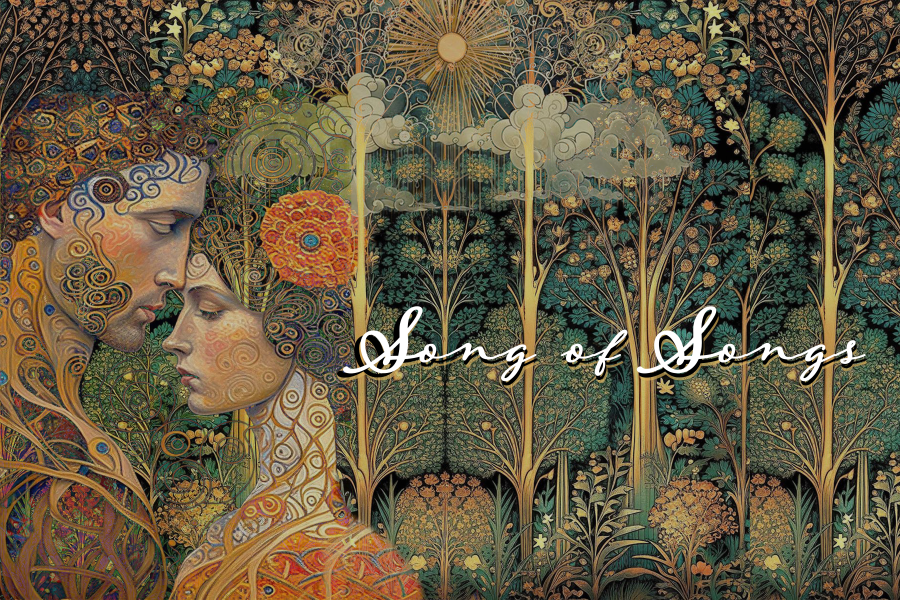
Let him kiss me with the kisses of his mouth!
For your love is better than wine;
your anointing oils are fragrant;
your name is oil poured out;
therefore virgins love you.
Draw me after you; let us run.
The king has brought me into his chambers.
We will exult and rejoice in you;
we will extol your love more than wine;
rightly do they love you.
Song of Songs 1:2-4 ESV
I sing of arms and a man.
It was the best of times, it was the worst of times.
Call me Ishmael.
Marley was dead.
It is a truth universally acknowledged, that a single man in possession of a good fortune, must be in want of a wife.
Great openings set the tone for great works, intuitively giving a bite-sized flavor of what is to come.
The same is true of Scripture.
In the beginning, God created the heavens and the earth.
In the beginning was the Word, and the Word was with God, and the Word was God.
Vanity of vanities, all is vanity.
Or two from last year:
In the days when the judges rule…
And the LORD called to Moses and spoke to him, saying…
Those openings give us a feel for the whole book. They set the scene.
So it is with the Song of Songs.
Verse one is the superscription or title verse. But the poem properly begins in verse two, and the very first line intuitively tells us much about the rest of the Song.
This is no theological treatise on marriage, nor a systematic discussion of marital roles and duties, nor does it plainly lay out moral imperatives for us to obey.
This is poetry.
It is meant to be felt and meditated upon.
And this poem begins with an explosion of eros.
Last week, we established six rules for reading the Bible’s greatest Song. Again, these rules can be applied to all of Scripture, but they are particularly worth remembering as we come to such a complex book. We will strive to keep those as our guiding principles as we actually begin the Song this morning.
While the Song is one unified poem, it is composed of various stanzas that are form complete units of thought. Verse 2-4 are the first stanza, which introduces the emotional and theological world of the Song. Within this stanza, four key motifs are sounded:
- Desire (v. 2): Love is embodied, intense, and unashamed.
- Integrity (v. 3): Love has a moral fragrance.
- Royalty (v. 4a): Love exalts and dignifies.
- Community (v. 4b): Love is witnessed, affirmed, and celebrated.
ON SPEAKER IDENTIFICATION
Before we get to verse 2 explicitly, notice the speaker identifications. The ESV and NIV say “She”, while the CSB says “Woman.” Others might say “Bride.” But most of our Bibles have some sort of identification. The ESV footnote says, “The translators have added speaker identifications based on the gender and number of the Hebrew words.” In other words, these are not in the original Hebrew text. Hebrew has prefixes and suffixes that tell the gender and number of many words, so these markers are not as necessary in the original language.
Even so, there are still some lines where the speaker is ambiguous, which is why reading multiple translations is particular helpful with this book. In fact, I side with the NIV and CSB’s decision to label the last line of verse 4 as the bride speaking again. Of course, for most of the book, the Hebrew grammar makes it fairly clear who is speaking.
We should also note that the bride is first speaker. She is also the final and most frequent speaker in the Song. This begins the rebuke on Solomon’s vision of marriage. With 700 wives and 300 concubines, Solomon could not have been emotionally intimate with any of his women. They were essentially prizes and perks for his kingship. Simply through her speech, the bride of the Song testifies that she is not a prize nor a perk; she is a person.
DESIRE // VERSE 2
The Song opens with quite a bang: Let him kiss me with the kisses of his mouth.
Iain Duguid points out that Egyptians had nose kisses, which were given between friends. Probably similar to how many cultures greet one another with a kiss on the cheek.
She does not want that kind of kiss. She has a desire and longing for her husband, which the second line builds upon: Your love is better than wine.
The word for love here (dodim) is always sexual. We find it used in Proverbs 7:18, where the adulteress says to her prey: “Come, let us take our fill of love till the morning. Let us delight ourselves with love.” For this reason, some translators say “caresses” or even “lovemaking”. It is a very specific kind of love.
The Greek language can also be very helpful here. In English, I use the same word to describe my love for pancakes, my wife, and God. The Greek had four words: storge (familial love), philia (friendship love), eros (passionate love), and agape (covenantal love). Agape is the most common translation of the Hebrew hesed (though philos is also used), which is the predominate form of love in Scripture. Indeed, agape is undergirding everything in the Song of Songs and will show its might at the end of the poem.
But here we begin with eros, which in Greek is not exclusively sexual. It is passion. Desire. Fire.
And unashamedly so. The rest of Scripture is filled with warnings and examples of eros unhinged, but here it is properly place because it is rooted in agape. Indeed, what makes marriage so powerful (for good or ill) is that it is the only place where all four loves meeting together. We should be friends with our spouse. We become family, the start of a new household together. We should desire our spouse and be fully committed to them (till death do us part).
Your love is better than wine.
Wine often represents pleasure, joy, and celebration in Scripture. It is the drink of delight, which makes this statement so strong. Even the greatest of pleasures pales in comparison to this love.
Of course, wine is used for more than just celebration. In the ancient world, it was used for comfort, similar to our modern anesthesia. But it would also be destructive when consumed beyond proper bounds. The same is true of intimacy. It can be comforting and strengthening, or it can be abused. Fire warms and cooks, but it also burns and consumes. That is why the Song’s refrain is so important: “Do not awaken love until it so desires…”
Now notice the subtle pronoun shift in this verse. First, she speaks of her beloved in the third person: Let him kiss me with the kisses of his mouth. Then she turns to address him directly in the second person: For your love is better than wine.
While she may simply be talking to herself or to her friends in the first part, I think she is using the royal way of address. Historically, kings were not addressed directly as “you.” Think of how Joseph spoke to Pharaoh, saying things like “if it pleases Pharaoh…”
She is speaking to her husband the whole time here, but she begins with this formal, exalted expression (Let him kiss me…) then moves into directly addressing him (your love is better than wine). First, she speaks with reverence then with intimacy.
This is one of most countercultural verses the whole Song because it pushes against two erroneous thoughts at the same time. First, we have the dominate message of our culture today, which tells women that they ought to be like men in every way, especially sexually. On the other hand, we have evangelical church culture that has largely swung to the opposite extreme, implicitly (sometimes explicitly!) teaching that women should be entirely passive and desireless.
This verse destroys both distortions. The bride here is not aggressive. But neither is she passive. She has a real desire. She knows what she wants, and she boldly invites her husband to come to her. She wants him to lead, but she is not a ragdoll waiting to be swept away.
That balance is especially important for married couples. Many wives have been taught (again sometimes explicitly and sometimes implicitly) that any form of initiation means usurping her husband’s leadership.
This also challenges the notice that desire primarily belongs to the husband, while intimacy is simply a wife’s duty. Indeed, my wife once received advice before we were married who told her that intimacy might not be pleasant but use it to get your husband to do what you want. That is a tragically broken view of marriage and intimacy.
Wives, this is the normal picture God gives us of marital love. Of course, an absence of desire is not sinful. An absence of eros is a check-engine light, not a condemnation. After all, hormones, age, seasons of life, grief, exhaustion, and plenty more factors affect desire. We live in a world broken by sin.
But Scripture gives us what is normative. Culture, secular or within the church, does not define what is normal. Scripture does. And Scripture shows us in this book that it is normal for a wife to desire her husband.
INTERGRITY // VERSE 3
In verse 3, the bride gives us reasons why she loves her husband.
Your anointing oils are fragrant;
your name is oil poured out;
therefore virgins love you.
First, his anointing oils are fragrant. She loves how he smells. Oils were often infused with herbs and spices to create perfumes in the ancient world. Few things are so bound to memory, emotion, and affection as smells. That is why the smell of fresh baked bread feels so cozy and at home.
I remember a scene from a television show where a widower kept his wife’s clothes sealed away and would smell them whenever he missed her most.
Indeed, now we know that something scientific is at place within our sense of smell: pheromones. Pheromones communicate genetic compatibility in ways that we do not consciously perceive. It is worth noting that hormonal birth control can disrupt that process, dulling a woman’s ability to properly interpret pheromones. As is so often the case, science is merely confirming what Scripture always knew: smell is crucial component of romance.
But then she moves to what matters most: his name. His name is like oil poured out. Oil, like wine, was one of the most valuable commodities in the ancient world. It was used for light, food, healing, worship, and perfume. Oil poured out was beautiful, useful, and costly.
When she speaks of his name, she is not simply saying that she likes how his name sounds. Something bigger is happening here than writing his name fifty times in her notebook. In the ancient world, a name represented the whole of a person, especially their character and reputation.
This is why names matter so deeply throughout Scripture. Consider Exodus (Names in Hebrews). Pharaoh’s name is never mentioned because anonymity is part of his judgment. Meanwhile, the LORD repeatedly makes His name known (“I am Yahweh”), revealing Himself as Redeemer, Shepherd, and Lawgiver.
With the patriarchs, God changed Abram’s name to Abraham to show that he would be the father of many. Jacob, the deceiver, became Israel, the one who wrestles with God. Adam’s name means ground and becomes the word for humanity itself.
Name reveal identity.
So when she says that his name is like oil poured out, she is saying that his character, reputation, and integrity are beautiful, valuable, and life-giving.
Therefore virgins love you.
This does not mean that all the young women want to steal her husband. The point is not jealousy but admiration. They look at her beloved and think: That is the kind of man I hope to marry.
This naturally leads us to a word for the men. Can your wife say this about you? Is your name oil poured out? Can you wife easily tell younger women to look for a husband like you?
If not, why not?
If you are not the man you want to be, do not despair. The path forward is repentance and growth. Submit yourself to Christ, and ask the Spirit to reshape your character from the inside out.
ROYALTY // VERSE 4A
Draw me after you; let us run.
The king has brought me into his chambers.
Notice again the shift in pronouns. It is the inverse of verse 2. First, she speaks directly to her beloved (Draw me after you) and then she again refers to him in the third person (the king has brought me into his chambers).
Why does she call him the king?
Many argue that this must be Solomon, but I don’t think so. Everything else in the book points to him being a common shepherd. Thus, she calls him king not because of his actual status but because of her respect for him.
He is her king.
And notice the irony here. If he is a shepherd, then his chamber is probably a simple hut with a straw bed and blanket. Nothing impressive. Yet through love, the ordinary becomes royalty.
This certainly fits with the broader theme of Scripture. We are constantly exhorted to consider what lies beyond mere sight. Faith alone makes unseen realities perceptible. “He who has eyes to see, let him see.”
The Song of Songs is similarly apocalyptic, meaning it unveils things that are hidden from our view. It gives us eyes to see the extraordinary happening in the ordinary.
This couple is not glamorous. They are certainly not impressive by worldly standards. Yet their love is glorious.
This is the antidote to discontentment. Instead of scrolling through other people’s lives and longing for what we do not have, Scripture calls us to see the spiritual beauty of the life God has already given us.
Calling him king also shows her respect for him. Paul explicitly commands wives to respect their husbands. The word Paul uses is where we get the phobia from. It does not mean a terror but a reverent fear, like one ought to have before the king.
And this is what all men should aspire toward: kingly faithfulness. Boaz is the perfect example. He was not an actual king, but he ruled his own field with righteousness. He protected Ruth within his domain. Likewise, whatever domain God has given you, be faithful there. Faithfulness in the small things is the mark of true maturity. None of us are kings, but we are called to be kingly.
Men, do you live in a way that invites respect? I say, invite, because the quickest way to lose respect is by demanding it. Respect is cultivated through character and integrity.
Women, do you respect your husbands? Respect is of the foundations of godly intimacy.
COMMUNITY // VERSE 4B
With this final section of our text, we are pulled outward to the community that surrounds the couple. In the ESV, these speakers are simply called ‘the others.’ The CSB calls them ‘friends’, and the NIV says ‘young women.’ That latter choice is probably who this chorus of voices are. And they rejoice with the bride.
We will exalt you and rejoice in you;
we will extol your love more than wine.
They celebrate her love because this is the kind of love they themselves long for. They hope their future husbands will be like the woman’s husband. And she concludes verse 4 by speaking to her husband again and affirming that they are right to see his worthiness.
Throughout the Song, these voices help us to step back from the intimacy of the couple and see how their love resonates outward into their wider community. And that is essential because while marriage is exclusive and intimate, it is never merely private. Marriage is only between one man and one woman, but no marriage ever affects only one man and one woman. Every marriage, Christian or not, has an impact on society as a whole. It certainly impacts the immediate household, children being the most obvious. Marriage is intended to be the foundation upon which the next generation is nourished.
Of course, we live in a broken world with many, many broken marriages. Children raised in broken homes are not doomed to irrevocably broken themselves. But the damage is nonetheless real.
This is why the author of Hebrews commands: “Let marriage be held in honor by all.” Not just by husbands and wives themselves. By everyone. Even those who are not married have a duty to honor marriage because marriages affect us all.
Historically, this verse stands as a rebuke to the medieval practice of discouraging marriage and treating celibacy as a superior spiritual state. But we must also beware of the danger of letting the pendulum swing toward the other extreme. After all, Paul speaks quite highly of singleness for the sake of the kingdom. And we should take him seriously.
But here is the bottom line. Marriage and celibacy are not competitors. One is not greater than the other. They are simply different callings. That is like asking who is greater, the husband or the wife? Neither. They are equal in value but distinct in role. Difference does not imply inequality.
Married believers should honor and affirm those who remain single for the sake of the kingdom. That calling was lived by the Apostle Paul and by Jesus Himself. Those are not minor examples to imitate.
At the same time, those who are single are called to honor marriage, for marriages are shaping the world they live in through the children that they produce.
Marriage affects everything. And it is always being watched, especially by the next generation. That is what the young women here remind us. Our marriages are always being lived out on a stage. What portrait of marriage are you displaying? Can the younger generations look at your marriage and say, “This is good. This is beautiful. This is what love ought to look like!”
DESIRING CHRIST
Now that we have worked through the text, let us consider how it points us to Christ. Again, while we are not taking the allegorical approach to reading the Song, we are reading typologically, which means that the text finds its great fulfillment in Christ. Indeed, marriage itself is ultimately a picture of Christ and His bride, the church. He is the great Bridegroom, and we are the Bride for whom he had died to rescue and redeem. So, let us walk back through this text and see how it finds its fullest meaning in the great Marriage.
First, as Christ’s bride, we should desire him. We should long to be near him, and it should be our deepest desire to be in His presence. Iain Duguid writes:
If you are married to Christ, is that relationship the center of your thinking? Do you find yourself dreaming about him, lost in amazement at how wonderful Christ is, how incredible it is that he should love you, and longing for more of his presence? Do you constantly wear out your friends and relations with your endless chatter about how wonderful your Beloved is? If you are anything like me, the answer most of the time is “No.” I have to admit to living most of the time as a functional single, spiritually speaking. Every now and then I bump into Christ, as it were, and am reminded that we are married. (11)
The same point we made earlier applies here. Desire ebbs and flows, and a lack of desire is not itself sinful. We all walk through dry seasons, where the darkness seems to hide His face. But the norm of the Christian life should be filled with desire for Christ.
In this life, we primarily encounter Christ through three means of grace: the Word, prayer, and gathering with other Christians. If it has been years since you have longed to hear from God in His Word, to pour out your heart to Him in prayer, or to see Him displayed in your brothers and sisters in Christ, the check-engine light is on. Something is off.
It could be the effects of sin. It could simply be a bitter providence of God. But either way, something is not normal. The normal pattern of the Christian life is to desire Christ, longing to be in the presence of our King.
And why do we long for Him? Because His name is oil poured out. Demons tremble before His name. Scoffers mock it. But one day every knee will bow before Him and confess that Jesus is Lord.
We do so now.
Christian are those who have already seen the beauty of Christ’s name. And we love the name of Jesus because it perfectly reflects His altogether lovely character. Indeed, He is the man of perfect integrity. He lived a sinless life. He alone did not deserve death, yet He freely chose death to redeem us from the penalty of our sin.
He is truly the greater Adam. Whenever Eve sinned, Adam should have crushed the serpent and then said to God, “Take me instead.” Where Adam failed, Christ triumphed. He slew the serpent, put death to death by death, and gave Himself as a ransom for His bride. He laid down His life so that we might live. And He makes us beautiful, even though we are not beautiful in ourselves.
Christ also came as a lowly carpenter. In His earthly appearance, there was no beauty that we should desire Him. Yet this humble shepherd is also the eternal King of kings.
Even today, many still see Jesus as simply the suffering servant or just as good moral teacher. But those with eyes to see behold Him as King. His people see that reality now by faith, but the day will come when all will see it by sight.
And on that day, He will take His bride into His chamber. He will usher us into the new heaven and new earth, where the covenant will be consummated once and for all. He will dwell with us, and we with Him.
In the meantime, we are also the community that encourages one another all the more as that Day draws near. We rejoice with one another, celebrating one another’s love for Christ. In that sense, we are each not only the bride but also the young women rejoicing over one another.
One of the chief ways that we do that is at the Lord’s Table. We rightly call it Communion because it is a fellowship meal, a celebration of our communion with God and with one another. The cup proclaims our vertical union with Christ. His blood has been shed to bring us back to the Father, to make us members of His household, and to claim us as His bride.
The bread proclaims our horizontal union with one another. We are the body of Christ. Think of the early church, gathered around a single loaf, breaking off pieces and passing it around. No two pieces are identical, yet all come from the same bread.
As we come to the Table this morning, may this meal stir up our desire for Christ. May it lead us to meditate on the name, the character, and the integrity of our King. May we stand in humble awe at He who gave His life to make us His bride. And may we rejoice together as a community in His love for us.
DISCUSSION QUESTIONS
- Why do you think God chose to begin the “Greatest Song” with desire rather than a set of rules?
- The sermon argues that the bride in verse 2 is neither aggressive nor passive; she has real desire and boldly invites. How does this push against messages you’ve received (from culture or the church) about desire in marriage?
- What does it mean that an absence of desire is “a check-engine light, not a condemnation”? How does that framing help or challenge you?
- She loves her husband’s name, his character and reputation. What would it look like for someone who knows you well to be able to say your name is “oil poured out”?
- The sermon asks men directly: can your wife point younger women toward you as a model? What habits or patterns of character would need to grow for that to be true?
- The sermon argued that the “King’s chambers” (v. 4) were likely just a simple shepherd’s hut, but the Bride saw them as royal because of her love. How does “discontentment” or “scrolling through social media” kill our ability to see the “royalty” in our own ordinary lives? How can we “unveil” the extraordinary beauty in our own homes this week?
- The sermon says no marriage is merely private; it affects everyone around it. How have other people’s marriages shaped your own understanding of what marriage can or should be?
- Whether married or single, how are you actively honoring marriage as the author of Hebrews commands?
- Iain Duguid’s quote describes living as a “functional single” spiritually — occasionally bumping into Christ but not truly oriented around him. Where do you recognize that pattern in your own life?
- The three means of grace mentioned are the Word, prayer, and Christian community. Which of these has felt most alive to you recently, and which has felt dry?
 B. C. Newton