
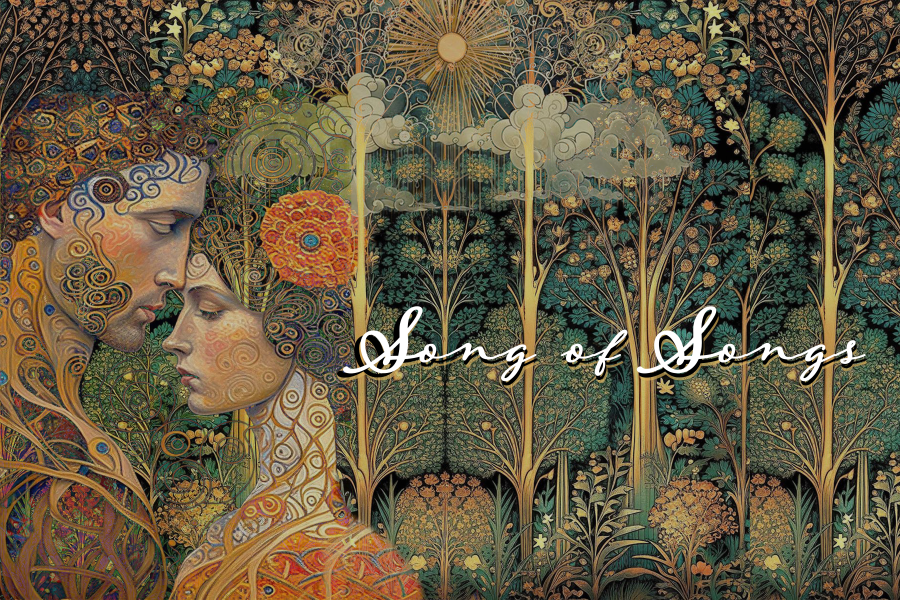
Behold, you are beautiful, my love;
behold, you are beautiful;
your eyes are doves.
Behold, you are beautiful, my beloved, truly delightful.
Our couch is green;
the beams of our house are cedar;
our rafters are pine.
I am a rose of Sharon,
a lily of the valleys.
As a lily among brambles,
so is my love among the young women.
As an apple tree among the trees of the forest,
so is my beloved among the young men.
With great delight I sat in his shadow,
and his fruit was sweet to my taste.
He brought me to the banqueting house,
and his banner over me was love.
Sustain me with raisins;
refresh me with apples,
for I am sick with love.
His left hand is under my head,
and his right hand embraces me!
I adjure you, O daughters of Jerusalem,
by the gazelles or the does of the field,
that you not stir up or awaken love
until it pleases.
Song of Songs 1:15-2:7 ESV
In the previous passage, we witnessed the Song’s first dialogue between the man and the woman. She spoke about her appearance, past, and her desire to be with him. He responded playfully, and they spoke words of praise over one another.
That passage introduced a subtle theme of the Song that will appear again. She described herself as beautiful but unkempt. There is a rugged, wilderness beauty to her. Then she concluded the passage by calling her beloved a cluster of henna blossoms in the vineyards of Engedi, which was (and still is) an oasis in the middle of the wilderness. Though surrounded by desolate wasteland, Engedi is lush with trees and even waterfalls.
We have already said that garden imagery dominates the book. Trees, fruit, flowers, vineyards. This poem is green and alive. Indeed, the images are meant to remind us of Eden, just as the tabernacle was decorated with similar imagery.
At the same time, the wilderness lingers in the background of the Song. It is certainly not as prominent, but it is there. The whole poem is somewhat like Engedi. The couple’s love is an oasis in the wilderness. It gives us a glimpse back into Eden, back to paradise.
But the lurking wilderness reminds us that this is not Eden.
Not yet.
The passage before us, I believe, is a continuation of the previous text that we studied. They form one unified movement, but we have broken it in two to study it more thoroughly.
There are four movements here. Verses 15-17 set the scene. Verses 1-2 of chapter two give us another short dialogue between the man and woman. Verses 3-6 describe their intimate embrace. Verse 7 then turns to the daughters of Jerusalem with the first refrain.
THE SONG OF THE GARDEN // VERSES 15-17
These verses have an unusual flow to them. First, he praises her: Behold, you are beautiful, my love; behold, you are beautiful; your eyes are doves. Then she praises him: Behold, you are beautiful, my beloved, truly delightful. But then she describes what appears to be their home: Our couch is green; the beams of our house are cedar; our rafters are pine.
What is the connection between their beauty and their house?
Let’s begin with the house. Most commentators interpret this as a literal description of their home because many also view Solomon as the beloved in the poem. Thus, this would be a description of Solomon’s palace, which took thirteen years to build and was extraordinarily luxurious.
But again, I do not think that the man is Solomon. He is a simple shepherd. Last week, we saw that he was tending to his flocks. We also saw that the woman is not a princess but evidently came from a working-class background. Thus, how would their home have beams of cedar like Solomon’s palace or even the temple?
Richard Hess points out that the Hebrew word for ‘green’ “normally describes trees that are luxuriant with growth” (73). This leads some commentators to conclude that this language is figurative. She is not describing their literal bed and home.
And I agree.
Remember that in verse 7 she longed to be with him at midday while he was resting from the afternoon sun. Now she is there with him. They are lying together in the grass, and they are surrounded by trees, which are the beams and rafters over them. This is their little oasis together in the middle of the day.
And as they lay there, they praise each other. He says that she is beautiful. Her eyes are doves, which likely conveys gentleness, innocence, and purity. She calls him beautiful and delightful. So, they are in a forest garden, speaking of beauty, delight, and innocence… This is an echo of Eden.
We can almost imagine these verses describing Adam and Eve, lying on the grass together and looking up at the trees around them, delighting in one another.
But it is also right that the beams of cedar and rafter of pine would make us think of Solomon because he imported that wood from Lebanon for his palace. Thus, this is likely another contrast with Solomon.
Remember that even though Solomon was the wisest of all men, he took many wives for himself against Deuteronomy 17’s command. And his 700 wives and 300 concubines led his heart from the LORD. So, Song of Songs is doing what all wisdom literature does: contrast wisdom and folly. In this poem, Solomon’s wealthy, royal, polygamous folly is contrasted with simple, beautiful, and biblical faithfulness.
That is why the description sounds like Solomon’s palace. Their real home is probably very simple. But the Song of Songs is apocalyptic, which does not refer to the end of the world, but refers to unveiling or revealing something. An apocalypse is the revelation of something previously hidden.
And that is what is happening here. Literally, they are lying on the grass beneath some trees. But love beautifies and exalts the humble and the ordinary. Thus, they are in a palace built by God Himself. They have something far greater than Solomon could ever hope to build.
This pushes back against the lie that having more will make us happier. People have always wanted fame, sex, money, and power. Solomon had it all. We too live better than any ancient king. Did make Solomon happier? Are we happier?
Much of our discontent comes not from what we lack but from comparing ourselves to others. Envy poisons joy. But when we receive what God has given with gratitude, even simple things become rich.
That is what we see happening here with the Song’s couple. They are together, and it is a glimpse of Eden.
A LILY OF THE VALLEYS // VERSES 1-2
That, then, is our setting. It feels Edenic, but it is not.
She speaks again: I am a rose of Sharon, a lily of the valleys.
This is very similar to what she said earlier about herself. Roses and lilies are beautiful flowers, among the most beautiful. But they are also common. In the plain of Sharon, they grow everywhere. Neither is a lily of the valleys are rarity.
Again, she is not beating herself down. She knows that she is beautiful. But she is essentially saying, “Yes, I am beautiful, but so are other women. I am nothing special.” It is a humble and realistic self-assessment.
And how does he respond? We see his playfulness again. It is as if he says, “Yes, you are indeed a lily, but you are a lily among thorns.” All other women are like brambles to him.
James Hamilton comments: “Married men, if you don’t look at your wife and say to her what Song of Songs 2:2 says, you need to repent” (56).
Those are strong words.
And I fully agree.
These two verses are both beautiful and difficult because both are true. She isn’t blind to her beauty or the beauty of the women around her. She is aware of the intrinsic loveliness of the female form. Matthew Henry said that man was dust refined, but woman is dust twice refined.
And we all know that intuitively. Men occasionally notice when another man is particularly handsome, but both men and women cannot help noticing a particularly beautiful woman. This is as common sense as saying that a flower is beautiful but also common.
So, verse 1 is true.
But verse 2 is also true.
Of course, by comparing other women to thorns, he is not saying that they are ugly. That would be blatantly false. Besides, love exalts, not diminish. His love for her does not diminish all other women; it exalts her above them. That is a subtle but crucial distinction.
It is rather like Jesus saying that His disciples must hate their father and mother if they would follow Him. To literally hate our parents would break the 5th Commandment. He is saying that our love for Christ should be so great that our love for even our parents looks like hatred in comparison.
These verses get at an age-old tension. How can a man say that his wife is the most beautiful of all women? Has he compared them all? Has he ranked them?
That is a materialist vision of beauty, as if beauty were purely physical and visual. He sees something much deeper, which makes for an interesting stereotype reversal. In the poem, as in life, the man is usually the visual one, while she focuses more on the other senses, like smell and taste. But when the woman looks at herself, she becomes the visual one. She evaluates herself simply by what she sees.
But he doesn’t do that. The beauty that he sees in her is deeper. Physical beauty is a wonderful part of what attracts a husband to his wife. But that is only a piece of the attraction. I think Tiff is physically gorgeous, but what sets her apart from other women is that she is mine. And I am hers. While still doesn’t fully make sense to me, she actually likes me. So much so that she decided to spend the only life she has with me. That is why she is a lily among thorns among all other women.
Husbands, do you see your wife as the most beautiful among women? If not, the problem is not with her beauty but with your vision. And if that is the case, as Hamilton says, we should repent.
THE HOUSE OF WINE // VERSES 3-6
She then speaks to him, using her own metaphor:
Like an apple tree among the trees of the forest,
so is my beloved among the young men.
With great delight I sat in his shadow,
and his fruit was sweet to my taste.
She compares him to an apple tree in the midst of a forest. He is unique among all the other young men. Like an apple tree, he is her shade and her fruit. He protects and provides.
First, he is her shade. Shade from what? From the sun, which beat down upon her while she worked and darkened her skin. But that was then. Now she sits beneath her beloved. He shields her. He shelters her.
Second, his fruit is sweet to her taste. He provides for her. He is her nourishment and refreshment.
That is, of course, what men are called to do. Protection and provision is part of the fundamental calling of a man. When men fail to do that, we feel lost, disconnected, even depressed, which is sadly the state of many men today.
Husbands would do well to evaluate our protection and provision of our household. Of course, protection is far more than simply owning a gun and being ready if an intruder breaks into the house. Protection is broader than that. For example, we could ask: are you emotionally protective of your wife? Are you her oasis in the midst of the chaotic world?
We can do this by providing stability. Often women experience emotions more intensely and expressively than men do. And husbands sometimes assume that their job is to react to every surge of emotion. But most often what is truly needed is steadiness.
And then there is provision. Our culture fiercely cries that women should be entirely self-sufficient. But a husband’s provision is good and biblical. When a husband shoulders that responsibility, his wife has freedom to devote herself to the household.
Wives, is your husband’s protection and provision delightful to you?
Then in verse 4 she says, He brought me to the banqueting house, and his banner over me was love.
In Hebrew, the phrase ‘banqueting house’ literally is the house of wine, which connects us back to the beginning of the poem. “Your love is better than wine,” she said. He has now brought her into the house of wine, the place of delight and love. Clearly, this is deeply intimate. They are together and enjoying one another.
His banner over me was love. A banner is something public. When an army approaches over a hill, the first thing seen would be the banner flying in the wind. A banner is meant to be seen.
That tells us something important about marital love. It is both private and public. It is intimate and exclusive, but it is not shameful. The house of wine is for them alone, but they do not hide it. It is not illicit. There is a banner flying over their banqueting house. While their intimacy is for them alone, everyone knows his love for her. Everyone knows that they belong to one another.
If you are married, can people see that in your marriage? Is your love for one another visible? Can others see it through your words and actions? Can they tell that you cherish your spouse?
That certainly does not mean: broadcast your affection on social media. The aroma of your everyday behavior is much more important than sentimental words tossed into the digital ether.
But this also applies more broadly to all Christians. Christ said, “By this all people will know that you are my disciples, if you have love for one another.” Our love for one another is meant to function like a banner for the world to see. The way Christians treat one another should make it obvious that we belong to Christ.
In verse 5, she says, Sustain me with raisins; refresh me with apples, for I am sick with love. In the ancient world, apples were valued for both refreshment and fragrance, which fits beautifully with how she has been describing him.
But why does she need refreshment? Because she is sick with love. The idea of lovesickness is nothing new. An ancient Greek novel describes this lovesickness between a young man and a young women, saying:
Her heart began to ache. She could not control her eyes. She was always talking about him. She neglected food. She was sleepless at night. She neglected her flock. Now she would be laughing, now she would crying. One moment she would sit quietly, the next she would leap into action. Her face would turn pale and then blush red. Not even a cow stung by a gadfly acted this way.
Anyone who has experienced the fire of eros, the passion of infatuation, knows that sickness. Even in marriage, we ought to feel it from time to time, as the woman does here. But C. S. Lewis rightly noted that we certainly could not live in that heightened emotional state all the time. Nothing would ever get done.
So he is the cause of her sickness, but he is also the remedy. Such is love.
Finally, in verse 6, she says, His left hand is under my head, and his right hand embraces me.
Up to this point, the poem has been overflowing with poetic imagery and metaphors. They are in house of cedar and pine. She is a rose of Sharon and a lily of the valleys. He is an apple tree among the trees of the forest. He brings her into the house of wine. He sustains her with raisins and apples. All of that language piles image upon image. But now the metaphors fall away, and we see the couple lying together in the grass. He is holding her, and she is lying in his embrace.
Sitting in his shade, tasting his fruit, entering the house of wine, being sustained and refreshed are all poetic pictures of the same reality. They are together, delighting and resting in one another.
It isn’t Eden. But it is a small lingering taste of that paradise. A glimpse of what was lost to us.
DO NOT AWAKEN LOVE // VERSE 7
The Song then shifts. With the two of them embraced, the scene suddenly cuts, and she addresses the daughters of Jerusalem:
I adjure you, O daughters of Jerusalem,
by the gazelles or the does of the field,
that you do not awaken love until it pleases.
Notice when the warning appears. It comes immediately after the embrace. The Song is showing us that the greatest danger of love is not when it begins but when it grows powerful. At that moment, wisdom must step in and say: do not awaken love until the time is right.
Again, she is speaking to her young friends, who are of age to marry but are not yet married. And she says, in effect, “This is beautiful. This is wonderful. But do not open the door until the time is right. Do not rush into this love. Don’t awaken it until it is ready.”
As magnificent as intimacy can be, it is also dangerous. As we have said, the tabernacle is the fitting comparison. It was the most glorious place on earth because God was there. It was also the most dangerous place on earth… because God was there. God’s presence is both beautiful and deadly.
Intimacy is also beautiful and dangerous. When it is received in its proper bounds, it is good. When taken outside those bounds, it becomes destructive.
So she warns her young friends: wait for this love. The desire for marriage is natural and good. But intimacy is a fire so hot that it must be guarded by covenant, commitment, and faithfulness.
Thankfully, there is healing in Christ for those who have awakened love too soon. There is forgiveness and restoration. Even so, sin leaves scars, as the hands and side of Christ can attest. God designed marriage to be the union of one man and one woman, bound together for life in covenantal love.
That covenant is the most significant decision that we can make in this life outside of following Christ. Because we are all sinners, marriage will inevitably bring pain and sorrow with it. And it has the potential to do so greatly. While the pain of waiting for marriage can certainly be great, the loneliness of lying next to someone when the love once shared has withered away is greater.
Eros, therefore, is good, but it must be guarded. It must be built upon covenant. Its banner must be steadfast and faithful love.
CHRIST OUR BELOVED
Now that we have observed the plain reading of the text, let us move through it again to see how it ultimately displays Christ and His love for His bride, the church.
Verse 15-17 gave us a glimpse of Eden through the couples’ delight in one another while lying in a forest garden. Our earthly marriages, at their very best, can only give us such a glimpse. Christ, however, has come to restore us back to that paradise which was lost.
Our sin separates us from God. The sin that Adam and Eve committed in the beginning is the same rebellion that each of us repeats continually in our own lives. We have all turned away from God. None of us deserve the abundant and delightful paradise that He originally gave to humanity.
Yet Christ restores what we tossed aside. The King who dwelt in heaven’s palace came down to earth as a servant, becoming obedient to the Father to the point of death, even death on a cross. And through that death, He dealt with our sin once and for all. The greatest of all exchanges takes place at the cross. Our sins were placed upon Christ, and His righteousness is credited to us whenever we believe in Him by faith.
Christ Himself is the true and better marriage, just as He is the true and better tabernacle. He is the perfect bridegroom who restores what we lost. And as He redeems us, He also delights in us. He makes us His bride and calls us beautiful, truly delightful.
Of course, in 2:1, the woman called herself a rose of Sharon and a lily of the valleys. But we could not say that of ourselves before Christ. Our problem is not simply that we were common rather than holy. Our problem was that we were not beautiful at all.
Sin may appear attractive in the moment. Proverbs 5-7 portrays sin as a seductive woman, luring us into being with her. But Proverbs 9 describes her luxurious feast as being a meal of the dead. Those seat at her table are decaying corpses. That is where sin always leads.
And that is where Christ came to us. We were not lovely flowers; we were decaying corpses. There was nothing lovely in us. Yet Christ died for us. And in dying for us, He makes us beautiful.
Now when Christ looks at His bride, He sees beauty. If we confess Christ, believe in Him, and call upon His name to be saved, we belong to His church. He looks at us and calls us a lily among thorns. We are now His beloved, whom He has set apart from the world of thistles and brambles. Day by day, He is making us beautiful.
Then in verse 3, we see another image of Christ. He is our apple tree. With great delight, we should long to sit in His shadow and taste His fruit. He invites us to do so: “Come to me, all who labor and are heavy laden, and I will give you rest.”
Yet how often do we seek rest elsewhere? We turn to endless scrolling or any number of distractions to quiet the noise and anxiety in our hearts. But Christ invites us to come to Him, to cast our cares upon Him in prayer and to hear from Him in His Word.
Christ alone is the true refreshment for our souls. Tozer rightly says that to have found God and to still be searching for Him is the soul’s paradox of love. Desire for Christ will inevitably ebb and flow. But there ought to be season when we are sick with love of Christ, when nothing can quiet our ache except being with Him.
But verse 7 reminds us that that longing will not yet be fully satisfied, for we are still in a time of waiting. Christ has restored the garden to us, but we still await its fullness. The kingdom of God has indeed come, but it is still coming. The covenant has been inaugurated but not yet consummated. We are in the already but not yet.
We see that reality in the Lord’s Table. Here verse 4 comes to life. Christ invites us to take the bread and cup as signs of His covenantal love. In doing so, He brings us into the banqueting house. The bread reminds us of His body, broken for us. The cup proclaims His blood, shed for the forgiveness of our sins.
Each week, the Lord’s Table stands like a banner flying high over us, declaring that Christ loves us.
But this is not the fullness. It too is a glimpse of what is still to come. By faith, we call it the Lord’s Supper, even though it is only a piece of bread and a sip of the cup. But we call it a supper because it points forward to the great feast that awaits us.
One day, Christ will return. Heaven and earth will pass away, and the new heavens and earth will come. Christ will raise His people with resurrected bodies, and we will then sit with Him at the Wedding Supper of the Lamb. That will be the fullness of the kingdom, and God will forever dwell with His people.
So, as we come to the Table, let us taste and see the goodness of our Beloved. He sustains us with Himself. He embraces us and calls us His own. He declares that we are beautiful and delightful. His cross stands forever as His banner of love over us.
DISCUSSION QUESTIONS
- The sermon argues that love beautifies the ordinary, that this couple lying in the grass beneath trees has something greater than Solomon’s palace. Do you find that convincing, or does it feel like romanticizing poverty?
- The sermon says that envy poisons joy. Where does comparison most consistently rob you of contentment?
- If you viewed your home or your marriage through “apocalyptic” eyes (seeing the spiritual reality instead of just the physical), what would change about your gratitude this week?
- As with last week, she sees herself clearly, beautiful but common. He sees something deeper. Which tends to be harder for you: seeing yourself too harshly or too generously?
- Does Hamilton’s challenge land as convicting, motivating, or both? What would it practically look like to grow in how you see your spouse?
- A banner is meant to be seen. Is the “banner” over your marriage (or your friendships) one of “love and honor,” or is it one of “sarcasm and frustration”? What does your “public banner” tell the watching world about the God you serve?
- Why is intimacy compared to the tabernacle (beautiful but deadly)? How does this change the way we talk to the “Daughters of Jerusalem” (the next generation) about boundaries and waiting?
- Christ is described as our apple tree, shade and fruit, protection and provision. Where are you most tempted to seek rest and refreshment somewhere other than in Him?
- The whole sermon moves between Eden lost and Eden restored. Where in your life do you most feel that in-between tension, tasting something good but knowing it is not yet the fullness?
 B. C. Newton