
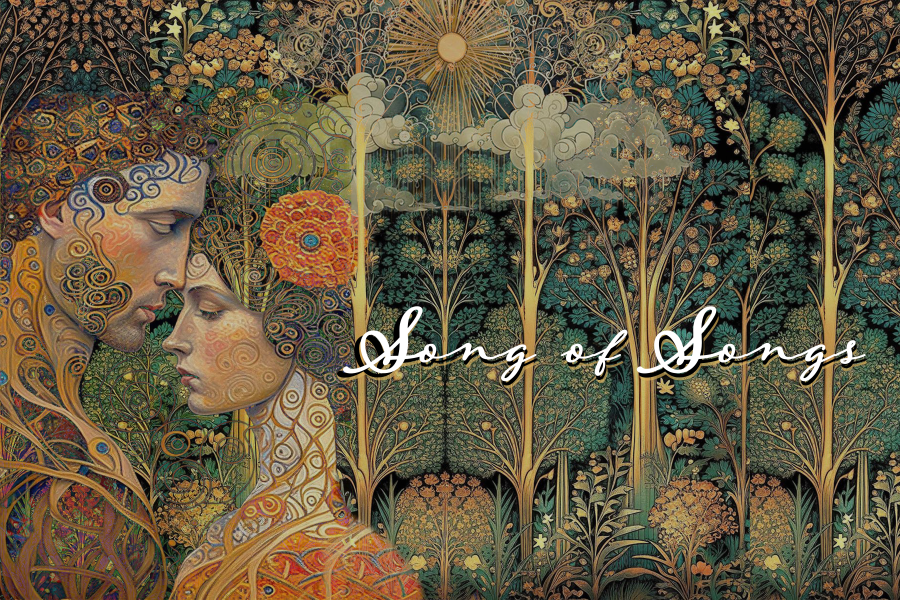
Even though the Song of Songs is a song, the Holy Spirit preserved no musical accompaniment for us; only the lyrics, which are God-breathed. So, as we read, we must be sensitive to the text’s tonal shifts.
We saw this in the previous section of the Song (2:8-3:5). While there are many repeated words and themes that clearly connect the parts as one unit, there was still a very jarring shift in tone. In 2:8, the beloved came, bounding over the mountains to announce that spring had arrived. But then, last week, the bride woke up and found herself alone in bed. She then went into city, searching the streets and asking the watchmen for her beloved. At last, she found him, clung to him, and brought him into her mother’s chamber.
That section gave us our first real glimpse of pain in the Song. Even though the Song of Songs is fundamentally hopeful, it is still set within the real world, where love feels absence as well as presence.
We come now to 3:6, which begins a unit that will continue until 5:1, though we will need to split it, as with the previous units, into two parts. And we have another shift, from a tone of desperation and searching (think minor chords) to celebration and exaltation, which is the dominate tone of the whole Song. Indeed, our text will lead us, next week, into the very center of the poem, 5:1.
For now, our passage divides clearly into two parts: 3:6-11 and 4:1-7.
THE LITTER OF SOLOMON // VERSES 6-11
Verse 6 sets the new scene for us:
What is that coming up from the wilderness
like columns of smoke,
perfumed with myrrh and frankincense,
with all the fragrant powders of a merchant?
Can you imagine the setting? You are standing on the wall of a city, or just outside a city, looking out toward the barren horizon of the wilderness. And in the distance, you see columns of smoke rising. You see a caravan approaching, a company of men, and everything is perfumed with myrrh and frankincense, expensive spices and luxury goods. The wind carries their fragrance all the way to you.
But what’s coming?
Behold, it is the litter of Solomon!
This is likely the royal carriage or couch, carried by men when the king traveled, but it is also connected to the bedchamber. This is a bed on the move. A portable throne-bed.
Notice that the focus is on the bed itself, not Solomon. Around it are sixty mighty men of Israel, armed with swords and experts in war. And there are apparently more at Solomon’s service. David, Solomon’s father, had thirty mighty men, which is doubled here. The thirty mighty men were essential for David’s reign because he was a man of war. He was constantly battling away Israel’s enemies. But God gave Solomon peace on every side, and he still surrounded himself with more warriors than his father.
You see, on the surface, this text looks magnificent, royal, glorious! But whenever we read it canonically, we begin to sense that something is off. Of course, the final phrase of the verse also gives us that hint: against the terrors of the night. What terror? Was Solomon not secure within his own palace and in his own bed? Why does he sleep with sixty armed guards?
That sounds less like peace and more like paranoia.
In Deuteronomy 17, God forbid Israel’s future kings from accumulating many wives and horses from Egypt. Both were ways of securing political security, and Solomon did both. He married many wives for political alliances, and he imported horses from Egypt because they were the greatest in the world. Thus, Solomon valued political and military security over trusting in the LORD.
Verse 9 gives us a description of the bed, and it is beautiful. It is made from wood from Lebanon, which was considered the best in the ancient world. It was decorated with silver, gold, and purple. It is as royal as it can possibly be.
But notice this interesting phrase: its interior was inlaid with love by the daughters of Jerusalem. The Hebrew essentially treats love as the material that lines the inside of Solomon’s bed. Does this mean, as some translations interpret, that it was lovingly inlaid by the young women of Jerusalem, as an expression of their great admiration for the king? Perhaps.
Later, we are told that Solomon has sixty queens, eight concubines, and young women without number. So, when we read that his bed was inlaid with love by the daughters of Jerusalem, it may not be as innocent as it first sounds. It may be saying that Solomon has made much use of this bed with many of Jerusalem’s daughters.
Verse 11 then says,
Go out, O daughters of Zion,
and look upon King Solomon
with the crown with which his mother crowned him
on the day of his wedding,
on the day of the gladness of his heart.
This again sounds very positive: Go out and admire the king in all his glory on his wedding day.
But which one? There were seven hundred of them, after all.
Perhaps, this is not purely admiration but warning or irony. Look at Solomon in all of his glory, and remember what he did with it.
YOU ARE BEAUTIFUL // VERSES 1-7
Now the second part of our text begins with a familiar word: Behold. Indeed, it was two! Behold, you are beautiful, my love; behold, you are beautiful.
Recall that 3:6 asked, What is that coming up from the wilderness? Solomon’s litter appeared to be the answer. But that happens to be a kind of fake-out. The Hebrew could also be translated as, Who is that coming up from the wilderness? Indeed, the grammar expects a feminine answer.
Both 3:7 and 4:1 answer 3:6’s question, which is why I believe that the two passages are intentionally set up for comparison. Just as the beauty of Solomon’s bed was described, now the beloved describes the beauty of his bride. Indeed, he traces his gaze down her body and describes her using poetic imagery. In ancient poetry, this form is called a wasf, a poem that catalogues the beauty of the body. The Song contains four of these, three focus on the woman, while the other describes the man.
We should remember that these metaphors are from a culture that is quite different from our own. And they are probably not meant to be visual comparisons as much as emotional and expressive poetic images.
He begins with her eyes. Your eyes are doves behind your veil. Because her eyes are behind a veil, most commentators believe that this scene is describing their wedding day, which is certainly possible. It would be fitting for the center of the poem to be a remembrance of their wedding day. But it does not need to be their literal wedding day. He could be using wedding imagery to show that he still sees his wife with the same love and beauty as on their wedding day. In other words, she is still his bride.
Your hair is like a flock of goats leaping down the slopes of Gilead. Remember that the bride tended flocks, so it makes sense that it would use this picture. Her hair is long, dark, and flows with beauty.
Your teeth are like a flock of shorn ewes that have come up from the washing, all of which bear twins, and not one of them has lost its young. Sheep that have shorn and washed are very white, and the fact that they all bear twins and have not lost their young means that they are healthy. Thus, her teeth are white, and she still has all of them. In the ancient world, especially for someone who is not wealthy, that would have been high praise indeed!
Your lips are like a scarlet thread, and your mouth is lovely. Your cheeks are like halves of a pomegranate behind your veil. The pomegranate image is probably referencing the color more than the size. Even behind her veil, he can see her rosy, flushed cheeks, which are often a biological response of attraction and arousal.
Your neck is like the tower of David, built in rows of stone; on it hang a thousand shields, all of them shields of warriors. Her neck is tall, strong, and graceful. She holds her head up with dignity. This certainly fits with her personality in the Song. She is not timid, constantly looking at the floor. She is bold, expressive, and confident. And he loves her confident dignity. She may not be an actual queen, but she carries herself like one.
Your two breasts are like two fawns, twins of a gazelle, that graze among the lilies. The image of fawns suggests gentleness, softness, fertility, and probably shyness or elusiveness, since fawns like to stay hidden. But they are grazing here, which means that they are in place of security and peace, a place where they do not need to hide.
And he stops there. He will cover more over her body later in the poem, but here his focus is largely upon her face. Notice also that he uses seven descriptions, which is the number of completion or perfection.
O’Donnell points out the possible echo of Genesis 1, where God repeats that His creation is good six times before declaring it all to be very good at the end.
Indeed, the beloved also declares her to be very good in verse 7: You are altogether beautiful, my love; there is no flaw in you. It is almost as if he steps back, after describing each part, and simply exclaims: “All of you is beautiful! You are completely lovely!”
Again, this is the language of love. When he says that there is no flaw in her, he does not mean that she is literally perfect in every possible way. Love changes how we see a person. What others might call a flaw become a part of what makes that person beautiful to us.
In verse 6, he also says, Until the day breathes and the shadows flee, I will go away to the mountain of myrrh and the hill of frankincense. Again, that phrase ‘until the day breathes and the shadows flee’ probably refers to dawn, the day taking its first breath and the light driving away the shadows of night.
But what do the mountain of myrrh and hill of frankincense mean? Consider two previous verses. In 2:17, she invited him to come to the cleft mountain, which was a playful reference to him calling her a dove in 2:14. Also, in 3:6, the company coming from the wilderness was perfumed with myrrh and frankincense. Thus, he is probably poetically speaking of her, of delighting in and being with her. He is answering her invitation. She invited him to come to her mountain, and he is resolved to stay in the pleasantness of her mountain until the day breathes and the shadows flee.
TWO VISIONS OF LIFE
This brings us to the big question: Why exactly are these two texts placed together? Why does the Song give us this description of the bed of Solomon on his wedding day (one of them!) and then give us the beloved’s description of his bride, both in answer to 3:6?
They provide a contrast between what we find to be truly beautiful, between what we are told to desire and what we should actually desire.
First, we have the bed of Solomon, which represents the luxurious life of the ancient king. The world largely tells us to chase four things: pleasure, fame, money, and power. Solomon had each in unimaginable abundance. Wealth, women, authority, fame, all of it!
And it looks magnificent. It looks impressive and enviable, like paradise on earth.
But the closer you look, the more the cracks begin to show.
Notice that the bride’s neck was like the tower of David, a picture of strength, dignity, and regal confidence. She is strong and secure. But Solomon, the actual king, has sixty mighty men surrounding him while he sleeps to keep away the terrors of the night.
Doesn’t that sound a bit like Daniel 6? King Darius spent the entire night awake out of fear for Daniel, but Daniel was protected by the angel in the lions’ den, meaning Daniel may very well have gotten better sleep than the king.
Proverbs says it like this: “The sleep of a laborer is sweet, but the abundance of the rich does not let him sleep.” Despite what the world proclaims, wealth and luxury do not bring peace. Often, the great ones of the world are actually anxious and constantly on guard, while the humble and faithful are truly happy and secure.
Even so, we are so easily seduced by the lie of the good life. Pleasure, fame, money, power. We are told that life is miserable without them.
But Scripture tells us something quite different. In 1 Thessalonians 4:11, Paul says to aspire to live a quiet life, minding our own affairs, and living peacefully with others. The good life is not one of fame and extravagance but of quiet faithfulness.
That is why these two texts are placed side-by-side. The empty pomp of Solomon versus the breath-taking beauty of a humble shepherdess. Which life do you want? Which beauty do you believe in and pursue?
The deepest joy is found not by impressing others but by living a simple life before God, loving Him and loving others.
GREATER THAN SOLOMON
As we consider how this text ultimately points us to Christ, we can begin with the imagery of myrrh and frankincense. These are royal and priestly fragrances, which were brought to Jesus as gifts when He was still a child. Take also the image of one coming up from the wilderness, perfumed with myrrh and frankincense. Can we not think of Jesus, who spent forty days in the wilderness being tempted by Satan? Yet He defeated the devil and came forth from the wilderness in triumph.
Of course, Jesus Himself said of His arrival that one greater than Solomon is here. For all of his sin and idolatry, Solomon was still a great king. At the start of his reign, he ruled with wisdom and faithfulness. But he was not great enough.
Jesus is the greater Solomon. He is the perfect King, the king that Solomon was supposed to be. In fact, that is true of everyone. Jesus is the true and better Adam, Abraham, David, Daniel, etc. He is the true human being as humanity was meant to be.
This is one of the most difficult to grasp elements of Christ’s humanity. It is like ours in every way, except without sin. But that is actually quite a significant difference. Because sin leads to the diminishing of our humanity, Jesus was actually more truly human than any of us are.
Sin distorts and damages. It clouds the mind, corrupts judgment, and makes us act more like irrational beasts that those who bear the image of God. The Psalms even warn us against acting like a horse or mule that must be controlled with bit and bridle.
But Jesus, being without sin, shows us what true humanity looks like. He shows us what it looks like to actually love God with all your soul, heart, and might and to love your neighbor as yourself. We cannot fulfill those commandments for one solid minute, but Jesus never failed to fulfill them for as much as a second.
And because Jesus is the true human, the perfect man, HE is also certainly greater than Solomon, the wisest and greatest of kings. But He did not look at all like Solomon. Jesus did not arrive in the pomp and splendor of Solomon. No, He came to earth as a servant. He worked, as Paul said, with His hands and lived a quiet life, minding His own affairs. Most of Jesus’ earthly life was lived in obscurity, working, living faithfully, obeying His Father.
Consider then 3:11 again. In the original context, it may have been more of a warning to see the emptiness behind Solomon’s glory. But there is nothing empty about the glory of Christ. Thus, if we apply that verse to Christ, it becomes quite different and altogether better: Go out, O daughters of Zion, and look upon the One who is greater than Solomon, with the crown of eternal glory upon His head, on the day of His wedding, on the day of the gladness of His heart.
Hebrews tells us that Jesus endured the cross “for the joy that was set before Him.” What was that joy? That He would bring many sons and daughters to glory. The joy that fueled Christ’s endurance of the agony of crucifixion was His love for His bride, the gladness of His wedding day, forever united with those whom He redeemed with His own blood.
So we, who are sons and daughters of the heavenly Zion, should make it our great aim to look upon Christ, to consider Him, to love Him, and to wait for Him.
Are you doing that? Is He the One whom your soul loves? Are you watching for His coming?
And when He comes, when He gathers His bride and raises all who have died from the grave, He will look upon us and say, Behold, you are beautiful, my love; behold, you are beautiful.
And on that day, we truly will be beautiful. Verse 7 will be entirely true of us. There will no longer be any flaw in us because sin will be gone forever.
C. S. Lewis argues that if we were to stand before a fellow Christian in his or her glorified state, we would be tempted to worship them. Conversely, if we were able to see the final state of the damned, it would be a horror that would haunt us the rest of our days. And every human being is moving toward one of those two ends: toward glory or ruin unimaginable.
But we will not be glorious on that day because of anything glorious that we have done. We will not be beautiful because we have made ourselves beautiful. It will be Christ who has glorified and beautified us, for our salvation is entirely of His grace.
Our justification (the moment we are first saved) is entirely of grace. We were dead in sin, but God made us alive together with Christ. By grace we have been saved, not by our works.
We now live in the process of sanctification, where we strive to grow in holiness, to look more like Christ. And we do truly strive and work and war against our sin. But even then, we do so by the grace of God within us. Paul say to work out your salvation with fear and trembling, for it is God who works in you both to will and to work for His good pleasure. We work, but we work because God is working in us. Even our sanctification is by grace.
One day our glorification will come. We will be raised from the grave and given glorified bodies like Christ’s resurrected body. And we will be free forever from sin. Even then, our final salvation will be entirely of grace.
Even though we are sinful and unworthy of the least of our Lord’s mercies, Christ will look at un on that day and say, “You are altogether beautiful; therefore is no flaw in you.”
Until that great day takes its first breath and the shadows flee for good, we continue to come to this Table of remembrance and anticipation. Though the world may promise extraordinary feasts, all of them end in death. This, the Lord’s Supper, is humble now, but it anticipates the greatest feast of all time. Thus, each time we come to this bread and cup, we are choosing which path we follow: wisdom rather than folly, life rather than death. May we therefore taste and see the goodness of our God as we gaze upon the glory of our King.
DISCUSSION QUESTIONS
- In 3:6, what (or who) is seen coming from the wilderness, and how is it described?
- What details are given about Solomon’s litter/bed and the guards surrounding it?
- How does the beloved describe the bride in 4:1–7? What images stand out to you?
- The sermon suggested a contrast between Solomon’s wealth and the shepherd couple’s love. What differences do you see between the two pictures? What does this passage teach us about what God considers truly beautiful or valuable?
- The sermon said the world teaches us to pursue pleasure, fame, money, and power. Where do you see those priorities in our culture? Which of those things are people most tempted to pursue for happiness? Which are you most tempted to pursue?
- What does a “quiet life” (1 Thessalonians 4:11) look like in practical terms today?
- The sermon described Jesus as the greater Solomon. In what ways is Jesus Christ greater than Solomon?
- Why is it important that Jesus lived a humble and quiet life rather than a life of luxury and power?
- Since Christ will return and look upon His people and say, ‘You are altogether beautiful,’ what do you hope He sees in your life now that reflects His eternal work in you?
 B. C. Newton