
In high school, there was a kid who dressed all in black, proudly proclaimed himself to be an atheist, and dabbled in Wiccan practices. By his own admission, it was all largely for the shock value.
One day, a close friend of mine got a chance to speak with him about God. Surprisingly, he said that he didn’t believe in God because he hated God. You see, God had let his grandmother die, and she was his favorite person in the world.
Now, he knew the contradiction in what he was saying, that his admission of hating God contradicted his unbelief. That wasn’t lost on him. He just didn’t care. He was angry with God.
I don’t share that story to mock or belittle him in any way; rather, I share it because I find that he was honest in way that many people refuse to be. I suspect that unbelief, for many, is not purely intellectual. In fact, I’ve never personally had a deep conversation with an unbeliever that did not ultimately reveal a significant well-spring of emotion undergirding their unbelief, which might even have been unknown to them. Much unbelief is rooted in anger.
And that anger is often rooted in pain or suffering, especially death.
Being pastor means that I’ve seen death up-close. I’ve preached funerals, stood beside hospital beds, and watched people take their final breath. And because being a pastor requires prayer, meditation, and suffering (as Luther said), the Lord graciously gave me the experience of those things personally through my father and my father-in-law. Here is a piece of a letter that I wrote to my daughter after watching a church member named Judy pass away (just a month and a half before my father-in-law lost his fight with cancer):
Judy was dying for long time, but around 11:57 yesterday morning, the cord snapped. The deed was done. The spirit was gone. Only the flesh remained.
Vanity of vanities, says the Preacher, vanity of vanities! All is vanity. What does man gain by all the toil at which he toils under the sun? A generation goes, and a generation comes, but the earth remains forever.
Your mother and I walked outside afterwards into the bright, clear day. Cars passed by on the highway. The hospital continued to treat other patients. The world didn’t even blink at Judy’s passing. She, alongside her generation, are going, but the earth keeps doing what it has always done. My generation and I will do the same.
I bring this up because death is the only great unavoidable aspect of life and because we are thoroughly detached from it. Previous generations, stared death in the face constantly. They lived in multigenerational families, and they buried their own dead. Death was unavoidable.
We, however, do our very best to avoid it, and when it eventually strikes too close to ignore (as it will do), we are deeply perplexed.
But it is here that we most clearly see that we are not purely logical creatures. If we were, we would not be so unsettled by death. We would logically consider death’s track record. Scripture tells us that only two men escaped its grasp. Even the Son of God Himself felt death’s great sting.
We know, therefore, that death is coming. We know it can come in countless ways, for the young or old, the strong or weak. It will come for us and for everyone we love.
Why then does it take us by surprise?
Why does death offend us?
Scripture’s answer is that we were not created for death. Death entered the world as a consequence of our sin. It feels so wrong because eternity is still etched in our hearts testifying that it is wrong. It is an enemy.
Of course, there is a sense in which death is a mercy from the Lord. It restrains evil, and it keeps us from being locked forever in our sin like Satan and his fallen are. But even so, death is still an enemy. It remains the great problem that every culture, every generation, and every person must wrestle with.
Why am I beginning with our mortality?
If we do not face honestly the weight of death, alongside the pain and brokenness of this world, then the beauty of this passage will be lost on us. We live with an abundance of clean, drinking water, and yet we struggle to stay hydrated. But a man in the Sahara does not need an app to tell him to drink. Whenever we put our earbuds in, close our eyes, and pretend that we are not in the Sahara, we will not recognize the beauty of the living water that Micah 4 is offering to us.
Micah 3 ended with a shocking promise of judgment: Jerusalem, the very center of Yahweh’s presence on earth, would be destroyed. Zion, the hill upon which Jerusalem was built, would be plowed into a field, and the city would become nothing but a heap of ruins. The city that held the temple, a reconstructed Eden, would be laid waste.
But immediately after that vision of destruction, chapter gives us a window into another world. A world where death, war, and suffering are gone. It is our world as God has always intended it to be.
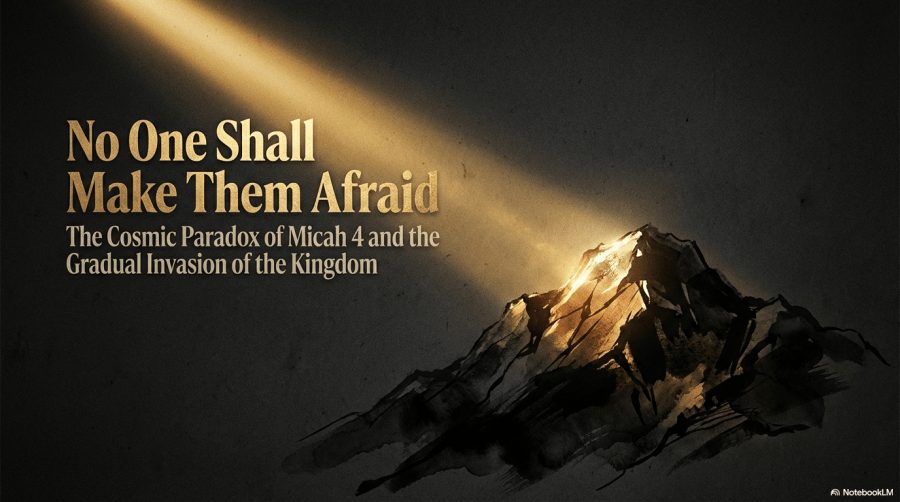
Micah 4 shows us the world as it will be when God finishes His work: a world at peace (vv. 1-5), a world where the broken are restored (vv. 6-8), and a world where Christ reigns over all nations (vv. 9-13).
WORLD PEACE // VERSES 1-5
It shall come to pass in the latter days that the mountain of the house of the LORD shall be established as the highest of the mountains, and it shall be lifted up above the hills; and peoples shall flow to it, and many nations shall come, and say: “Come, let us go up to the mountain of the LORD, to the house of the God of Jacob, that he may teach us his ways and that we may walk in his paths.” For out of Zion shall go forth the law, and the word of the LORD from Jerusalem.
Notice what is described in these first verses. In the last days, God will lift the mountain of Yahweh, Zion, above everything else. Is this a literal rearranging of the earth? Perhaps. This text is very likely describing the new earth, so it could be a literal elevation of Mount Zion. The language may just as easily be figurative for Jerusalem becoming the most important place on earth.
We see a parallel picture in Revelation 21, where the New Jerusalem comes down out of heaven, as a bride prepared for her husband. And the point of that passage is that God’s dwelling place is now with men. Yahweh’s heavenly throne will now be on earth at the New Jerusalem, and all the nations will come to it, saying, “Let us go up to the mountain of the LORD…that He may teach us His ways.”
Can you imagine that? People no longer fight over truth but longing for it instead. No longer resisting God but desiring to know Him, wanting to walk in His paths. From Zion, God’s law will go forth. The whole earth will know His Word, and the nations will be drawn to Him.
The imagery of a mountain is, of course, not accidental. Mountains are a picture of where heaven and earth meet. Some theologians even argue that Eden itself was a mountain garden, which is why the tabernacle is described as a portable mountain of God.
Thus, the vision is of Eden being restored and fulfilled. What was lost in the garden, echoed at Sinai, and glimpsed in the tabernacle and temple will finally be accomplished.
Verse 3 continues:
He shall judge between many peoples and shall decide for strong nations far away; and they shall beat their swords into plowshares, and their spears into pruning hooks. Nation shall not lift up sword against nation, neither shall they learn war anymore.
This is world peace. Weapons of war shall be transformed into tools of cultivation. Instruments of destruction will become instruments of life.
Can you picture a world without war? A world where war is not only absent but forgotten entirely? Where nations no longer train for it?
Verse 4 then gives this beautiful image:
They shall sit every man under his vine and under his fig tree, and no one shall make them afraid, for the mouth of the LORD of hosts has spoken.
This is even better than global peace. This is personal, individual peace.
Every person has a place. The vine and fig tree are commonly used in Scripture to represent personal blessing, fruitfulness, and abundance. The fig tree gives fruit and shade. The vine produces wine, a symbol of gladness and celebration.
These blessings are personal and secure. There is no property tax or mortgage that makes the land into a rental from the bank or government.
Every person has their place. Every person has their blessing.
And they are each flourishing. Without fear.
Verse 5 then is a break from the vision of the future into the present. For now, the nations of the earth walk after their own gods, but we walk steadfastly in the name of Yahweh. We do so knowing that all nations will soon worship Yahweh as well.
I WILL MAKE A REMNANT // VERSES 6-7
In that day, declares the LORD, I will assemble the lame and gather those who have been driven away and those whom I have afflicted; and the lame I will make the remnant, and those who were cast off, a strong nation; and the LORD will reign over them in Mount Zion from this time forth and forevermore.
Here we see who populates this restored Edenic kingdom.
The weak.
The outcast.
The afflicted.
God gathers those who the world rejects and restores them. He makes those who are unworthy of belonging to a people and makes them His people.
That is a theme that Scripture returns to again and again: God opposes the proud but gives grace to the humble. He raises us the lowly and brings down the exalted.
God will restore those who are broken. He will heal. He will gather them into His people and reign over them.
As Christians, we ought to deeply resonate with these verses. Paul specifically tells us that God did not choose us because we were great or worthy of His affection. Rather, we have been made into the people of God purely by His grace. In us, God has chosen the weak in the world to shame the strong.
THE SUBMISSION OF THE NATIONS // VERSES 8-13
Now why do you cry aloud? Is there no king in you? Has your counselor perished, that pain seized you like a woman in labor? Writhe and groan, O daughter of Zion, like a woman in labor, for now you shall go out from the city and dwell in the open country; you shall go to Babylon. There you shall be rescued; there the LORD will redeem you from the hand of your enemies.
Here Micah speaks of a time when the Davidic throne is collapsing, when there is no faithful king ruling over God’s people. He then repeats the promise the Jerusalem would fall.
This is a clear reference to the Babylonian Exile, which would be God’s judgment upon Jerusalem. The city would be destroyed. The temple would be torn down. Its people would be carried away into foreign lands.
It would be pain and agony. Like the pains of labor.
But that image is intentional.
Labor pains are intense. But they lead to the birth a new life.
So shall the Babylonian Exile be: There you shall be rescued. There the LORD will redeem you from the hand of your enemies.
Even in exile, God would work the restoration of His people.
And those the nations will gather against God’s people, thinking that they have triumphed. But they do not understand God’s plan. God will gather them for judgment.
In the end, He will establish His people. He will vindicate them. And every nation will be brought under submission to His eternal rule.
This is a vision beyond Judah’s return from Babylon. It is a restored world.
A world without war. A world without fear. A world where the broken are made whole. A world where paradise is restored once and for all.
This is God’s answer to the problem of sin, suffering, and ultimately death: The world will not always be like this. A new world is coming.
KINGDOM COME
But, you might say, “That sounds wonderful, but when does it all happen? When will all of Micah 4 actually come to pass?”
It will fully come to pass with the second coming of Christ to judge the living and dead. But there is a wonderful phrase that describes much of biblical eschatology: already, but not yet.
You see, we can place all of Micah’s promises under one umbrella: the kingdom of God. Micah is describing the kingdom of God in its fullness. God Himself reigning from Mount Zion, the Son of David seated on His eternal throne, the nations of the earth gather to worship the one true God, and the lowly are restored and gathered together in God’s people.
That happens fully and completely with Christ’s return, but it began with His first coming. Jesus began His ministry with this announcement: Repent, for the kingdom of heaven is at hand.
But Jesus wasn’t just heralding the kingdom; he was bringing the kingdom.
And we see glimpses of that fulfillment even in His earthly ministry. The wise men come from a far-off nation to offer their worship to the Davidic King. Greeks and Gentiles come to hear Jesus’ teaching.
Or consider verses 6-7 again. Jesus does just that. He draws lepers, tax collectors, sinners, the poor, and He makes them into His people. That gathering is what the New Testament calls the church, ekklesia, which means the assembly or the gathering. After all, Jesus said that He did not come to call the righteous but the sinners, just as a doctor does not come to the well but to those who are sick.
A Mustard Seed
So Micah 4 has begun. Does that look like it?
There are still wars.
Nations still worship their own gods.
Death is not yet undone.
Jesus explains the disconnect with a parable:
The kingdom of heaven is like a grain of mustard seed that a man took and sowed a field. It is the smallest of all seeds, but when it has grown it is larger than all the garden plants and becomes a tree, so that the birds of the air come and make nests in its branches. (Matthew 13:31-32)
The point of the parable is the contrast. A mustard seed is tiny, but it becomes a tree large enough for birds to make their nest in its branches.
The kingdom of God is like that. It began with Christ Himself, the King stepping into His creation. Then He calls a handful of disciples: Peter and Andrew, James and John, Matthew. Soon He has twelve apostles alongside other disciples. After His resurrection, there are 120 that gather together, waiting in prayer for the arrival of the Spirit. Then at Pentecost 3000 are added in a single day.
And from there, the kingdom continues to grow.
What began as a small, seemingly insignificant movement in Galilee around an iterant teacher from Nazareth has now spread (and is spreading) across the globe. The gospel is still being proclaimed in every language, even among the smallest and most remote of peoples.
That is the mustard seed.
The kingdom of God is here, and it is growing.
A Gradual Invasion
We should expect nothing less. Jesus said that He would build His church and the gates of hell would not prevail against it. For 2000 years, that is exactly what has happened.
The kingdom of God has invaded this world, and it continues to expand. Every local church is an outpost of the heavenly kingdom. And wherever the gospel is proclaimed and Christ is worshiped, that is the kingdom advancing.
But what about Zion and Jerusalem, which are the primary focus of Micah 4?
Jerusalem was so significant because it held the temple, but the New Testament teaches that we are now the temple of the Holy Spirit. So when Micah prophesied that “out of Zion shall go forth the law, the word of the LORD from Jerusalem,” we are fulfilling those words each time we share the gospel, each time the church carries God’s Word into the world.
In that sense, we are the seeds of the world to come. Christ is the firstborn of the new creation, the firstfruits of the resurrection, and in Him, we too are made new. If you have trusted in Him, you are a new creation. You belong to His kingdom.
We are His people, His temple, and His ambassadors.
Many nations still worship their own gods as we see in verse 5. They are often desperate to hear from their idols, to receive some sign of favor or word of assurance from beyond this life. I’ve seen it personally. People climbing vast mountains to pray from temple that they believe will bring them closer to their gods.
I’ve stood in those temples as a temple of the living God, praying for those people. The true God cannot be reached through human effort, but He does send His temples into the world to gather the lame and the driven away.
We are the seeds of the new creation.
For all of its flaws (and there are many), God has and still is transforming the world through His church. How so?
In his book Dominion, Tom Holland makes an argument that everyone in the West is fundamentally shaped by Christian values, whether we recognize it or not. Many secularists argue that they do not need Christianity to feel compassion for the suffering, poor, and weak or to have a concern for love, mercy, and justice. But Holland rightly points out that those things are not universal human instincts; they are Christian instincts.
In the ancient world, even in our ancestors the Greeks and Romans, there certainly is a concern for justice and virtue, but the idea of elevating the weak, of showing mercy to the afflicted, or of caring for the outcast… In many cases, suffering was seen as something deserved, likely a punishment from the gods. And if the gods had afflicted someone, why risk involving yourself?
Then came Jesus.
Even where Christianity is rejected, its moral fingerprints remain. Secularists still live in the shadow of cross, even when they reject the One crucified. The world has been fundamentally shaped for the better by the kingdom of God.
Of course, that does not mean that the church has been without fault. Far from it. Both we and our ancestors are often guilty of bringing dishonor to Christ’s name.
Thankfully, the building of the church is not on our shoulders. Jesus is building His church.
His kingdom has come and is still coming.
Our Blessed Hope
Micah 4 is presently in motion. But the world is not yet what it will be.
Paul says that creation itself groans for the day when all things are made new, when the ground will be delivered from Adam’s curse.
And we groan as well. For now, there is still pain. Still sickness. Still death. Still sin, the root of it all.
There is sin in the world and sin in our hearts.
We should, therefore, expect suffering. The apostles taught that “through many tribulations we must enter the kingdom of God.” And Peter tells not to be surprised by affliction as those something strange were happening to you. We should expect sorrow in this life.
In a very real sense, we are still in exile. We are still in Babylon.
But it will not always be so.
Christ came to redeem His people. He has already dealt with sin at the cross, once for all. And He will come again, no longer as the suffering servant but as the triumphant King. On that day, the heavens will melt as they burn, and Christ will judge the living and the dead.
But if we are in Him, we do not need to fear that judgment. It is true that God must judge all sin. To be truly just and good, He cannot simply pretend as though our sin never happened. But by His lovingkindness, Christ has taken the judgment for is people.
Thus, every sin ever committed will meet judgment. We can either bear it ourselves or look to Christ and be saved. That is why Paul calls Christ’s return our blessed hope. For those who are in Christ, the judgment of God has already fallen upon our sin, so we have nothing fear on the great Judgment Day. Every sin we have committed, are committing, or will ever commit was laid upon Christ.
And in exchange, He gives us His perfect righteousness.
Do you believe that?
Christ has rescued us. And He will rescue us again.
He has defeated our great enemy: sin. And soon, He will come again to destroy the final enemy: death.
On that day, the promises of Micah 4 will be fulfilled entirely. He will assemble the lame, gather the outcast, and restore the afflicted. All nations will worship Yahweh. God Himself will be with His people in the New Jerusalem. We will each sit under our own vine and fig tree, and no one will make us afraid anymore, for our King “will wipe away every tear from their eyes, and death shall be no more, neither shall there be mourning, nor crying, nor pain anymore, for the former things have passed away” (Revelation 21:4).
 B. C. Newton