
Last week, we began the section of the Song of Songs that takes us today to the very center of the poem. It began in 3:6 with the question of who or what is coming up from the wilderness like a column of smoke? I made the argument that both of those translations are correct because the ambiguity of the Hebrew is meant to apply to both the litter of Solomon in 3:7 and the woman in 4:1.
The text then gave us a contrast between the cracked glory of Solomon and the woman. What is coming up from the wilderness? It is the litter of Solomon, glorious but also hollow and broken. Who is coming up from the wilderness? It is the bride of the Song, simple but altogether beautiful.
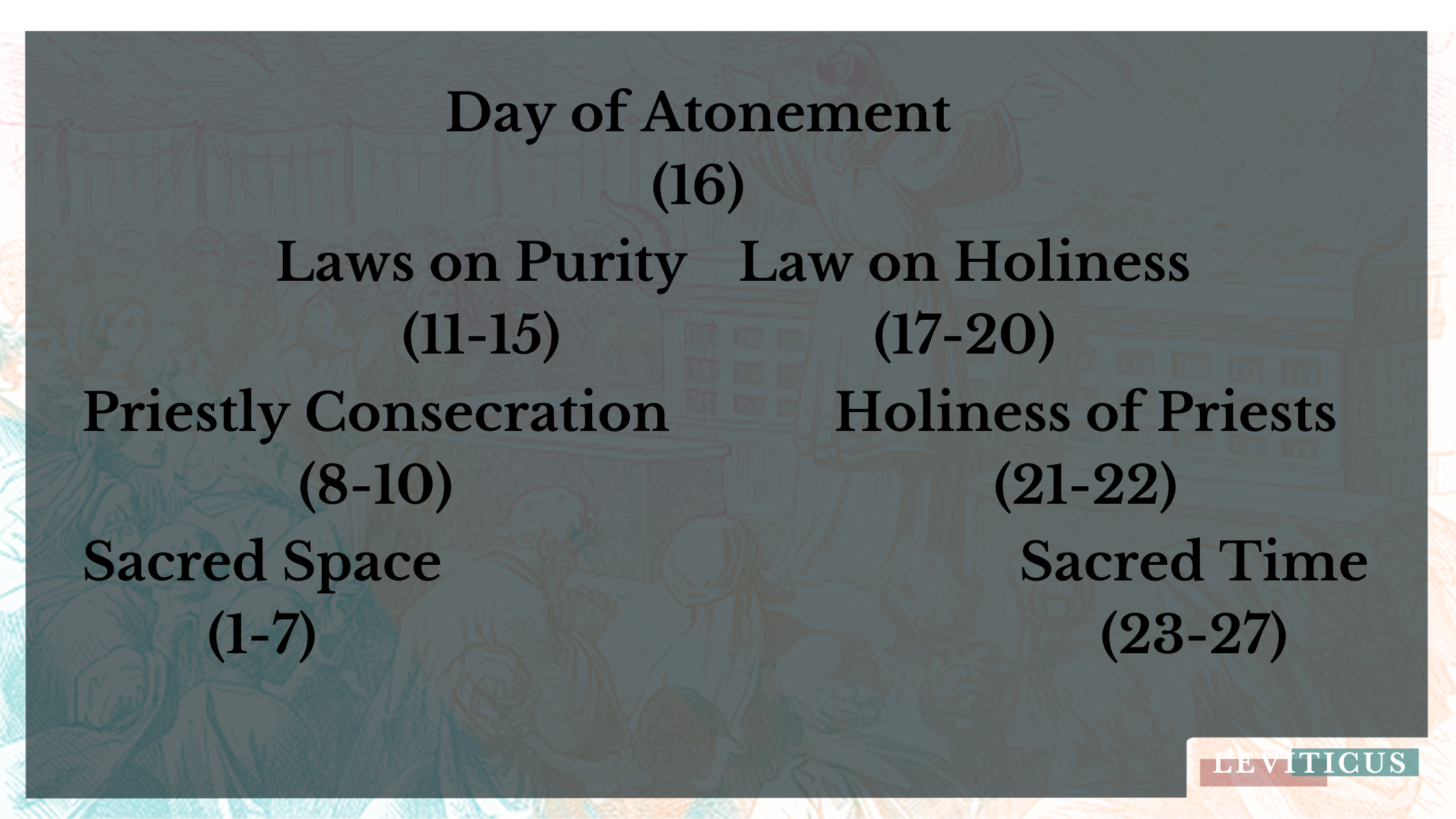
That unit continues into our present text, which takes us to the heart of the Song. While the structure of the Song is notoriously difficult to pin down, most theologians agree that it has a chiastic structure just like we saw in Leviticus last year. Remember that Leviticus is structured like a literary mountain (which was fitting since the tabernacle was a portable Mount Sinai), and the Day of Atonement in chapter 16 was the mountaintop.
Song of Songs has a similar structure. Our text is the mountaintop of the poem. Specifically, many commentators point out that 5:1 has 111 lines before it and 111 lines after it, making it the dead-center of the Song.
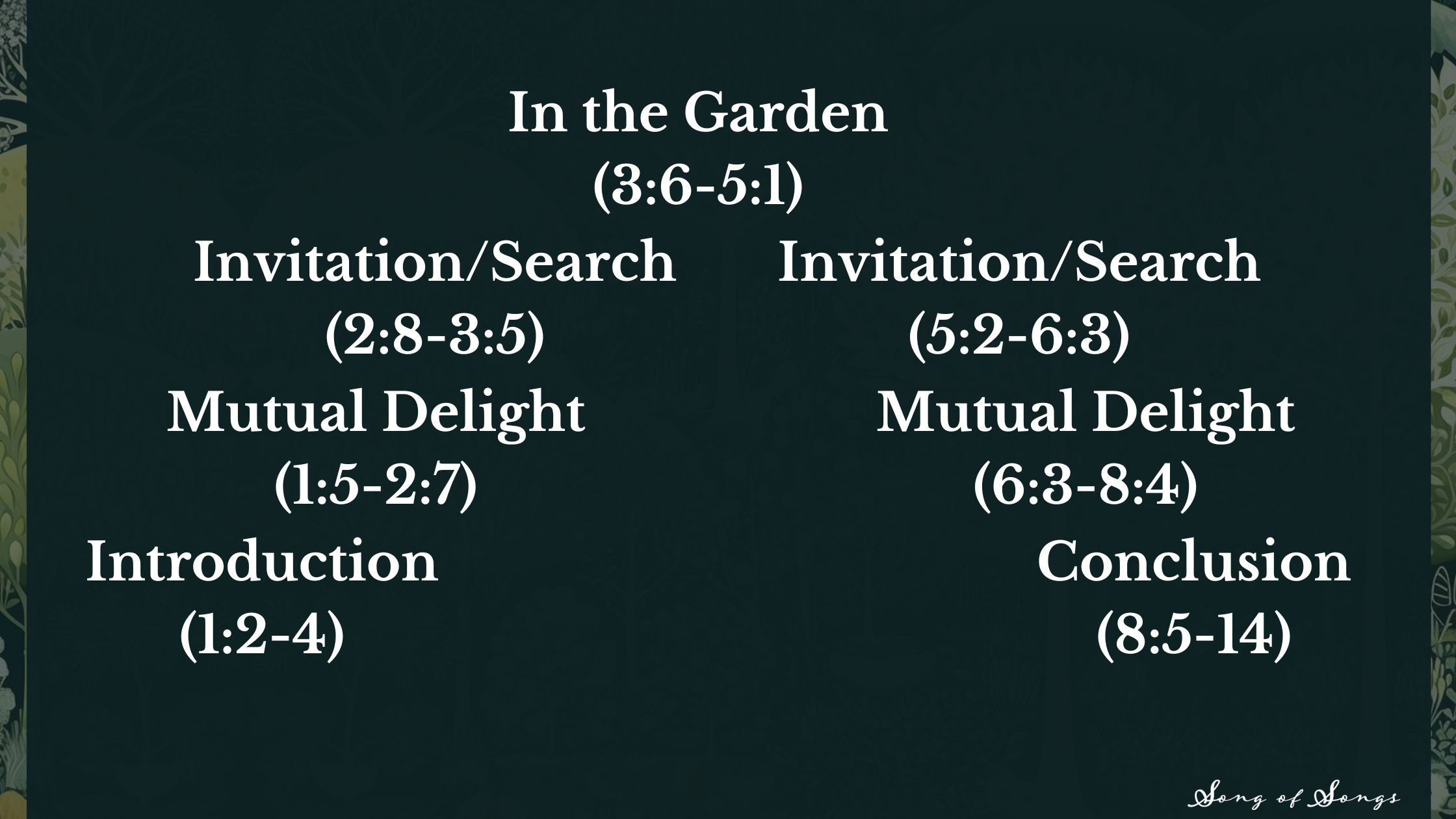
And the comparison between Leviticus and the Song is fitting. The Day of Atonement was the closest that we came to going behind the veil into the Holy of Holies. Likewise, 5:1 is the closest that the Song comes to the veil that guards the marriage bed. The Bible places both atonement and marriage behind a veil because both are holy. But while the Day of Atonement was a solemn day of fasting and repentance, this text is a celebration and a feast, making it very fitting for this Resurrection Sunday.
Five words will guide our look at the text: call, delight, garden, union, feast.
CALL // VERSE 8
We see the call in verse 8:
Come with from Lebanon, my bride;
come with me from Lebanon.
Depart from the peaks of Amana,
from the peaks of Senir and Hermon,
from the dens of lions,
from the mountains of leopards.
The man is calling to the woman, and this is his first time to call her his bride. Glancing at the remaining verses, you will notice that he calls her this several more times. Most commentators take this as an indication that the text describes their wedding day or, more specifically, their wedding night.
And that may be the case. As I have said before, it would be fitting for the Song to feature a remembrance of their wedding at the center of the poem. Yet it seems just as likely to me that he is using wedding imagery to remind her that she is still his bride, that the flame of their wedding night has not died away. He still loves her as much as the day he first saw her.
He calls her from Lebanon, which was known for its great wood for building. It was also near Israel but still outside of it. That seems to be the point which the mountains reinforce. Amana, Senir, and Hermon were mountains in the wilderness. Remember that she was poetically coming up from the wilderness in 3:6?
We know this is wilderness because those mountains were the dwelling place of lions and leopards. Thus, he is metaphorically picturing her as being far away from him yet still within view, like smoke rising on the horizon. She is not in the garden. She is in the wilderness, alone, in the place of danger.
Even though this is heightened and dramatic language for poetry, it reflects an ordinary aspect of marriage. There is always need for a call because there is always a movement back and forth between presence and absence. Marriage is a constant rhythm of absence and return, of distance and nearness. All intimacy is, in some sense, a renewal of presence after absence.
But dangers still lurk in the ordinary. That’s why the wilderness is the den of lions and leopards. The longer the distance and absence, the greater the danger becomes. Marriage is more than physical intimacy, but it is not less than it. Illness, injury, or any other number of circumstances may remove physical intimacy for a time or even permanently. That does change the marriage. Marriage is more than physical intimacy.
But that does not make intimacy unimportant. God designed physical intimacy to knit the hearts of a husband and wife together. And the longer that it is ignored or neglected, the more danger there is that all forms of intimacy also die out.
Neglecting intimacy is dangerous, like living with lions and leopards. You are exposing yourself to danger, which is why Paul commands couples in 1 Corinthians 7 not to deprive one another.
The same also applies more broadly to the Christian life. While it is technically possible to be a lone-wolf Christian, it is life of unnecessary danger. The call of Christ is to also be near His people.
DELIGHT // VERSES 9-11
In verses 9-11, the beloved delights in his bride.
Notice that he calls her my sister, my bride. The idea here is not of biological siblings but of familial closeness. After all, in marriage, a new family is created. She becomes, in a sense, the sister of his soul, his closest kin.
As Christians, this language is not entirely foreign to us. Our spouses are also our brother or sister in Christ. Indeed, that is most fundamentally what they are to us. Jesus says that in the resurrection we will not be given in marriage. Earthly marriage is a temporary union, till death do us part. It is absolved upon death. But we will spend all eternity as brothers and sisters in Christ.
The language, therefore, is of closeness, family, covenant, and love.
He then says, You have captivated my heart. Iain Duguid points out that today we think of the heart as the seat of the emotions, for the ancients that was the bowels. No, in Hebrew thought, the heart was more like what we call the mind, the center of thought, will, and identity.
Thus, when we hear, you have captivated my heart, we should not think that she has captured his emotions. No, she has captured his mind. It is as if he is saying, “I cannot stop thinking about you. My thoughts are imprisoned by you.” Indeed, Tremper Longman III translates this phrase as “You drive me crazy, my sister, my bride!”
He is so delighted in her that he is disoriented. She has captured all of his thoughts. He cannot escape her. And, importantly, he doesn’t want to.
How beautiful is your love, my sister, my bride!
How much better is your love than wine,
and the fragrance of your oils than any spice!
Your lips drip nectar, my bride;
honey and milk are under your tongue;
the fragrance of your garments is like the fragrance of Lebanon.
Here again ‘love’ might be also translated as lovemaking. And notice that he says that milk and honey are under her tongue. That is unmistakably language of the Promised Land, the land flowing with milk and honey. She is, therefore, his personal Promised Land. She is his abundance, his sweetness. She is the very fruit of life.
Interestingly, this is nearly the exact counterpart to the warning that we find in Proverbs 5:3-6.
For the lips of a forbidden woman drip honey,
and her speech is smoother than oil,
but in the end she is bitter as wormwood,
sharp as a two-edged sword.
Her feet go down to death;
her steps follow the path to Sheol;
she does not ponder the path of life;
her ways wander, and she does not know it.
Notice the contrast. The adulteress’ sweetness is a lie that leads to death. The bride, however, has true sweetness that is bursting with life. Indeed, Proverbs 5 goes on to command husbands to do exactly what this man is doing.
Drink water from your own cistern,
flowing water from your own well.
Should your springs be scattered abroad,
streams of water in the streets?
Let them be for yourself alone,
and not for strangers with you.
Let your fountain be blessed,
and rejoice in the wife of your youth,
a lovely deer, a graceful doe.
Let her breasts fill you at all times with delight;
be intoxicated always in her love.
That is precisely what this text is showing us. He is intoxicated with her love. He is captivated by her. But, critically, his delight is exclusive. It is wild and untamed, but it is only for her.
GARDEN // VERSES 12-16
That exclusivity is seen in verse 12:
A garden locked is my sister, my bride, a spring locked, a fountain sealed.
In that ancient world, gardens were often enclosed, especially private ones. They were planted around a home and then guard by a wall. One could not simply walk into it. Only the owner had access to his garden.
Likewise, she is a garden locked. She is not public, not available to everyone. She is exclusive.
This ties back to Proverbs 5. She is not “streams in the street.” She is not “springs scattered abroad.” She is his.
Then he expands the imagery:
Your shoots are an orchard of pomegranates
with all choicest fruits,
henna with nard,
nard and saffron, calamus and cinnamon,
with all trees of frankincense,
myrrh and aloes,
with all choice spices—
a garden fountain, a well of living water,
and flowing streams from Lebanon.
Iain Duguid points out that this is an impossible garden. These spices and plants do not all grow in the same nor the same climate. This cannot be a botanical reality, but it is a picture of poetic abundance. It is an idealized garden.
Interestingly, the word used here for orchard is not a regular Hebrew word. Instead, pardes, which is a loanword from Persian, is used. And it is the root of our word paradise, which came to us through Greek and Latin.
She is not simply a garden; she is paradise. She is a taste of Eden, a personal Promised Land.
Just as earlier in the poem she called him her Engedi, her oasis in the wilderness, now he calls her his paradise. She is a garden fountain, a well of living water, flowing streams. She is his refreshment and delight.
Wives, is that a fitting description of you for you husband? Do you strive to place a well of living water for him, a private garden where he can find rest and rejuvenation? Does delight to be with you? Or does he need to constantly walk on eggshells around you? Are you instead the quarrelsome, nagging wife of Proverbs that makes the corner of the roof or the wilderness look like quiet spots to get away?
The text goes on:
Awake, O north wind,
and come, O south wind!
Blow upon my garden,
let its spices flow.
Though she is a garden locked, which remains true, he now calls her my garden. He says, in effect: Let the fullness of your beauty be revealed. Let the winds blow. I want to smell all of your fragrances. I want to enjoy my garden.
She is still locked, just not to him. She is still sealed, but not from him.
That is why she responds with her only words in this section: Let my beloved come to his garden and eat its choicest fruits.
His garden. When she said earlier, “My beloved is mine, and I am his,” she meant it. She invites him into her garden. She invites him to delight himself in her.
I find it notable that throughout most the Song, the bride is the dominant voice. At the beginning, her desire initiates. The end concludes with her desire. But here, at the heart of the Song, his desire is front and center.
UNION // VERSE 1A
And so we come to the summit of the mountain:
I came to my garden, my sister, my bride,
I gathered my myrrh with my spice,
I at my honeycomb with my honey,
I drank my wine with my milk.
This is as close as the Song brings us to the veil. But even here, the language is still veiled. The Song brings us to the threshold but never peals back the curtain.
Douglas O’Donnell points out that for all the repeated words like bride, sister, and garden, the most frequent word in this passage is my. Now, in Hebrew ‘my’ is not a separate word but a suffix. For example, dan means judge, and dani means my judge, which is why the name Daniel means God is my judge.
But it is used repeatedly here: my garden, my sister, my bride, my myrrh, my spice, my honeycomb, my honey, my wine, my milk.
She is his. And he is hers. Mutual belonging. That is fundamentally what marriage is, which we see in the biblical definition of marriage:
Therefore, a man shall leave his father and mother and hold fast to his wife, and the two shall become one flesh.
One flesh means union. Wives are not their own but belong to their husbands. Husbands are not their own but belong to their wives. Mutual belonging.
Indeed, we should bring back the old word husbandry, which originally meant to manage a household, cultivate land, repairing and restoring what is broken. A husband was someone who cultivated, protected, and guided flourishing.
If you are a husband, your wife is your garden. Are you tending to her? Are you nourishing her and cultivating her?
Likewise, wives, are you tending the garden entrusted to you? Are you cultivating your body, your mind, your emotions, so that you are a place of companionship and delight?
FEAST // VERSE 1B
The passage concludes with the chorus, probably the daughters of Jerusalem, and they say:
Eat, friends, drink, and be drunk with love.
This brings back an important theme of the book. Biblical intimacy is private and exclusive, but it is lived out in community. Of course, the community does not enter the garden. They do not go behind the veil, but they rejoice with the couple, celebrating their love.
This is a reminder that we once lived in a garden paradise, naked and unashamed. And marriage, properly ordered, is a taste of that paradise lost to us. Marriage does not push back the curse of death, but it does bring new life into the world. It is worthy of celebration, even intoxication.
In the New Testament, Christians are repeatedly told to be sober-minded. But there is no contradiction with those commands and this passage. Marriage is the only place to be intoxicated with love. In the garden, all pleasures were for the taking; only one fruit was forbidden. Now, life is the opposite. When it comes to sexuality, everything is forbidden, except within marriage.
And it is right for us to celebrate and encourage each marriage around us, Christian or not.
BACK TO THE GARDEN
Our reading of the Song is not complete unless we have set our gaze upon Christ. While we do not aim to turn every poetic metaphor into an allegory, we do know that marriage ultimately points to Christ and His bride, the church.
Every marriage is pointing to Jesus and His bride. Even though the Song of Songs is plainly about earthly marriage, our earthly marriages are living metaphors for that great Marriage, the eternal marriage.
The same five words can guide us again.
Just as the beloved called his bride, Christ calls us. He calls us out of the wilderness, out of the place of isolation and danger. He calls us out of the world, which lies under the power of the evil one, who roams like a roaring lion seeking those to devour.
But Christ calls us to leave worldliness behind and be with Him.
Ephesians 2 says that we were dead in our sins, following the prince of the power of the air, following the course of this world, and following the passions and desires of our flesh. Colossians says that we belonged to the domain of darkness. But Christ calls us out of death and into life, out of darkness and into His everlasting kingdom.
As the beloved then delighted in his bride, so Christ delights in us. Although we were not lovely, Christ makes us lovely. Even our righteous deeds, Isaiah says, are like filthy rags, but Christ clothes us in His own righteousness to make us beautiful.
I find it interesting that Longman gives the translation “you drive me crazy, my sister, my bride” because, in a sense, the gospel appears to be the craziest and most foolish news of all time. God became a man. The King of glory dies for those who rebelled against His rule. He brings salvation through a cross.
Yet Paul tells us that though the cross is foolishness to the world, to those being saved it is the very power of God. It is not foolish or reckless, though it may appear so to the world; it is the eternal purpose of the Father, the Son, and the Holy Spirit.
And all the greatest pleasures on earth are only a shadow of the joy that Christ has prepared for His people. He is the true treasure, the pearl of great price.
What of the garden? If the bride is her beloved’s garden, then we must admit that we are a ruined garden. Just as the first sin ruined Eden, none of us have a garden locked nor a fountain sealed for God alone. As Calvin rightly said, our hearts are perpetual factories of idols. We constantly violate the very first of His commandments: You shall have no another gods before me. We give our attention, our affection, and our adoration to other things, to that which are not gods. No, we are not a paradise garden for our God.
Interestingly enough, in John 20, Mary mistakes the resurrected Jesus for the gardener, but as the Song shows us, in one sense, Christ is the great Gardener. He is great Husband that did not abandon His garden. Though we ruined ourselves, defiled ourselves, and repeatedly rejected our Beloved, He still came for us, to rescue and restore us.
Christ cleanses us from our sins and sends us His Spirit to bring us to life, to prune and cultivate us. Just as the husband calls for the wind to blow upon his garden, the Spirit is often compared to the wind, and it is the Spirit that revives our dead hearts.
It is also the Spirit that causes our lives to give off the fragrance of Christ. To those who are perishing, the aroma is bitter, a fragrance of death. But to those who are being saved, the aroma is sweet, a fragrance of life.
He not only brings us back to the garden; He begins restoring Eden within our own hearts. Consider how Hosea 14:4-7 describes the promise of salvation:
I will heal their apostasy;
I will love them freely,
for my anger has turned from them.
I will be like the dew of Israel;
he shall blossom like the lily;
he shall take root like the trees of Lebanon;
his shoots shall spread out;
his beauty shall be like the olive,
and his fragrance like Lebanon.
They shall return and dwell beneath my shadow;
they shall flourish like the grain;
they shall blossom like the vine;
their fame shall be like the wine of Lebanon.
Does that language sound familiar? God is saying that He will make His people into a garden again. He will restore what was ruined by sin.
That is God’s answer to our idolatry.
And Christ has already come to His garden. He already made us His bride, His brothers and sisters, co-heirs with Him. He has already given us the honey of His Word. He has already brought us into the true Promised Land, the kingdom of God.
But the kingdom has not yet come in its fullness. It has been inaugurated, but it is not yet consummated. Christ is with us now spiritually, even to the end of the age, but there will come a day when He returns to make all things new, when we receive resurrected bodies, and when we will stand before Him face-to-face. New Jerusalem, a garden city, will be our eternal home.
On that day, we will be altogether beautiful. There will be no flaw in us. Our sin will be gone forever. We will be a garden fully renewed. Death will be no more. Sickness and pain will also pass away. And the heavenly host will celebrate with us the marriage supper of the Lamb. The great marriage, the true marriage, will at last be consummated. The kingdom will have, indeed, come.
But until that day, we take this small feast. We are not yet gathered with the whole body of Christ across both space and time, but we are an outpost of the kingdom. Likewise, this bread and cup are not a full feast but a waybread for the journey and a sip of life in the wilderness. They are signs that point us toward Christ, our oasis and garden in the midst of the broken world. Here, then, we have a glimpse of a better world to come, a world in which we will eat and drink with our Beloved, intoxicated with His love forevermore.
DISCUSSION QUESTIONS
- Why does the Song use garden imagery to describe marriage and intimacy? What does a garden communicate that another image might not?
- Why does the Song bring us close to the marriage bed but still keeps everything veiled in poetic language instead of being explicit?
- The sermon described marriage as a rhythm of absence and return, distance and nearness. Have you seen that rhythm in marriage or close relationships? Why is intentional pursuit important?
- The sermon described spouses as gardens entrusted to one another to cultivate. What are some practical ways a husband or wife can “cultivate” their spouse rather than neglect them?
- The passage ends with a feast and celebration. Why is it important for families and churches to celebrate and support marriages rather than ignoring them?
- The sermon connected the bridegroom’s call to Christ calling us out of the wilderness. In what ways does Christ call people out of danger, isolation, and sin?
- The Holy Spirit was compared to the wind that blows over the garden and spreads its fragrance. What are some ways the Spirit produces “fragrance” or fruit in a Christian’s life?
 B. C. Newton