
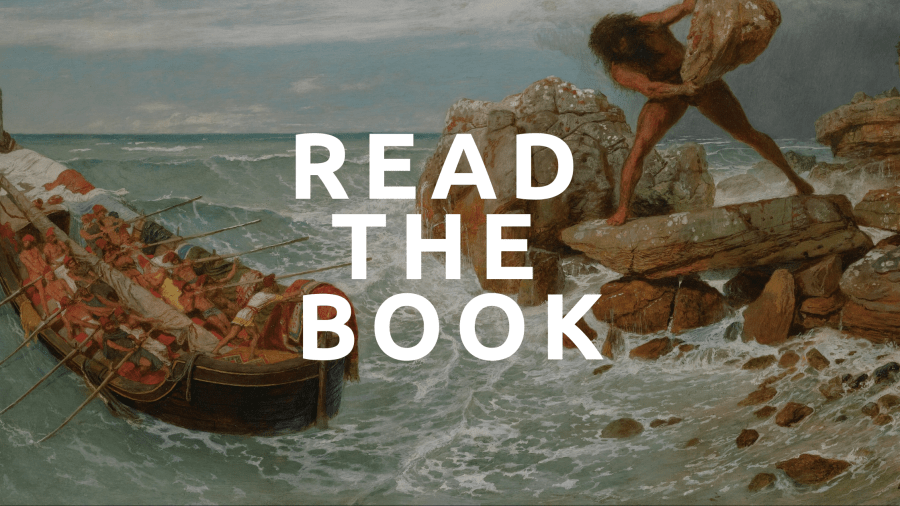
I haven’t seen Christopher Nolan’s Odyssey. I don’t know if I will.
The internet seems divided. Some call it one of Nolan’s greatest achievements; others call it a desecration of Homer. I suspect the truth is somewhere between those extremes. Great artists have always reimagined great works, and viewers have always been free to embrace or reject those interpretations.
Whatever one thinks of Nolan’s film, I hope it leads many people to read the original.
Homer’s Odyssey is still worth reading.
Why Should We Still Read the Odyssey?
The reasons for reading the Odyssey are many, but here are the two that are most meaningful to me.
First, it is a foundational work of Western literature. If you live in the West, the Odyssey is a part of your cultural DNA, whether you know it or not. It and the Iliad were two of the most formative books in ancient Greece, and we owe much to the influence of Greek thought and ideas. To be ignorant of Homer is to be disconnected from the roots of our cultural heritage.
Second, the Odyssey grapples with perennial questions of humanity. Great books shape whole societies through shaping individuals, and they do so by dealing with the great ideas that make us human. They act as mirrors, giving a setting for us to ponder the great questions of life.
For instance, the Odyssey is fundamentally about a man. The first line tells us that much. Odysseus is the subject of the work, and through Odysseus, Homer explores what it means to be a man. We see this in the three ways that man is used.
In the broadest sense, Odysseus is a man, a human being, and we see his humanity through his interaction with animals, monsters, and gods.
Odysseus is also a man in the sense that he is the masculine sex. The Odyssey invites us to consider a man’s role in society, especially how a man who has won glory and fame in war is able to reintegrate back into normal society.
In Greek, the word for “man” (aner) can also mean “husband,” which we see through Odysseus’ devotion to his wife, Penelope. Of course, that devotion is quite different from what we might expect. He has no remorse, for example, about sleeping with two nymphs, Calypso and Circe. Yet he does still reject an immortal life with Calypso to return to his mortal wife and live the rest of his days with her.
In the midst of the story, we also find a myriad of other themes. The first four books (of 24) focus on Telemachus, Odysseus’ son, which is very much a sort of coming-of-age story. The suitors wreaking havoc to Odysseus’ home are young men whose fathers went to fight in the Trojan War, so we also have the idea of what becomes of a fatherless society.
Then there is the question of what makes people civilized. How does hospitality make us different than the beasts and monsters around us?
The Odyssey doesn’t give us definitive answers to those questions. But the beauty of classic literature is that it raises great ideas so that we can wrestle with them in the context of a story.
How to Read the Odyssey
If that makes the Odyssey sound intimidating, the truth is that it is remarkably approachable with a little guidance. So let me offer four pieces of advice.
First, you don’t have to read the Iliad first. Yes, the Odyssey takes place after the events of the Iliad, but it is not a sequel as we think of today. Both are standalone stories that are focused on different themes and subjects. You can dive straight into the Odyssey.
Second, listening to the audiobook still counts. This is especially true of Homer, who was probably a bard who composed and told his stories orally. They were only written down later, which means that they were made to be heard. Indeed, if you are reading a physical copy, I would still suggest that you read it out loud.
Third, I first heard this regarding the Divine Comedy, but it applies to all epics: once you have read it, you are now prepared to begin reading it. The point is not to get bogged down by trying to understand every detail. There is simply too much to process, especially on your first reading. Read it as something that you will very likely return to and just get through it. Try to get the overall grasp of the story. Further readings can focus on exploring the details that make the work so great.
Fourth, get help while reading. This can be through a reading group or through online teachings. Two of my favorites for the Odyssey were Elizabeth Vandiver’s lectures and Spencer Klavan’s episodes on the Young Heretics podcast. Vandiver’s lectures are more suited to be listened to alongside a first-time reading. Klavan’s episodes walk through the Odyssey chronologically and would, in my opinion, fit better before or during a second reading.
That was my experience. I read the Odyssey alongside the Iliad and the Aeneid three years ago. I liked the Iliad much more than I anticipated and was excited to read the Odyssey. But it wasn’t what I expected, so I was quite disappointed (“the true first season of Undercover Boss” were my exact words). But Klavan’s discussions unveiled much of what I had not noticed while reading and elevated it to one of my favorite works of literature. The problem, of course, was not with Homer but with my failure to understand him.
Whether you see or like Nolan’s Odyssey, I hope you read the book.
It really is worth it.

