
Author
As with the other books of the Torah or Pentateuch, Moses has traditionally been acknowledged as the author of Leviticus. Since Jesus affirms Moses’ authorship of the Torah generally, we are well within reason to do so with Leviticus specifically.
Theme
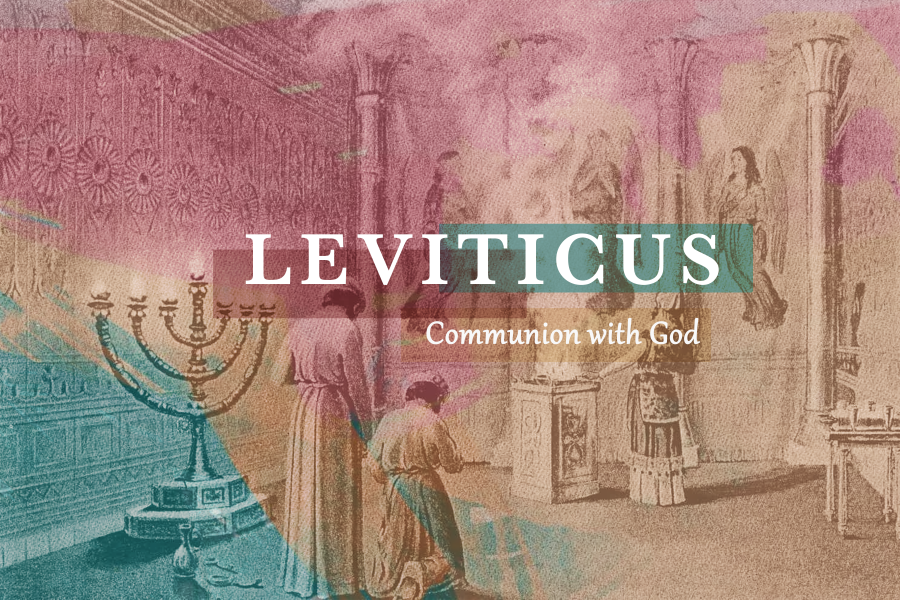
Yahweh gives Moses instructions for how His covenant people can enter into His presence and have communion with Him at His tabernacle.
Background
As the central book of the Pentateuch, Leviticus cannot be properly understood apart from the books before (Genesis and Exodus) and after (Numbers and Deuteronomy). Indeed, as with Genesis and Exodus, we can presume at least that Moses wrote the words of Leviticus down sometime during Israel’s forty-year wandering in the wilderness. However, Leviticus may very well be one of the earliest pieces of the Torah to be scribed. While Yahweh does not explicitly command Moses to write the words of Leviticus down, as He does with the Book of the Covenant in Exodus 24:3-4, we can easily imagine Moses’ writing this book during Israel’s stay at the base of Sinai.
Purpose
The purpose of Leviticus seems to be captured in its title. Leviticus comes from the Latin Vulgate, which translated the Greek Λευιτικον, meaning pertaining to the Levites. Since the Levites were charged with caring for the tabernacle and since the tabernacle is the great focus of the book, the title makes sense. There is even a Hebrew tradition of calling Leviticus, the Book of the Priests. Thus, many rationally assume that Leviticus was written to be a manual for the priests and Levites regarding tabernacle protocol.
Yet, while there are certainly commands that are given directly to the priests, the book itself is not addressed specifically to them. Instead, in 1:2, Yahweh tells Moses: “Speak to the people of Israel and say to them…” Leviticus was not merely for the priests but for the whole people of Israel, which we see in 26:46 as well:
These are the statutes and rules and laws that the LORD made between himself and the people of Israel through Mose on Mount Sinai.
But since the tabernacle is the setting and focus of the book, these are specifically statutes, rules, and laws regarding Israel’s worship of Yahweh at the tabernacle. Taken by itself, this makes Leviticus quite dull to read since we are not ancient Israelites worshiping at the tabernacle. Yet we can push back against that dullness endeavoring to consider Leviticus in context as the central book of the Torah.
Genesis, of course, is the book of beginnings. It tells us of creation, the fall, the flood, and the patriarchs of Israel. It is the story of wonder, of loss, and of glimmers of hope. Genesis 1-11 tells us how humanity was exiled from Eden and how we have been going further down and further out ever since. Yet while those chapters end with humanity united in rebellion against Yahweh and then scattered by Him throughout the earth, chapter 12 tells how God chose a particular man to be the ancestor of a particular people that He would covenant with.
Exodus sees the descendants of Abraham become a large people, but they are enslaved in Egypt. Therefore, Yahweh redeems Israel from her slavery, takes her into the wilderness, and brings her to Mount Sinai. Upon that desert mountain, the Creator Almighty made a covenant with the people of Israel, just as He promised to their ancestor. But they could not stay in the wilderness at Sinai forever. They needed to enter the land of Canaan that Yahweh had promised to Abraham. So that His presence would continue to be in their midst, God commanded the Israelites to build a tabernacle, according to His design. Exodus ends with the tabernacle complete, and the glory of Yahweh filling the tent. And yet are marvelous as this is, Moses cannot enter the tabernacle.
That, in a nutshell, is the context for Leviticus. that fuels its purpose. We ought to read it imagining the wonder of an ancient Israelite, knowing that the Creator Himself was choosing to dwell in the midst of your people and that He intended to go with you into the land of Canaan. But also consider the fear that begins Leviticus. Why could Moses not enter the tent of meeting? More importantly, how could such a righteous and holy God dwell in their midst without consuming them?
The various rituals and commandments must be seen through that lens of wonder and fear. Wonder that God’s presence was dwelling in the middle of Israel, but fear over how such a sinful and defiled people could ever be in His presence. From this understanding, we should read each ritual as a gracious revelation of Yahweh to His people, detailing for them exactly how they should approach Him for worship. And if we see the sacrifices and rituals of Leviticus as displays of God’s grace, how much more should we now magnify the grace of God given through the once for all sacrifice of Christ?
 B. C. Newton