
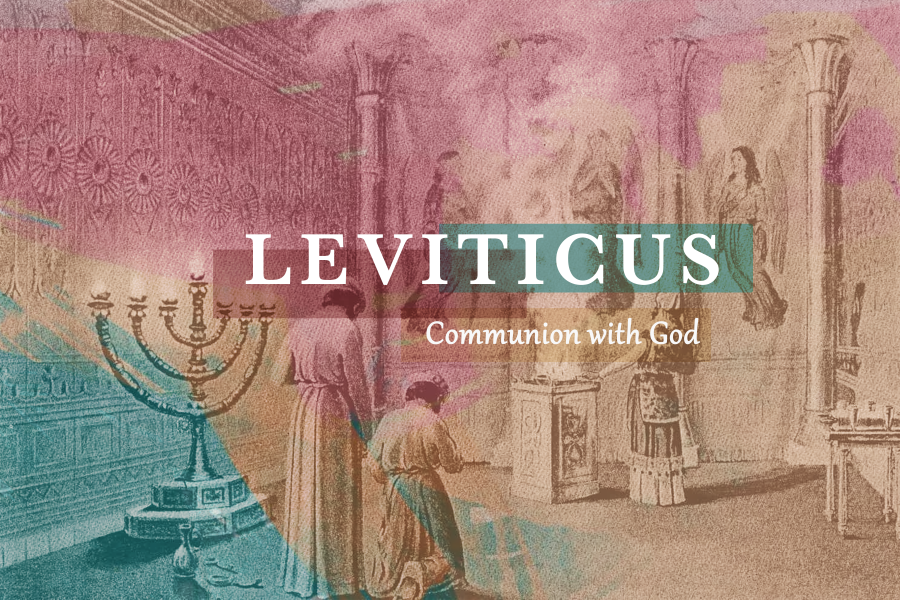
The LORD called Moses and spoke to him from the tent of meeting, saying,
Leviticus 1:1 ESV
Leviticus is a manual for proper worship. “Worship is addressed in every single chapter in Leviticus. It is Israel’s orienting center” (Palmer, 823). And center is a very fitting word.
The Torah, the first five books of the Bible, are also called the Pentateuch, which means five scrolls or five volumes. Indeed, we can think of these books of Moses as being one book in five parts. Genesis, Exodus, Leviticus, Numbers, and Deuteronomy all form one cohesive text as the foundational Scriptures for the Hebrew people. Because Leviticus is the third of these five scrolls, it cannot be properly understood without knowledge of the two previous. For that matter, a correct reading of Leviticus propels the reader into the two following volumes as well. You see, Leviticus is literally, literarily, and theologically at the center of the Pentateuch. It is the mountain peak that Genesis and Exodus have been building toward, and it is the song that Numbers and Deuteronomy are reflecting upon and carrying forth toward the Promised Land. Leviticus is fundamentally connected to the four books around it. We cannot read it alone.
While I have already preached through Genesis and Exodus (which, by the way, is what brings me here to Leviticus), we can also use this first verse of the book to recount those books and properly orient ourselves for the remainder of our study. To do this, we will break the first verse into the three nouns and three verbs that we find in this verse.
YHWH
In English writing, we tend to place the word or argument of most importance either at the beginning or the end. Biblical Hebrew tended to use the middle. We recently saw this with the poetic book, Lamentations. Composed as five poems, the third is clearly meant to be literary tree whose top is bathed in the light of the sun, even as the thick smoke continues to swirl around its base. “The steadfast love of the Lord never ceases; his mercies never come to an end; they are new every morning; great is your faithfulness” (Lamentations 3:22-23). Those are the words that the writer intends to linger in our minds, after we finish the book.
This verse functions the same way (in a chiasm, no less). In Hebrew, it is nine letters. At the center, with four words before and after, is the tetragrammaton, which literally means, the four letters: YHWH (יהוה). Your Bible most likely says the LORD (using all capital letters), and it is often pronounced as Jehovah or Yahweh. English translations typically use Lord because they follow the pattern of the Septuagint. This is the most important word in the verse for good reason; Yahweh is the personal name of God, revealed to His covenant people.
In Genesis, Yahweh is introduced from the beginning by His most well-known title: “In the beginning, God created the heavens and the earth.” But He is first called Yahweh God in 2:4. Particularly within these first two chapters, we are given a critical aspect of who Yahweh is. He is the Creator of all things. In fact, the phrase “the heavens and the earth” in Genesis 1:1 is a merism that refers to the entire cosmos. Everything that exists came into existence because of God. He is the Creator and the only uncreated being. He gives matter itself its beginning, yet He has no beginning. Before the beginning ever began, He was.
Because He is unique among all things as the Creator, God is also holy. Quarks and nebulas, motes of dust and mighty mountains, chihuahuas and archangels all share at least one trait in common: they were made. We and everything else were designed like pieces of pottery, but Yahweh alone is the Designer and Potter. No one and nothing else is like God. He is holy.
Nothing in Leviticus will make sense unless we cement the holiness of God firmly within our minds and, more importantly, our hearts. Regardless of how we feel about particular ordinances and rituals in this book, we must repeatedly remind ourselves that the Creator owns His creation. Because God is the Creator, all of creation belongs to Him. He is the potter, and we are His living, breathing pottery. He is the painter, and the sun, moon, and stars are His radiant canvas. He is the sculptor, and the earth is His intricately designed monument.
Yet to be even more precise, the Creator alone has the right to dictate the purpose of His creation. We affirm this over our own creative endeavors but wince at the thought of logically applying it to God. Even so, regardless of our acknowledgement and assent, Yahweh alone has the right to define the purpose for which we exist. The Westminster Shorter rightly says that our purpose or chief end is to glorify God and enjoy Him forever. God created us to worship Him in communion with Him for all eternity.
For our first parents, Adam and Eve that was achieved through positive commands and a single negative prohibition. Positively, Yahweh told mankind to rule over the earth and all the animals upon it, to make the rest of the earth look like the garden that God planted for them in Eden, and to fill the earth with their children. God gave Adam and Eve all things on the earth enjoy, including one another, and He Himself walked among them, dwelling with them as their God and they as His people. There was only one single prohibition. The fruit of the tree of the knowledge of good and evil was not to be eaten.
Even if you know nothing at all about Genesis, you can probably guess what happened next. Adam and Eve rebelled against their Creator. Sin and death entered the world, and our first parents were cast down from the garden of God and out of God’s holy presence.
Within the next generation, their son Cain becomes the first murderer by killing his brother, Abel. For his punishment, the LORD casts him even further down and further out from His presence.
Generations pass, and the world grows morally dark. “The LORD saw that the wickedness of man was great in the earth, and that every intention of the thoughts of his heart was only evil continually” (Genesis 6:5). So, God annihilated mankind. Mostly. Just as only the blameless (tamim) and righteous (tsadiq) can enter God’s tabernacle (Psalm 15:1-2), so only Noah, “a righteous man, blameless in his generation” (Genesis 6:9), could enter an ark of God’s design and be safe from the chaotic flood waters that Yahweh unleashed upon the face of all the earth.
But even after such a cataclysmic reset, mankind assembled together within a few generations in united rebellion against Yahweh. Since they had been cast down from God’s heavenly mountain, they would climb up themselves. God came down to get a closer look at their mighty tower. He then confused their languages and “dispersed them from there over the face of the earth” (Genesis 11:8). Michael Morales rightly notes that “the broad movement from Genesis 1 to 11, then, is a descent from the heights of the mountain of God down to the depths of exile, from Eden to Babylon” (61). Further down. Further out.
Yet while humanity was furthest from Eden, Yahweh began His great reversal. From among the scattered nations, God chose a man named Abram (who became Abraham), promising to give him a child, to make his descendants into a great nation, and to give them the land of Canaan. The remainder of Genesis is the story of Abraham and his family trusting in Yahweh’s covenantal promises, even though they died “not having received the things promised” (Hebrews 11:13).
Indeed, Genesis ends with the Abraham’s descendants dwelling in Egypt rather than Canaan, and Exodus begins by telling how they continued to multiply and fill the land, until the Pharaoh became afraid of them and forced them to be slaves to the Egyptians. For four hundred years, they groaned under their slavery. What had become of God’s promises to Abraham?
MOSES
This brings us to the second noun in our verse. To whom is Yahweh calling? To Moses, the prophet through whom He liberated Abraham’s children and the mediator between Yahweh and Israel. Somewhat like Noah, the LORD rescued Moses from Pharaoh’s slaughtering of Israelite sons through floating upon the waters of the Nile in an ark. He was then found by Pharaoh’s daughter and brought up in Pharaoh’s household.
After killing a man and fleeing into the wilderness, God revealed Himself to Moses upon Horeb, the mountain of God, which is later called Sinai. In Exodus 3, the LORD tells Moses that He will deliver Israel from captivity and bring them into the land that He promised to Abraham. Most importantly, God declares His name, Yahweh, to Moses, saying that He is, which asserts His sovereignty and aseity.
If you carefully read Exodus, you will notice a number of details that we tend to remember incorrectly. For instance, we are never told that Israel actually cried out to God to deliver them from Egypt and into the Promise Land. They certainly cried and groaned, but we are simply told that God heard, that God saw, and that God remembered His covenant.
But the greatest misconception of Exodus is about its central theme. While Exodus is certainly a fitting title, since God brings His people out of slavery and into covenant with Him, the Hebrew title, Names, may be better suited for the book. Names, both given and excluded, play a significant role in understanding the book, but most significantly, that title draws our attention to the great theme of Exodus: the revelation and glorification of God’s name. That theme is the glue that unites the exodus chapters (1-15), the wilderness chapters (16-18), the Sinai covenant (19-24), the tabernacle instructions (25-31), the golden calf incident (32-34), and the tabernacle construction (35-40) into a cohesive whole. This is summed up in Exodus 6:7: “I will take you to be my people, and I will be your God, and you shall know that I am the LORD your God, who has brought you out from under the burdens of the Egyptians.”
And for Israel, to rightly know Yahweh is to worship Him. Indeed, God repeatedly commands Pharaoh to let His people go so that they may serve and worship Him. Thus, no passage better captures the heart of Exodus than the song in chapter 15.
Through the plagues and splitting of the sea, Yahweh reveals Himself to be Israel’s mighty Redeemer. “The LORD is a man of war; the LORD is his name” (Exodus 15:3). Through His provision in the wilderness, Yahweh reveals Himself to be Israel’s faithful Shepherd. “You have led in your steadfast love the people whom you have redeemed; you have guided them by your strength to your holy abode” (Exodus 15:13). At Sinai, Yahweh reveals Himself as their merciful God of the covenant, who has redeemed them in order to dwell among them. “You will bring them in and plant them on your own mountain, the place, O LORD, which you have made for your abode, the sanctuary, O Lord, which your hands have established” (Exodus 15:17).
Yet there was still a problem. When Yahweh descended upon Sinai and spoke audibly for all of Israel to hear, they became terrified and begged God to stop speaking to them lest they die. Furthermore, even though Israel had been removed from Egypt, Egypt had not yet been removed from them. At the base of God’s mountain, Israel made a golden calf and gave their worship to it.
In both of these moments, Moses stood between Yahweh and Israel as a mediator. While people cried for God to stop speaking to them directly, “Moses drew near to the thick darkness where God was” (Exodus 20:21). When the people worshiped the golden calf, Moses told the people, “You have sinned a great sin. And now I will go up to the LORD; perhaps I can make atonement for your sin” (Exodus 32:30).
Yahweh was bringing Israel into covenant with Him, but they could not have direct contact with Him. It is perilous for sinful people to come into the presence of the Holy and Righteous One. After all, the cherubim that guarded Eden were there to protect Adam and Eve from transgressing Yahweh’s dreadful presence. Indeed, Israel had to ritually cleanse themselves for three days before Yahweh descended upon Sinai and spoke the Ten Commandments to them. Moses, therefore, was the intermediary. Speaking to Yahweh on Israel’s behalf, and speaking to Israel on Yahweh’s behalf.
Even though it was very much a come-but-stay covenant, it was nevertheless a fine system while Israel was camped around Sinai. But how would God’s presence dwell in their midst as they left Sinai and entered Canaan? God could have simply sent an angel to give them the land, but that wasn’t the point. The point was for them to have a restored communion with God in the land of Canaan. Eden renewed. Communion with God restored.
THE TENT OF MEETING
Answering that question brings us to our third noun in the verse: the tent of meeting. Since Israel could not live forever at the base of Sinai, Yahweh would send Sinai with them into the Promise Land, which He accomplished through the tabernacle. The Hebrew word that we translate as tabernacle, miskan, means “dwelling place.” Thus, the name of the tent was also a description of its purpose, which we find in Exodus 25:8 when Yahweh told Moses: “And let them make me a sanctuary, that I may dwell in their midst.” Yahweh brought Israel out of Egypt and took them into the wilderness to meet with them at Sinai. But once the tabernacle was complete, God’s glory would leave the mountain and dwell in this tent. As a tent, it could easily be taken apart and carried with them so that God’s presence would go with them through the rest of the wilderness and into Canaan.
By the end of Exodus, the tabernacle does fulfill its name, for the glory of Yahweh fills it. God’s presence can now travel with His people! And yet, for all the build up to this incredible moment, Exodus ends with a problem: “And Moses was not able to enter the tent of meeting because the cloud settled on it, and the glory of the LORD filled the tabernacle” (Exodus 40:35).
This was a problem because the tabernacle was not only the dwelling place of God’s presence; it was also a place for God’s people to meet with Him. That is the significance of its second title, the tent of meeting. Even though the ordinary Israelite could not actually enter the tabernacle, they could come into its courtyard. Indeed, as we will see next week, they were to bring their offerings to the entrance of the tabernacle. This was a way for the Israelites to have fellowship with their God. If they desired to seek for Yahweh, they knew where to find Him. They could have communion with their Creator and Redeemer. What could be more amazing than that?
Yet that amazement is checked because Exodus concludes with Moses, the mediator himself, unable to enter the tabernacle. Morales argues that this problem is essential for properly reading Leviticus, especially the first ten chapters:
The book of Exodus ends, after all, without humanity’s actual re-entry into the divine Presence—the story cannot be complete. Rather, Exodus ends in such a way as to transform the entire narrative history of Genesis and Exodus into something of an introduction to the book of Leviticus, even an exposition of the theology of the tabernacle cultus. (113)
He then goes on to argue that the sacrifices described in Leviticus 1-9 particularly are the answer to that unresolved tension. After all the sacrifices are explained and Aaron is consecrated as the high priest, we will read in Leviticus 9:22-24:
Then Aaron lifted up his hands toward the people and blessed them, and he came down from offering the sin offering and the burnt offering and the peace offerings. And Moses and Aaron went into the tent of meeting, and when they came out they blessed the people, and the glory of the Lord appeared to all the people. And fire came out from before the Lord and consumed the burnt offering and the pieces of fat on the altar, and when all the people saw it, they shouted and fell on their faces.
The question, therefore, that should be lingering in our minds especially as we study these early chapters is: what must impure and sinful humans do in order to come into Yahweh’s presence? We could also clarify the danger by adding the words: and not die. Nadab and Abihu, in chapter 10, are examples of how deadly the presence of the Holy One is. Indeed, every chapter of Leviticus is a reminder that it is both wonderful and dangerous to be in the Creator’s presence. “How lovely is your dwelling place, O LORD of hosts! My soul longs, yes, faints for the courts of the LORD; my heart and flesh sing for joy to the living God” (Psalm 84:1-2). And yet, “O LORD, who shall sojourn in your tent? Who shall dwell on your holy hill? He who walks blamelessly and does what is right and speaks truth in his heart…” (Psalm 15:1-2). Indeed, the previous psalm affirmed that “there is none who does good, not even one” (Psalm 14:3).
The blood of each sacrifice (and no one was permitted to come without a sacrifice of some kind) was a perpetual reminder that the wages of sin is death. The sacrificial system was a gracious testimony to the Israelites about the reality of their sin and their need for redemption from their slavery to sin far more than their slavery to Pharaoh. Jay Sklar comments that “while many Christians view Leviticus as a burden, the Israelites were to see it as a blessing. For them, it was life-giving instruction that answered life’s most important questions: How do we live in relationship with the LORD, our covenant King? How do we reflect his holy character to the watching world” (2)?
Of course, as Christians, a correct reading of Leviticus will set our eyes with over-flowing thanksgiving for Christ as the once-for-all sacrifice and for the bold access to Yahweh as our Father in Him. Yet the legalism and even abomination that the sacrificial system would now be after the finished work of Christ should not alter our view of it during the time that the LORD appointed for it. Before Christ, an Israelite was meant to present his sacrifice as a visible display of His faith in and desire to be in the presence of Yahweh. But we will have plenty to say regarding sacrifices and rituals in the coming weeks. For now, let us conclude by looking at the three verbs within Leviticus 1:1.
CALLED, SPOKE, SAYING
We have now considered Yahweh as the subject of this verb, Moses as the recipient, and the tent of the meeting as the location, but we have not yet commented on what exactly Yahweh is doing. Notice the three verbs: “The LORD called Moses and spoke to him from the tent of meeting, saying…” To call, to speak, and to say are also synonyms for the act of verbal communication. Remember that one of the most important principles for studying Scripture is repetition means pay attention, and here in this first verse, the Holy Spirit is making a threefold declaration that the words that follow are God’s word. Indeed, Jay Sklar notes:
Thirty-seven times, some variation of the formula, “The LORD spoke/said to Moses (and/or Aaron),” appears and is immediately followed by divine speech. To put this into perspective, of the 859 verses in the Leviticus, 723—approximately 85 percent—are the Lord’s direct speech. Thus, Leviticus is not simply a record of divine law, but a record of divine law spoken directly from the heavenly King. Because of this, when we read Leviticus, we are not to imagine ourselves pulling a dusty law book from a library shelf; we are to imagine ourselves in the throne room of the divine King, listening as he proclaims his divine laws for his priests to pass on to the people. And because the Lord himself is proclaiming these laws, we should expect that they are important, and that they are worth knowing. (54-55)
Or, at least, it ought to cause us to study Leviticus with that expectation. Unfortunately, Gordan Wenham’s opening paragraph to his commentary on Leviticus is probably more accurate regarding our personal experience with the book:
Leviticus used to be the first book that Jewish children studied in the synagogue. In the modern Church it tends to be the last part of the Bible anyone looks at seriously. This neglect is understandable, since Leviticus is largely concerned with subjects that seem incomprehensible and irrelevant to contemporary man. Rituals for sacrifice and regulations concerning uncleanness appear to have nothing to say to men living in the closing years of the twentieth century. “You shall love you neighbor as yourself” (Lev. 19:18) is the only memorable maxim in what is to many an otherwise dull book. In practice then, though not of course in theory, Leviticus is treated as though it does not really belong to the canon of sacred Scripture.
As if in answer to our practical neglect of Leviticus, it begins with this threefold emphasis that these are the words that Yahweh directly gave to Moses for the benefit of His people. And because Leviticus is holy Scripture, it is God-breathed and profitable to us. All of us. Indeed, if you take a glimpse over at verse 2, you find that Moses was to “speak to the people of Israel…” Leviticus is Yahweh’s words to all of His people, not merely the priests. And in speaking to all the people, He also speaks of all areas of life, even aspects that make us blush to mention. Yet we ought to marvel that the Holy One does not shy away from all the messiness of being human. After all, He would eventually become one of us, tabernacling among us, God with us.
Yet as radically physical as the worship of Israel was at the tabernacle, the emphasis on Yahweh speaking here in verse one reminds us that true worship is fundamentally rooted in God’s word. He alone dictates how He is to be worshiped. Even though the actual tabernacle has passed away, Leviticus is written monument of it. Indeed, just as all of Leviticus focuses upon the worship of and communion with God at His tabernacle, the book is itself a literary tabernacle.
Indeed, we should think of the whole Pentateuch in terms of movement. Genesis 1-11 is a downward spiral away from the presence of Yahweh. The remainder of Genesis and Exodus are about Yahweh bringing His chosen nation back up into His presence. Leviticus is a written journey into that Presence. The first half of the book takes us from the courtyard in the first several chapters and into the Most Holy Place at the center of the book in chapter 16. The second half of the book (chapters 17-27) focuses on how Yahweh’s people are to live as they go out into the world as those who live in communion with the Creator of heaven and earth. In fact, Numbers and Deuteronomy are about Yahweh preparing and moving His people toward the Promise Land, where they will be a kingdom of priests among all the nations.
Thus, in broad strokes, Leviticus has the same structure as Ephesians and Colossians: the first half is the good news of how we can have fellowship with God and the second half is how we should then live in light of that good news.
As we noted in our study of Exodus, the physical tabernacle was a picture of Jesus Christ. The tabernacle was a glimpse of heaven on earth, but Jesus is heaven come down to earth and living among us. Just as the beauties of the tabernacle were concealed by the plain skins that covered it, our Lord concealed His divine glory by taking same kind of skin, muscle, and bones that you and I have. Indeed, “he had no form or majesty that we should look at him, and no beauty that we should desire him” (Isaiah 53:2). Yet for all to whom the Spirit has given eyes to see, He is the radiance of the glory of God and the exact imprint of His nature. And we can say the same for Leviticus. Through passing readings, we only see the outward leather and the variously slaughtered animals, but upon entering this Holy Place, we will find the golden shimmers of God’s presence and the ornate designs of Holy Spirit.
And just as there was only one entrance into the glory of God within the tabernacle, Jesus Himself is only way to return to Eden and meet with God. As He said, “I am the door. If anyone enters by me, he will be saved and will go in and out and find pasture” (John 10:9). There is no other means of salvation.
In the same way, the book of Leviticus is also ultimately about Jesus. Christ said to the Jews in John 5:39-40: “You search the Scriptures because you think that in them you have eternal life; and it is they that bear witness about me, yet you refuse to come to me that you may have life.” The great treasure within these verses is Christ. Christ, the Word of God made flesh. Christ, perfect and final sacrifice. Christ, the merciful and faithful high priest. Christ, the mediator and guarantor of a far better covenant. Christ, the righteous, our advocate and propitiation for our sins.
By the tabernacle and the sacrifices within its gates, the Creator called His people to commune with Him. Brothers and sisters, Yahweh is still calling and speaking. No longer through the mediation of Moses, from the tent of meeting, nor through sacrifices of bulls and goats. Today, He speaks to us through His Son as we listen to His Word, but His message is still the same: communion with God. Indeed, that is the wonder of why we call this Table before us Communion. Though this bread and cup also look plain and ordinary, they summon us to set our eyes by faith upon the crucifixion of our Savior to cleanse us of every sin, upon His return to make all things new, and upon the communion that we have with Yahweh our Creator through Christ our Redeemer.
 B. C. Newton