
And the LORD spoke to Moses, saying… All of Scripture is God-breathed and profitable. It is profitable for teaching, for proper doctrine. God’s Word is also profitable for reproof. While being reproved is never pleasant, it is necessary and for our good. David once prayed: “Let a righteous man strike me—it is a kindness; let him rebuke me—it is oil for my head; let my head not refuse it” (Psalm 141:5). His son also gives this counsel: “It is better for a man to hear the rebuke of the wise than to hear the song of fools” (Ecclesiastes 7:5). If we are able to benefit from the rebukes of men who can still err, how much more from God who is always good and always true? Let us always come to Scripture as David did, knowing it is kindness for the Lord to strike us and His rebuke is like a oil upon our heads.
“The heavens declare the glory of God.”
We often read those words as though David were simply saying that the sky is beautiful, and its beauty tells us how good God is. But there is more theological grandeur to that statement. The heavens certainly declare the majesty of God, but Genesis 1 gives us a glimpse at how exactly they do that.
During the days of creation, God made light on Day 1 and divided it from night. On Day 2, He made the heavens, the firmament or expanse, separating the waters above from the waters below. Then on Day 4, He filled the heavenly expanse with the great lamps: the sun, moon, and stars. And here is what Genesis 1:14 says about those lights:
And God said, “Let there be lights in the expanse of the heavens to separate the day from the night. And let them be for signs and for seasons, and for days and years.”
In the ESV, there is footnote next to the word seasons, which says “or appointed times.” That is significant to our present text and to Leviticus as a whole.
Michael Morales points out in his excellent book Who Shall Ascend the Mountain of the Lord, the Hebrew word used there is mo’ed, and it is never used for the natural seasons of the earth, such as spring, summer, fall, and winter. Instead, it is used for seasons or appointed times of worship. When it is used by itself, it refers to Israel’s sacred festivals, where they gathered together and worshiped Yahweh as one.
But I say ‘used alone’ because most of the time mo’ed is paired with another Hebrew word: ohel, which means tent. Together, we have the construct phrase ohel mo’ed, the tent of meeting or of appointed time. And that is exactly what it is: a place where God meets His people at the times He appoints.
So, Genesis 1 teaches that the heavens were made for worship. The heavens do indeed declare the glory of God, and they summon us to do the same. The sky above our heads is a cosmic call to worship. The days, nights, months, and years are all designed ultimately to shape and order our worship of God.
Michael Morales puts it beautifully, saying:
The creation account, let us recall, is structured by a Sabbatical principle, opening with a seven-word sentence, containing seven paragraphs with seven days, and climaxing on the seventh day of divine rest. The first, middle, and last days all deal with time: the period of a day (day 1), the heavenly lamps for marking annual cultic festivals (day 4), and the weekly Sabbath (day 7). The catechism is clear: the cosmos was created to be a meeting place between God and humanity, specifically on the appointed days of meeting, which are built upon the Sabbath. (198)
This touches on a point that we made last year in Exodus and have mentioned briefly here in Leviticus: the cosmos itself is a kind of tabernacle, and the tabernacle is the cosmos in miniature. It is a microcosm of the universe. (Now I use the word cosmos more often than universe because it emphasizes the order and beauty of created world as designed by the Creator.) The tabernacle or tent of meeting is a portable model of God’s great tent, the cosmos all around us.
Of course, it is here in creation that God intended to meet with His people and for them to walk in fellowship with Him, as Adam once did. But sin shattered that communion. The heavens do still declare the glory of God, but we could no longer walk in unbroken relationship with Him. So, God came down to us, in the tabernacle, then the temple, and ultimately Christ.
Which brings us to the chapter before us. God, through the tabernacle system, brings His heavenly glory down to earth to dwell with His people. And today we see that He gives them rhythms for worship, so that their days, months, and years are marked by His presence and given to His praise.
The first half of Leviticus focused on entering sacred space. Remember that the Hebrew word for offering is related to the verb to draw near. God gave His people instruction for the offerings with which they could draw near to Him and enter His presence.
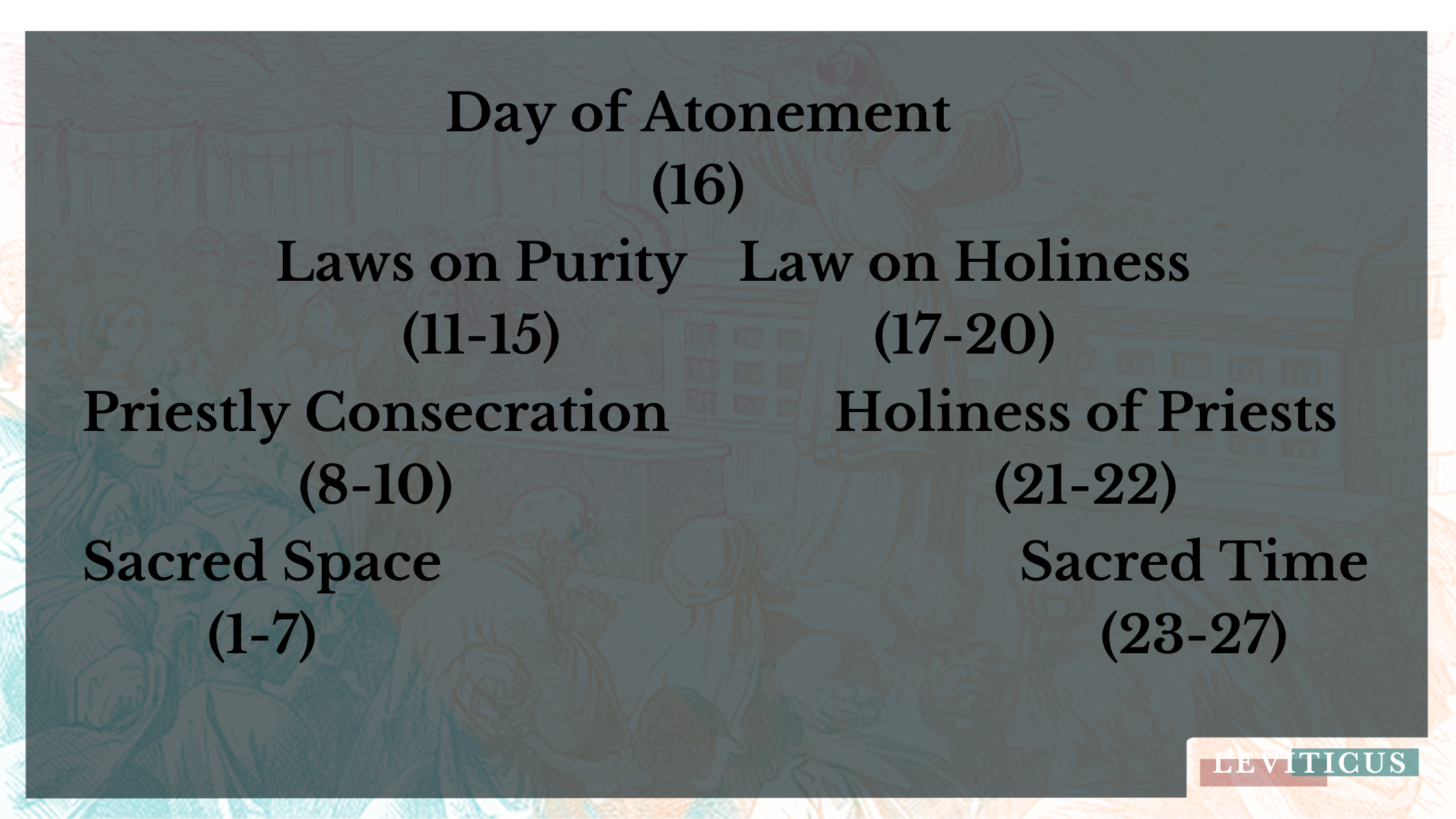
Now, in this second half, God teaches His people about sacred time, how to live as His people not only in space but in time. Because we are creatures who inhabit both. The appointed times listed in Leviticus 23 are holy interruptions to the ordinary flow of life, and they were intended to remind Israel who God is and what He has done, is doing, and will still do. It was all designed to draw Israel’s hearts to the faithfulness, goodness, and majesty of God.
Here is our plan for studying. We will walk through the text, focusing first on what it meant for God’s people then, drawing out the primary principles that still apply to us today. We will then end with two practical questions and gazing upon how everything here points to Christ.
As for the chapter itself, the structure is quite simple. Verses 1-3 begin with the Sabbath, the weekly festival of rest. The other feasts and festivals fall into two categories: spring festivals and fall festivals. The spring festivals are Passover, Unleavened Bread, Firstfruits, and Weeks, while the fall festivals are Trumpets, the Day of Atonement, and Booths. So, the Sabbath is a continuous weekly practice, while the rest are annual rhythms that build upon it.
THE IMPORTANCE OF THE SABBATH // VERSES 1-3
Let us begin with the Sabbath. Each week, Israel was to end with rest and worship. The Sabbath was woven into creation. God rested on the seventh day, sanctifying that day as holy and creating a rhythm for His people to imitate.
As we mentioned in chapter 19, it was also a litmus test for Israel’s obedience. Through the Sabbath, Yahweh distinguished Himself from Pharaoh and the other pagan kings. Pharaoh was a cruel master who relentlessly drove his people to work, building his kingdom brick by brick. Yahweh, however, does not need to His people to build His kingdom; therefore, instead of demanding work, He commands rest under His reign.
Thus, the Sabbath was a visible display of trust in God. Would Israel believe that God would still provide if they stopped working for one day? Would they rest in His care? If they could not trust Him with one day of rest, how could they trust Him in anything else?
In many ways, the Sabbath command is like telling a toddler to take a nap. That might sound simple, but every parent knows the complexity inherent in that task! A nap requires surrender, trust, and maturity to understand that there will be more time later. A child that has not learned that will not be ready for greater responsibilities down the road.
That is exactly how the Sabbath functioned in Israel. It tested their spiritual maturity. Could they rest? Could they trust God? Could they depend upon Him rather than themselves?
Indeed, the Sabbath and marriage are the only two blessings that come to us directly from the Garden of Eden. Both were given in creation as gifts for our good. And when rightly enjoyed, both still allow us to taste something of Eden again. To reject the Sabbath is, in some sense, to reject a taste of paradise, of the world as God made it to be and as He will make it again, a world of rest and delight in God.
But the Sabbath does not simply pervade creation; it also is the foundation for all the festivals and feasts that follow. Gordon Wenham notes:
Keil points out that the sabbatical principle informs all the Pentateuchal laws about the festivals. There are seven festivals in the year: Passover, unleavened bread, weeks, solemn rest day, day of atonement, booths, day after booths. During these festivals there were seven days of rest, first and seventh unleavened bread, weeks, solemn rest day, day of atonement, first of booths, first day after booths. The majority of these festivals occur in the seventh month of the year. Every seventh year is a sabbatical year. After forty-nine (7 x 7) years there was a super-sabbatical year, the year of jubilee. Through this elaborate system of feasts and sabbatical years the importance of the sabbath was underlined. Through sheet familiarity the weekly sabbath could come to be taken for granted. But these festivals and sabbatical years constituted major interruptions to daily living and introduced an element of variety into the rhythm of life. In this way they constantly reminded the Israelite what God had done for him, and that in observing the sabbath he was imitating his Creator, who rested on the seventh day. (301)
All of these feasts and special days were built around the Sabbath. Indeed, they were designed to reinforce the purpose of the Sabbath, to draw Gods’ people back to rest, remembrance, and worship. By ceasing from their ordinary work, they were imitating God their Creator. And that is what holiness fundamentally is: being set apart for God and walking in imitation of Him.
THE SPRING FESTIVALS // VERSES 4-22
Now we come to the spring feasts in verses 4-22. I have already preached full sermons on the Passover and the Feast of Unleavened Bread while in Exodus, and we will study the other feasts later in the Pentateuch. So for now, let us take the 30,000-foot view with which the text also presents them.
Passover
The first feast of the year was the Passover, which fittingly began the whole cycle of worship. Passover celebrated Israel’s redemption from Egypt, which was the moment when they become a free nation under God. On the night of the tenth plague, the LORD sent His angel to strike down every firstborn in Egypt, from Pharaoh’s house to the lowest slave. Yet God made a way of salvation for His people. Every household that painted the doorpost of its home with the blood of the lamb would be spared. The angel ‘passed over’ those households.
So, Passover commemorated Israel’s deliverance, when they were brought out of the house of slavery.
Feast of Unleavened Bread
Immediately connected to this was the Feast of Unleavened Bread. The two feasts often get confused because of how closely related they are to one another. But one commentator gave a helpful analogy. Just as Christmas Eve and Christmas Day or New Year’s Eve and New Year’s Day are distinct but inseparable celebrations, so too are Passover and the Feast of Unleavened Bread.
If Passover celebrated God’s triumph over Egypt and deliverance of Israel, the Feast of Unleavened Bread symbolized Israel’s separation from Egypt. In the ancient world, bakers did not have instant yeast at their disposal. To make leavened bread, women would take a small piece of dough from the day’s batch and save it as a starter for the next day’s bread. So, every loaf was connected to the one before it. There was a continuous line of fermentation.
But unleavened bread broke that chain. It was an entirely new batch of bread. Thus, it fittingly represented Israel’s new start, apart from Egypt. They were to break themselves off entirely from that nation. While they physically took the plunder of the Egyptians with them, they were to spiritually take nothing from Egypt with them.
Paul draws on this imagery in 1 Corinthians 5 and applies it directly to us. For context, the Corinthians were tolerating sin in the church, and here is how Paul answers them:
Do you not know that a little leaven leavens the whole lump? Cleanse out the old leaven that you may be a new lump, as you really are unleavened. For Christ, our Passover Lamb, has been sacrificed. Therefore, let us celebrate the festival, not with the old leaven of malice and evil, but with the unleavened bread of sincerity and truth.
We, as Christ’s church, are new, unleavened bread. Christ, our great Baker, has started us over completely fresh. We are a new creation. So, we must live like it. This again is the call ot holiness. Let our lives be marked by sincerity and truth, not by the old yeast of sin.
Feast of Firstfruits
The next feast of was the Feast of Firstfruits, where the people offered the first part of their harvest to God. The first represented the best, so offering it to God was a declaration that He is worthy of our best. It also symbolized the whole. For instance, when God consecrated the firstborn, the whole nation was being dedicated to Him. Thus, giving the first of the harvest declared that the whole of it really belonged to God, who gives the harvest.
Indeed, this festival also set their hope upon the full harvest that God would continue to give them.
Feast of Weeks
Then came the Feast of Weeks, which is called Pentecost in Greek. It is so called because it came fifty days after the Feast of Firstfruits, and it marked the completion of the grain harvest. It was another celebration of the food that God had provided for them.
Verse 22 also gives us a beautiful aspect of this feast:
When you reap the harvest of your land, you shall not reap right up to its edge nor shall you gather the gleanings of your harvest. You shall leave them for the poor and the sojourner. I am the LORD your God.
Even while celebrating the abundant provision that God had given them, the LORD built compassion for the poor into the rhythm of worship, reminding God’s people to care for the needy among them.
How fitting that on this very day the Lord would later pour out His Spirit on His people! In Acts 2, the Holy Spirit descends upon the disciples, filling and sending them to proclaim the gospel. The Great Commission began in earnest on the day of harvest.
Jesus had already told His disciples in Matthew 9 that “the harvest is plentiful, but the workers are few. Therefore, pray earnestly to the Lord of the harvest to send out laborers into the harvest.” The Greek word for “send out” is not aposteleo or pempo but ekballo, which literally is to throw out. It is the same word used to describe Jesus casting out demons or when the Spirit “drove” Jesus into the wilderness. It is a forceful word.
So, when we pray that God would send workers into His harvest, we are asking Him to hurl His people out into the world, to drive them out toward fulfilling His mission. And that is exactly what begins to happen in Acts 2. God sends the Spirit, and the Spirit filled the disciples with Christ’s authority to proclaim the gospel to the ends of the earth.
Even today, when we experience trials, moves, and disruptions in life, we should ask ourselves this question: Why is the Lord of the harvest sending me into this field? After All, God orchestrates the lives of His people not around our personal comfort but for the sake of His kingdom, placing us where the gospel can take root and bear fruit.
Again, how fitting that Pentecost became the day the harvest of souls began, as the Holy Spirit filled God’s people as His new tabernacle and sent them into the world to gather His harvest.
THE FALL FESTIVALS // VERSE 23-44
Now we come to the fall feasts, which begin in verse 23 and go through the end of the chapter.
Feast of Trumpets
First, we have the Feast of Trumpets or the day of solemn rest, as Wenham called it. Not much is said here, but we can understand its meaning from the role that trumpets play throughout Scripture. Trumpets were calls to attention. They announced something significant. When Yahweh descended upon Mount Sinai, His coming was heralded by blasts of trumpets. When Israel marched around the walls of Jericho, they blew their trumpets on the seventh day as a declaration that victory belonged to the LORD. And on the great and final Day, Scripture tells us there will be the trumpet of the archangel announcing to the world that Christ the King has come again to establish His eternal kingdom upon the new heaven and new earth.
So, the Feast of Trumpets served as a call to worship. It was celebrated on the first day of the seventh month, calling God’s people to lift their eyes and prepare their hearts for the season of atonement and feasting. After months without a festival, this was God’s gracious way of calling His people back to renewed devotion, reawakening their worship.
Day of Atonement
Next comes the Day of Atonement, the most solemn day in Israel’s calendar. Although this was ultimately a day of joy, it was primarily a day of repentance over sin. Notice that even here, it is still called a Sabbath of solemn rest. It is rest, but it is a serious rather than festive rest. It was a time to stop, reflect, and confess sin.
On this day, the high priest would enter the Most Holy Place to offer sacrifice first for his won sins and then for the sins of the whole nation. The people were to afflict themselves, meaning they fasted and humbled their hearts before God.
And that practice is still worth remembering. God gave His people many days of feasting and celebrating. But He also gave them days of fasting and repentance. Both are necessary.
We do something similar to this whenever we observe Good Friday a solemn remember of Christ’s crucifixion before the joy of Resurrection Sunday. And I think it is worth practicing because today we often quite good at feasting celebrating but inexperienced at fasting and lamenting over our sin.
Now, under the New Covenant, there is no command binding us to fast on certain days or times. Jesus gives us no set schedule. Yet He does assume that His followers will fast. In Matthew 6, Christ says, “When you fast…” We often subconsciously hear, “If you fast…” But while the how and when are matters of individual discernment, fasting should still be a regular part of the Christian life.
Feast of Booths
After the Day of Atonement’s solemn Sabbath came the final celebration: the Feat of Booths (or Tabernacles). This was joyful, catechistical feast that served as a weeklong reminder of God’s care for His people in the wilderness.
For seven days, the Israelites lived in temporary shelters (booths) made from branches and leaves. Since nearly every child loves camping under the stars, it was intended to be both a celebration and a visible catechism. It reminded them that when their ancestors came out of Egypt, they had no permanent homes but lived in tents as Abraham did before them.
And God, in His kindness, met them there. He did not demand that they build Him a palace or a fortress for Himself as their king. He commanded a tent, sharing their own condition.
At the academy, I teach my students hand motions for the books of the Bible. For Leviticus, we make a tent shape with our hands because the whole book fo Leviticus is about God dwelling in tent alongside His people.
The Feast of Booths taught that to every generation that followed, calling them to remember the goodness of their God providing manna from heaven, quail for meat, water from the rock, and protection from their enemies. It reminded them that they were sojourners, dependent upon the mercy of God.
And that brings us to the close of the chapter:
These are the appointed feasts of the LORD, which you shall proclaim as times of holy convocation, for presenting to the LORD food offerings, burnt offerings, grain offerings, sacrifices and drink offerings, each on its proper day, besides the LORD’s Sabbaths, and besides your gifts and your vow offerings and all your freewill offerings, which you give to the LORD.
This is the grand rhythm of Leviticus 23, a calendar of sacred time. God structured His people’s lives around His presence and His promises. Every feast and every fast, every trumpet and every Sabbath rest, all turned their eyes upon Yahweh their God.
TWO QUESTIONS FOR MODERN APPLICATION
Now that we have observed the whole chapter, let us consider two questions that relate to modern application.
On the Liturgical Calendar
First, should Christians observe the liturgical calendar?
If you are not familiar with the term, the liturgical calendar developed throughout church history as a way of structuring the year around the life of Christ. It is meant to be a Christian parallel to Israel’s festivals listed here. It begins with Advent, goes through Christmas, Epiphany, Lent, Easter, and Pentecost, and the rest of the year is classified as ordinary time.
So, should we observe it?
Maybe. There is no biblical command either way. You are not obligated to do so. Neither are you forbidden from doing so. You have freedom to do either in Christ. If you find it helpful, the celebrate it. If you find it distracting, then don’t worry about it. As Paul says in Romans 14: “One person esteems one day as better than another, while another esteems all days alike. Each one should be fully convinced in his own mind.”
Observing the Sabbath
The second question is larger and more significant: Are we still required to observe the Sabbath?
All these feasts flowed out of and pointed toward the Sabbath. The Sabbath itself was the foundation of this chapter and is one of the Ten Commandments. So, we should take this question seriously.
And my answer is yes. But not in the same way as Israel did. Christ has changed the outward expression.
I am not a strict Sabbatarian, which teaches that Sunday is now the Christian Sabbath and should be observed with the same restrictions. The New Testament gives us a much deeper vision of the Sabbath. You see, we are absolutely still called to “remember the Sabbath day, to keep it holy.” But under the New Covenant, the question is no longer merely which day we keep but how and where that rest is found. Hebrews 4 makes this clear, saying:
For if Joshua had given them rest, God would not have spoken of another day later on. So then, there remains a Sabbath rest for the people of God, for whoever has entered God’s rest has also rested from his works as God did from his.
And then the writer says, paradoxically, “Let us strive to enter that rest.” That is the Christian life in a nutshell: striving with all our might to rest in what Christ has already fully accomplished. The true Sabbath rest is found in Him.
Jesus is both Creator and Redeemer. By Him, all things were made, and also by Him, all things are being made new. He is the Lord of the Sabbath. In Him, we cease from our labors to earn God’s favor and rest in our acceptance through Christ.
So, yes, the Sabbath command still applies, but it is fulfilled in Christ. We obey it by resting in His finished work, turning from self-reliance to faith alone in Christ alone.
Now, should we still gather for worship weekly? Certainly. Hebrews 10 commands us not to neglect meeting together, and even in the New Testament, we find Christians gathering on the first day of the week, which we call the Lord’s Day. That rhythm for worship is good, beautiful, and true.
Indeed, it gives us one of the clearest pictures of the difference between the Old and New Covenants. In the Old, the week of labor ended with rest, but in the New, we begin the week with rest. The Lord’s Day comes first, and our work follows. That is a picture of the gospel. We do not work in order to rest; we rest in order to work. Grace is the foundation of our good works, not the result of them.
So, when we gather for worship on Sundays, we are starting our week from a place of worship and rest, remembering who God is and what He has done for us.
Christ is the fulfillment of the Sabbath. He is our rest.
Christ the Fulfillment of the Feasts
And this brings us to Christ. Each of these feasts finds their fullness in Him. Indeed, because the Lord’s Supper points to Christ, they also are each expressed at this Table as well.
Christ is our Sabbath rest. The bread and cup remind us that our rest is not found in striving for favor but resting in Christ’s faithfulness.
Christ is our Passover lamb, the Lamb of God who takes away the sin of the world. Not for one household, not for one day or one year, but for all His people, once for all. The Table proclaims His blood shed for our redemption from the slavery of our sin.
Christ makes us into unleavened bread, that is, a people set apart for His glory. Through communion with Him, we are called to holiness, to leave behind the leaven of sin and corruption and to walk in the purity of His presence. The weekly warnings of this Table serve as goads to that end.
Christ is the firstfruits of the dead, the firstborn of the resurrection. He is the beginning of the new creation, the first to rise to everlasting life. As we share this meal, we look forward in hope, proclaiming that He will one day return to raise us to life eternal.
Christ is the Lord of the Harvest, the one who sends out laborers into His fields, calling every nation to Himself. The Table reminds us that one day the harvest will be complete. One day, the Great Commission will be accomplished and people from every tribe and tongue will feast together in the kingdom at the marriage supper of the Lamb.
Christ is the trumpet of God, the great Amen through whom all the promises of God are fulfilled and the one who presents us perfect before the Father for worship. The table, like a trumpet, proclaims His victory and summons us to worship. It is a visible sermon declaring that salvation has indeed come.
Christ is our atonement, the once-for-all sacrifice that perfectly satisfies the justice and wrath of God and secures our peace. Abel’s blood cried out for vengeance at his murderer, but even though we put Christ on the cross, His blood cries out for mercy, forgiveness, and reconciliation. His blood speaks a far better word, for His blood declares us forgiven and welcomed into the household of God.
Christ is our Emmanuel, God with us. The Word became flesh and tabernacled among us, and now by His Spirit, He dwells within us. The Table draws our eyes to both advents. His first coming, when He came not to be served but to serve and give His life as a ransom for many. His second coming, when the tabernacle of God will be with men again, always and forever, world without end.
So, as we eat this bread and drink this cup, let us taste and see the goodness of Christ our Rest, our Redemption, our Righteousness, our Guarantee and Hope, our Priest and Atonement, our Emmanuel.
All of time is in His hands. And in Christ, so are we.
 B. C. Newton