
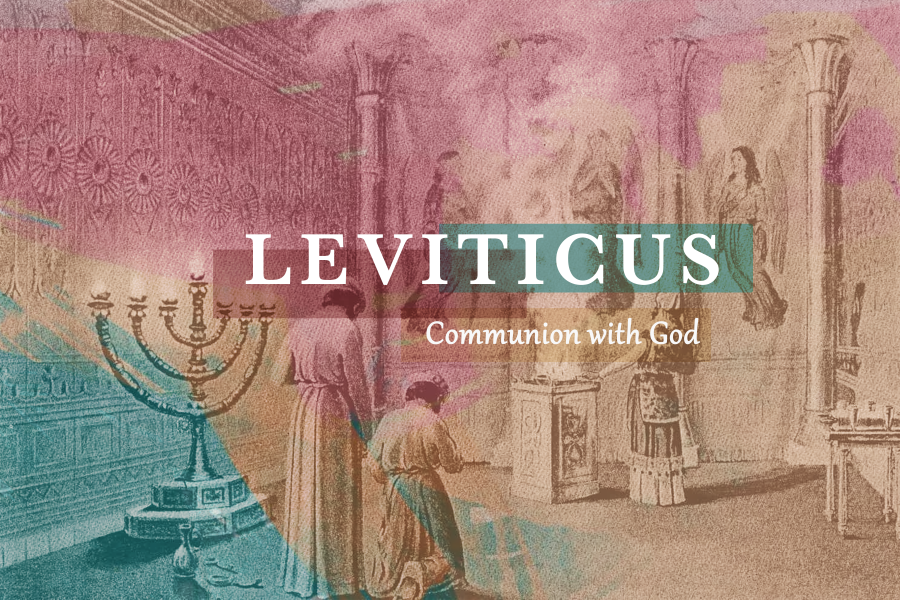
And the LORD spoke to Moses, saying… All of the Bible is God-breathed, and all of the Bible is profitable. Each portion of Scripture teaches us and reproves us, but God’s Word does not leave us in rebuke. It is also profitable for correction. God’s Word is the instrument of our loving Father for correcting our wandering ways. That is why we pray each week for God to search our hearts, to expose any grievous ways in us, and lead us in the way everlasting. The Scriptures always point us toward the path to life eternal.
As we come to Leviticus 24, two questions have lodged within my mind. First, how do we make sense of this chapter’s placement in Leviticus? Remember that Leviticus 17-27 form what many theologians call the Holiness Code. The overarching theme of Leviticus is how God’s people can have communion with Him as He dwells in their midst. The first half focused on how Israel could draw near to Him, while the second half, this Holiness Code, teaches the holiness that is necessary to live in His presence.
Within the second half, we have already seen several distinct sections. Chapter 17 addresses ritual holiness, the proper place of sacrifice and the prohibition of consuming blood. Chapters 18-20 then focused on moral holiness, in which 18 and 20 warned against the pagan practices, while chapter 19 displayed true godliness: “love your neighbor as yourself.” Chapters 21-22 listed the heightened holiness required of the priests. Then last week, in chapter 23, we studied Israel’s weekly Sabbath and annual feasts.
Next week, in chapter 25, we will encounter commands regarding the sabbatical year and the year of jubilee, which Wenham called a super-Sabbatical year. So, chapters 23 and 25 are obviously connected. Yet between them sits chapter 24, which does not appear to have anything to do with Israel’s liturgical calendar. So, how does it fit?
Second, the chapter itself seems to contain two unrelated sections. Verses 1-9 give instructions about the lampstand and the bread of the Presence. But verse 10-23 recount the second narrative of the book: a man blasphemes the name of the Lord, and judgment is dealt. Why are these two sections side-by-side, and why are they between the feast calendar and the sabbatical years?
Those are the two interpretive challenges before us, and they are challenges that can be answered. And that answer further reveals the great intentionality that the LORD used for structuring His holy Word, for as we will see the light, the bread, and the Name are intrinsically bound together and, in many ways, represent the main themes of Leviticus.
THE LIGHT & THE BREAD // VERSES 1-9
We begin with the first section, which gives us a visual image of God’s favor upon His people. These verses divide into two parts: verses 1-4 focus on the lampstand, and verses 5-9 on the bread of the Presence.
The LORD spoke to Moses, saying, “Command the people of Israel to bring you pure oil from beaten olives for the lamp, that a light may be kept burning regularly. Outside the veil of the testimony, in the tent of meeting, Aaron shall arrange it from evening to morning before the LORD regularly. It shall be a statute forever throughout your generations. He shall arrange the lamps on the lampstand of pure gold before the LORD regularly.
Just as the priests were responsible for keeping the fire of the bronze altar burning in the courtyard, they were also to keep the lampstand burning inside the Holy Place. And the people of Israel were to supply the oil for the lamps.
We start by reminding ourselves what the significance of the lampstand is. In Exodus, we saw that the lampstand was a stylized tree with seven branches, decorated with almond blossoms and cups. Remember that the tabernacle was intended to remind Israel of Eden, where humanity once walked freely in the light of His presence. In Genesis, however, humanity was cast east of Eden as a result of their sin. The tabernacle, therefore, faced east so that entering the courtyard and then the tent was walking west back to God’s presence.
The lampstand, then, signified God’s light shining again among His people. It was the illumination of His presence, His favor, and His Word. As long as the lampstand burned, Israel had a visible reminder that God was shining upon them.
The second piece of furniture in the Holy Place, opposite the golden lampstand, was the table holding the bread of the Presence. Verses 5-9 give the commands regarding it:
You shall take fine flour and bake twelve loaves from it; two tenths of an ephah shall be in each loaf. And you shall set them in two piles, six in a pile, on the table of pure gold before the LORD. And you shall put pure frankincense on each pile, that it may go with the bread as a memorial portion as a food offering to the LORD. Every Sabbath day Aaron shall arrange it before the LORD regularly; it is from the people of Israel as a covenant forever. And it shall be for Aaron and his sons, and they shall eat it in a holy place, since it is for him a most holy portion out for the LORD’s food offerings, a perpetual due.
What exactly was this bread? The Hebrew expression is literally ‘the bread of the face.’ It is the bread that is set before the face of God, in His presence. This bread symbolized Israel living before God’s face, enjoying His favor and nearness.
We saw a glimpse of this idea in Exodus whenever Moses, Aaron, Aaron’s sons, and the elders of Israel ascended Mount Sinai to share a meal before Yahweh. That meal functioned as a covenant meal, a sign that the relationship between God and Israel had been established and confirmed. In the ancient world, eating together communicated fellowship. Enemies did not dine together; friends did. To eat with someone was to demonstrate peace and unity.
So, the bread of the Presence signified continual fellowship between God and Israel. Though ordinary Israelites could not enter the Holy Place, the priests brought the flour supplied by the people and baked these large loaves. And these were indeed large loaves of bread, which perhaps emphasized the fullness of God’s provision.
Every Sabbath (literally Sabbath by Sabbath, as verse 8 says), the priest replaced all twelve of the loaves, which represented the twelve tribes of Israel. And the lampstand shone continually upon them, visually portraying the people of God basking in the light of God’s face.
Before stepping back to consider the large significance, notice something quietly woven through his passage: the constant faithfulness required of the people. The priest kept the lamp burning every day, evening to morning. He replaced the bread each week. But the people supplied the oil and flour. Festivals and feast days, as we saw in chapter 23, were major spiritual events. They drew the community together in concentrated, joyful worship. But ordinary faithfulness was also required for the regular work of the tabernacle.
Surely there were feast-only worshipers in Israel, just as there are Christmas and Easter only Christians today. Of course, one great benefit of festivals is the opportunity to awaken those who have been sleepwalking through their faith. Ultimately, faith must be lived out daily, not by occasional bursts of devotion. Weekly worship and routine generosity are regular habits of faithfulness. That is what these offerings of oil and flour display. Even though only the priests entered the Holy Place, the entire nation participated in what happened inside.
And this brings us to the larger them of verses 1-9: the presence of God is the purpose of worship. That is the central point that the lampstand and the bread of the Presence communicate together. Michael Morales captures this connection well. He writes:
Just as the creation account establishes the even and morning of days for the sake of the Sabbath, the daily tamid of verses 1-4 establishes the rhythm of days for the sake the Sabbath tamid in verses 5-9. Already one may discern the profound homology between the cosmos and cult. Just as the cosmos was created for humanity’s Sabbath communion and fellowship with God, so too the cult was established for Israel’s Sabbath communion and fellowship with God. Sabbath by Sabbath, as verse 8 has it, the twelve loaves of bread are renewed in the light of the lampstand. This cultic drama symbolized the ideal Sabbath: the twelve tribes of Israel basking in the divine light, being renewed in God’s presence, Sabbath by Sabbath.
That is the picture Leviticus is giving us. The lampstand and the bread together form a living portrait of the ideal Sabbath: God’s people continually renewed under the light of God’s shining face.
As Morales pointed out, notice the creation language (evening and morning) which mirrors Genesis and reminds us that the tabernacle is a microcosm of the world as it was meant to be.
Of course, the most vivid connection is likely through the Aaronic blessing. The lampstand and the bread are essentially that blessing made visible. The priests, standing inside the tabernacle, see the light shining on the bread, the bread of God’s face. Then those same priests, dressed to match the tabernacle’s inner glory, walk back out to the people to pronounce a blessing. Numbers 6 records the words:
The LORD bless you and keep you;
the LORD make his face to shine upon you and be gracious to you;
the LORD lift up his countenance upon you and give you peace.So shall they put my name upon the people of Israel, and I will bless them.
This is the very opposite of judgment. His face shines upon His people, giving grace and peace to them. That is exactly what the lamp and bread symbolize: the perpetual nearness of God, the light of His favor and the fullness of His presence.
But Israel must faithfully participate: bringing the oil and flour, walking in obedience, and contributing to the daily life of the sanctuary. As long as they walk in God’s ways, they dwell in the light of His face, a people who have the blessing of Yahweh’s holy name upon them.
BLASPHEMING THE NAME // VERSES 10-23
Our text now sharply shifts, and the jarring shift is the intention of the text. The narrative breaks into three parts: the incident (vv. 10-12), the law given in response (vv. 13-22), and the judgment (v. 23).
Now an Israelite woman’s son, whose father was an Egyptian, went out among the people of Israel. And the Israelite woman’s son and a man of Israel fought in the camp, and the Israelite woman’s son blasphemed the Name, and cursed. Then they brought him to Moses. His mother’s name was Shelomith, the daughter of Dibri, of the tribe of Dan. And they put him in custody, till the will of the LORD should be clear to them.
In the middle of a fight, the man blasphemes “the Name” (ha-shem, the reverent way of referring to Yahweh that many Jews still use today). This is Yahweh’s holy name. The man very likely did not shout a careless expletive; instead, this was probably a deliberate act of contempt, either cursing the LORD directly or invoking the LORD to curse the man he was fighting. Whatever the precise nature of the sin, the offense was a serious violation of the Third Commandment.
The Third Commandment forbids using God’s name in vain, which means in an empty or common way. This clearly then also includes using it as profanity. Indeed, this incident seems to be beyond the realm of carelessness. It is a conscious despising of God’s holiness. Rather than hallowing God’s name, this man publicly profanes it.
The community responds wisely. They detain him. There is no mob rage here. They know that he must be judged, but he must be judged rightly. Thus, they wait until God reveals how such an offense should be handled.
Then, in verses 13-22, the law is given. The first section (vv. 13-16) addresses the offense at hand:
Bring out of the camp the one who cursed, and let all who heard him lay their hands on his head, and let all the congregation stone him. And speak to the people of Israel, saying, Whoever curses his God shall bear his sin. Whoever blasphemes the name of the LORD shall surely be put to death. All the congregation shall stone him. The sojourner as well as the native, when he blasphemes the Name, shall be put to death.
Capital punishment is the sentence. The reason is bound up with the significance of the Name. God’s name represents His person, character, and covenantal presence. To blaspheme the Name is the commit a symbolic act of violence against God Himself. Nadab and Abihu treated God’s presence lightly and were consumed; this man treats God’s name lightly and is destroyed.
The ones who heard the blasphemy place their hands on his head. This was probably both to serve as witnesses and to symbolically separate from his guilt. They are essentially saying, “We heard the sin, but we do not share it.” Then the entire congregation carried out the sentence. Because the offender is not a consecrated priest, God does not strike him down directly; the covenant community is responsible to uphold God’s holiness.
Beginning in verse 17, the LORD widens the scope of the law:
Whoever takes a human life shall surely be put to death. Whoever takes an animal’s life shall make it good, life for life. If anyone injures his neighbor, as he has done to him, fracture for fracture, eye for eye, tooth for tooth; whatever injury he has given a person shall be given to him. Whoever kills an animal shall make it good, and whoever kills a person shall be put to death. You shall have the same rule for the sojourner and for the native, for I am the LORD your God.
This is the principle of lex talionis, the law of retaliation. Far from authorizing personal revenge or gruesome retaliation, it existed to limit retaliation and ensure that punishment fits the crime. As scholars note, Israel did not generally conduct literal eye-for-eye mutilation; rather, courts assigned compensation proportionate to the loss. The point is measured justice, neither minimizing wrongdoing nor escalating harm beyond what was committed.
But why is lex talionis mentioned here in connection to the blasphemer? Because the principle clarifies the gravity of the offense relative to who is sinned against? Killing an animal must be made right if it belonged to someone else, but it was not deserving of death. Killing a human was meant with the death penalty because humans bear God’s image. The seriousness of the crime corresponds to the worth of the one offended.
What, then, of blaspheming God? If even taking a human life warranted death, how much weightier is an assault on the honor, name, and holiness of the eternal Creator of heaven and earth? No one can kill God. He is life itself, but blasphemy is the symbolic equivalent of attempting to destroy God. It is spiritual treason.
That is why the blasphemer’s sentence is death. His sin strikes at the very heart of covenant relationship. He refused to honor the Name that Isreal was called to hallow, the Name that dwells among them, the Name that blessed them, the Name that shines upon them in grace and peace.
And with that legal principle laid out, the text concludes with judgment:
So Moses spoke to the people of Israel, and they brought out of the camp the one who had cursed and stoned him with stones. Thus the people of Israel did as the LORD commanded Moses.
The judgment had to be carried out. God uses His own people as the instruments of His justice, and this is for their good. By executing the sentence themselves, they are actively separating from evil. They were acknowledging God’s decree, submitting to His will, and practicing His judgment with their own hands.
We still see a reflection of this today. Churches that refuse to deal with unrepentant sin are tolerating sin. Yes, all believers battle sin daily. But church discipline is not for repentant sinners; it is for those who claim the name of Christ and persist in open rebellion without repentance. Excommunication is the New Testament counterpart to the judgment in this passage, which is not execution but removal. The church says to the unrepentant member, “We can no longer affirm your profession of faith. We must separate from you.” Such a person is living in a way that brings reproach on the name of Christ. They claim to represent Jesus to the world while living in defiant sin. Discipline is the equivalent of laying hands on the man’s head here. It is a testimony and a separation.
Of course, someone who has been excommunicated can return. That is the entire purpose of church discipline. It is a final call for repentance. The new covenant is marked by this grace. Even when our sin brings dishonor to Christ (as all sin does), He bore that reproach Himself on the cross. If we turn from our sins and return to Him, He welcomes us back.
THE BIG PICTURE
Now, why is this narrative placed here? It stands as a companion to the earlier narrative of Nadab and Abihu in chapter 10. Those two stories are the only narrative sections in Leviticus, and their placement in intentional. Nadab and Abihu violated sacred space; this man violated the sacred name.
Notice what phrase has dominated the second half of Leviticus. Beginning in chapter 18, the LORD has declared over and over again: I am Yahweh. I am Yahweh your God. I am Yahweh your God who brought you out of Egypt. God has been revealing His name through these holiness commands. And now in the midst of that repeated self-revelation, comes a man who publicly despised God’s name.
It is also significant that he is the son of an Israelite mother and an Egyptian father. His mixed heritage symbolized the condition of the entire nation. Israel spent 400 years in Egypt, long enough for them to entirely blend into the Egyptian ethnicity. Yet providentially their slavery preserved their identity.
Of course, after the exodus, a mixed multitude left Egypt with Israel. And God welcomed them, as long as they obeyed His laws. Twice our text emphasizes that the native and the sojourner were under the same law. Rahab and Ruth are great examples of foreigners who are grafted into God’s people by embracing their new identity as Israelites.
Thus, this man is held up in this text as a picture of Israel as a whole. Would they embrace their Abrahamic identity, or would they act like Egyptians? Would they honor Yahweh’s name or repeat the sin of this blasphemer?
This question points us forward to Leviticus 26, where God will lay before the entire nation the same choice embodied in this chapter: blessing for faithfulness or judgment for rebellion.
There is, therefore, a remarkable cohesiveness to this chapter that makes it a unified display of the themes of the second half of Leviticus. God’s name, presence, and light are fundamentally linked. Indeed, think again of the Aaronic blessing in Numbers 6: “The LORD make His face to shine upon you… So they shall put my name upon the people of Israel, and I will bless them.” Three times in that blessing the name of Yahweh is invoked for the blessing of His people. That is the thread tying these two sections together. The priests enter the Holy Place and behold the light of the lampstand shining upon the bread of the Presence, God’s face symbolically shining upon His people. And all Israel, in their daily lives, is to honor and hallow God’s name. Indeed, whenever they do so, they were walking in the light of His countenance. The light, the bread, and the Name fundamentally interconnected ideas.
This chapter, therefore, gives us a vivid contrast. The way of faithfulness leads to blessing and peace, but the path of rebellion leads to death and destruction. This mirrors what we observed in Leviticus 9-10. First, there was the manifestation of God’s glory and the people’s worship, then immediately came Nadab and Abihu’s sin and the God’s swift judgment upon them. The same happens here. First, we see rightly ordered worship of God: the lampstand shining evening and morning upon the bread of the Presence which is renewed Sabbath by Sabbath. Then suddenly comes sin and destruction. Again, this prepares us for the choice that God will set before Israel in Leviticus 26. The light and bread are visual symbols of God’s blessing, while the stoning of the blasphemer is a visual display of God’s curse.
THE NAME ABOVE ALL NAMES
And like every text in the Old Testament, this passage ultimately directs our eyes to Christ. At the Lord’s Table we see both life and death. Christ is the true light of heaven come down to us. “In him was life and the life was the light of men. And the light shines in the darkness and the darkness did not overcome it.”
Christ is also the true bread from heaven. He is the radiance of God’s glory, the visible image of the invisible God. In Him, the Presence of God fully dwelt among us. He was the true tabernacle. And unlike the bread and light of the tabernacle, which were sights that only the priests could behold in full, Christ brings all of His people into His presence now.
As I have noted before, the New Testament’s language reinforces this. There are two Greek terms for temple: heiron, which refers to the entire temple complex, and naos, which refers specifically to the sanctuary itself. When Scripture calls the church the temple of God, it uses naos. All believers are the sanctuary now. There are no courtyard Christians. All of us have access to the very presence of God. All of us live beneath the shining light of His face.
We have an image far greater than the golden lampstand shining upon the bread of the Presence. We have Christ Himself, set before us in the bread and cup, the One who bears the name above every name and who took the divine name upon Himself, saying, “I am the bread of life. I am the light of the world. I am the resurrection and the life. Before Abraham was, I am.” Indeed, that is why the early church rejoiced to suffer for the Name. Jesus is Yahweh. Jesus is the Name.
As come to the table and meditate upon Christ’s finished work, let us consider these words from Andrew Bonar. He imagines what it must have been like for the blasphemer to be dragged outside the camp and stoned. Then he writes:
Now, of what does that mangled and marred form emphatically speak to one that passes by? It speaks of the curse of an injured God. Each wound, left by the ponderous mass that some witness cast upon his shivering body, was an external representation of the infinite curse that cleaves to the condemned soul. And hence it is that when we see Jesus, “wounded and bruised,” “his visage so marred more than any man, and his form more than the sons of men,” we therein see the marks of the curse having really fallen on him–the curse which our sins wreathed around him. The Father lays his hand on his holy head, as if pointing him out as guilty–but only guilty in our guilt–and every overwhelming curse is showered upon his head. “Surely he hath borne our griefs and carried our sorrows!” Never man spake like that man, and yet he seems visited with the same marks of tremendous wrath as this son of Shelomith.
The wrath is equally real in both cases, while the reason is very different in either case. The mangled body of Shelomith’s son declared that the wrath due to him was poured out, and in exhausting its terrors had swept life away. Even so, the dead body of our Surety, all bruised and torn, declared to Joseph and Nicodemus, as they wrapt it in the fine linen and spices, that the curse had fallen and had spent its fury on him. Well might they have sung as they bore his body, his pale body, to the new-hewn tomb without the gate, “Christ has redeemed us from the curse of the law, being made a curse for us!”
This is why we are not led outside the camp to die. This is why eternal death does not fall upon our heads. This is why, though we are blasphemers and profaners of God’s name by nature, are received by grace. Christ became a curse for us, enduring our death, bearing our judgment. Indeed, He was condemned for blasphemy for our sake. So, as we take the bread and cup, may we taste and see the goodness of our Savior, the light who shines upon us, the Bread who sustains us, the Name who saves us, bearing our curse so the light of God’s face might now shine upon us forevermore.
 B. C. Newton