
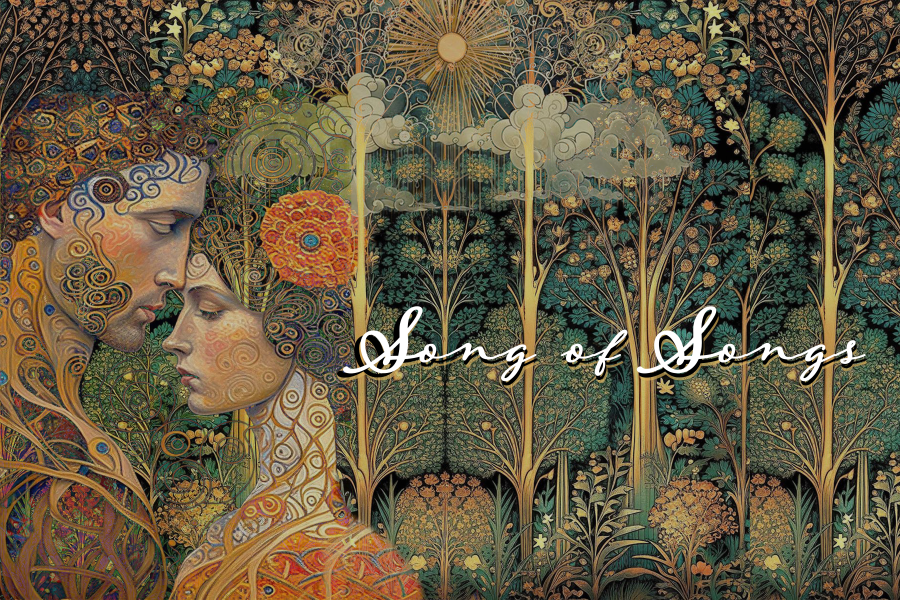
Quite often, when it comes to marriage or the Christian life, we want a detailed, five-step plan for success. Something clean and precise. But life is rarely clean and precise. And marriage is not a formula; it is a dance.
Now, dances do have steps to learn. True. You must practice some basics, but at the end of the day, if you are constantly in your head about getting the steps exactly right, you will have missed the joy of dancing.
The same happens in both marriage and the Christian life. And that is why the Scriptures do not give us specific and detailed commands, like ‘only go to a college that has the following traits…’ Instead, the Bible gives us principles that the Holy Spirit applies to our individual circumstances. For example, take Paul’s command to “bear one another’s burdens.” What exactly does that look like? It depends on what the particular situation is.
And that is what I find so beautiful about books like the Song of Songs. It is the only book in Scripture that has marriage as its primary focus. But it is not a marriage manual, nor is it a systematic theology on marriage. It is a song, which means that it is meant to be danced to at least as much as it is analyzed.
Of course, there are principles to be found here, which I pray we have been drawing out of the text. But even those principles are broad and must be applied individually by the wisdom of the Spirit. And that is necessary because, just as no two people are the same, no two marriages are the same.
To some, that makes the Song and other wisdom literature feel messy. And it is. Quite messy. But so is life. Concrete is neat and efficient, but it is also sterile. While the garden of life now brings forth thorns and thistles, the solution is not to remove all vegetation. As all of Scripture testifies, God works in the midst of our mess. Indeed, if we do not have place for messiness in our theology, we are placing our own mental limitations on the LORD.
I bring this up because our text this morning is messy. It is messy in form, for it contains some of the most difficult to translate verses in the whole Bible. And it is messy in content because gives us a dialogue between the couple of the Song, and their dialogue is a dance. He praises her, and she responds. He praises her again, and she responds again. That is the simple layout of the text, but the actual words are not simple. But they are fascinating, like a dance between two armies.
THE BELOVED SPEAKS: PART ONE | 6:4-10
If we glance over verses 4-7, we will notice things that are familiar and new. The beloved’s praise of his bride is certainly not new. It is one of the definitive features of the Song of Songs. Neither is his short wasf over her hair, teeth, and cheeks. Indeed, those words are repeated word-for-word. And there is certainly nothing wrong with repetition. God repeats Himself all over Scripture. There is a principle for us. How often should we tell our spouse or our children that we love them? More than we would think.
But the language of these verses is also new:
You are beautiful as Tirzah, my love,
lovely as Jerusalem,
awesome as an army with banners.
Turn away your eyes from me,
for they overwhelm me.
Previously he spoke of being captivated or captured by her beauty, but now his language intensifies. She is awesome, which is a word that we have certainly watered down. Awesome means awe-inspiring, something that takes your breath away. Think of looking over the Grand Canyon or up at a snow-capped mountain or gazing at the Milky Way.
That is how he sees his bride. He compares her to two great cities. Jerusalem was, of course, the capital of Israel, and most significantly, it was the place of God’s presence on earth in the temple. Tirzah was another great city, known for its beauty. And he follows this by comparing her to an army with banners. Like watching a vast and powerful host of soldiers advancing with their flags flying high, he is awestruck by her.
We still speak like this today whenever we say that someone is breath-taking, gorgeous, or even a bombshell. And notice how the emphasis of always falls on the front of the word, as if we are being verbally struck by the person’s beauty.
He is overwhelmed by her.
Of course, he doesn’t want anything less.
In verse 8, he says,
There are sixty queens and eighty concubines,
and virgins without number.
This is almost certainly a reference to Solomon’s harem, as he chased the world’s vision of fulfillment. Indeed, today, we each have access to a digital harem that may very well have made Solomon blush. That is what the world offers us.
But in verse 9, he rejects that vision, saying:
My dove, my perfect one, is the only one.
Out of the multitude, he chooses one. Solomon can have his harem; he has his bride, his perfect one. To him, she is precious and irreplaceable.
Interestingly, the second half of verse 9 says,
The young women saw her and called her blessed;
the queens and concubines also, and they praised her.
Why would they praise her?
We should not have a simplistic view of Solomon’s wives, which views them purely as being used by the king. Just like today, there are those who would happily accept a comfortable life, even if they did not have the sole attention of the king. But it is also probable that many of them did long for more, specifically for the exclusive devotion that they see in this couple.
That seems to be what is happening here. The queens, concubines, and young women call her blessed because she has what they do not. She has the undivided loved of her husband.
They look at this simple country girl and her shepherd husband, and they see what they do not possess: a love that is exclusive and devoted.
The ESV presents verse 10 as if it were the words of those women, but I think it best to read it as the man’s words again:
Who is this who looks down like the dawn,
beautiful as the moon, bright as the sun,
awesome as an army with banners?
After comparing her to the beauty of Israel’s great cities, he now looks at the two great lights that God Himself created. She is majestic, even glorious.
HER RESPONSE: PART ONE | 6:11-13
Then we come to her response:
I went down to the nut orchard
o look at the blossoms of the valley,
to see whether the vines had budded,
whether the pomegranates were in bloom.
This likely connects back to chapter 2, when he came to her, announcing that winter had passed and spring had come. Here is checking to see whether spring has truly arrived. Are his grand, overwhelming words about her true?
This makes sense, especially in light of her tumultuous dream in the previous text. The dream ended happily enough with the couple back together. But why did she have the dream at all? Did it leave her in a somewhat somber mood?
We see that in real life, especially in marriage. Problems can be worked through, forgiven, and resolved, while still leaving behind a lingering tension.
Either way, she wonders, “Can it really be true? Does he really see me like that?”
Then in verse 12, she says,
Before I was aware, my desire set me
among the chariots of my kinsman, a prince.
If you are unsure what that verse means, you are in good company. Even though Song of Songs is known for its challenging verses to translate, many give this verse the crown of being the most difficult. Iain Duguid notes that an extremely literal translation would be something like this: “I don’t know–my soul– it (or you) set me–chariots of Amminadab (or my noble people or with a noble).”
That doesn’t help much, does it?
The CSB seems to capture the most likely sense of these lines: “I didn’t know what was happening to me; I felt like I was in a chariot with a nobleman.“
In other words, she was questioning her beloved’s praise, checking to see if spring had truly arrived. But in the midst of her skepticism, she finds herself being swept away. Despite her hesitations, she is carried along by his words, and it is as if she suddenly finds herself in the chariot with a nobleman.
This, again, is the beautifying effect of love. Her beloved is not a nobleman; he is a shepherd. Just as she is not a queen but only a country girl. When she is with him, she feels like she is with a king. And when he is with her, he might as well be looking at Jerusalem in all its splendor.
But just she is being swept away, the daughters of Jerusalem interject:
Return, return, O Shulamite;
return, return, that we may look upon you.
Why do they call her a Shulamite? Some argue that it is a regional name, but others argue that it comes from the root word shalom, meaning peace. And I think that is the best explanation. Return, return, O peaceful one, is how we might read it.
Now, most translations take the second half of verse 13 as the man speaking, probably to the daughters of Jerusalem, essentially telling them that she will not be returning to them just yet. And that is possible.
But I agree with Longman that, in the flow of the text, it seems more likely to read it as the woman’s words. She answers back to them:
Why should you look upon the Shulamite,
as upon a dance between two armies?
She is still hesitant. She asks her friends and probably her beloved: Why do you want to look at me? Why are you so fascinated with me?
Imagine standing on a cliff, looking down at two mighty armies, each preparing themselves for a battle. They line up. They shift. Their commanders try to find just the right spots to give them a strategic advantage over their enemy. The tension keeps building and building.
Today, we would call it being on the edge of your seat. That is the idea. She is saying, “Why are you so captivated by me? Am I really as awesome as you say?”
THE BELOVED SPEAKS: PART TWO | 7:1-9
Thankfully, he is pleased to answer that question with the Song’s final wasf of his bride, this noble daughter. The previous two wasfs that he gave focused largely on her face. Not so here. Now he praises her head to toe…or, more accurately, foot to head.
As with the bride’s wasf of the man last week, we do not need to walk through every image here. Again, these are not meant to be literal or even visual. This is emotive language that expresses how he feels about her.
Of course, if a husband today told his wife that her belly is like a heap of wheat, it might not be received well, even if he adds encircled with lilies. But we have to read these with the understanding that ancient Israel was a distance culture from our own, and we must read the text in that context first.
Notice at the end of the wasf, in verse 5, that her locks are purple. Cities like Tyre became extremely wealthy for producing purple dyes. It was the color of royalty because, very often, only royalty could afford it. Indeed, a king can be held captive by her royal hair.
Now, that is not much of a poetic exaggeration. Think of David and Bathsheba or of Samson and Delilah. Think of Solomon himself. But he, remember, is her king. She has snared him. And he is not at all mad about that.
Next, notice back in verse 1 that he calls her the work of a master hand.
Who is that master hand?
Her Creator, God.
Thus, he not only sees beauty when he looks at her; he sees craftsmanship. She is a work of divine artistry. Again, this pushes back against the gnostic thought that nothing good can come from the body. Here he is carefully surveying her body, and his praise of her beauty is also a praise of her Creator, for he sees her as a masterpiece of God.
He then goes on:
How beautiful and pleasant you are,
O loved one, with all your delights!
Doesn’t this language draw us back to Eden, the garden of beauty, pleasure, and delight? Our original paradise overflowed with God’s good provision, which we were to receive with joy and thanksgiving. And although we are no longer within that paradise, she is, for him, a glimpse back into that lost garden. She is beauty and pleasure and delight. She is his mini-Eden.
And since Eden was notably filled with trees, he has particular plans for his tree:
Your stature is like a palm tree,
and your breasts are like its clusters.
I say I will climb the palm tree
and lay hold of its fruit.
Oh may your breasts be like the clusters of the vine,
and the scent of your breath like apples,
and your mouth like the best wine.
The imagery here is still poetic, but subtlety is clearly not his top priority here. We can feel that he too is being carried away and caught up in his own words. He is enraptured with his wife.
HER RESPONSE: PART TWO | 7:9-8:4
But notice that the rest of verse 9 is her speaking. Both Longman and Hess point out that she is essentially interrupting his words and finishing his sentence. Again, the CSB communicates this most clearly, reading, “Your mouth is like fine wine–flowing smoothly for my love, gliding past my lips and teeth!”
She is enraptured as well. And she declares in verse 10:
I am my beloved’s,
and his desire is for me.
This is the third time that we have heard this refrain, but notice that each time has been different. First, it was “My beloved is mine, and I am his.” Then it was “I am my beloved’s, and my beloved is mine.” Now it is “I am my beloved’s, and his desire is for me.”
The emphasis has shifted. She is no longer starting with her possession of him. Now she happily declares her belonging to him. That is subtle but crucial shift. In a healthy marriage, there is mutual belonging. But there is a great difference between thinking first of how you belong to your spouse rather than how your spouse belongs to you.
Interestingly, the word desire here is only used three times in the Bible. It first appears in Genesis 3:16, where, after the fall, God says to the woman, “Your desire shall be for your husband, and he shall rule over you.” Now, the interpretations of what exactly that verse means are numerous, but it seems most likely that God is simply declaring the broken relationship between men and women that would now exist. Post-fall desire can no longer be trusted. The woman would long to control her husband, and he would not lovingly lead her but dominate her.
But this verse is quite literally the opposite of that. His desire for her is not oppressive. Rather, it is security and stability for her. She finds peace in that desire.
And from that place of peace, she is not striving to be free of him nor to rule over him. Instead, she belongs to him. She gives herself completely to him, knowing that she is safe in the arms of her beloved.
Therefore, she calls him to come away with her in verses 11-13. She wants to get away with him, to leave behind the noise of everyday life and simply be together. And that is a wise instinct. Especially after seasons of strain or distance, it is good to step away and be intentionally together. But, of course, your marriage does not have to be on the rocks to have a getaway. In fact, regularly scheduling those kinds of times will likely guard against having a near complete marital meltdown.
But she does not want just a private get away. Wishing that her beloved was her brother sounds odd to us, but her meaning is simple. Today, public displays of affection might get a groan or sideways glare, but in their culture, it was strictly taboo. So, she is saying that she wishes that she could show him affection in public without being condemned by others.
Notice, then, that twofold desire. She wants to be with him in private, but she always longs for her love for him to be public. She wants both. She is no longer hesitant but gladly rests in his love for her.
Verses 3-4 should be familiar to us because they are nearly repeated from 2:6-7. She is once more in his embrace. Thus, we are pulled back toward the beginning of the Song. Her desire for him is rekindled, and they are together again. But notice that the tone is different. What began with raw eros is now more mature, even weathered, love.
And like before, there is a jump cut away from the embracing couple, and for the third time, we hear: Do not awaken love until it pleases.
Again, marriage is a dance, a constant call and response. It is always moving, always shifting, always developing. It is complex, which is why it requires wisdom rather than formulas and algorithms. Marriage is a well of deep, deep joy, but it is always tremendously difficult.
So, wait for it. Don’t force it. Let love awake at the proper time.
HIS DESIRE IS FOR ME
There is our large and rich text. How then does it point us to Christ and the church? Again, our text has a simple pattern: he praises her, she responds, he praises her again, she responds again. If we read this, thinking of Christ as the beloved and ourselves as the bride, surely we can resonate with her responses.
For Christ to look at us and say, “You are beautiful, lovely, and awesome,” we should rightly feel what she feels. “Are you sure? Is that really how you see me?” Why would Christ be on the edge of His seat in interest of us?
After all, we know what we really are. At best, we are small and insignificant. At worst, we are rebels and traitors. We are Gomers, all of us. Constantly and freely giving our love to things that are not gods. We not naturally lovely, nor are we naturally faithful.
And the gospel does not make sense until we see that ugliness within ourselves. Think of Mephibosheth in 2 Samuel 9. He is the grandson of Saul, the previous king who repeatedly tried to kill David, the current king. In any other kingdom, he would have been executed as a threat to the throne. But David shows him mercy instead, restoring his inheritance and giving him a permanent seat at the king’s table.
And how does Mephibosheth respond?
“Why would you show regard for a dead dog such as I?”
That is the correct posture for receiving the gospel because the good news only really begins to make sense when we realize that we are nothing more than a dead dog. We deserve nothing from God’s hand but judgment.
And yet, the good news is that God sets His love upon us. He gives us His attention. He hears our cries. He shows us mercy. Not because we are lovely but because He is making us lovely.
That is the key.
God does not love us because we are beautiful. He loves us into becoming beautiful. We are God’s workmanship, His poiema, His crafted work, His poem. In Christ, we too are the work of the Master’s hand. And, therefore, anything beautiful and good within us is His work as He forms us more and more into the likeness of Christ. And as He makes us more like Christ, Whom the Father eternally delights in, we become more and more delightful in His sight.
That will culminate in His bringing us to something even greater than Eden. Not a garden, nor a city. It will be a garden-city, both cultivated and vibrant. And we will dwell forever with Him in that heavenly Jerusalem.
Until that day, Christ is already delighting in us. He already rejoices over us, and we already have fellowship with Him. Christ is truly ours. Amen!
But remember 7:10. It ought to be the Christian’s motto. I am my beloved’s, and his desire is for me. It is wondrous that Christ is mine, but my only comfort in life and death is that I belong to Him. The apostles echoed this thought when they called themselves slaves of Jesus Christ. Remember that in Israel, a slave who loved their master would remain with him permanently. That is what the apostles were declaring. It was much better to be the slave of Jesus than to masters of themselves. A life captivated by Christ is far greater than any life we could ever hope to construct for ourselves.
And then we have the second half: His desire is for me.
We know that is true because of the cross. If we had nothing else, that would be enough. Of course, we have the full testimony of Scripture. We have the accounts of history. We even have the witness of creation. But the cross is the greatest display of God’s love and desire for His people. Nothing else even comes close.
It is said often because it is worth hearing often: every other religion tells us how to get to God. They give us steps, a program. To this, and maybe you will arrive at blessedness. And honestly, that is the kind of religion that we all want. Clear, measurable…controllable.
But it is not the gospel. The gospel is messier. The gospel is the cross, where the Son of God suffered, bled, gasped for breath for you and for me. The King of glory came down precisely because we could not come up.
But does Christianity abandon good works entirely? By no means! Good works matter, but they come after grace. They flow from what God has already done. We obey because we are His workmanship, not because we are trying to earn His love.
Is that messier? Certainly. But when we are dealing with an infinite God, shouldn’t we expect some mysteries? Shouldn’t we expect realities that stretch beyond our own minds and categories?
Again, that is why Scripture uses so much poetry. There is truth that cannot be fully or at least neatly systematized. God is one yet three. Christ is one yet two. God is sovereign yet we make real choices. It’s not neat, but it’s all true.
And it magnifies the greatness of God, for He alone is able to hold together such a complex and messy world, which includes marriage and the Christian life.
Here is the big idea: Christianity is not a system for earning God’s love. Christianity is believing this: I am Christ’s, and His desire is for me.
Or perhaps we can simply say, “Jesus loves me, this I know, for the Bible tells me so.”
Finally, we have her twofold response: she wants both private and public love. And that ought to be true of us as well. We should long to make our love for Christ public. But we will never have a vibrant public love of Christ if we do not first cultivate a private love of Christ.
In the book of Hosea, God speaks to His unfaithful people and says that He will allure them into the wilderness and speak tenderly to them. He will take them away from the noise of their sin and idols and take them where they could be alone with Him. Isn’t that what the bride desired of her beloved?
Do you desire that of Christ? If you feel distant from Him, this is the place to start. Set time aside to be alone with Him. Remove distractions. Leave your phone in another room. Listen to His voice in the Word and pour your heart to Him in prayer.
That should certainly be a daily rhythm, but it is always wise to plan extended times of retreat and focus.
And as our private love deepens, our public love will also grow.
One of the clearest places where our love becomes public is here at the Lord’s Supper. When we come to the bread and cup, we are declaring openly that we belong to Christ and His desire is for us.
These elements are signs. The bread represents His body, and the cup represents His blood. There is nothing magical about them. Yet through these ordinary things, Christ is truly and specially present with us. Of course, Christ is always with us. But just as God’s presence was specially present at the tabernacle and temple, there is a particular nearness to Christ here at the Table, which makes it both good and dangerous.
So, come. Come and fellowship with the Beloved. Come taste the meal that points forward to the great feast to come. On that we will be the finished work of His hands, fully beautiful, forever His, and permanently at rest in His love.
DISCUSSION QUESTIONS
- In Song of Songs 6:4–8:4, the couple speaks back and forth in a kind of “dance.” What do you notice about how the man speaks to the woman, and how she responds to him?
- The sermon described marriage as a “dance” rather than a formula. What do you think that means in practical terms?
- What stands out to you about the man’s repeated praise of the woman? Why might repetition be important in a relationship?
- The woman initially seems hesitant or unsure of his praise (6:11–13). Why do you think that is? Have you seen something similar in real relationships?
- Why is it often difficult to truly believe and receive loving affirmation from a spouse (or others)?
- The phrase “I am my beloved’s, and his desire is for me” (7:10) marks a shift from earlier refrains. What is different about it, and why does that difference matter?
- Are you more prone to think in terms of “how others belong to you” or “how you belong to them”? How does that shape your relationships?
- The woman desires both private intimacy and public expression of love (7:11–8:4). Why are both important in a healthy marriage?
- Why might it feel difficult to believe that Christ truly delights in His people?
- How does the idea “I am Christ’s, and His desire is for me” challenge or comfort you personally?

