
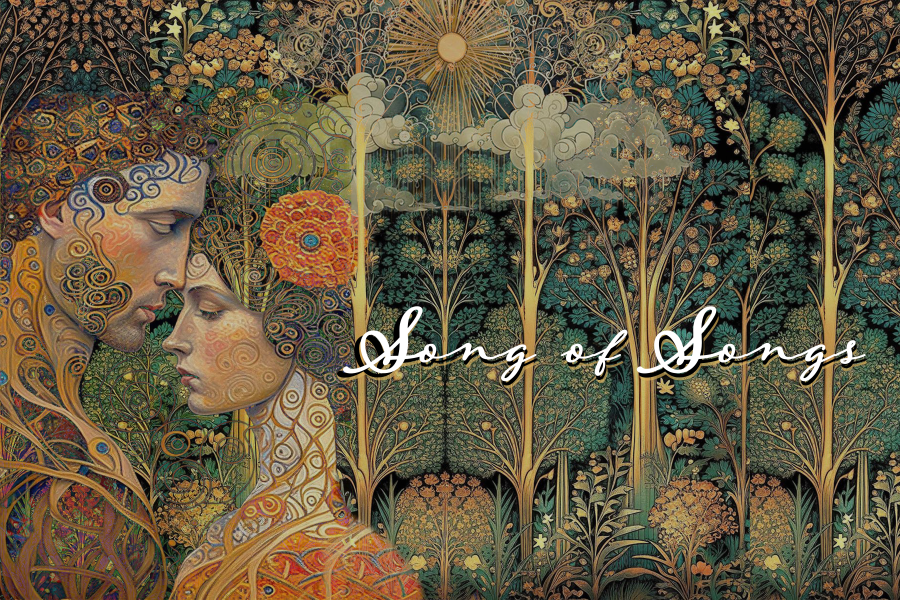
As we said previously, the Song of Songs is a chiasm; therefore, we can picture the structure of the poem as being like a mountain. The peak of the mountain was 5:1, which either was their wedding day or evoked that same newlywed love. As we have moved through the descent, we have noted some of the parallels that the second half has with the first half. Many of the same phrases and themes have reappeared but deeper and more matured.
We come now to the conclusion of the Song, to its epilogue, which we will break into two parts. Again, if we think of the book as a mountain, we have already been to the summit, and for the last two weeks we have been descending. Today, we are at our final camp of the descent. Next week, we will be at base camp, looking back over the whole journey and drawing out its final implications.
But for now, we are still on the mountain, only a day’s journey from the end.
For a being a love song, the poem does not conclude without giving us meditation of love itself. In fact, many commentators note that this is the closest that the Song comes to giving a definition of love. And I would argue that it must come here at the end of the Song. Here, after the highs and lows, the passions and the fears, we are finally prepared to receive these words as they are meant to be heard.
Indeed, love has always been the theme of this book. It began with passionate love, eros. And eros has been present throughout. But in the second half of the Song, the passion has deepened, becoming more rooted and enduring.
Now, we clearly see agape, the steadfast and covenantal love, that undergirds it all. Indeed, the three verses before us will show us that love is secure, rooted, exclusive, strong, and valuable. Love is nothing less than the flame of Yahweh.
LOVE IS SECURE // VERSE 5
Who is that coming up from the wilderness,
leaning on her beloved?
This question should be familiar to us. Back in 3:6, we heard the question: “What is that coming up from the wilderness?” But as I noted there, that verse could also be translated as who. Here we have the same question. The ESV presents this as the woman’s words, and she may indeed be speaking of herself. But it seems more likely that they should be read as the words of her friends, the daughters of Jerusalem. They have been watching and interacting with the couple the whole Song. Now they see her coming up from the wilderness, and this time she is leaning on her beloved.
Remember that the wilderness in Scripture is the place of chaos, isolation, and testing. It is outside the ordered life of the community. The woman, therefore, is coming from there. And this time she is not alone. She is leaning on her beloved.
This is a fitting image considering the tensions that we have witnessed in the previous two sections. She has had a dream (perhaps a nightmare) about being abandoned by him, and she was quite hesitant in responding to his praise in 6:11-13.
But here we see them together. They are restored and united. She is leaning on him, which is a picture of her security in him.
In our cultural moment, there is tremendous confusion about masculinity and femininity. But something is clearly shifting. More and more, men are longing to be men, and women are wanting to be women. But few know what exactly that looks like anymore.
As Christians, Scripture ought to be our supreme guide, and the Song of Songs particularly has given us beautiful verbal pictures of what biblical masculinity and femininity truly look like. This is one such image. Her husband is someone that she can lean on. He provides stability and strength. He is her place of earthly security. And that ought to be the aim of every husband.
Of course, that is not to say that there aren’t moments where a husband will lean on his wife for comfort. There certainly are. But husbands are called to be rocks that their wives can rest upon.
We can make the same application within the body of Christ as a whole. We should likewise strive to be places of security for our brothers and sisters in Christ, shoulders that they can lean on when the weariness of life becomes overwhelming.
LOVE IS ROOTED // VERSES 5
Now the woman very clearly does speak:
Under the apple tree I awakened you.
There your mother was in labor with you;
there she who bore you was in labor.
Given the threefold refrain of the Song warning against awakening love until it pleases, we can assume that she does not mean that her beloved was taking a nap. Under the apple tree, she awakened him to love. We might have expected him have awakened her, but that continues that counter-cultural nature of the Song. The bride is not simply a passive recipient of her husband’s love. When the time was right, she gladly awakened his love for her.
And she did so under the apple tree, where her husband was born. Again, that is strange to us because our culture actively teaches romance to be detached from the couple’s family. But the Song has given us the opposite message. The woman has rejoiced that their love is not isolated and detached but rather rooted in community, especially their family.
Indeed, we should probably not assume that the apple tree is literally where he was born and where their love was consummated. The tree is a picture of covenantal love and probably similar to our concept of a family tree. She is rejoicing in the love of their parents, which brought them into the world, and it anticipates the hope of future generations that their love may one day produce.
Thus, their love is not self-contained nor self-focused. It belongs to a larger story of love.
Is that how we think about love?
Many today approach life, family, and ministry with the desire for something unique and new. But Scripture invites us into an ancient story, the ancient story, for the gospel is God’s eternal purpose. Remember that the kingdom is like a mustard seed that gradually grows from a tiny seed to a mighty tree. And so it is with us, as we are grafted into God’s kingdom. As Psalm 1 describes, we become like trees that are deeply rooted with unwithered leaves that yields its fruit in season. Of course, fruit is for the immediate benefit of others.
Love is rooted in a story that is larger than ourselves.
LOVE IS EXCLUSIVE // VERSE 6
Set me as a seal upon your heart,
as a seal upon your arm
We now enter some of the most well-known lines of the entire book. In the ancient world, a seal was your proof of identity. Kings often wore signet rings, which they used to stamp their authority onto documents. Others would often carry their seal on a chain close to their heart. In a world without photographs or modern identification, this was essential for anyone of any level of influence. It was the proof that you were who you said you were, like a signature and identification rolled into one.
The absence of this identification is powerfully illustrated in one of my favorite scenes from the Odyssey. Odysseus returns home and reveals himself to his 20-year-old son whom he left as an infant. With no tangible way to prove his identity, he simply tells his son that no other Odysseus will ever come to him. He had no seal, only his word.
On the other hand, Odysseus’ nurse immediately identifies him by a scar upon his leg, which was a permanent and identifiable mark. That is what the bride is asking for here. By asking to be set as a seal upon his heart and arm, the woman is telling her beloved to make her a fundamental part of his identity. She wants to be imprinted upon his heart, which is his thoughts, his will, and the core of who he is. And she wants to seal his arm, which represents his strength and actions. She wants to mark who he is and what he does, his character and his actions.
She has declared three times that their mutual belonging and exclusivity to one another. Last week, he also testified that she was the only one in his eyes. All of this builds to a common message: biblical eros is exclusive.
LOVE IS STRONG // VERSES 6-7
Many poets have sought to compare love to objects in nature. “O my luv’s like a red, red rose…” “Shall I compare thee to a summer’s day?”
The Song does the same, but with a notably different tone. Love is strong as death, jealousy is fierce as the grave.
What, in the natural world, is stronger than death? When death comes, no one is able to resist its summons. Across all of history, every attempt to be liberated from death has failed. The scorecard is thoroughly stacked in death’s favor. This, therefore, is not sentimental language. It is heavy and even somewhat disturbing. Love is a force that rivals the strength of death itself.
But what of jealousy? For us today, jealousy is most often negative. We think of a jealous husband as being insecure and suspicious of his wife. But Scripture often speaks of a positive form of jealousy that is rooted in covenantal love. Indeed, God declares in the Second Commandment that He is “a jealous God.” This kind of jealousy is a holy, protective zeal for those who belong to Him. God refuses to share what is uniquely His.
That is idea here. Suspicious jealousy can certainly corrode love, but righteous jealousy guards it. It says, “I am yours, and you are mine. Nothing will separate us. Nothing will take you away from me.”
So, love is strong as death and as fiercely jealous as the grave, which does not release those whom belong to it.
Of course, we might argue (from the natural world) that death is stronger than love. After all, in our marriage vows, we say, “till death do us part.” But while death absolves a marriage, it does not eliminate love. A moving example of this is a letter written by a physicist named Richard Feynman to his wife, which reads:
When you were sick you worried because you could not give me something that you wanted to and thought I needed. You needn’t have worried. Just as I told you then there was no real need because I loved you in so many ways so much. And now it is clearly even more true — you can give me nothing now yet I love you so that you stand in my way of loving anyone else — but I want you to stand there. You, dead, are so much better than anyone else alive.
I know you will assure me that I am foolish and that you want me to have full happiness and don’t want to be in my way. I’ll bet you are surprised that I don’t even have a girlfriend (except you, sweetheart) after two years. But you can’t help it, darling, nor can I — I don’t understand it, for I have met many girls and very nice ones and I don’t want to remain alone — but in two or three meetings they all seem ashes. You only are left to me. You are real.
My darling wife, I do adore you.
I love my wife. My wife is dead.
Rich
P.S. Please excuse my not mailing this — but I don’t know your new address.
Feynman’s stubborn love for his deceased wife illustrates love’s jealousy to cling to even what the grave has taken away. “Till death do us part” may be legally and physically true, but try telling that to the person who feels robbed of the one whom their soul loves.
But if that is not enough, the strength of love is further described:
Its flashes are the flashes of fire,
the very flame of the LORD.
Some translations will render the last part as ‘a mighty flame’ or something along those lines. But I think the ESV is correct to translate this as the divine name: Yahweh. Love itself is described as the flame that comes from the LORD.
That is critical for us to understand. Love is not an abstract force that God just so happens to align with. No, God is love. He is the source, the definition, and the substance of love. Every true display of love, wherever it may appear, has its source in God. Even those who reject God, still have this common grace upon them. It is a borrowed flame.
In theology, we differentiate between common and special grace. Special grace is poured out only on those who belong to God, but common grace is given to everyone while they still have breath in their lungs. Common grace is temporary. But the point remains the same. All love that aligns with God’s character, whether special or common, is a grace from God. Every true fire of love comes from God’s flame.
The first part of verse 7 then gives us the third picture of love’s strength:
Many waters cannot quench love,
neither can floods drown it.
The fire of love cannot be extinguished, even when flooded with water. In Scripture, water is often the symbol of chaos and judgment. We see this in the great flood, which was the second greatest outpouring of God’s judgment so far in history. Yet even that flood which covered the highest mountain peak in water did not extinguish God’s love for His people. He preserved for Himself Noah and his family.
LOVE IS VALUABLE // VERSE 7
Our passage concludes with the preciousness of love:
If a man offered for love
all the wealth of his house,
he would be utterly despised.
Love cannot be bought. It cannot be negotiated or purchased. A man may have the greatest luxuries that the world has to offer and still not possess love. Of course, is that not what we have seen in the Song already? Solomon had everything that the world tells us to chase: sex, money, power, and fame. But the shepherd and his working-class wife have what the great king still lacked: exclusive and covenantal love.
Love is utterly beyond monetary value. It is a treasure against which gold and silver have no power. We see why in Pauls’ definition of love in 1 Corinthians 13:4-8:
Love is patient and kind; love does not envy or boast; it is not arrogant or rude. It does not insist on its own way; it is not irritable or resentful; it does not rejoice at wrongdoing, but rejoices with the truth. Love bears all things, believes all things, hopes all things, endures all things. Love never ends.
None of those things can be said of wealth.
THE FLAME OF THE LORD
Love is secure, rooted, exclusive, strong, and valuable. That is the vision that these verses give us of love. But that vision is only magnified whenever we reconsider them in the light of Christ and His love for His bride.
Who is that coming up from the wilderness,
leaning on her beloved?
In many ways, that is the picture of the church right now. We are still in the wilderness of this world, as Bunyan so rightly called it. We are not yet home. We are pilgrims on a long journey to the celestial city.
Even so, we are indeed coming up from the wilderness. Whether by our death or by the return of Christ, within less than one hundred years each of us is be in the presence of our Lord. Days can certainly feel long, but the years are short. The end is within sight, if we have eyes to see. And that ought to give us somber hope.
We are even now coming up out of the wilderness, and we do so leaning on our Beloved. We do not yet see Christ visibly, but He is not absent from us. He has given us His Spirit. As the old hymn says, we are leaning on the everlasting arms. Our life with Him is secure. No one can snatch us from His hand.
Indeed, His love for us is rooted. We are like the tree planted by streams of water, and we belong to an entire forest that is far greater than ourselves. Whether we know their names or not, we each stand on the shoulders of the giants in the faith who have lived before us. And by God’s grace, we should each long to leave behind such a legacy of faithfulness as well. We are each one thread in the tapestry of Christ’s kingdom.
His love for us is also exclusive. He has truly set us as a seal upon His heart and arm. Remember that the high priest did something similar under the old covenant. He carried the names of Israel on his breastplate and upon his shoulders. The people of God were always upon him since he was their mediator in the presence of the LORD.
But that was temporary. Those garments had to be taken off at the end of the day. Indeed, they were passed on the next high priest whenever the one before died.
Not so with Christ.
He is the true and better high priest. We sealed upon His heart and arm. Our names are no longer written on removable stones but a bound to Him forever. We belong to Him.
His love is also strong and fierce. Again, we catch a glimpse of love’s might in this life when love holds on even in the face and presence of death. But in Christ, we see something far better. In Him, we see a love that is not simply as strong as death; it is stronger.
Christ Himself said, “I am the resurrection and the life.” And He proved it. Death had no claim on Him. Neither could the grave contain Him. He defeated death through His own death.
Through His work, the grave also has no final claim on those who die in Him. If Christ does not return first, we will all certainly die. But death is a doorway for the Christian, a river that must be crossed. Indeed, death itself will be the last enemy to be defeated.
Likewise, Christ is the perfect flame of Yahweh, and He could not be quenched. Mark Chanski gives a wonderful survey of Christ’s unquenchable love for His bride:
For His Bride, He left heaven’s glory.
For His Bride, He was willing to wiggle in Bethlehem’s manger and work in Nazareth’s workshop.
For His Bride, He was numbered with the transgressors in His baptism.
For His Bride, He endured near starvation and Satanic temptation in the wilderness.
For His Bride, He absorbed years of public ministry abuse by a wicked and adulterous generation.
For His Bride, He had no place to lay His head.
For His Bride, He marched fearlessly toward the Jerusalem slaughterhouse.
For His Bride, He broke the bread in the upper room.
For His Bride, He was drenched in blood-like sweat.
For His Bride, He said, “Not my will, but Thine be done.”
For His Bride, He handed Himself over to a kangaroo court.
For His Bride, He was again and again spat upon and struck in the head.
For His Bride, He stood bare-backed at a pillar–absorbing scourge after scourge.
For His Bride, He was mocked while holding a reed scepter.
For His Bride, He carried and collapsed under the crossbeam.
For His Bride, He was stripped naked.
For His Bride, He accepted the spikes into His hands and feet.
For His Bride, He was lifted up between heaven and earth as an accursed spectacle.
For His Bride, He hung His head before wagging scoffers.
For His Bride, He gasped for breath and cried out “My God, my God, why hast thou forsaken me?”
For His Bride, He finished it and died.
At the cross, the floodwaters rose, and God poured the fullness of His wrath upon His Son. And by His sacrifice, Jesus has now become for us the greater ark. In Him, we are safe from all the waters of judgment.
His love is, therefore, of infinite value.
If a man offered for love
all the wealth of his house,
he would be utterly despised.
Interestingly, Jesus tells a story that similar. A man finds a treasure hidden in a field, and in his joy, he sells everything he has to buy that field. To the world, that looks foolish and certainly worthy of being despised. But in reality, it is gain beyond measure.
Jim Elliot rightly said that he is no fool he trades what he cannot keep for that which he cannot lose. And that is Christ. He is the great treasure, the pearl of great price. Silver and gold certainly cannot buy our salvation in Christ. But He is more than worth the loss of all things. As Paul says,
But whatever gain I had, I counted as loss for the sake of Christ. Indeed, I count everything as loss because of the surpassing worth of knowing Christ Jesus my Lord. (Philippians 3:7-8)
Can you say that as well? Is He better to you than everything else in creation combined? If so, walk in it. Rest in it. Let the love of Christ be your foundation and your hope both now and forevermore.
DISCUSSION QUESTIONS
- Which description of love in the passage stood out to you most (secure, rooted, exclusive, strong, valuable)? Why?
- What does it look like, practically, to have a love that is rooted in something bigger than yourself?
What does it mean for love to be described as a “seal upon your heart” and “seal upon your arm”? What does that communicate about identity and commitment? - Why is love compared to something as strong and unavoidable as death? What does that add to our understanding of love?
- The passage calls love “the flame of the LORD.” How is that different from how our culture typically defines love?
- How does this passage deepen your understanding of Christ’s love for His church?
- In what ways is Christ’s love not just as strong as death, but stronger than death?
- What does it mean for you personally to be “set as a seal” on Christ’s heart—that you belong to Him?
- How does the cross demonstrate that love is truly “the flame of the LORD”?
- When you struggle to feel loved by God, how can truths from this passage anchor you?

