
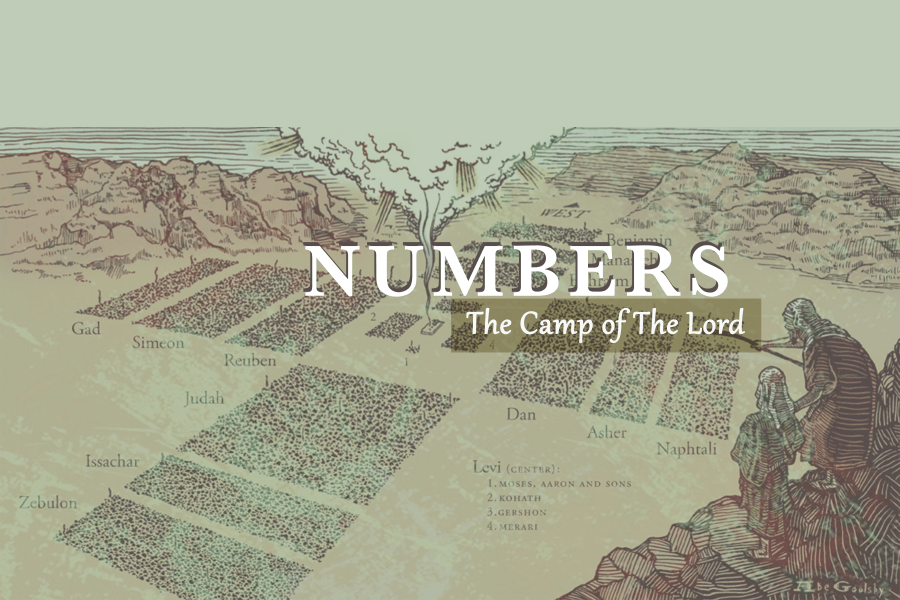
Why Numbers?
Because it was next.
The first series I preached at Western Meadows was Genesis 1-11. Only three years since have been without a series through a portion of the Pentateuch. By the Lord’s grace, we have completed Genesis, Exodus, and Leviticus, which brings us now to Numbers.
We will not study the whole book this year, as we did with Leviticus last year. Rather, we will divide it into three sections, tackling the next two parts in 2027 and 2028, Lord willing.
Fittingly enough, the text before us (Numbers 1) can also naturally be divided into three parts. First, verse 1 will give us a brief orientation to the entire book. Second, verses 2-46 recount the first census of this book. Third, verses 47-54 describe the Levitical exemption. Of course, we will ultimately set our eyes upon Christ, God’s final revelation and perfect Shepherd and Mediator.
AN ORIENTATION TO THE BOOK OF NUMBERS // VERSE 1
The key words of this first verse orient us to the themes of the entire book. The first word is Yahweh, the LORD. He is the subject of this sentence, as well as the subject of all the Pentateuch.
In Genesis, God is introduced as the Creator of all things: “In the beginning, God created the heavens and the earth.” He creates the world good, but Genesis 1-11 recounts how humanity rejected Yahweh and His presence. In Genesis 12-50, the LORD establishes a covenant with Abraham and his descendants, promising to make him into a mighty nation and give him the land of Canaan.
In Exodus, Yahweh redeems Israel out of slavery in Egypt with a mighty hand and an outstretched arm. He then takes them to Mount Sinai in the wilderness and makes His covenant with him, promising to be their God and to make them into His people.
Leviticus focuses largely on the tabernacle and how God’s people could come into His presence and have fellowship with Him. The second half of the book, however, addresses how God’s people should live as Yahweh’s holy nation.
The Book of Numbers picks up where Leviticus left off, describing how God continues to make Israel into His people and disciplines them in order to make them holy.
Yahweh here is speaking to Moses. Moses, of course, is the mediator between Yahweh and Israel. There was a brief moment in Exodus 20 when God spoke the Ten Commandments directly to the people from Sinai, but they then begged Moses to be with representative instead.
And God is indeed speaking to Moses, which emphasizes that this is divine revelation. Moses brought the words of Yahweh to the Israelites, and he also wrote them down for us to read today. Thus, we must remember from the outset that Numbers is fundamentally the word of God spoken to His people, and we must come to this book believing that it is “God-breathed and profitable for teaching, for reproof, for correction, and for training in righteousness” (2 Timothy 3:16).
So, we have the subjects and the action: Yahweh spoke to Moses. Next, we have the location: in the wilderness of Sinai. First, Sinai is the place of God’s covenantal revelation to Israel. Yahweh has given them His law, made them into His people, and bound Himself to them as their God.
But Sinai is in the wilderness, which happens to be the Hebrew title for the book: In the Wilderness. Indeed, while Israel will move locations in Numbers, they are always in the wilderness. This is important because the wilderness represents chaos and disorder. It was the place outside of civilization. But it also becomes the place of testing, refinement, and discipline. Yahweh has led His people into the wilderness to give them order in the midst of chaos.
He also speaks to them from the tent of meeting, which is also called the tabernacle. Those two terms are important. At the beginning of Leviticus, it was called the tabernacle, meaning ‘dwelling place.’ God’s presence had come down among the people of Israel, but Moses and Aaron could not yet enter. Over the course of the first chapters of Leviticus, the tabernacle also becomes a tent of meeting.
Numbers fittingly begins by calling it the tent of meeting. Now that the priesthood is established, God’s people can now meet with Him there. Indeed, Moses no longer needs to climb Sinai’s height to hear from God. Yahweh now speaks from the tent of meeting.
Finally, we have a timestamp: on the first day of the second month in the second year after they had come out of the land of Egypt. This reminds us of God’s mighty work in Exodus, where Yahweh redeemed His people from the house of slavery. They are now in their second year of being the free covenant people of the Most High God.
Again, those words give us a nutshell orientation to the rest of the book. It is also important that do not overlook seemingly plain portions of Scripture such as opening verses. Much profit is gained in Bible study simply by pausing long enough to pay attention and linger over each verse.
THE CENSUS // VERSES 2-46
With verse 2, we now move into the primary purpose of this chapter, which is to give us the census of Israel. Thus, we read Yahweh’s command:
Take a census of all the congregation of the people of the people of Israel, by clans, by father’s houses, according to the number of names, every male head by head. From twenty years old and upward, all in Israel who are able to go to war, you and Aaron shall list them, company by company.
Since this is the first command of the book, we can certainly understand why it is called the Book of Numbers. But why does God command a census of the whole congregation?
The most basic function of a census is to find out the number of individuals within a particular community. And that number is important because belonging to a community always comes with both responsibilities and privileges. A census clarifies who will be counted on for the responsibilities and counted in for the privileges. That is why nations still take censuses today.
What then were the responsibilities that came with belonging to Israel? A census was already taken in Exodus 30 that required the giving of a contribution for the tabernacle, and the sharing of resources through giving is certainly one of the responsibilities for belonging to a community. The other primary responsibility is found in our text. The purpose of this census was to number Israel’s military, the men who would defend the nation.
These are still the two biggest reasons for censuses today: to know who can be taxed, how many people will need those tax monies spent on them, and to know a country’s potential fighting force.
That second reason is especially important to our present study. In these opening chapters of Numbers, God is organizing Israel at Sinai to be His earthly host, paralleling and mirroring His heavenly host. The people of Israel are to be Yahweh’s earthly army, just as the angels are His heavenly army.
Of course, there are also privileges of being numbered as a part of a community. In all nations, those privileges are supposed to include the support and protect that the people responsibly contribute to. For Israel specifically, belonging to God’s people meant also having access to the presence of Yahweh Himself through making offerings at the tent of meeting. They also were counted in future division of the land that God had promised to their ancestor Abraham.
Though the particulars vary, every community comes with a set of responsibilities and privileges, which makes numbers perpetually important. Again, being numbered within a community says that you are counted in the community and can be counted on within the community.
Verses 4-16 describe how Moses will actually take this census. He is to begin by calling the twelve tribal leaders to himself, and they will be ones responsible for numbering their particular tribe.
This introduces us to a key theme running quietly through Numbers: the importance of leadership and societal structure within a community. We were already given a glimpse of this in Exodus 18. In that text, Moses’ father-in-law sees how all the people were bringing Moses their problems, and he rebuked Moses, telling him that he could not handle the day-to-day affairs of an entire nation alone. He then counseled Moses to establish a structure of leaders, so that only the most difficult matters would come to Moses.
Again, this fits with the title of Numbers. To have delegation, order, and leadership, you need numbers. People need to be accounted for. And isn’t that the opposite of the wilderness? The two titles reveal the great tension of the book: Numbers and In the Wilderness. Order or chaos?
In some places, the people of Israel will faithfully follow the leadership structures that Yahweh establishes. In other places, particularly chapters 11-25, they will reject God’s order, rebel against their leaders, and suffer the judgment and discipline of God. Repeatedly, Numbers will show us the blessings of submitting to God’s ordered rule and the curses that come with rebelling against that structure.
So, from the beginning, Moses is relying upon other leadership. Notice, of course, that there are twelve tribes listed, even though the tribe of Levi is excluded. As we will see in verses 47-54, God has a special design for the Levites, and in accordance with Jacob’s blessing in Genesis 48, Joseph’s two sons were numbered among Jacob’s own sons. Thus, the tribe of Joseph is broken into the two half-tribes of Manasseh and Ephraim.
Verses 17-46 record the taking of the census and its results. There are a few things worth noting. First, notice that everyone is counted by families, clans, and fathers’ houses. Long before Aristotle reasons that the family is the basic unit of society, God had already revealed that truth.
Second, the wording for each tribe’s results is almost identical, only the tribe and numbers are changed. Of course, this does not make for the most exciting of reading experiences. But crucially, excitement is not the goal of the text. And the text is important, nonetheless. Few children dream of being accountants when they grow up, but accountants are quite important for the overall society. We should remember that Scripture accurately reflects human life, which means that we should not expect all of it to be exciting.
Furthermore, we should remember that repetition means pay attention. Whenever we see this repeated formula, we should not ask, “Why does God have to say the same thing over and over again?” Instead, we should ask, “Why is God saying the same thing over and over again?” After all, God does not waste words. Every word of Scripture was inspired by the Holy Spirit for our profit, and we would do well to consider it.
What then might be the reason for the repetition? I believe it highlights the unity and equality of the twelve tribes. Each certainly has its own distinct identity, yet by listing them using the same formula, the LORD is emphasizing that they are collectively one covenant people, that they are all descendants of Abraham.
This is paralleled and even magnified in the church, for we are one body composed of many members. We too each have our own individual gifts and identities, but we collectively form one body of Christ.
Now, the total result of the census is 603,550, and many commentators point out the various difficulties with that number. Archaeological evidence suggests that 600,000 fighting men, which would put the total population at 2-3 million people, was exceptionally large for the ancient world. And that would seem to contradict other places, such as in Deuteronomy, where Israel is called the least of all the nations on earth.
What then are we to make of these numbers in Numbers? There are four main solutions, and we should keep in mind that there are God-fearing theologians who hold to the inerrancy of Scripture that hold to each of these proposals.
First, we can simply take the numbers as accurate, which would assume that our understanding of the archaeological evidence is incorrect. That may very well be the case.
Second, some propose that we have mistranslated the word ‘thousand,’ which can also mean ‘clan’ or ‘family.’ This would mean that there were 603 families in total. I find this to be the weakest solution.
Third, we could read the numbers as either hyperbolic or symbolic. Some suggest that an extra zero was intentionally added to the numbers, which may have been an ordinary practice at that time.
The fourth proposal comes from Michael Morales, who reads these as being the full number of the Israelites, not just the military-age men. We see a suggestion of this in verse 2: Take a census of all the congregation of the people of Israel, by clans, by fathers’ households, according to the number of names, every male head by head. We tend to read the phrase every male head by head as a qualifier to all the congregation, but Morales suggests that they were the ones presenting their families to the tribal chiefs. After all, the main point of the census was to register the fighting men of Israel, so it would make sense that they would represent their households during the census.
Furthermore, in Numbers 11, Moses says to God, “the people among whom I am number 600,000 on foot.” In that text, Moses refers to the people as ha’am, which most plainly includes every human being in the nation.
Thus, the males from 20 years old and upward were the representatives of their families and were being registered in the census, but the numbers given are of the entire nation. I find this solution to make the most sense personally.
Either way, the primary point of the census is that God is numbering His people. He is organizing Israel for the journey into the Promised Land and then for their war against the Canaanites. And whether their total number is 600,000 or 2-3 million, God’s promises to Abraham were coming to pass. Israel was growing into a mighty nation, and Yahweh was preparing to give them the land as well.
THE LEVITICAL EXEMPTION // VERSES 47-54
The final verses of the chapter address why the Levites were not included in the census. They were set apart from the rest of the Israelites for a holy task, which we read in verse 50:
But appoint the Levites over the tabernacle of the testimony, and over all its furnishings, and over all that belong to it.
Then in 53, we read:
The Levites shall camp around the tabernacle of the testimony, so that there may be no wrath on the congregation of the people of Israel. The Levites shall keep guard over the tabernacle of the testimony.
Notice the distinction. The other tribes were to guard Israel from external enemies, but the Levites were to guard Israel from the danger of God’s holiness. They were to be encamped around the tabernacle, as a buffer between it and the rest of the people.
This goes back to one of the main themes of Leviticus: God’s presence is both the highest good and the greatest danger. God is both good and great, and to be with Him is the very joy for which we have been made. But He is also deadly to those who come into His presence in sinfulness or uncleanness (which are two distinct categories). The Levites, therefore, were a protective boundary for the rest of Israel.
NUMBERED AND KNOWN
There are significant applications of this text to our present day. One of the most obvious is the parallel between the census here and the practice of church membership. Again, in any community (no matter how big or small), it is important to be known and counted, that is, to be counted in and counted on. The same is true of church membership. Belonging to a church comes with both responsibilities and privileges. Iain Duguid expresses the importance of church membership well:
When you become a member of a local church, you are saying to them, “You can count in. You can count on my resources to this community of believers, and I’d like you to count me when you think about the flock you are watching over.” You are saying that you are going to contribute as much as you are able to the work of ministry in that place, both in terms of financial support and using your own personal spiritual gifts to edify and build up that particular expression of Christ’s body. You are saying that you are join up with that battalion of Christ’s army in the spiritual warfare that engages all of us, young and old, men and women. You are saying, “I’m going to fight alongside this family, wrestling together in prayer, reaching out together with the good news, tending the wounded with love and care, sounding the trumpet of God’s greatness together with you in worship.” God’s people need to stand up and be counted. (30)
Amen. God’s people do still need to stand up and be counted. Being numbered is still important because it represents the privilege of being known and counted into the community and the responsibility of being counted on by the community.
Earthly leaders both in ancient Israel and in the church today need to learn the names of their people. We must submit ourselves to structures of leadership that God designated for us in this life. Of course, there is also the glorious truth that God does not to take roll in order to learn our names. Christ knows (and knew before He began creation) the full number of His people. He stands outside time and sees each one of us and knows us by name. And that ought to be a tremendous comfort to us.
Indeed, Christ is also our great mediator. He is greater than Moses. As the author of Hebrews says, “Long ago, at many times and in many ways, God spoke to our fathers by the prophets, but in these last days, God has spoken to us by His Son.” Christ is the radiance of God’s glory and the exact imprint of His nature. He reveals the fullness of God to us by becoming one of us.
And He is also greater than the Levites. His cross is the eternal buffer between us and the wrath of God, for all of God’s judgment fell upon Christ. And by absorbing the rightful punishment for our sin, Christ now brings us safely into the presence of God by transferring His righteousness onto us.
Even though the holy presence of God is a great danger to the sinful, in Christ we are now commanded to “boldly approach the throne of grace that we may find mercy in the time of need.” Again, we are free to do this without fear because Christ has taken all of our sin and given us all of His righteousness. Thus, whenever we come to the Father in prayer, He sees the blood of Christ cleansing us rather than all of multitudes of rebellions against Him.
Let us, therefore, give thanks to Christ our Lord. He who saved us from our sin will also be faithful to lead us through the wilderness of this life. As with Israel in the Book of Numbers, we are in the wilderness. We have been delivered from slavery, but we are not yet in the Promised Land. We daily need the leadership and guidance of Christ, and we need one another.
And that brings us to the beauty of the Lord’s Supper, which is fundamentally a wilderness meal. We come to this table in between two points in time: our deliverance and redemption that was worked by Christ on the cross nearly 2,000 years ago, and His second coming to make all things new.
In between that, as often as we take this, we proclaim His death until He comes. The bread and the cup testify to the body and the blood of our Lord that has made it so that we are counted in among the people of God. It is also a visible proclamation that we will be counted among the people of God. As we come to this bread and cup this morning, let us indeed give thanks to our Lord for the great privilege of being numbered and therefore known.
Further Resources
You can find my primary resources for this study at the link here.

