
Why is the Bible so full of chiasms?
A chiasm, we should recall, is a literary mountain, where the emphasis is placed upon the center and everything before and after that center parallel with one another.
We observed a number of chiasms last year during our study of Leviticus, which is chiastically structured around chapter 16, the Day of Atonement. That chapter is itself a chiasm, and the Pentateuch or Torah is also a chiasm centered around Leviticus. We even saw that Song of Songs is written as a chiasm with 5:1 being its center. And there are plenty more in Scripture’s pages.
Why then does God use so many chiasms in Scripture?
God is a God of order, not chaos, and His works clearly reflect His character. We see this in Genesis 1, where He systematically forms and fills the earth. It should not surprise us, then, to discover purposeful structure within God’s Word as well. While the Lord did use human authors with their own unique styles and skills, the Holy Spirit is the ultimate author of Scripture. As Peter says, the human authors were carried along by Him as they wrote. Thus, we see should expect to find divine architecture in the Bible.
Indeed, we noted last week that the importance of God’s revealed order and structure is a theme throughout the Book of Numbers, and we see it fittingly in Numbers 2, which describes the organization of the camp of Israel. Since all of God’s Word is profitable to us, we will aim to see the rich instruction that is present within our text.
DEGREES OF HOLINESS
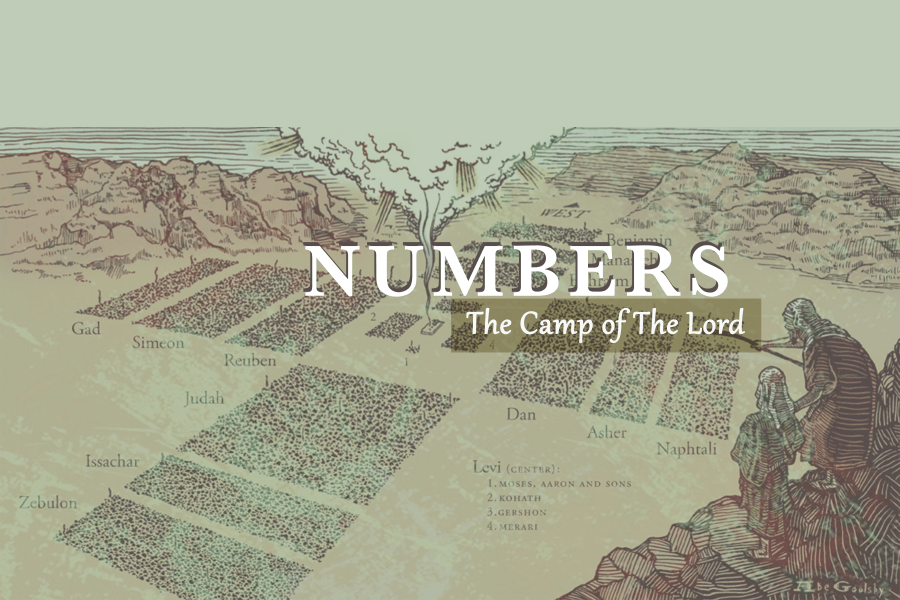
Numbers 2 is rather short (compared to other chapters in the book) and fairly straightforward. It describes the layout of the Israelite camp within the wilderness. Even though the camp likely looked like a square from the sky, we should think of it in terms of concentric circles of holiness.
At the very center of the camp was the tabernacle, which itself consisted of three parts. The innermost part was the Most Holy Place. It contained only the Ark of the Testimony and could only be entered by the high priest once a year on the Day of Atonement.
The outer room of the tabernacle was called the Holy Place. It contained the golden lampstand, the bread of the Presence, and the altar of incense, and it could only be entered by the priests.
Around the tabernacle was the courtyard, which was marked by a fence. Any Israelite could “enter His gates with thanksgiving and His courts with praise” as long as they were ritually clean. The courtyard contained the bronze altar and the bronze basin. Here Israelites could bring a variety of offerings. They could offer a sin or guilt offering as a sign of repentance, a burnt offering as a sign of devotion, a grain offering as sign of fealty, or a peace offering as a sign of communion and fellowship with Yahweh. Indeed, the peace offering represented the overall function of the tabernacle: to be a tent where Yahweh’s people could come into His presence.
As we already saw last week, the Levites were camped around the tabernacle, acting as a buffer between the holiness of God’s presence and the rest of the Israelites. The following two chapters will focus on their particular duties, which included keeping ritually impure Israelites from entering the court of the tabernacle.
Around the Levites were the other eleven tribes of Israel (still numbering twelve because of the half-tribes of Ephraim and Manasseh). This layer of the Israelite camp is clearly the dominate focus of the chapter.
Finally, though it is not mentioned in our present text, past these tribes was called outside the camp, and it represented being separated from God’s presence and people and left to the chaos and danger of the wilderness.
THE WARNING AND HOPE OF HIERARCHY
With this overall structure of the camp in mind, let us consider how our chapter describes the positions of each tribe.
First, note that the tribes are grouped by their mothers. The first two groups are the children of Leah and her maidservant, while the second two are the children of Rachel and her maidservant. The children of the maidservants are placed after the children of Jacob’s wives.
We are given four divisions of three tribes each, and each division has a chief tribe around whose banner they are to camp: Judah, Reuben, Ephraim, and Dan. Judah is listed first and is given the place of prominence. He camped east, which was in front of the entrance to the tabernacle.
In Numbers 1, Reuben was listed first because he is the firstborn, and we would expect him to have the place of preeminence here as well. So, why is Reuben’s standard after Judah? In Genesis, Reuben sinned by lying with Bilhah, Rachel’s maidservant. And on Jacob’s deathbed, he gave this blessing to Reuben:
Reuben, you are my firstborn,
my might, and the firstfruits of my strength,
preeminent in dignity and preeminent in power.
Unstable as water, you shall not have preeminence,
because you went up to your father’s bed;
then you defiled it–he went up to my couch!
But after Reuben came Simeon and Levi, who both likewise removed themselves from the primary place in Genesis 37. In that chapter, their sister Dinah is violated by a young man named Shechem, and in response, they slaughtered every male in the city. It was a severely disproportionate act of judgment, and Jacob gave them this word from his deathbed:
Simeon and Levi are brothers;
weapons of violence are their swords.
Let my soul come not into their council;
O my glory, be not joined to their company.
For in their anger they killed men,
and in their willfulness they hamstrung oxen.
Cursed be their anger, for it is fierce,
and their wrath, for it is cruel!
I will divide them in Jacob
and scatter them in Israel.
Thus, here in the structure of the camp, we find a warning about the lingering effects of sin. Of course, we know that God does not hold children responsible for their fathers’ sins. Even so, sin can certainly still affect future generations. We see this most fully with Adam, but we can likely point to any number of examples in our own lives or the lives of those close to us. Of course, we cannot change our heritage, but we can alter the inheritance that we leave, which we see in both Judah and Levi.
Judah was not elevated in preeminence because he was less of a sinner than Reuben. In fact, Judah committed a similar sin by impregnating his daughter-in-law. But Judah and Reuben are contrasted in Genesis 43-44. When trying to convince Jacob to let them bring Benjamin down to Egypt, Reuben tells Jacob that he could kill Reuben’s own sons if he failed to bring Benjamin back. That was a foolish proposal. Why would killing his grandsons compensate for the loss of his own son?
Judah, however, pledges to personally be responsible for the boy, and when Joseph tests them by framing Benjamin for stealing, Judah follows through with his pledge, offering himself in place of his brother. Joseph surely told Jacob about this moment later, which led to Jacob declaring:
The scepter shall not depart from Judah,
nor the ruler’s staff from between his feet,
until tribute comes to him;
and to him shall be the obedience of the peoples.
The Levites also had their moment of redemption in Exodus 32. After the sin of the golden calf, Moses asked all who were on Yahweh’s side to come to him, and the Levites did so. Moses then ordered them to slay the idolatrous Israelites. Notice the parallel to Levi’s slaughter of Shechem. Both were acts of violent judgment. The first was a sinful judgment, while the second was at God’s command. From that day on, the Levites were ordained into the service of Yahweh. The words of Jacob would still stand. The Levites would be scattered through Israel, but they would do so in service of the LORD and of His tabernacle.
So, while Ruben and Simeon are reminders of the effects of sin upon future generations, Judah and Levi are pictures of the power of repentance. Like the Levites, you may be living under the effects of your ancestors’ sins, but their commitment to the LORD is portrait of rewriting their legacy for their descendants. Likewise, we have no control over our heritage, but we can change the inheritance that we leave.
Or maybe you are more like Judah with your own personal sins always hanging over your mind, wondering if you could ever leave a positive legacy for those who follow you. The Apostle Paul is another example of God’s marvelous grace toward those who repent.
THE CENTER AND THE FOCUS
Yet the most important aspect of the layout of the camp in Numbers 2 is the tabernacle at its center. With the census in Numbers 1, the boundary of the community was defined, who is counted in and could be counted on. Now, in Numbers 2, the central focus of the community is established. Indeed, the key verse in this second chapter is verse 2, which can easily be rushed over:
The people of Israel shall camp each by his own standard, with the banners of their fathers’ houses. They shall camp facing the tent of meeting on every side.
The tent of meeting, which is another name for the tabernacle, is at the center of the camp. Yahweh’s presence was quite literally the center of the people of Israel. This, of course, is a beautiful picture of how God’s people are to always keep God at the center of our lives.
But notice that the tabernacle was not simply central to the camp; it was also the focus of the camp. Being camped in the wilderness, it would have been natural for Israel to camp facing outward, so they would be ready to face any enemies who sought to attack them. Rather, they were to camp facing inward toward the tabernacle and the presence of God.
Since we too are in the wilderness of this life, between our redemption in Christ and His return, do we structure our lives similarly? Is the LORD the center and the focus of all that we do? After all, is that not what Paul commands whenever he says “whether you eat or drink, or whatever you do, do all to the glory of God” (1 Corinthians 10:31)?
A LITERARY TABERNACLE
But how do we do that? We have a hint here in the text. You see, the structure of the camp is highly intentional for their time in the wilderness, but whenever they enter the Promised Land, the tabernacle will no longer be at their center. Will this structure then only be a distant memory for them?
No, because the layout of the camp was also meant to call their attention to God’s law. The Scriptures, which they will be commanded to keep as signs on their foreheads and hands all the days of their lives, are a literary tabernacle, revealing who Yahweh is and inviting His people to have fellowship with Him. Whenever the tabernacle was no longer in their visible sight, God’s people were to keep His law always on their lips to keep their minds, hearts, and strength centered and focused on Him.
And that is still true today. To have our lives centered around God means focusing our lives on His Word. Too often, we look for ways that we can fit Scripture into our everyday routines, but if it is truly the living and active Word of the Creator of heaven and earth, then it should be the salt that invades every aspect of our schedule rather than a garnish.
Just as the camp of Israel was structured around the tabernacle and the presence of God, the Pentateuch is likewise structured with the book of Leviticus at its center. As we noted last year, the description of the Day of Atonement in chapter 16 stands at the center of Leviticus’ chiasm (with Leviticus 16 itself also being a chiasm). Chapters 1-15 describe how the Israelites could enter God’s presence, which is the culmination of Genesis and Exodus. Chapters 17-27 then focused on the holy conduct that God expected from His people, which leads directly into Numbers and Deuteronomy.
But at the center of it all is the presence of God, restored communion with the Creator through atonement. The layout of the camp and the layout of the Pentateuch have the same message: God is to be the center and focus of His people. Leviticus declared and the tabernacle displayed that Yahweh could only dwell in their midst through atonement for their sin. The wages of sin is death, but God graciously permitted the blood of bulls and goats to be offered in their place.
But as glorious and gracious as the tabernacle was, it was insufficient. As Hebrews 10:4 says, “for it is impossible for the blood of bulls and goats to take away sins.” They were a gracious shadow, but Christ is the substance. They pointed forward by faith to Christ, just as the Lord’s Supper now points back by faith to Christ. But Christ alone is the all-sufficient sacrifice for sin.
THE TRUE AND BETTER
While this is the good news of the entire New Testament, Hebrews tells us this through a structure that parallels the Torah. With thirteen chapters, we would expect chapter 7 to be at the center, but because the final chapters are much longer than the early ones, the central point of Hebrews is actually 9:1-10:18. And here is how that central section begins:
Now even the first covenant had regulations for worship and an earthly place of holiness. For a tent was prepared, the first section, in which were the lampstand and the table and the bread of the Presence. It is called the Holy Place. Behind the second curtain was a second section called the Most Holy Place, having the golden altar of incense and the ark of the covenant covered on all sides with gold, in which was a golden urn holding the manna, and Aaron’s staff that budded, and the tablets of the covenant. Above it were the cherubim of glory overshadowing the mercy seat. Of these things we cannot now speak in detail. (Hebrews 9:1-5)
Just as the center of the Israelite camp and of the Pentateuch was the tabernacle, the author of Hebrews begins the central argument of his sermon with the tabernacle. He then proceeds to describe the true Day of Atonement that Christ worked through His atoning death upon the cross.
Thus, the book of Hebrews is giving us the same message as Numbers 2: God’s people must be focused and centered on the presence of God, which we are now able to draw near to through the finished work of Jesus.
Of course, this now makes the message much more divisive. Many are willing to make God the center and the focus of their lives, as long as they are able to choose which God. Today, materialism is increasingly being abandoned in favor of a kind of open spirituality. More and more people are focusing upon God in some sense. However, it is not enough to simply contemplate God as a vague and malleable concept. Scripture calls us to be focused and centered on Jesus Christ who is the eternal Word of God that tabernacled among us (John 1:14). He is the way, the truth, and the life, and no one has communion with the Father except through Him (John 14:6). Christ is the only source of atonement for restoring our relationship to God. Is Jesus the center and focus of your life? How about the gospel?
Paul is a wonderful picture of this. Paul had a death grip on the gospel and an open hand with virtually everything else. He did not care about being circumcised or uncircumcised, eating pork or not eating pork, observing feasts or not observing feasts. Whatever a person decided to do was fine for Paul. Yet he would also defend the gospel to the death, lest anything else be added to it. The gospel was the center of Paul’s life, orienting everything he did. Can we say the same?
Notice also that Paul’s intense focus upon the gospel did not leave him an isolated monk, hiding from the world around him. No, it led him out, carrying its message to all the world. Here too Hebrews explains this to us. In 13:10-13, we read:
We have an altar from which those who serve the tent have no right to eat. For the bodies of those animals whose blood is brought into the holy places by the high priest as a sacrifice for sin are burned outside the camp. So Jesus also suffered outside the gate in order to sanctify the people through his own blood. Therefore let us go to him outside the camp and bear the reproach he endured.
To become a Christian quite often looks like going outside the camp, abandoning our former people to be united to God’s people. But Jesus knows that pain. He was rejected by the very people that He came to save. His atonement did not take place upon the bronze altar or inside the temple; it took place outside of Jerusalem, in the place of rejection and death, in the wilderness.
Today we are still called to have God as our focus and center, but our orientation is not faced inward but outward. We are to face Christ, the true tabernacle, who has gone outside the camp. As we saw last week, every community certainly needs to know its members, but we are to do while always looking outward, welcoming others into the camp. Christ has called His people to be fundamentally mission oriented. Indeed, we are ambassadors of Christ, calling others to come and have fellowship with God through Christ.
As with most things, there are two errors into which we might easily fall. The first is to have a purely inward focus. These communities often have a strong center and clearly defined boundaries for membership, but they may also develop into a tight-knit community that no one else is able to enter. The second is to be so externally focused that there is no internal community of any real depth.
The pattern of Scripture is both/and. To be a community, we must establish who is counted and can be counted on, but we must also have an outward focus to where Christ has gone and is still going. Individually, this means living a cruciform life, a life shaped by the cross. Indeed, if we do as Christ has commanded (denying self, taking up the cross, and following Him), then we will naturally live such lives. We will strive to do good to others, especially those of the household of faith, while also continuing Christ’s mission to seek and save the lost.
In fact, we are inviting others into the great center of history. You see, the gospel ought to be the center and focus of our lives, but even if it is not, the gospel is the focal point of all history. It begins with creation, moves into the Fall, and then we have the wait for Christ’s coming. At the center of all time is the life and work of Jesus Christ. We are now waiting for His return, which will bring the final judgment and then the new creation. Christ stands in the place of utmost preeminence, at the center of all things.
Just as the sacrifices visibly rooted the Israelites in their hope of the coming Christ, the Lord’s Supper also roots us in His atonement. As we said last week, this is not our permanent feast; it is a wilderness meal, anticipating the wedding supper of the Lamb. So, we look back to the true Day of Atonement and look forward to the day when sin is put to death for good. May this bread and cup do what Numbers 2 shows God’s people should always do: focus and center us upon the finished work of Jesus Christ and fellowship that we now have with the Father through Him.
Further Resources
You can find my primary resources for this study at the link here.

