
The overall purpose of Numbers 1-10 is that Yahweh is organizing and preparing Israel to be His earthly hosts. They are to be His earthly army through whom He will enact His judgment upon the Canaanites.
So far, the first two chapters have given us the number and focus of the whole congregation. In Numbers 1, they were counted. The census defined who was counted in God’s people and who could be counted on as God’s people. Numbers 2 then centered the Israelites around the tabernacle and the presence of God within their midst.
Chapter 3 and 4 shift from the whole congregation to the Levites in particular. Numbers 3 addresses who the Levites are and why they exist, while chapter 4 will discuss the specific duties and responsibilities that are assigned to the Levites. Thus, these two chapters are moving from the overall function of the Levites to their particular tasks.
Our text can be divided into three sections. Verses 1-5 distinguish the Levites from the priests, verses 5-39 show us that the Levites were guardians, and verses 40-51 reveal that they are living substitutes.
OF PRIESTS AND LEVITES // VERSES 1-4
These are the generations of Aaron and Moses at the time when Yahweh spoke with Moses at Mount Sinai.
The opening phrase these are the generations of is the main organizational framing of Genesis, but this is the only time that it is used in the Pentateuch outside of that first book. Because the Torah is indeed a Pentateuch, a five-volume book, the use of this phrase signals the beginning of the next great stage of God’s people. It also connects the narrative of the Exodus generation here to the patriarchal generations in Genesis. The story of Abraham is still going through Aaron and Moses.
Notice too that Aaron is listed first. This is because Aaron rather than Moses is the focus. His family is being listed here, according to his four sons: Nadab, Abihu, Eleazar, and Ithamar. Yet notice that the text groups them into two groups of two. Nadab and Abihu are connected together with ‘and,’ while Eleazar and Ithamar are connected together with ‘and.’ The next verses remind us why:
These are the names of the sons of Aaron, the appointed priests whom he ordained to serve as priests. But Nadab and Abihu died before the LORD when they offered unauthorized fire before the LORD in the wilderness of Sinai, and they had no children. So Eleazar and Ithamar served as priests in the lifetime of Aaron, their father.
This is bringing back to mind one of the great themes of Leviticus: God’s presence among His people is the highest good but also the greatest danger. Nowhere was that more clearly evidenced than in Leviticus 10. In chapter 9, the tabernacle had been consecrated, and the glory of the LORD had consumed their first offering. God’s people were still shouting their praise whenever God struck Nadab and Abihu dead for offering unauthorized fire in the tabernacle. As we noted in our sermon on that text, regardless of what particular mistake Nadab and Abihu made, their ultimate error was making light of God’s holiness. They clearly did not truly believe in the danger of God’s presence.
Since the priests have the task of ministering in the presence of God, this reminds us of the great danger of their work. To be a priest for Yahweh was certainly the highest honor in Israel, only next to being a prophet like Moses. But the higher honor came with greater responsibility and danger. That danger is vividly shown in the death of half of Israel’s first four priests.
This is the context for everything that we read in this chapter and indeed in all of Scripture. God’s presence is glorious and good but also dangerous and deadly.
The presentation of Aaron and his sons as priests is listed here as a helpful reminder to us of the distinction between the priests and the Levites. And that is a distinction that many Christians today do not recognize because many assume that the Levites and priests were essentially the same thing. But that is not the case.
Moses and Aaron were Levites, but only Aaron and his sons were chosen as priests. The rest of the Levites, therefore, were not priests. There is, then, a fundamental connection between the two. A priest had to be Levite because he needed to come from Aaron’s family, but most Levites were not priests because they were not descendants of Aaron.
This distinction is important for at least two reasons. First, if all priests must also be Levites, how can Jesus be our great high priest whenever He comes from the tribe of Judah. That is the question that the author of Hebrews answers in Hebrews 7 by showing that Jesus is of a higher priesthood, that of Melchizedek.
Second, we should acknowledge that God’s ways are the same across history. The expression certainly changes between the Old and New Testaments, but God is the same. In both Testaments, God appoints leaders for His people, and He Himself establishes the qualifications for those leaders. For example, we find that pastors (or elders) are only to be men who meet the qualifications listed in Titus 1 and 1 Timothy 3. And that limitation runs against the egalitarian spirit that is naturally within us through modernity.
In Israel, priesthood was limited only to Aaron’s family. Fundamentally, God’s way have not changed. The office of elder is still quite limited. And it should still be given through calling, not by self-appointment. The rebellion of Korah will arise in Numbers 16 because some of the Levites think that they should also be priests. Similarly, in my experience, those who attempt to seize offices of ministry for themselves rarely end well. We see this principle in the parable of the wedding banquet in Luke 14:7-11. It is better to sit in the lowest place and be told to move higher than presume the chief seat for yourself.
THE GUARDIANS OF THE CAMP // VERSES 5-39
In verses 5-10, we read the overview of the Levitical task:
And the LORD spoke to Moses, saying, “Bring the tribe of Levi near, and set them before Aaron the priest, that they may minister to him. They shall keep guard over him and over the whole congregation before the tent of meeting, as they minister at the tabernacle. They shall guard all the furnishings of the tent of meeting, and keep guard over the people of Israel as they minister at the tabernacle. And you shall give the Levites to Aaron and his sons; they are wholly given to him from among the people of Israel. And you shall appoint Aaron and his sons, and they shall guard the priesthood. But if any outsider comes near, he shall be put to death.
Two words punctuate those verses: guard and minister. The Levites were given to Aaron to minister or serve him and to keep guard. They are guardians and ministers (or servants).
What are they to guard? They are to guard the priests, the tabernacle, and the people of Israel. Even though the Levites were not listed with Israel’s regular army, they still needed to be ready to use the sword should the need arise, for their task was to defend the tabernacle and the priesthood from outside threats. That is why, as verses 14-39 show, they were encamped around the tabernacle as well. The Levites were to be encamped around the tabernacle and before the other tribes.
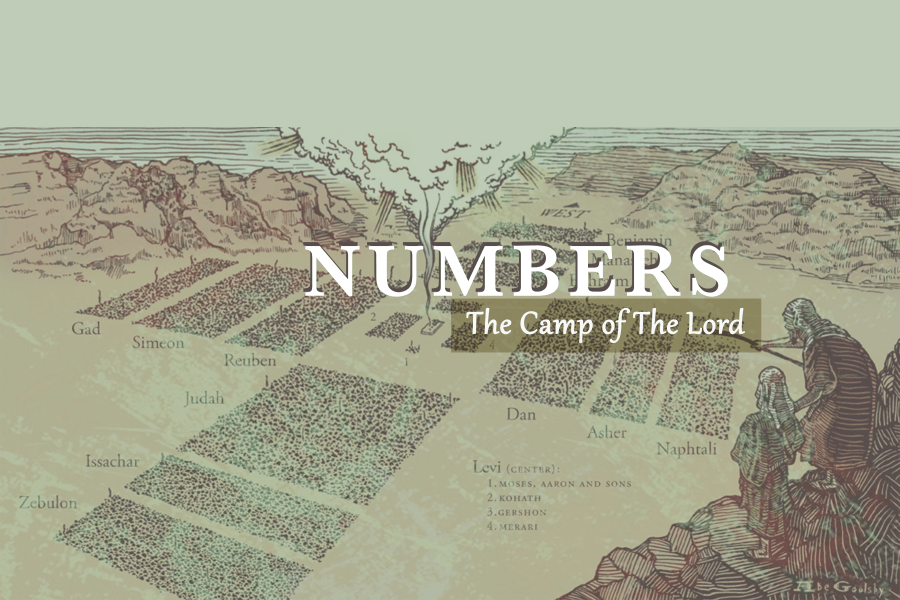
Moses and the priests were camped in the east, at the entrance of the tent of meeting and in front of Judah’s standard. Since Levi had three sons, the remaining directions are given to each clan. Kohath was to be in the south, before the standard of Reuben. Gershon was in the west, before the standard of Ephraim. Finally, Merari was in the north, before the standard of Dan.
The text also gives a summary of their duties regarding the tabernacle, but those will be expounded more in chapter 4.
There are three things to note from the layout of the Levites.
First, Gershon is Levi’s firstborn, but Kohath, the second son, is given the place of greater prominence in the south. Unlike Reuben and Simeon, there is no sin mentioned in Scripture for why the older is placed below the younger. Moses and Aaron are descendants of Kohath, so that may be part of the explanation. But then we could just as easily ask: why did God choose Moses and Aaron and not someone descended from Gershon? The humbling answer is simply that it is God’s prerogative to choose. We see the same pattern with Isaac and Ishmael, Jacob and Esau, Judah and Reuben, Perez and Zerah, and Ephraim and Manasseh. God has the right to choose whomever he chooses.
Thankfully, prominence in God’s kingdom does not work the same as it does in the world. To be first, in God’s economy, is to be last, and to be last is to be first. Indeed, notice that while Moses and Aaron are encamped in the east, they are listed last in the chapter. Even though they have the most distinguished positions in Israel as prophet and priest of Yahweh, their positions are fundamentally acts of service to the rest of Israel. Moses served Israel by being their mediator and speaking God’s word to them. Aaron served Israel by presenting their offerings to Yahweh and giving them the blessing that we will see in Numbers 6. Moses and Aaron were certainly chiefs, but they were chief servants.
No one displayed that truth more than Jesus, who explicitly said, “For the Son of Man came not to be served but to serve and to give his life as a ransom for many” (Mark 10:45). If anyone had the right to be served, it is Jesus, who is God of God, light of light, very God of very God, as we confess. Yet He did not come to lord over others; He came to serve others. Thus, Moses and Aaron have the place of highest prominence, which is also the place of highest service, for they were tasked with serving the whole congregation of Israel. That is how leadership always ought to work in the church today. The greater authority a person has the less they should think of themselves because having greater authority means to be in the service of more people.
Finally, the layout of the camp facilitates their function as guardians. If Israel were invaded, the Levites would be called to die defending the priests and the tabernacle. They were a buffer of defense in that sense. But notice that they were also to guard the whole congregation. Guard them from what? Certainly not against outside invaders. No, they were placed between the Israelites and the tabernacle as buffers between the common and the holy.
Recall from our study in Leviticus that a person could be in one of three states: unclean, clean, or holy. The process of moving from uncleanness to cleanness was called purification and of moving from cleanness to holiness was consecration. Being unclean was not sinful, but it meant being impacted by the effects of sin in the world. Uncleanness was only sinful if it entered into holy space.
The Levites are stationed between the people of Israel and the tabernacle as buffers to guard the congregation from accidentally bringing deadly judgment upon themselves. They were to guard the ordinary Israelites from the dangerous holiness of God.
LIVING SUBSTITUTES // VERSES 40-51
So far, we have seen that the Levites are distinguished from the priests but called to serve and guard the priests, the tabernacle, and the whole congregation of Israel. This last portion of the text gives a further function of the Levites. We passed over verses 11-13, so let us begin by considering them:
And the LORD spoke to Moses, saying, “Behold, I have taken the Levites from among the people of Israel instead of the firstborn who opens the womb among the people of Israel. The Levites shall be mine, for all the firstborn are mine. On the day that I struck down all the firstborn in the land of Egypt, I consecrated for my own all the firstborn of Israel, both of man and beast. They shall be mine. I am the LORD.
The significance of the firstborn is that they represented the entire family. That was God’s point in striking down the firstborn in Egypt. It was one final warning that He would next wipe out the entire nation. Pharaoh understood the message and let Israel go. For the Israelites, the firstborn were spared because of the blood of the lamb that was painted upon their doorposts. Even so, God claimed the firstborn as His, and that point is thoroughly made in these verses as He repeatedly claims that the firstborn are His.
How, we might ask, can God make such a claim? Most importantly, because He is the Creator of all things. He owns what He has made, and that includes us. This is another humbling truth. We like to think that we belong to ourselves alone, but that is not the case. A creator owns his creation.
With the firstborn, God is simply exercising His right as Creator. And by claiming the firstborn, He is showing that He has ownership of the entire nation. However, instead of the firstborn, Yahweh takes the Levites. Verses 40-51 continue to describe this.
In these verses, the Levite males are listed and so are the firstborn of Israel. There are 22,000 Levites and 22,273 firstborn. The Levites are taken as substitutes for the firstborn, and a redemption price is paid for the remaining 273.
There are two main points that I would like to consider here. First, the numbers of the Levites and firstborn are marvelously close. Indeed, they were so close that there easily could have been a temptation not to worry about the other 273. But when it comes to obeying the LORD, close is not enough.
Consider Saul and the Amalekites. God commanded the king to destroy the whole nation and everything they had, but Saul took the king captive and spared the best of their animals. When confronted by Samuel, Saul claimed that he was bringing the animals as a sacrifice to Yahweh, but the prophet rebukes him, saying, “To obey is better than sacrifice.” We should keep the lesson in mind as well. What God commands should be followed exactly.
Second, the Levites are living embodiments of Israel’s redemption. They are set apart a as substitutes for the firstborn, as a sign that the whole nation belongs to God. If the LORD wanted to make all of Israel into the guardians of the His tabernacle, He could have done so. But the Levites are Israel’s living substitution. Each time that an Israelite, especially the firstborn, saw the Levites at work, they were to remember that substitution had been made. The firstborn in Israel do not need to be given to tabernacle service because the Levites have been taken in their place.
A BETTER PRIEST AND SUBSTITUTE
Who then are the Levites? They serve the priests, guard the tabernacle and the people of Israel, and are the substitutes for the firstborn before Yahweh. As honorable as that calling was, Christ is substance that the role of the Levites pointed forward to.
Jesus is our great high priest. Being from the tribe of Judah, Jesus could not be ordained into the Levitical priesthood, but that does not limit Christ’s work of salvation. Christ’s priestly office is greater than the Levitical priesthood. He is of the order of Melchizedek, the mysterious priest-king to whom Abraham gave a tithe.
And though He continuously intercedes for us, He does not need to stand in the tabernacle nor temple to offer sacrifices for our sins. Instead, He became the ultimate sacrifice, the once-for-all sacrifice.
Indeed, through His sacrifice, Christ became the perfect buffer between us and the deadliness of God’s holiness. Whenever we speak of the gospel, we often think of how through His death, Jesus shields us from the wrath of God. By taking our sin upon Himself, He absorbs every ounce of it, and all we now receive the perfect mercy of God instead. And praise the LORD that is wonderfully true!
But the wrath of God is pictured in the sacrifices within the tabernacle, especially as they were burnt upon the bronze altar. The Israelites were to watch their presented animal burn and remember that God was graciously accepting the animal in their place.
That is not the picture that the LORD is using the Levites to paint. The Levites are the earthly parallel to cherubim that guard the heavenly throne of Yahweh. The tabernacle had become Yahweh’s earthly throne; thus, the Levites were to be His earthly guards. While the sacrifices made atonement for sin and placated God’s justified wrath, the Levites protected the unclean from having a deadly encounter with the Holy One.
Here too Christ is greater. Christ is not a buffer between we who are unclean and the perfect holiness of God; He is a mediator. While what is unclean cannot enter God’s presence, Jesus is God’s holiness entering into our uncleanness. And His holiness was not defiled by our corruption. His holiness cleansed our corruption! Whether He touched a leper or the woman with the issue of blood, His touch purified and healed, rather than afflicted and killed.
As glorious as the old covenant with Israel was, it was fundamentally a come-but-stay-away covenant, declaring how great the presence of God is but also warning not to get to close. The Levites are the living picture of that message. But Jesus, as the guarantor of the new covenant, simply says, “Come near.” But He does not call to us from the camp of the Levites, He enters into the camp of the ordinary Israelites and even goes outside the camp to those who are defiled and after touching them, tells them to enter God’s presence.
He accomplished this through His death, where He became our substitute. By taking our sins upon His shoulders and being stricken by His Father, Jesus has cleansed us of all our iniquity. He cut away the very root of our uncleanness, and now through His death and resurrection, we are called saints, which literally means holy ones. We are now free to boldly draw near to God’s holy presence because we have been fully and permanently consecrated to Him. Indeed, in Christ, we no belong to God, no longer simply as His creatures. Instead, Christ secured our adoption. We are fellow heirs with Christ, sons and daughters of God Most High.
Even so, this place of privilege also comes with danger and responsibility. The Lord’s Supper is a beautiful picture of both. This bread and cup testify to the saving grace of Christ. But we receive them with warning against presuming upon the grace of God as Nadab and Abihu did. If we come to the Table presumptuously, there is judgment.
Yet this judgment is only meant to keep us sober-minded about the goodness and danger of God’s presence. We can rightly come to the Table boldly, not because we are worthy but because we acknowledge our unworthiness and cling only to the righteousness of Christ. He alone is our perfect substitute and the One who has opened for us a new and living way into God’s presence.
Further Resources
You can find my primary resources for this study at the link here.

