
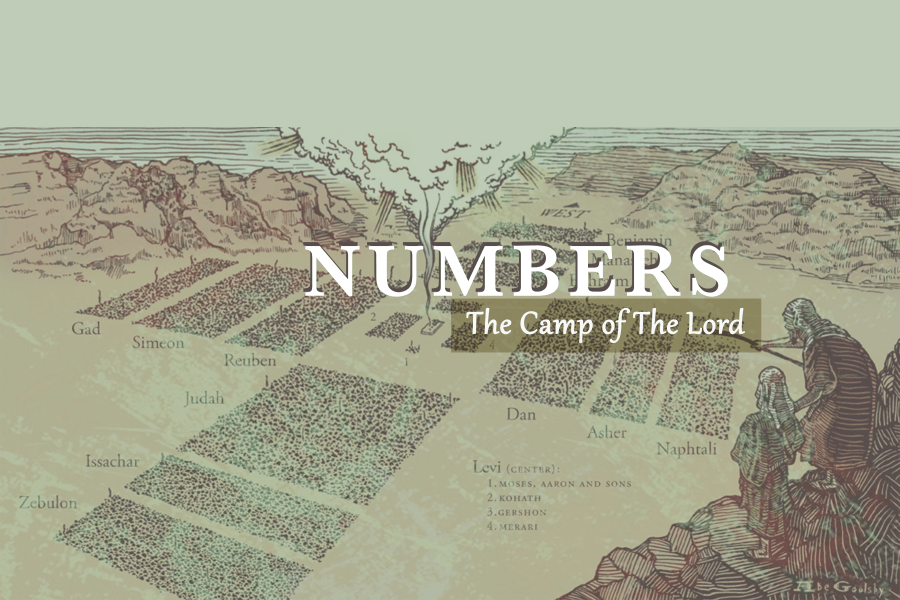
Going on a journey requires planning and preparation. Since Exodus 19, the people of Israel have been camped at the base of Mount Sinai, and these opening chapters of Numbers have been about Yahweh preparing His people to leave and enter the Promised Land.
Chapters 1-7 moved from broad to specific, focusing first on the whole congregation then moving to individual cases. Now the movement has been reversed. 7:89 gave us a glimpse at Yahweh speaking to Moses within the Most Holy Place. The text then moved outward to the lampstand within the Holy Place and the Levites ministering within the courtyard. Our present text moves further out, focusing on the entire camp.
There are three clear divisions within our text: the Passover, the cloud, and the trumpets. In the Lord’s providence, these are not disconnected from one another. Instead, they all have the same goal: to equip Israel to follow God’s presence as they leave Sinai.
9:1-14 describe the Passover and give new regulations for future observance. 9:15-23 describe the pillar of cloud and fire that led Israel in the wilderness. 10:1-10 describe the silver trumpets, which are used for communications within the camp and to call upon Yahweh to remember His people.
Though these three things may initially seem unrelated: a feast, a cloud, and a pair of silver trumpets. But they have something profound in common. They are all means by which Yahweh ministers His covenant grace to Israel. The Passover continually rehearses their redemption. The cloud manifests His presence and leads them. The trumpets gather them together and give them a prescribed way to call upon Him. Yahweh does not simply redeem Israel and send them into the wilderness alone. He gives them means by which they may continually live as His redeemed people in His presence.
Of course, that is not merely an Old Testament reality. We too are pilgrims in the wilderness between Christ’s first and second coming, and Christ has likewise given His church appointed means by which He ministers His grace to us: His Word, the sacraments, prayer, and the gathered worship of His people.
THE PASSOVER // 9:1-14
The Passover was one of the most important feasts in Israel. In some ways, it was the central feast. It celebrated their deliverance from Egypt, the night when Yahweh struck the firstborn of the Egyptians dead but passed over the homes of the Israelites. Because Israel’s exodus from Egypt is the narrative heart of the Old Testament, this feast was at the heart of Israel’s yearly worship. Each year, they were to celebrate their national salvation and teach their children the goodness and greatness of their God.
And notice that they were commanded to celebrate the feast on the day and in the manner that Yahweh told them. This is a principle that we call the regulative principle: God alone dictates how He is to be properly worshiped. We do not have the right to worship God in the manner that feels best to us. Worship is about the one worshiped, not the worshiper.
But verse 6 adds a complication. There are men who desire to celebrate the Passover, but they are ritually unclean from touching a dead body. Do they observe the Passover and worship God, or do they refrain because of their uncleanness?
Of course, their uncleanness was not sin. Touching a dead body simply brought them into contact with the effects of sin in the world, namely, death. Thus, the conflict is not through any fault of theirs. It is a simple fact of living within a broken world. Desire and ability clash with one another, which happens more than we would prefer in this life.
Moses does not know what to do, so he asks the LORD. Yahweh then gives him three commands regarding the Passover.
First, anyone who is unclean or on a journey will keep the Passover a month later. God made a provision for His people who were not in a state of sin but would have sinned by coming into God’s presence. The LORD honors their desire to worship Him and gives them another opportunity to do so.
Consider the graciousness of God in meeting His people. He was willing to shift the celebration of the Passover for Israelites that could not observe it through being unclean. Iain Duguid has a fantastic section in his commentary on this, calling it the irregularity principle. Of course, this was not a license for Israel to do whatever they wanted to do, but it was a significant accommodation. We must still walk in that balance today. Strict observance of the letter of the law often becomes legalistic and unloving, but it also must be ultimately followed.
Second, if anyone refrained from observing the Passover, even though they were not unclean or traveling, they were to be cut off from the people. This referred to exile, at the very least, and quite possibly to death or even damnation.
Third, for sojourners and foreigners to take the Passover, they must be circumcised and fulfill the commandments just like the Israelites. Circumcision was the initiation rite into the covenant community; therefore, it came before the celebration of their communal salvation. Thus, even though the Passover celebrated what made Israel distinct from the other nations, God made a way for people from other nations to join in that celebration.
For New Testament believers, the Lord’s Supper is similar to the Passover. It is not a one-to-one replacement, but there are plenty of similarities. The Passover was God’s appointed means by which Israel rehearsed and proclaimed its redemption. The Lord’s Supper is Christ’s appointed means by which His church proclaims His death and feeds upon the promises of His covenant.
As with the Passover, there are circumstances where we ought to refrain from observing the Lord’s Supper. If you have a matter that still requires forgiveness with another person, you should resolve it to the best of your ability first. If you are walking in unrepentant sin, you are heaping judgment upon yourself. And if you come thinking yourself worthy and not utterly dependent upon Christ, you should refrain.
But if a person has no desire to take the Lord’s Supper, that is a warning signal that something is off. Just as the Passover celebrated Israel’s deliverance from Egypt, the Lord’s Supper celebrates our deliverance from sin. It is a proclamation of our Lord’s death until He returns. Every Christian should have a desire to celebrate and proclaim Christ’s work of salvation for us.
Finally, the Lord’s Supper is also a guarded feast. Just as only the circumcised were permitted to celebrate the Passover, today only the baptized should rightly partake in the Lord’s Supper. Of course, the heart of God is still the same. He desires all to come to Him. Those who have not yet confessed faith in Christ should do so, and those who have not been baptized should do so, before taking part in the Lord’s Supper.
THE CLOUD // 9:15-23
The passage here is quite repetitive, emphasizing in virtually every possible phrasing that the cloud by day and fire by night stayed over the tabernacle and guided their movements throughout their journey through the wilderness. When it lifted, they moved. When it settled, they made their camp there. We are also repeatedly told that they did this at the command of Yahweh.
The cloud of glory was the physical manifestation of Yahweh’s presence among His people. It first appeared as they left Egypt to guide them into the wilderness. It led them to the coast of the Red Sea, it kept Pharaoh’s chariots back from them, and then it permitted Pharaoh to enter the sea and be consumed by the LORD. And it had been with them ever since.
This text now emphasizes that God’s presence continued to go with them as they left Sinai, guiding them through the wilderness.
This is significant because, after the gold calf, God told Moses that He was going to destroy Israel and start over with Moses. The prophet interceded for the people, and God told Moses that He would send them into the Promised Land with an angel to defeat their enemies, but He would not go with them. Moses understood that God’s gifts and blessings mean nothing apart from knowing Him as the Giver. The promised land was never the greatest promise. Yahweh Himself was. And Yahweh finally agreed to go with His people again.
Our desire ought to be like that of Moses. We should desire His constant, guiding presence. Of course, that does not come to us today in cloud and fire. It comes through His Word. Israel did not know where to go because they possessed a map of the wilderness. They went where Yahweh went. And we likewise need more than information about God’s will; we need God Himself to transform our hearts and minds through His Word. The Spirit who dwells within us takes the Word He has given and uses it to lead, correct, comfort, and sanctify us.
Now, the Scriptures do not give us an answer for every situation, nor should we use them as if they were a magic totem. They will not tell us directly who to marry, which job to take, or which city to live in. Instead, we should be so saturated in the Bible that our discernment is sharpened for the countless decisions we face each day. To make decisions that do not have a neat answer, we must be rooted and grounded in God’s Word so that we know something of God’s heart, intentions, will, and ways.
And we should take comfort that the presence of God is with us through the indwelling Holy Spirit. It is not the spectacle that the cloud was, but it is God Himself dwelling within each of us. Furthermore, it is the Spirit who illuminates our hearts to understand the Scriptures, which is how the Father leads and guides us. Let us, therefore, cling to God’s Word and follow its commands as the Israelites followed the cloud of God’s presence.
THE TRUMPETS // 10:1-10
Like the Passover, the silver trumpets described in these verses are perpetual statutes that were to remain with the Israelites even as they settled in the land of Canaan. We can think of the trumpets as having four quadrants of use. They are used for communication to the whole congregation and for remembrance before Yahweh, and in both cases, they are used for both worship and for war.
When communicating to the camp, there are different calls for different purposes. The whole congregation is assembled with two calls, and the leaders are assembled with one. There is a call of alarm for war and a call to worship during the feasts and festivals.
They are also used for remembrance before the LORD. When an enemy struck, the trumpets were a plea for Yahweh to remember His people. When feast was at hand, the trumpets were again a plea for remembrance that He would approve of their worship.
In Christ, the usage of the silver trumpets has passed away, but their meaning still endures, for both worship and war still continue. Indeed, we find a parallel to the trumpets in our weekly gathering and prayer.
The trumpets remind us that the people of God are meant to call upon God together. Israel had appointed sounds by which the whole congregation was summoned before Yahweh. The church likewise gathers to hear God’s Word, to sing His praise, and to call upon Him in prayer. Our corporate worship is a part of how God equips His people for the wilderness.
Indeed, each Sunday we begin our service with a call to worship (a text of Scripture and an opening prayer) for the purpose of summoning our hearts to focus upon worshiping God. And just as the silver trumpets were for the benefit of the people of Israel, so is the call to worship. My aim from the call to worship to the benediction is to set our sight as fully on God as possible. I agree with Lewis that the perfect liturgy would be the one that you didn’t notice because through it our attention was entirely upon Christ.
With that goal, I am extremely guarded about what goes between those two elements. Special recognitions are made before the call to worship or in the place of the benediction. I aim for God to be the primary object of our attention for this one hour on the Lord’s Day. Though the call to worship is not a silver trumpet, its purpose is much the same.
Of course, we are also at war. In Ephesians 6, Paul tells us that we wrestle against spiritual forces of evil in the heavenly places, so we must take up the whole armor of God. Passages of Scripture, such as that one, summon us to arms against the enemy that is actively seeking any whom he may devour.
We might also say that requesting prayer from one another is another modern parallel to the silver trumpets, for it summons God’s people to petition Him for help and healing.
Since the silver trumpets were also for calling upon Yahweh to remember His people, they were a kind of public prayer. Now, did God need to be reminded of His people? No, He never forgot them, even though reverse was quite often true. Instead, the people needed to be reminded that they were in God’s remembrance. Though the trumpets were blown before the LORD, they were really for Israel’s benefit.
Interestingly, the same is true of prayer. Have you ever wondered why prayer is important if God is truly sovereign over all things? Why do we need to ask for anything at all if the LORD is going to accomplish His will regardless?
In many ways, prayer is more for our benefit than for God’s. Even though God never forgets us, we need to be reminded that He remembers us. Even though God’s will certainly will be done, prayer tunes our hearts into His will. Indeed, when we pray, we are not attempting to change God’s mind; we are conforming ourselves to His will, which He often works through prayer.
Consider an example from Genesis. Why did God allow Rebekah to be barren, if He was always going to answer Isaac’s prayer to heal her? If God’s will was to heal her, wouldn’t it have been more efficient to bypass Isaac’s prayer? Perhaps. But throughout Scripture, God does not appear to be nearly as concerned for efficiency as we are. Indeed, God often seems to mock our efficient attempts. The same is true here. God allowed Rebekah to be barren so that He could work through Isaac’s prayer. That was His ordained means of healing Rebekah and showing His faithfulness to Isaac.
God is indeed sovereign, and He works through the prayers of His people, ordaining them as a real means through which He accomplishes His sovereign purposes. And the LORD is also shaping and conforming us to His will as we pray.
Notice how these three texts display the blessings of the covenant that God made with His people. The Passover was a kind of covenant proclamation and renewal, physically replaying the night that Yahweh redeemed them from their slavery. The cloud was a visible sign of God’s presence among them and before them. The trumpets were a reminder of the LORD’s continual remembrance of His people and their privilege to call upon Him. Even as Israel journeyed through the wilderness, Yahweh equipped them to walk in the blessings of His covenantal presence.
We too dwell in the wilderness of this world. We have been delivered from a slavery far greater than Egypt, but we have not yet entered the Promised Land. We live between the first and second comings of our Lord. Our sin has been defeated, but we have not yet reached the fullness of our salvation.
But Christ has not left His people unequipped. He has given us His means of grace. We have the Supper by which we proclaim and rehearse our redemption. We have His Word, illuminated by His Spirit, by which He guides and sanctifies us. We have prayer and the gathered church by which we call upon Him and encourage one another as we journey together.
God did not redeem Israel from Egypt and abandon them in the wilderness. And He has not redeemed us from our slavery to sin only to leave us to find our own way home. He gives us Himself, and He gives us the means by which He continually ministers His grace to us until He brings us safely into the Promised Land.
Let us, therefore, come to Table, remembering the good deliverance of our God, that Christ has saved us and will save us still. He has given us His Word. He has enabled us to pray to God as our Father. And He gives us this visual sermon. The bread testifies that we are one body in Christ, and the cup testifies that we are justified before the Father in Christ. Let us rejoice as we come that the Lord equips us to remember His salvation, to be guided by His Word, and to call upon Him for help in our time of need.


Pingback: The Judgment Is for You | Hosea 5 – B. C. Newton