
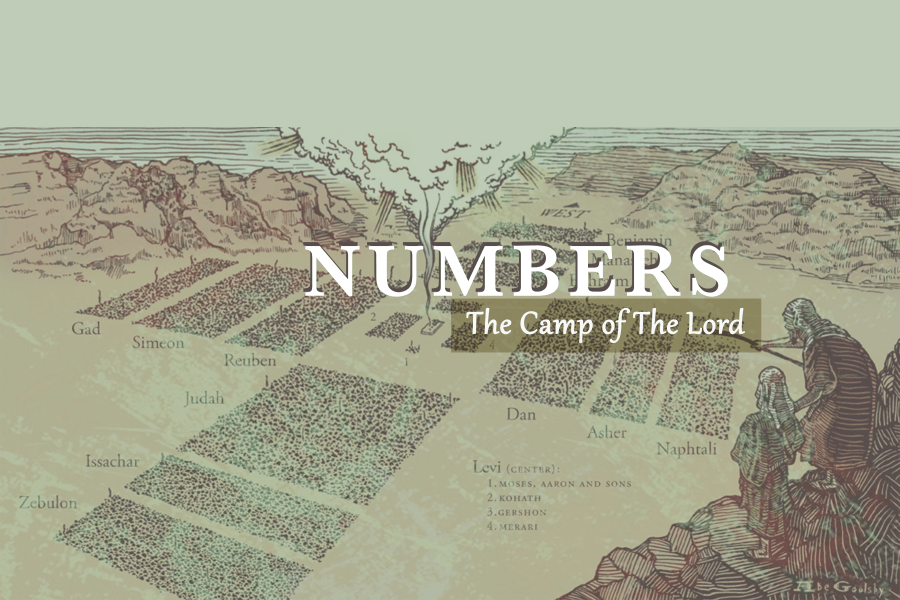
Last week, we came to one of the climatic moments of these opening chapters of Numbers. Remember that everything in these first ten chapters is about preparing Israel to leave Sinai and enter the Promised Land, where God will fulfill His promise to Abraham and also use them as His instrument of judgment upon the Canaanites.
Chapters 1 and 2 focused on the camp as a whole: a census and the layout of the camp. Chapters 3 and 4 narrowed in upon the Levites, describing who they were and what their duties were. Chapters 5 and 6 narrowed even further to address individual cases of sin or impurity and then of the Nazarite vow. Chapter 6 then ended with the Aaronic blessing, which Yahweh commanded the priests to put upon each individual Israelite as they came to the tabernacle for worship.
The preparation continues in chapters 7-10 but with a notable difference. In Numbers 1, we were told that Yahweh spoke to Moses on the first day of the second month, in the second year after they had come out of Egypt.” But the opening verse of Numbers 7 says, On the day when Moses had finished setting up the tabernacle… Exodus 40 tells us that happened on the first day of the first month in the second year, which was a month before Numbers 1.
Why then is Numbers 7 jumping back in time? Indeed, why does this flashback to the dedication of the tabernacle last all the way through Numbers 10:10?
Broadly speaking, Numbers 1-6 displayed the preparation of God’s people, while Numbers 7-10 focuses on the preparation of God’s tabernacle for leaving Sinai, which it describes by jumping back to the time when the tabernacle was first dedicated.
Our text, which is one of the lengthiest chapters in the Bible, takes us back to the consecration of the tabernacle. Despite its size, there are three clear sections. Verses 1-9 describe the initial gifts of the tribal leaders. Verses 10-88 detail the gifts that each tribe gives during the twelve days of consecration. Finally, verse 89 gives us the great theological truth of this chapter.
THE LEADERS GIVE // VERSES 1-9
After establishing the time of these events, verses 2-3 read:
the chiefs of Israel, heads of their fathers’ houses, who were the chiefs of the tribes, who were over those who were listed, approached and brought their offerings before the LORD, six wagons and twelve oxen, a wagon for every two of the chiefs, and for each one an ox. They brought them before the tabernacle.
Notice, first, the theme of leadership again in Numbers. The census in chapter 1 was conducted through these twelve tribal leaders, and now we learn that the consecration gifts were brought through them as well. Especially as we study Numbers 11-25 next year, this theme of leadership, either proper or improper, godly or ungodly, will run steadily through the text.
Indeed, crucially, the leaders represented the people under them. Thus, the gifts are not simply from the leaders themselves but from the tribes as a whole through them.
Consider also what is absent from these verses. Fourteen times in the first six chapters the text said, “And the LORD spoke to Moses, saying…” Why is it not used here? It is to show that these gifts of oxen and carts were not commanded by the LORD. The leaders simply decided to give them to the service of the tabernacle. It is a freewill offering, over and above what Yahweh explicitly commanded. They knew that the tabernacle would need to be transported alongside them, so seeing a opportunity to give, they gave.
Verse 4 tells us that Yahweh accepted these gifts and directed them to their proper service. Two wagons and four oxen are given to Gershon, while the rest were handed over to Merari. Recall that the Levites were to carry the pieces of the tabernacle as Israel traveled. Merari was given four wagons because that clan was responsible for the frames of the tabernacle and courtyard. Gershon received two because they were tasked with carrying the curtains, which were also heavy but could more easily fit on only two carts. The descendants of Kohath received nothing because they carried the most holy items, which needed to be carried on the shoulders, not on a cart.
Later in Scripture when Uzzah touches the ark because it begins to fall off of the cart, he is struck dead. Clearly, God’s law was either forgotten or simply neglected; the ark was never to have been carried on a cart.
How beautiful that the leaders saw an opportunity to give, and their gifts were accepted by Yahweh. These gifts reflect thoughtful care to the service of the tabernacle. In a sense, all giving today is freewill giving. We are certainly commanded and expected to give. But there is no set amount or even form. A tithe is still a wonderful principle to follow, but it is not commanded in the New Testament. We are simply told to give cheerfully and sacrificially.
But the approval of the LORD is also critical. If the leaders had been insistent on the sons of Kohath also receiving wagons and oxen, their kind intentions would have been in contraction to the commandment of Yahweh. When it comes to worship, it is not the thought that counts; it is obedience to God’s Word.
THE TRIBES WORSHIP // VERSES 10-88
We now come to the bulk of the chapter, which focuses on the offerings that each tribe gave for the dedication of the altar. These offerings were given over the course of twelve days, one tribe each day, and they were identical to one another. Here is the first tribe, Judah:
He who offered his offering the first day was Nahshon the son of Amminadab, of the tribe of Judah. And his offering was one silver plate whose weight was 130 shekels, one silver basin of 70 shekels, according to the shekel of the sanctuary, both of them full of fine flour mixed with oil for a grain offering; one golden dish of 10 shekels, full of incense; one bull from the herd, one ram, one male lamb a year old, for a burnt offering; one male goat for a sin offering; and for the sacrifice of peace offerings, two oxen, five rams, five male goats, and five male lambs a year old. This was the offering of Nahshon the son of Amminadab.
This pattern is repeated for all twelve tribes, and verses 84-88 close the section by summarizing all the offerings listed.
Notice that there are two kinds of gifts that each tribe makes: utensils for daily service in the tabernacle and offerings for worship.
The silver and gold dishes were items fit for the house of a king because Yahweh was Israel’s king and the tabernacle was His house among them. Yet the plate, basin, and dish were not decorative ornaments; they would be used each day as the Israelites brought their worship to the tabernacle.
Then came the offerings. A grain offering was given inside the silver plate and basin, which is fitting because it acknowledged Yahweh as their king.
Of the three animal offerings, the burnt offering was made first. It made atonement for sin in general and expressed the wholistic devotion of God’s people toward Him. The entire animal was consumed upon the altar. Most often this was the first offering made by a worshiper because it was an appeal for forgiveness of sin and a restored relationship with the LORD.
The sin (or purification) offering came next. It was made to cleanse the worshiper from the impurity of sin and sin’s effects in the world.
The third offering was the peace or fellowship offering. It was the very heart of Israel’s worship. A portion of the animal was burned to Yahweh, a portion was given to the priests, and the rest was eaten by the worshiper and whomever he shared it with. The peace offering represented the fruit of a restored relationship with Yahweh: communion and fellowship with Him. As the Israelites ate the meat of the peace offering, they were essentially sharing a meal with the LORD at His table within His house.
Together, these three offerings present a beautiful picture of salvation: atonement, cleansing, and communion. Of course, the wondrous fullness of these images is found in Christ, who is full atonement, perfect cleansing, and eternal communion. But the grace shown to the Israelites was still real and mighty, even if it was only a shadow of the grace to come.
But what of the million-dollar question of this chapter: Why the repetition? Why did Moses not give a slightly expanded summary?
Repetition means pay attention. God’s Word is never accidental or randomly thrown together. And given the great effort and immense cost required to produce scroll parchment in the ancient world, written words were never wasted. Passages such as this one may make for boring reading, but the goal of Scripture is not to entertain us. The goal of Scripture to change us, to conform us more and more into the image and likeness of Christ.
The repetition emphasizes that each tribe brought the exact same offering to God. The Spirit could have easily had Moses summarize the gifts, but instead, He lists each tribe and each gift. This is a reminder to us that God sees every act of service, no matter how small. Every cent, every deed, every word, even every tear is seen by our Father.
And He sees them equally among His servants. Each offering was the same and of equal worth. The larger tribes did not give more, nor did the smaller tribes give less. Even though Judah had the place of prominence, he was not inherently any more valuable than the final tribe of Naphtali. That is the importance of listing each one individually. God desired the day of worship and fellowship with each tribe. Through their representative leader, each tribe contributed to the ministry of the tabernacle and experienced atonement, cleansing, and communion with Yahweh Himself.
The same is true for us today. In the kingdom of God, there is order and responsibility. There are greater and lesser roles, but all are equal in God’s sight. Paul affirms this in his letters: in Christ, there is no male or female, Jew or Gentile, slave or free. All are equally God’s people, just as every Israelite was equally part of God’s chosen nation.
Of course, there are still differences in prominence and responsibility. Some of us will have heavier burdens and greater responsibilities. Some less. But we should remember the parable of the talents. The servants were not of different worth simply because they received greater or lesser responsibility. Faithfulness over what was given was the only thing that mattered.
THE LORD SPEAKS // VERSE 89
Now that the leaders have given their gifts and the tribes have brought their inaugural worship to the tabernacle, we have the very purpose for which the tabernacle was erected:
When Moses went into the tent of meeting to speak with the LORD, he heard the voice speaking to him from above the mercy seat that was on the ark of the testimony, from between the two cherubim, and it spoke to him.
Even though this verse can seem disconnected from the verses before it, it is the key and climax of the chapter. To understand the importance of this verse and its connection to the dedication offerings, we have to understand its place within the narrative of the Pentateuch. We begin in Exodus 25:22, where Moses received the instructions for the ark of the testimony from the LORD:
There I will meet with you, and from above the mercy seat, from between the cherubim, I will speak with you about all that I will give you in commandment for the people of Israel.
This is now the fulfillment of those words. It further reveals the tabernacle’s role as a mobile Sinai. Just as Moses previously ascended the mountain’s peak to speak with God, he would enter the Most Holy Place of the tabernacle and receive Yahweh’s commands.
Interestingly, this is the third description of the tabernacle’s dedication. The first was in Exodus 40, which focused on the assembling of the pieces of the tabernacle together. It concluded with the cloud of God’s glory filling the tabernacle so that Moses was unable to enter.
The second is recorded in Leviticus 8-9. These chapters focused on the consecration of the priesthood and conclude with Moses and Aaron both entering the tabernacle and the fire of Yahweh consuming the offerings upon the altar.
Now we come to Numbers 7, which emphasizes the offerings of the people, made through their tribal leaders.
These three descriptions each focus on a particular element of worship: place (Exodus 40), priests (Leviticus 8-9), and people (Numbers 7). Indeed, the threefold perspective of the same event is quite similar to the four Gospels. Though each describes the life of Jesus, they each do so from a particular perspective and angle, and together they give a full picture of the good news of our Lord.
The threefold description is also perfectly fulfilled in Christ. He is our place of worship, the true and better tabernacle. He is our great high priest, who has made full atonement for our sins and continues to intercede for us before the Father. He is also the only sinless representative of the people of God, becoming one of us to redeem us from the curse of sin.
Beyond this, Jesus also produces these in us was we are united together with Him. We become the place of worship, living tabernacles. We are priests who are called to minister and intercede for one another under Christ our great high priest. And we become the people of God through Christ’s redemption of us.
Consider also the end of the three descriptions. Exodus 40 ended with the cloud and glory of God coming upon the tabernacle, such that Moses could not enter. Leviticus ended with Moses and Aaron entering and the fire from heaven consuming the offering on the altar.
Numbers, interestingly, does not have fire, cloud, or the impenetrable glory of God. Here God speaks to Moses from within the tabernacle. This is simple and quiet compared to the other two, but it is also the culmination of the tabernacle’s consecration. The movement of the Pentateuch is toward greater intimacy with the LORD. In Exodus, He descended in glory. In Leviticus, He accepted the offerings of His priests. Now, in Numbers, God speaks to His people’s mediator, Moses.
The fire and the glory were marvelous displays of Yahweh’s presence, but the goal was that God would speak to His people. Moses heard Yahweh speak from the mercy seat, which was constructed to be God’s earthly throne. It was also the place where the high priest, once a year, would sprinkle blood to atone for Israel’s sins. The throne of Yahweh, the seat of atonement, and the place of revelation.
We no longer have Moses among us nor the ark. Instead, we have what the saints of the Old Testament, including Moses, longed for yet did not see in their day. The Spirit of God dwells within each one of us, and He draws us into communion with God through His Word, through Scriptures the written Word and Christ the embodied Word. Each time we open the pages of our Bible we have what Moses did not: the complete revelation of Yahweh. We do not hear the LORD’s voice audibly as Moses did from the mercy seat, but through these words, the Spirit now makes Christ known to us, our perfect atonement and mediator before the heavenly throne of our Father.
May verse 89 be our meditation through this week, for it is a privilege that is as great as that of Moses within the tabernacle.
And since communion with God is the highest privilege, let us rejoice as we come to the Table this morning. Just as the Israelites had the peace offerings, coming into Yahweh’s presence and eating at His table within His house, we now have the Table of the King before us. As we come, we do not bring animals nor silver and gold. We bring ourselves. We come as living sacrifices. Freely giving ourselves in response to Christ giving Himself for us.

