
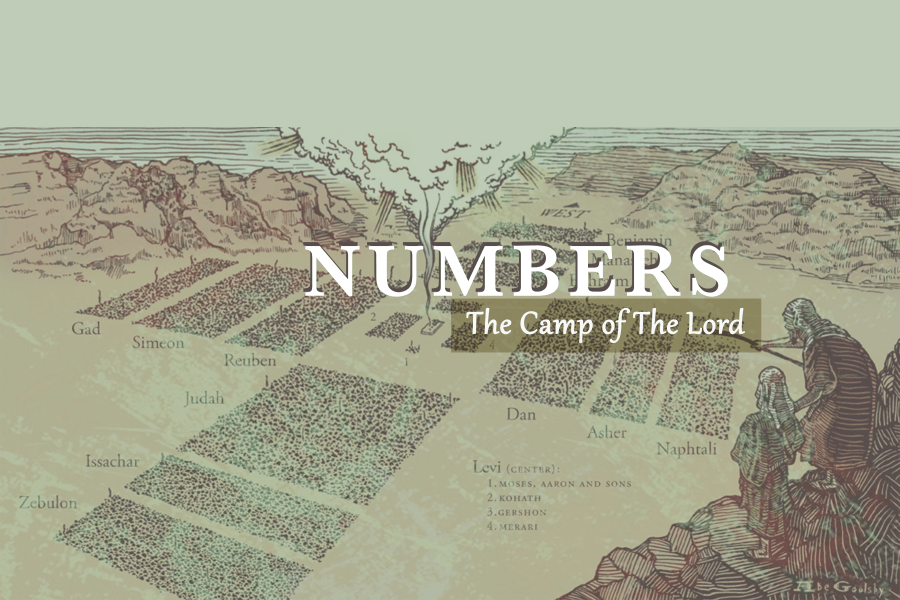
Yahweh is preparing His people to enter the Promised Land.
That is the big idea for all of Numbers 1-10. And He is not simply getting them ready for possession but for invasion. Four hundred years prior, God promised to give Canaan to Abraham’s family, but He did not do so in the patriarch’s day. Why? Because the sins of the Amorites were not yet complete.
But by the time of the Exodus, those four hundred years have passed. The sins of the Canaanites were complete, and God was preparing to bring His chosen nation, Israel, into Canaan as an instrument of His divine justice.
The first two chapters focused on the entire congregation: counting the people and enrolling Israel’s men to war, then centering and focusing them around Yahweh’s presence in their midst. The next pair (chapters 3 and 4) addressed the Levites, who were to be the guardians of the tabernacle, the priests, and the people. They were to be living buffers between the people and the perilous presence of God Most High.
Now we come to chapter 5, which, at first glance, appears to be three random laws. Nothing, however, is random within the Scriptures. Numbers 5 and 6 form another pair of chapters, focusing this time upon individuals within the camp, but we will address that relationship next week. For now, God’s people have been counted, centered, guarded, and assigned; they must also be cleansed. In order to be God’s holy nation, Israel must properly deal with the sin that keeps them from communion with Yahweh.
Fittingly, then, this chapter gives us a threefold portrait of sin and how it must be dealt with. Verses 1-4 display the defiling effect of sin and how it must be put away. Verses 5-10 show sin as a transgression that must be repented of. Verses 11-31, then, reveal sin as covenant unfaithfulness that must be exposed and cursed.
THE DEFILEMENT OF SIN // VERSES 1-4
Our text begins:
The LORD spoke to Moses, saying, “Command the people of Israel that they put out of the camp everyone who is leprous or has a discharge and everyone who is unclean through contact with the dead. You shall put out both male and female, putting them outside the camp, that they may not defile their camp, in the midst of which I dwell.” And the people of Israel did so, and put them outside the camp; as the LORD said to Moses, so the people of Israel did.
The focus of these verses, crucially, is not sin itself but the effects of sin in the world. Being a leper, having a discharge, or coming into contact with the dead were not sinful acts, but they did make a person unclean. As we discussed in more detail in Leviticus 12-15, uncleanness was not sin; it simply meant that a person had come into contact with the effects of sin in the world. Disease and death are only in the world because of sin; therefore, the diseased person or someone who recently handled the dead were rendered unclean.
Their uncleanness meant that they could not come into the presence of God’s holiness. To enter the tabernacle’s courtyard in an unclean state would have been a sinful transgression, warranting being struck down by the Levites. ‘
But Israel, as a whole, was a holy nation. True, the tabernacle was a higher degree of holiness, but all God’s people set apart to Him as a nation of priests. Thus, the place for the unclean was outside the camp.
Of course, in most cases, that would not be permanent. Leviticus gave the proper procedures for purification. Those procedures are not listed here because Numbers is focusing on the camp of Israel. The unclean must be kept away from the clean.
Although there was likely a hygienic benefit to this practice, hygiene is not the point. Holiness is. God’s holiness cannot be in contact with sin nor any of its effects. Not because God’s holiness would become defiled but because God’s holiness would consume the defilement. Again, this was guarding God’s people from the fate of Nadab and Abihu.
Once more, while being unclean was not a sin, it is a portrait of sin. Sin defiles. Sin is a contagion that contaminates everything around it. Even though not all sickness and death are directly caused by sin, all sickness and death are indirectly caused by sin. Indeed, this ought to remind us that no sin is ever entirely private or isolated. Sin always, in some fashion, damages those around us.
Since sin is a defilement and a contagion, we are called to put it away and to cast it aside. If we each are now the camp and dwelling place of God, all uncleanness must be thrown outside the camp as well. We see this commanded in the New Testament, as well. In Ephesians 5:3-4, Paul writes:
But sexual immorality and all impurity or covetousness must not even be named among you, as is proper among saints. Let there be no filthiness nor foolish talk nor crude joking, which are out of place, but instead let there be thanksgiving.
Notice the language of sin as impurity and filthiness that must be put away. Why? Because we are now saints, God’s holy ones in Christ. Would a leper continue to use his old tunic after he had been healed? By no means! Likewise, the filth of sin is out of place among us because we have already been cleansed through Christ. Why would we put our diseased garments on again?
Indeed, the defilement of sin ought to cast our minds to the cleansing of Christ. Sin is far more to be feared than leprosy, for it not merely rots the flesh but the soul as well. Yet Jesus, by touching lepers and eating with sinners, revealed that He had no fear of sin’s contagion. Instead of becoming defiled, Jesus healed and made clean. Indeed, Jesus’ contact with the dead brought them back to life!
And He did this, as Hebrews says, by going outside the camp. The Holy One left His rightful place at the center and focus of the camp to heal and cleanse the unclean outside the camp. Though His holiness was just as deadly as seen in the Old Testament, in Christ, it became a purifying holiness. And we, who were once dead in sin and leprous of heart, now boldly sing, “Jesus paid it all. All to Him I own. Sin had left a crimson stain. He washed it white as snow!”
SIN AS TRANSGRESSION // VERSES 5-10
The second picture, in verses 5-10, is of sin as a transgression. These verses are closely connected with the guilt offering that we studied in Leviticus, which was an offering to be given as a sign of repentance for a specific sin. It also required restitution to be made to the injured party.
Notice the movement of the laws. First, defilement was addressed, which was broad and dealt with the effects of sin that each of us will face at some point. Now, an actual offense committed against one’s neighbor is being discussed. This is not merely an effect of sin; this is sin as we most often think of it: a transgression. It is the breaking of a law, doing what ought not to have been done.
The response, then, is to confess and make restitution. We have already seen from Exodus and Leviticus that the restitution differed if the crime was actually confessed by the sinner. If found in sin, the restitution was double. But if confessed, a fifth was added to the repayment. Thus, there was a clear, monetary incentive to confess sin rather than wait for it to be discovered. That is because repentance necessarily begins with confession. Repentance means to change one’s mind and course of action, to turn around and go the other way. That cannot happen until we acknowledge that we went down the wrong path in the first place.
So, repentance begins with confession: “I have sinned. I am guilty. I am in the wrong.” But it then makes restitution. If there was no particular person to make restitution, it was presented to the priests. Zacchaeus is a perfect example of restitution. “If I have defrauded anyone of anything, I restore it fourfold,” (Luke 19:9) he said. Since he confessed, the law only bound him to that additional 20%, but the beauty of his own forgiveness and fellowship in Christ made him voluntarily make it 400%!
We are still to confess and make restitution today. Since all sin is ultimately against God, sin must be supremely confessed to Him. We see that in David’s prayer of repentance in Psalm 51. But if we sin against another person, we are also to confess to them, asking their forgiveness and making whatever restitution that we are able. Jesus says that we should do so before making any offering to the LORD. Perhaps the closest New Testament parallel to the offerings of the temple is the Lord’s Supper, and it should rightly be a weekly goad toward repentance. Each week, the bread and the cup should confront us with the same questions: What transgression do I still need to confess and make right? Is there any specific person that I need to repent to?
Of course, there is one other kind of confession. James tells us to “confess your sins to one another, and pray for one another, that you may be healed” (5:16). This is not a confession to those whom I have specifically wronged but a confession for help in prayer.
But our restitution can only go so far. How can we make right our transgression against the good and loving commands of the Eternal One? Because our offense is against His eternality, eternal restitution must be paid. That is why each of our transgressions is worthy of the eternal fires of hell. Sin rightly bears greater or lesser consequence depending on who is sinned against. Lying to a stranger may produce no visible consequence to me, while lying to my spouse may create a wound that takes years to heal. How much more so whenever we rebel against the Creator of heaven and earth?
That is the beauty of the gospel. Jesus paid that eternal restitution because He is Himself the Eternal One. He gave His life as our ransom, the perfect and complete restitution before God.
SIN AS ADULTERY // VERSES 11-31
Lastly, we see that sin is adultery. In this passage, a man suspects that his wife may have committed adultery, but he has no actual proof. Crucially, if he had proof, other laws were then to be followed. But since the husband had no proof, he was to bring her to the priest along with a grain offering. Remember that the grain offering could also be called the tribute offering because it was primarily to express loyalty and fealty to God as king. The priest then pronounced curses, put them into water, made the woman take an oath, and then must drink it. If she was innocent, nothing would happen, but if she were guilty, her womb would swell and thighs fall away, which was probably a picture of barrenness and infertility.
At first glance, this whole practice can seem quite barbaric to our modern minds, but for the ancient world, this was remarkably humane. In many cultures, because a woman was considered the property of her husband, she could be executed for suspected adultery without any further investigation. But here, among God’s people, that was not to be the case. Notice that this practice places the woman’s judgment firmly in the hands of Yahweh. If she truly did commit adultery, then it leaves the punishment to God, but if she is innocent, her lack of punishment vindicates her in the eyes of the community.
We should also note that the curses were not magic. There was nothing magical about the dust of the tabernacle. And while it likely did not taste great, it probably wasn’t terribly bitter either. The bitterness was a reference to the spiritual curse that was invoked. The whole affair was simply a ritualistic way of handing the matter over to God. Since no proof of wrongdoing was found, the All-knowing One would be either her judge or her vindication.
Again, notice the movement of the chapter. First, we had the defilement caused by the effects of sin. Then we had actual transgression committed against one’s neighbor. Now, we have potential sin within the most intimate relationship in this life: marriage. Sin is defilement and transgression, yes, but it is also covenant unfaithfulness, spiritual adultery.
It is fitting that the bulk of the chapter is spent here because, in many ways, this is the most painful image of sin. Indeed, especially within the prophetic books, it will become the dominant picture of sin. Just as a man and woman make a voluntary covenant to be faithful to one another, so Yahweh made a covenant with Israel. If they were faithful to Him, their union would have been a restoration of Eden, as the Song of Songs depicted. But they were not faithful. They repeatedly gave themselves to other gods, as we will see in Hosea in just a few weeks.
There are also at least two events that the observant Israelite would have likely thought about in connection to these laws. After all, this is not the first time that we have seen bitter water. At the end of Exodus 15, God brought Israel to the bitter waters of Marah, and after the people groaned, He made it sweet. Then the LORD gave them this warning:
If you will diligently listen to the voice of the LORD your God and do what is right in his eyes, I will put none of the diseases on you that I put on the Egyptians. For I am the LORD, you healer.
It was the LORD’s desire heal them, but if they needed the discipline of disease, He was more than capable of doing to them what He had done to the Egyptians.
Then, after the golden calf was made, Moses burned the idol, ground it into dust, scattered into the water, and forced the Israelites to drink it. As warned, Yahweh then sent a plague into the camp.
The imagery is the same. The golden calf was like a husband coming home and finding another man in bed with his wife. Idolatry is spiritual adultery. And it is against the very One who sees all things. There is no such thing as an unproven case with Him. God, therefore, was entirely justified to cut off the people of Israel and begin again with Moses, as He threatened to do. But He is merciful, gracious, slow to anger, and abounding in steadfast love.
We see this powerfully displayed in Jesus. In John’s Gospel, the religious leaders bring to Jesus a woman caught in adultery to see what Jesus would do. According to the law, since she was caught in the act, she was to be stoned. But Jesus tells her accusers, “Let him who is without sin among you be the first to throw a stone at her.” Beginning with the oldest, they each walk away. Jesus then asks, “Woman, where are they? Has no one condemned you?” She says, “No one, Lord.” G. Campbell Morgan notes:
In that saying our Lord revealed for all time this principle, that sinlessness is the only qualification for punishment. That sentence put me out of the stone-throwing business for the rest of my life! (John, 148-149)
Jesus then answers, “Neither do I condemn you. Go, and from now on sin no more.”
Jesus was without sin. Morgan again writes, “Incarnate Purity standing confronting the saddest thing in all human life, convicted impurity.” Indeed, He is the Son of God; the One whom we each continually sin against. He was entirely justified to stone the woman. Even more, to damn her.
But he doesn’t stone her. Neither does He curse her, swelling her womb and causing her thigh to fall away.
Why?
Because He Himself was going to drink the bitter cup of cursing for His people. In the garden, Jesus prayed, “Father, if it is possible, let this cup pass from me. Yet not my will, but you will be done.” The cup was the bitter curse of God against sin. Psalm 75:8 describes it: “For in the hand of the LORD, there is a cup and foaming wine well mixed, and he pours out from it, and all the wicked of the earth shall drain it down to the dregs.”
Who are the wicked of the earth? Surely, it’s “them” out there. Surely, it’s the woman that we caught, in the very act!
Or maybe it’s also we who have only looked with lust.
Maybe it’s we who have thrown verbal stones at others’ reputations.
Maybe it’s we who have used food and drink and entertainment to dull stress rather than trust the LORD.
Maybe it’s our own covetous hearts, which is really idolatry.
I don’t have a stone to throw at anyone else because all ought to be aimed at me. I am the wicked. I’m the idolater. I deserve the bitter cup and every curse put into it.
Amen, amen.
But God, being rich in mercy, because of the great love with which he loved us, even when we were dead in our trespasses, made us alive together with Christ–by grace you have been saved.
How did Jesus save us? By becoming a curse for us, by drinking God’s wrath, draining it down to the dregs. You see, sin as spiritual adultery must be exposed and handed over to God, and that is exactly what Jesus did. The cross of Christ exposes our deepest sins and, most importantly, enables to “view its nature rightly,” as the hymn says. The death of the Holy One is the only proper assessment of sin’s true guilt and shame. It brings the darkness into His blinding light.
And then it hands them over to God, but not for judgment. Instead of being cast before the Father in our nakedness and shame, Christ dresses us in spotless linen and brings us with Him into the Father’s presence as His redeemed and renewed bride.
Indeed, before He drank the cup of God’s wrath, Jesus held up another cup and said, “This is the cup of the new covenant in my blood. Do this, as often as you drink it, in remembrance of me.” In other words, He gives us another cup to drink. It is not a cup of wrath or judgment but of fellowship, forgiveness, and blessing. It is the cup of covenant blessing, offered by the One who has taken punishment for our covenant unfaithfulness upon Himself.
Brothers and sisters, as we come to this Table, let us give thanks that Christ is our great than our sin. Though our sins may be many, praise the Lord, His mercy is more.
Further Resources
You can find my primary resources for this study at the link here.

