
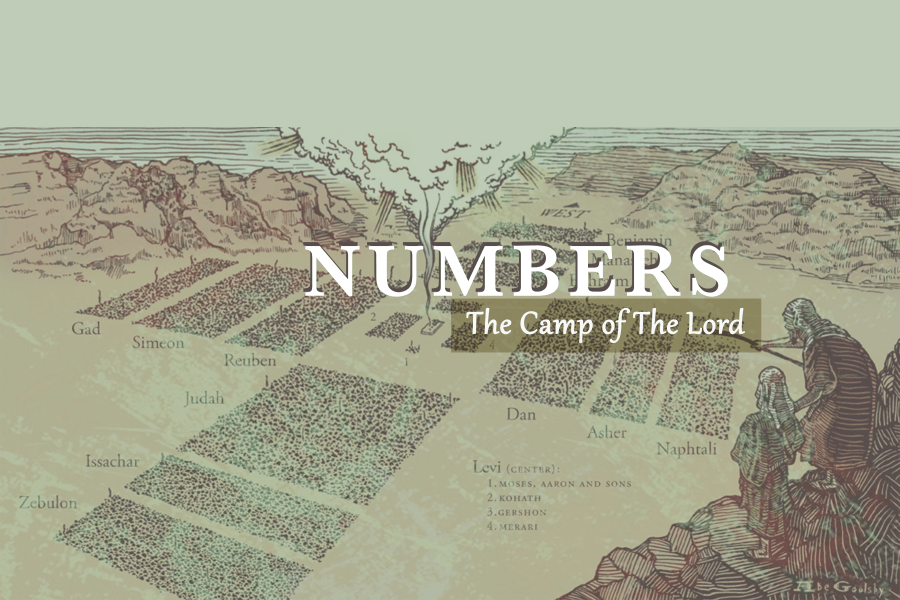
Numbers 4 must be understood in the context of Numbers 1-10, which is primarily about Yahweh preparing Israel to be His earthly army, paralleling His heavenly army.
That preparation began in Numbers 1 with the first census. God’s people needed to be counted, both counted in for the privileges and counted on for the responsibilities. Chapter 2 gave us the arrangement of the camp, particularly that they were centered and focused upon the tabernacle at their center. These two chapters addressed the whole congregation, while noting that exceptions were made for the Levites.
The Levites then became the chief focus in chapter 3. There we learned the purpose and nature of the Levites. First, they were distinct from the priests. All priests were Levites, but most Levites were not priests. Second, the Levites were to serve the priests and guard the people of Israel from the danger of God’s holiness. Third, they were living substitutions for the firstborn of Israel and, thus, continual reminders that all of Israel belonged to Yahweh.
Chapter 4 is connected to chapter 3 because the Levites are still our primary focus. But now that we have addressed the identity and purpose of the Levites, we turn our attention toward their duties, especially the physical work with transporting the tabernacle. After all, the LORD requires a holy people to bear His holy things.
In our study of this text, we will first survey the duties commanded, then we will consider the nature of those duties, and finally the danger of the work.
THE WORK OF THE LEVITES
To begin, let us grasp an overview of the chapter as a whole. Their work with the tabernacle is clearly the primary focus here, and each of the three clans is assigned particular elements to carry as the tabernacle is moved.
Notice again the ordering of the clans. Even though Kohath was Levi’s second son (after Gershon), he is listed first here. As we noted in Numbers 3, we do not know of any particular reason why the younger was given preeminence over the older in this case. It is the sovereign and providential choice of the LORD. He has the right to choose whomever He desires.
The clan of Kohath is placed first here because they are in charge of the most holy items, the furniture of the tabernacle: the ark of the covenant, the table of the bread of the Presence, the golden lampstand, the altar, and all the utensils associated with those items.
These items needed to be covered with covers appropriate to their holy status because they were not allowed to be seen by the ordinary Israelites. Indeed, notice that even the Kohathites were not allowed to touch the items themselves. Eleazar and the other priests needed to prepare the items for the Kohathites to carry, using the poles that God commanded the people to make for transporting the tabernacle.
Gershon is listed next. They were responsible for the curtains and coverings of the tabernacle and the courtyard. Finally, the clan of Merari was to carry the pieces for the frame of the tabernacle and courtyard: the posts, bases, tent pegs, etc.
Notice too that these duties are assigned during a special census. The Levites were not counted in the first census of chapter 1, but they were numbered in the previous chapter. But this census concerns a particular segment of the tribe: males between the ages of 30 and 50. These would be the only Levites allowed to carry the pieces of the tabernacle.
The natural question is: why?
The honest answer is: we aren’t told.
But I do think we can make an informed deduction. In Psalm 90, Moses indicates that normal years of a man are seventy or eighty years. So, forty is the midpoint of a man’s life, which also happens to be in the middle of thirty and fifty. Forty, therefore, likely represents the convergence of a man’s strength and wisdom. Before forty, a man has plenty of strength but likely lacks in wisdom. After forty, he hopefully continues to grow in wisdom, even as his physical strength begins to decline. Since the task of carrying the tabernacle required both strength and wisdom, the age range of thirty to fifty is quite appropriate.
Each of the three censuses that we have seen so far give particular duties to a particular group of men. Numbers 1 assigned men to military service. Numbers 3 assigned to the Levite men to guard and serve the priests and the tabernacle. Now Numbers 4 assigns a particular segment of the Levites to the task of carrying the tabernacle as it moves. And from these censuses, we can see that God has a place and duty for everyone, even though those duties look different for different groups.
We should also note that these are commands from Yahweh given through Moses. The LORD did not look for volunteers nor did He conduct a survey or poll to find out what each Israelite preferred to do. Ancient Israel was not a bureaucracy. God assigned people to particular roles, placing the tribe of Judah at the east and Dan at the north, giving Kohath the furniture to carry and Merari the frames. And each task was for the purpose of serving and building up the rest of the nation.
Even though we no longer dwell in the wilderness nor worship at the tabernacle, Paul makes a similar point in 1 Corinthians 12:4-11:
Now there are varieties of gifts, but the same Spirit; and there are varieties of service, but the same Lord; and there are varieties of activities, but it is the same God who empowers them all in everyone. To each is given the manifestation of the Spirit for the common good. For to one is given through the Spirit the utterance of wisdom, and to another the utterance of knowledge according to the same Spirit, to another faith by the same Spirit, to another gifts of healing by the one Spirit, to another the working of miracles, to another prophecy, to another the ability to distinguish between spirits, to another various kinds of tongues, to another the interpretation of tongues. All these are empowered by one and the same Spirit, who apportions to each one individually as he wills.
In fact, because Jesus has now given us His Spirit, under the new covenant, all believers are set apart like the Levites. In ancient Israel, if you were not a Levites, then you were an ordinary Israelite, but in Christ, there are no ordinary Christians. We are all set apart as priests to God through Jesus our great high priest. That is because we are all saints, which means holy ones. We have all be set apart as holy through Christ.
But we are not only the priests now; we are also the temple, living tabernacles. Indeed, there are two Greek words for temple in the New Testament: hieron, which refers to the whole temple structure and naos, which refers to the sanctuary itself. Under the old covenant, any clean Israelite could worship God within the courtyard, but only the priests were permitted into the sanctuary (naos). But when Paul calls us the temple of God, he uses naos rather than hieron. There are no courtyard Christians in the new covenant. All Christians are welcomed into the sanctuary because through the indwelling Holy Spirit, we are the sanctuary.
We should continuously stand amazed that the prohibition against touching or even seeing the holy items has been taken away in Christ. Not because things have gotten less holy but because Christ has fully sanctified His people. Christ stepped down from glory and into our sinfulness to make us holy.
Notice the order of the Levites service. The priests needed to prepare the items first. Mediation was required. And for us, Christ has perfectly mediated on our behalf. Again, Christ has not purchased us the privilege of entering His temple; He has transformed us into His temple! We now have the Holy Spirit dwelling within us. And through the forgiveness of sins and the receiving of the Holy Spirit, Jesus too makes us ready for service. We can only now glorify God and do good works because Christ has cleansed us and made us fit for holy service to Yahweh.
THE NATURE OF THE WORK
With an overview of the work described, let us consider the nature of those duties. Remember that the Levites were a people called and set apart by Yahweh. They were not consecrated to touch the holy things nor to enter the tabernacle like the priests, but they were still set apart for a holy purpose. Numbers 3 told us that they were given to priests as servants and assistants. So, while Levites could not make the sacrifices themselves, we should imagine Levites within the courtyard of the tabernacle, assisting the priests with whatever service was needed.
They would have very likely also had swords on them because they were also to guard the priests, the tabernacle, and the people of Israel.
Here the focus is on the transportation of the tabernacle, and there are six words that we find repeated in this chapter to describe their work: duty, work, service, carry, burden, ministry. Notice that those are hard, earthy words. When we think of leadership and being set apart, we often have worldly vision of leadership and authority, where leaders are served by those under them. That certainly how the world thinks of authority, lording over one another, as Jesus said in Mark 10.
But that is not how things are supposed to be with God’s people. In God’s kingdom leadership and authority is given to serve those who are being led. We see that here. The Levites have a privileged place among the Israelites, but those privileges come with work, service, and burden-bearing. Indeed, the LORD set them apart specifically to do this work.
We should keep that in mind as well. Serving God and doing His will never comes with the promise of being easy. In fact, the LORD repeatedly tells us the exact opposite. Following Him will be difficult. Jesus said that being His disciple means taking up your cross and denying yourself. He also said that the road to life was narrow, difficult, and few would find it (which He says right after saying, “seek, and you will find”, meaning that those who don’t find it never looked for it).
This is a principle that God has woven into His creation. If you want an abundant crop, you need to make peace with having a manger that is dirty from being used. If you want to bear good fruit, don’t be surprised when your boughs bend and others consume it. Good fruit is heavy and meant to be eaten by others, not simply to be ornamentation. Our time and our lives were made to be spent.
Leadership and authority does not bring greater rest and relaxation; it brings more labor and more work. And that is a blessed, though tiring, thing. It imitates the Son of Man who came to serve rather than be served.
Notice also the structure of their work. The Levites have the privilege of carrying and guarding the tabernacle, but they are servants of the priests. The Kohathites report to Eleazar, while the Gershonites and the Merarites were overseen by Ithamar. There is always a hierarchy and structure to God’s people. The Levites were under the priests. The priests had a greater privilege than the Levites, but they also had a greater responsibility.
Importantly, since all Christians are saints, the work of the ministry is the task of every believer. Ministry is not merely those we tend to call “ministers.” Paul says this in Ephesians 4:
And he gave the apostles, the prophets, the evangelists, the shepherds and teachers, to equip the saints for the work of ministry, for building up the body of Christ,
But what is the work of ministry? It is proclaiming the good news and serving Christ and His body. Just as the Levites were tasked with bearing the burden of the tabernacle, we are each called to bear the burdens of God’s living tabernacle: one another.
Of course, there is still leadership and hierarchy in the Christ’s church. Notice Paul lists some of those leadership roles: apostles, prophets, evangelists, pastors, and teachers. Their primary task is to equip the saints for the work of ministry. They do this through prayer and the ministry of the Word. Elders are somewhat like foremen on a construction site, making certain that the architect’s blueprint is followed.
THE DANGER OF THE WORK
This brings us to our third point: the danger of their duties. Toward the end of their commands, there is a threefold warning to the Kohathites about the deadly nature of their task. We see that warning in verses 15, 19, and 20. The Gershonites and Merarites certainly needed to be clean and consecrated in order to carry the curtains, coverings, and frames, but those items were not as holy as the furniture that the Kohathites were tasked with carrying. Thus, they were warned that if they did not follow God’s instructions exactly, they may very well be struck dead by the LORD.
Interestingly, we already saw this language in Exodus regarding the instructions for the priestly garments, which were punctuated by the phrase “lest he die.” Being a priest in Israel was a great privilege, but it was also a fearful and deadly work, if not performed with reverence. Again, this was most vividly displayed in the deaths of Nadab and Abihu.
But even though we have the great privilege of God’s continuous presence with us under the new covenant, we should not presume that it is any less perilous than the old covenant was. In Acts 5, Ananias and Sapphira lied to the Holy Spirit about their donations to the church and were struck dead. The episode resembles Nadab and Abihu for good reason. Just as Aaron’s sons profaned God’s tabernacle, Ananias and Sapphira profaned God’s living temple. Thus, they are a reminder that God is same yesterday, today, and forever. The character of God did not change between testaments, as some like to think. God’s grace is still dangerous to presume upon.
We still see the danger of leadership in James’ warning that not many should presume to be teachers because teachers will receive greater judgment. It is, indeed, a noble thing to aspire to the office of elder, but it is also a fearful thing that should be entered with great sobriety. If Eleazar had a high responsibility and burden while preparing the items for the Kohathites to carry, how much more those who handle the Word of God as Christ’s stewards over His flock? We are responsible for laying out the blueprint of God’s Word for God’s people to conform their lives to. May those of us who preach never take that burden lightly.
Think also of how we are called to bear one another’s burdens. If the Levites mishandled the pieces of the tabernacle that they bore, they were guilty of the judgment of God. Consider Uzzah who, years later, touched the ark of the testimony to keep it from falling on the ground, directly disobeying what God commanded here in Numbers 4. R. C. Sproul says that Uzzah assumed that his hands were cleaner than the dirt; God said no. That is certainly true. The problem was, like Nadab and Abihu, Uzzah did not have a proper grasp of the greatness of God’s holiness. He mishandled God’s holy things, and he was struck dead.
But we are no longer bearing the burden of holy furniture but of holy people. How much more cautious ought we to be than the Levites? We might think of how careful we would be if we were tasked with carrying the ark, but when a brother or sister is struggling with affliction or sin, do bear them with the same reverence? Whenever we bear with one another, we are shouldering something of far greater value than the golden lampstand. We are supporting “one for whom Christ died,” as Paul says in Romans 14:15. How might our interactions with fellow believers change if we actively remember that they are the blood-bought bride of Christ, both within particular congregation and especially between congregations and denominations?
Of course, we might not always feel that sense of gravity. As the Levites marched mile after mile under the hot desert sun, were they always thinking about what a privilege it was to carry the tent pegs of the tabernacle? Probably not. How much easier is it to forget that we are handling holy people whenever God’s holy ones still do sinful things? The ark may have been heavy, but at least it wasn’t a gossip or a drunkard. Our work is now greater and much more complex. Praise God for His indwelling Spirit to guide and strengthen us!
We likewise see another danger in the Table before us. All who have the privilege of coming to the Table also have a responsibility to come cautiously. That is what the warning we read each Sunday proclaims: some sickness and even death come within the church because the Lord’s Supper is profaned.
Now to take the Lord’s Supper in a worthy manner does not mean that we ourselves are worthy of partaking. No, we come to the Table and receive it freely because we need the grace of Christ that it symbolizes. Paradoxically, coming to the Table in a worthy manner means recognizing our unworthiness and clinging to the grace of Christ alone. Let us come, therefore, to this communion meal, recognizing the great privilege of the work of ministry that we have with one another as the united body of Christ.
Further Resources
You can find my primary resources for this study at the link here.

