
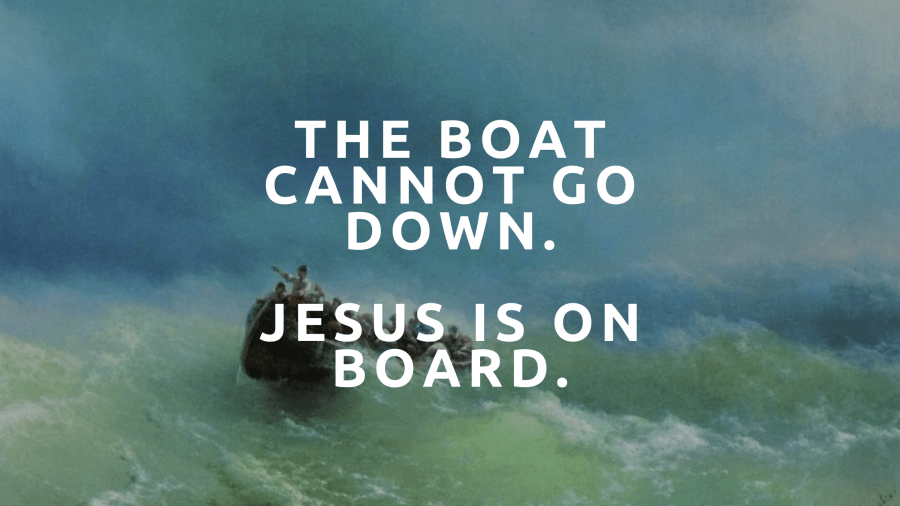
Here is an extended quote from G. Campbell Morgan’s teaching on Luke 8:19-39, concerning Jesus calming the storm on the sea.
The next thing that we observe is the concern of the disciples. They did everything they could before they woke him, and do not forget that they were not novices. They knew how to navigate that boat. When they were beaten, they were completely at their wit’s end, and when they saw that they could do nothing else and saw the boat was nearly filling, and they were in jeopardy, then they woke him.
Now, I think that we had better get bluntly to the point at once. They made a mistake. It is very easy for me to say that. I would not dare say it except upon a certain basis. If I know myself, I would have wakened him before they did. I think I would. I would have got after him before they did, but I would have been wrong as they were.
He awoke and stilled the storm. He pronounced the word. He brought about peace, exactly what they wanted, and the moment he had done it, he turned to them and said, ‘Where is your faith?’ Matthew, Mark, and Luke all record that in different phrasing. They do not give you exactly the same words. They all declare when Christ had stilled the storm, he criticized the men who woke him, and the reason of his criticism was that their action demonstrated their lack of faith. They made the mistake of waking him. It is a hard thing to say to my own soul. They made a mistake because there was no need to wake him.
Why? Do you think any boat can go down if Christ is on board? That is the whole question. We have a hymn, ‘Master, the tempest is raging.’ In it occur these words,
‘No waters can swallow the ship where lies
the master of ocean and earth and skies.’They did not understand that. They did not feel that. He said, ‘Where is your faith?’
What were they concerned about? They said, ‘Master, master, we perish.’ When they said ‘we,’ what did the ‘we’ stand for? Themselves and Jesus. If you look at the story, you will see that the personal pronoun is in the plural, in the objective case, then you will find it in the nominative case. Jesus had said, ‘Let us go over.’ Let us, and Luke is careful to tell us that Jesus himself and his disciples went. When they came to him, they said, ‘Don’t you care that we perish? Not merely we disciples, but the whole of us are going down.’
I do not believe those men were frightened of death. I do not think that such an idea touches the deepest note. They were afraid they would be drowned, and they were afraid he would be drowned. Well, what of it? Is that all that troubled them? Not at all.
They felt that if that boat went down, everything he stood for was going to fail. They had heard him preach for nearly three years now. They had heard him teach. They had been with him. They had seen the glory of the Kingdom of God as he had interpreted it. They had seen the breadth and the beauty and the beneficence of the ideal. They saw the glory of the thing towards which he was moving. They felt that all that was imperiled. ‘Don’t you care that we are perishing, and if we perish in this boat, the Kingdom of God is going to fail.’ That was the trouble of the disciples. ‘Master, how can you sleep here? The boat is going down, and what about those parables concerning the coming of the kingdom?’
There are many Christians today who seem to think the boat is going down. I am tired of the wailing of some of my friends who take that view. The boat cannot go down. Jesus is on board.

