
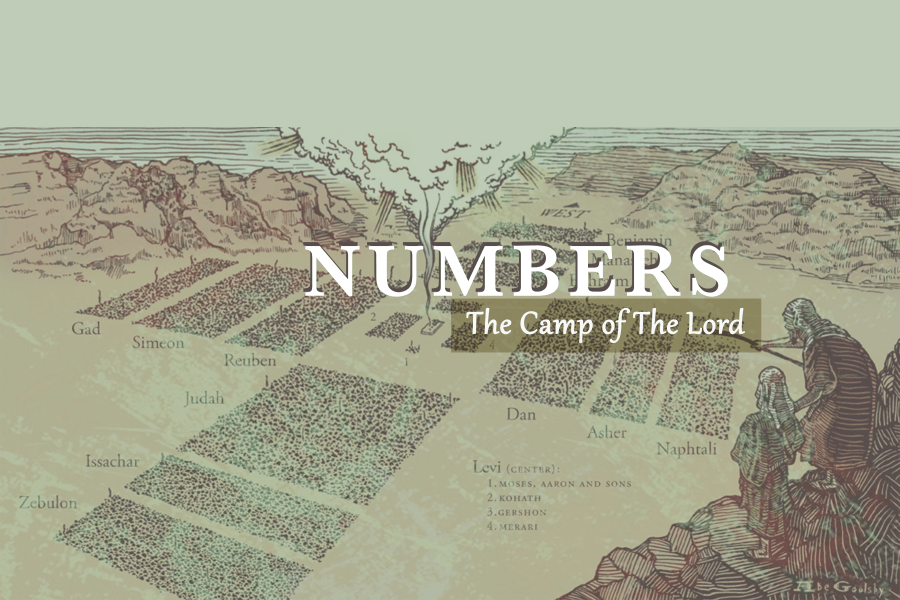
Counted, centered, guarded, assigned, cleansed, consecrated, blessed, spoken, purified, and equipped. Over the course of these first chapters of Numbers, God has been doing all of these things to prepare His people for leaving Sinai. And, now, Israel actually marches out.
Israel spent nearly a year at the base of the mountain of God. For us as readers, it has been since Exodus 19 (which I preached in 2023). And it is at the point that we will also be pausing our study until we return, Lord willing, to Numbers 11 next year.
MARCHING IN GOD’S ORDER // VERSES 11-28, 33-34
Our text begins with these words:
In the second year, in the second month, on the twentieth day of the month, the cloud lifted from over the tabernacle of the testimony, and the people of Israel set out by stages from the wilderness of Sinai. And the cloud settled down in the wilderness of Paran.
Notice that this is the twentieth day of the second month. Numbers 7:1-10:10 took place in the first month, and Numbers 1-6 took place on the first day of the second month. Thus, twenty days have passed since the start of the book.
We should also remember that the unclean men who received permission to celebrate the Passover would have done so on the fourteenth day of the second month. Yahweh, therefore, gave those families the appropriate amount of time to keep the Passover.
Verse 12 is a summary of the whole text, which verses 13-28 then describe in more detail. Israel marched out of Sinai as an army prepared for war, and Yahweh Himself is their commander: They set out for the first time at the command of the LORD by Moses. Moses is the prophet and mediator, communicating the orders of the LORD to the people as they march according to their standards.
The marching order reflects the layout of the camp as we saw in Numbers 2 and the assignments of the Levites given in Numbers 4. The standard of Judah goes first, followed by the sons of Gershon and Merari with the tabernacle. Reuben then goes forth with the sons of Kohath behind him, carrying the golden lampstand, the table of the bread of the Presence, the altar of incense, the bronze altar, and the bronze basin. Finally, Ephraim marches, and Dan serves as the rear guard, which was an important function considering how the Amalekites already attacked them once from behind as they first entered the wilderness.
As we said with the layout of the camp, we should now say again: God is a God of order and structure, not of chaos. Thus, even as the people prepare to walk through the wilderness, which represents chaos, God commands them to march in an orderly and structured fashion.
Of course, this is still true today. Paul plainly commanded in 1 Corinthians 14:40 that “all things should be done decently and in order.” And he is specifically addressing the gathering for worship.
I once attended a church that was the exact opposite. They wanted the service to be entirely under the guidance of the Holy Spirit, so no one prepared anything. People suggested songs to sing during service. Or someone would pray. Or perhaps stand and share a thought from the Bible. To their credit, it was not pure chaos, but they clearly believed planning to be contradictory to being led by the Spirit.
I disagree. I believe that the Spirit is entirely sovereign enough to work through our planning. Here is one of my favorite examples. I plan sermon series for each year, and I begin laying them out in the summer. Numbers 11-25 and 1 Timothy are the two currently planned for 2027.
Back in 2017, I had the plan to preach Ecclesiastes and Philippians, and since I had been reading Puritans for the first time, I wanted to preach Puritan-ish sermons on one of my favorite verses, Philippians 1:21: “For to me to live is Christ, and to die is gain.
A year later, I preached those sermons. At that time, a church member nearly died following a surgery, and when she woke up, she was angry that the Lord did not simply take her home to Him. In the Lord’s providence, she listened to my sermon from the previous Sunday: To Live Is Christ.
That week, we put my father-in-law on hospice. I preached To Die Is Gain that Sunday; he passed away the following Wednesday.
Again, I planned those sermons a year in advance, just wanting to preach some sermons like the Puritans. But the LORD, in His sovereign kindness, ordained them for the exact moment that He willed.
Organization is not the opposite of the following the Spirit. God is big enough to work through our plans. But, of course, we must hold them with an open hand. I love adapting the words of President Eisenhower: “Planning is everything; plans are worthless.” God very often works through our preparation and planning, but we must also be flexible enough to trust whenever He changes our plans. Trust God enough to make plans, and trust Him enough to abandon them.
Notice also the intentionality of the layout. The Levites were to march between the tribes. The sons of Gershon and Merari went between Judah and Reuben. The sons of Kohath were at the very center, carrying the most holy items. Just as the camp was ordered around the tabernacle, so was their traveling.
But importantly, verse 33 tells us that not every piece of the tabernacle was at the center:
So they set out from the mount of the LORD three days’ journey. And the ark of the covenant of the LORD went before them three days’ journey, to seek out a resting place for them.
The ark was carried out in front of the people of Judah. It was their guide, following the cloud of God’s glory. Thus, as they moved through the wilderness, the presence of God was both in their midst and before them, leading them and guiding their way to rest.
We too should do the same. We are each walking through the wilderness of this world. Like the Israelites, we have been redeemed from the house of slavery, not from Egypt but from our sin. And we are not yet in the Promised Land, which for us the heavenly Jerusalem upon the new earth and in resurrected bodies. Indeed, our baptism is a picture of our death and rebirth in Christ, but right now it is spiritual. One glorious day, it will be physical. But that day has not yet arrived.
We are still at war against our sin and still moving through the wilderness and chaos of this life. We too need God within us and God before us, and that is precisely what Christ has given us. The Spirit dwells within us, and the Word of God leads us. As we discussed last week, the Scriptures do not give us answers to specific questions like who to marry or which job to take. Rather, through the Scriptures, we come to know the heart of God and are given a framework for living according to His wisdom.
Of course, the Word should also be within us. Psalm 119:11 says, “I have stored up your word in my heart that I might not sin against you.”
Is God’s Word at the center of your life? Do you have a daily rhythm of opening up the Scriptures and storing them in your heart? We do not have the ark of the covenant nor the cloud of glory of guide our way, but we do have the Scriptures. If we will cling to them, the Spirit will make them into “a lamp to my feet and a light to my path” (Psalm 119:105).
THE BENEFIT OF HUMAN WISDOM // VERSES 29-32
In verses 29-32, we have an interesting scene.
And Moses said to Hobab the son of Reuel the Midianite, Moses’ father-in-law, “We are setting out to the place of which the LORD said, ‘I will give it to you.’ Come with us, and we will do good to you, for the LORD has promised good to Israel.” But he said to him, “I will not go. I will depart to my own land and to my kindred.” And he said, “Please do not leave us, for you know where we should camp in the wilderness, and you will serve as eyes for us. And if you do go with us, whatever good the LORD will do to us, the same will we do to you.”
Mount Sinai was likely close to Midian. After all, Sinai’s other name is Horeb, which is where God first revealed Himself to Moses within the burning bush. At that time, Moses was living in Midian as a shepherd for his father-in-law. Thus, the two places were near to one another, so he likely had a decent amount of contact with Zipporah’s family.
Hobab would then have been Moses’ brother-in-law, and the prophet invites him to come with Israel to Canaan. Hobab declines at first, but Moses requests again more strongly, leaving many commentators to presume that Hobab did indeed go with them. Since the Midianites were desert dwellers, Moses wants the skill and local knowledge of his brother-in-law as they set out.
Was this a sign that Moses did not trust the LORD? I don’t think so. Just as order and planning do not negate the leading of the Spirit, neither does the guidance of the LORD entirely exclude human wisdom. Moses knew that following the presence of the LORD did not mean that Hobab’s knowledge of the wilderness would be of no value to them.
We too should gladly receive the wisdom of those who have knowledge that we do not possess. And we do so almost every day. The Christian who says, “I don’t need advice; I’m just trusting the Lord,” may actually be refusing one of the ordinary means by which the Lord provides guidance.
Of course, the converse is also erroneous. We can gather experts, make spreadsheets, read books, and seek counsel from everyone around us, but if we do seek and consider the will of God and if we are walking in His ways, it is all worthless. .
Indeed, we see Moses’ faith in the LORD in his certainty that God would bring them into the Promised Land and do good to them. Moses saw his brother-in-law as a valuable resource, but he also knew that Hobab would benefit from the good that Yahweh would give them. Moses, therefore, is trusting in the continuation of God’s promise to Abraham: “Those who bless you, I will bless, and those who curse you, I will curse.” By doing good to the Israelites, Hobab will also experience the goodness of God.
Hobab, then, is a reminder that even in the Old Testament, God’s plan was always to bless all nations and even to include the nations as His people. 9:14 hinted at this last week, making provision for the foreigners to celebrate the Passover as long as they were circumcised and followed the same regulations as the Israelites. God’s heart has always been for all nations to believe in Him. And through Christ, the kingdom of God is now a spiritual kingdom that is invading all the kingdoms of the earth.
ARISE, O YAHWEH // VERSES 35-36
Israel had an order for the march. Israel had guides who knew the wilderness. Both were gifts of God, and both were valuable. But ultimately, Israel’s hope was neither its organization nor its expertise. Yahweh Himself went before them, as we read in the final verses:
And whenever the ark set out, Moses said, “Arise, O LORD, and let your enemies be scattered, and let those who hate you flee before you.” And when it rested, he said, “Return, O LORD, to the ten thousand thousands of Israel.”
This is similar to the Aaronic Blessing in that both are liturgical reminders. The Aaronic Blessing was reminder of Yahweh’s favor during worship. This is a liturgy of war.
But that is fitting. Israel had become the earthly army of Yahweh, paralleling the angelic hosts in the heavens. They were entering the Promised Land to receive the promise that God made to Abraham, certainly. But they were also entering as the LORD’s instruments of judgment upon the wickedness of the Canaanites. God had given them four hundred years of grace, but that time was coming to an end.
Thus, as the ark went and returned to camp, Moses gave this cry of war as a reminder of Yahweh’s presence among His people and leading His people. The first cry depicts Yahweh as the divine warrior, scattering His enemies. We have already seen this imagery in Exodus 15:
The LORD is a man of war;
The LORD is his name.
Pharaoh’s chariots and his host he cast into the sea,
and his chosen officers were sunk in the Red Sea. (vv. 3-4)
He goes before His people and defeats His enemies. And He does not send His people where He does not go first. We see this in the life of Christ. The Christian life is not an easy march through the wilderness. Christ calls us to deny ourselves, to put sin to death, to endure suffering, to love our enemies, and to count others more significant than ourselves. Every instinct of our flesh resists that road. But Christ does not send us down a path that He Himself refused to walk. He goes before us. He has faced the scorn of the enemy. He has endured misunderstandings from those He loved. But in all things, He triumphed over sin.
Indeed, Christ conquered His enemies without ever striking a blow. He overthrew the mighty gods of this world by having nails driven into His hands and feet and dying upon the tree of cursing. Paul says in Colossians that Christ made a triumph over the rulers and authorities. A triumph was a Roman victory parade that often ended with the conquering general placing his foot upon the conquered king’s neck. So Christ did to the forces of evil in heavenly places.
The moment of greatest weakness became the eternal triumph. At the cross, the enemies of God appeared to scatter His people. In reality, Christ was scattering His enemies. He nailed the debt of our sin to His cross. He defeated death itself by burst it open from the inside out. All the so-called powers of this world are put to shame by the death, burial, and resurrection of Jesus Christ.
Then, when the ark rests, Moses cried: Return, O LORD to the ten thousand thousands of Israel. The Hebrew could also be read as, “Return, you who are the ten thousand thousands of Israel.” Israel is God’s army, but also God Himself is Israel’s army. Their confidence, while entering the Promised Land, would be in the LORD alone to defeat their enemies. No giant or army was too big. Yahweh is their God, Maker of heaven and earth, the one who draws out Leviathan with a fishhook.
Iain Duguid makes this comment:
If I remembered this reality, I would pray more and be more constant in invoking God’s aid in my struggles. I would awaken every morning, crying, “Rise up, O Lord, protect me against my enemies and against temptation. Walk with me throughout this day.” And I would go to sleep at night asking the Lord to remain with me, thanking him for his sustaining presence and power throughout the day. Moment by moment, in between rising and resting, my thoughts would return repeatedly to the Lord to invoke his presence and his power with me.
If we truly saw our need for the Lord, we would do the same. Waking up we would pray: Arise, O Lord, go before me. Let all my temptations to sin be overcome through the power of the Spirit you have given me. Let the victory of Christ be the banner that I follow. Even when I sin, may I remember that my sin is not greater than Your mercy.
And as we rest: Return, O Lord, give me rest. You are my might and power, the one who sustains and upholds me. I have no good apart from You. Neither have I rest apart from You.
Of course, the people of Israel were journeying toward the rest of the Promised Land. But the ark of the covenant found places of rest within the wilderness as well. How beautiful of a picture. Our final and eternal rest will come with Christ’s return, but until that day, He still gives us rest in the midst of life’s brokenness.
Samuel Rutherford wonderfully said that Christ reserves His softest pillows to lay at the head of those whose feet are in a bed of nails. Many have found that to be true through personal experience, the peace that surpasses understanding.
This life is a journey, a wrestling against forces of evil in heavenly places. We march through the wilderness, striving against our sin. But we do not march in order to earn God’s favor. We march from the rest that Christ has already secured for us. Jesus, after all, is our Sabbath. All of our striving after the favor of God is perfectly and fully complete in Christ. Our debt is paid, our sin defeated, and Christ’s righteousness is imputed upon us. We stand before the Father complete, cleansed, and justified in Christ.
Each week the Lord calls His pilgrim people to stop marching for a moment. We gather around His Table and remember that our salvation does not rest upon the strength of our feet, the wisdom of our plans, or the success of our battles. Christ has already won. Christ has gone before us. Christ is with us. And Christ will bring us safely home.

