
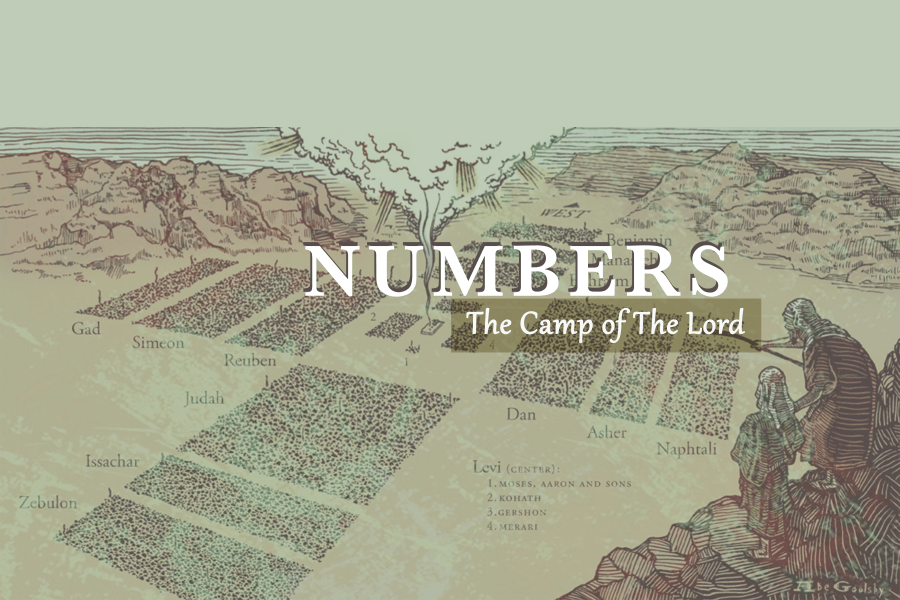
As we have noted, Numbers 1-10 is about God preparing His people to leave Sinai and to enter the Promised Land as His instruments of judgment upon the Canaanites and receive the promises that Yahweh made to their ancestor Abraham.
The first six chapters focused on the people themselves as the LORD counted, centered, guarded, assigned, cleansed, consecrated, and blessed them. Chapter 7 then began a flashback to the dedication of the tabernacle one month before. These texts now focus upon the preparation of the tabernacle to go with and lead them into the Promised Land.
Indeed, we should notice Numbers is now moving somewhat the opposite direction than it was. Chapter 1-7 moved from the full congregation of Israel to Levites specifically and finally to individuals. A similar but reverse order now occurs here. 7:89 gave us a glimpse into the Most Holy Place, and the text will now move outward along the concentric circles of holiness that defined the camp of Israel.
Here in Numbers 8, Yahweh is giving light and the Levites to serve His people, but it is composed of three sections. Verses 1-5 regard the seven lamps on the golden lampstand. Verses 6-22 describes the purification of the Levites. Verses 23-26 then command the age of service for the ministry of the Levites.
LIGHT FOR SERVICE // VERSES 1-4
Now the LORD spoke to Moses, saying, ‘Speak to Aaron and say to him, when you set up the lampstand, these seven lamps shall give light in front of the lampstand.’ And Aaron did so. He set up its lamp in front of the lampstand as the LORD commanded Moses, and this was the workmanship of the lampstand, hammered work of gold. From its base to its flowers, it was a hammered work according to the pattern that the LORD had shown Moses. So he made the lampstand.
To many, this seems to be yet another disconnected command, randomly compiled together in the Book of Numbers. Hopefully, we have already observed enough to presume that is not the case.
Indeed, this very naturally flows from 7:89.
Recall that the tabernacle was a large tent composed of two rooms. The Most Holy Place was the inner room. It was separated by a curtain and contained only the ark of the testimony with the mercy seat (or seat of atonement, depending on your translation) on top. Only the high priest was permitted to enter this room once a year on the Day of Atonement. But in Exodus 25:22, Yahweh said that He would no longer speak of Moses from the peak of Sinai but from the mercy seat.
Thus, as we noted, the dedication of the tabernacle was ultimately about the presence of God being in the midst of His people so that they could hear and receive His commands through Moses. The purpose of the tabernacle was hearing the Word of God within their very own camp. What beautiful reminder that God’s people have always been centered and focused upon God’s Word.
But the text now moves outward. The golden lampstand was not within the Most Holy Place; it belonged to the outer room: the Holy Place. If you were an Israelite priest entering the tabernacle, you would first notice the altar of incense and the curtain guarding the Most Holy Place in front of you. Then you see two items on the sides of the tent: the golden lampstand and the table of the bread of the Presence. Thus, by addressing the lampstand, we have literarily moved out of the Most Holy Place and into the Holy Place.
But why is the lampstand addressed? Why not the bread of the Presence or the altar of incense?
Notice that the text ends by emphasizing the workmanship of the lampstand. I think that is significant because the lampstand itself illuminates the work of the priests within the tabernacle. This was quite practical because the tabernacle had several layers of cloth and leather that would make it rather dark inside. But it also had a symbolic purpose. The lampstand was to never go out, and that continuous illumination represented the light of God’s presence upon the chosen mediators of His people, the priests. As the light shone upon them, they were to know that they were ministering in the light of God’s presence. Indeed, as the lamps kept burning at night, they were to remember that even though the mediators must sleep, Yahweh “who keeps you will not slumber. Behold, he who keeps Israel will neither slumber nor sleep” (Psalm 121:3-4).
But I think that we are also to consider the layout of the tabernacle because while it is not explicitly mentioned, the lampstand also illuminated the table of the bread of the Presence, which was facing it on the other side of the tabernacle. Upon the table sat twelve loaves, which were renewed each week and that represented the twelve tribes of Israel. As the light of the lampstand shone upon the loaves of bread, it was a tangible picture of God’s shining face upon His people.
Again, remember that in Hebrew face and presence are the same word. This, therefore, is an image of the Aaronic Blessing:
The LORD bless you and keep you.
The LORD makes his face to shine upon you and be gracious to you.
The LORD lift up his countenance upon you and give you peace.
Today, we do not worship with the golden lampstand nor the bread of the Presence, but the purpose of the tabernacle is still preserved for us. We still have God’s Word at the heart of our worship. We do not need cherubim to hear God speak; we simply open the Scriptures and have our hearts illuminated by the Holy Spirit.
And in these pages, we hear the One who said, “I am the light of the world” and “I am the bread of heaven.” Here we find the testimony of Jesus Christ, our true light and our daily bread. He is the radiance of God’s glory come to us in human form, and He is our true sustenance and provision.
As we read and reflect on these verses, we should marvel that we have an even greater picture today of the shining face of God in the person and work of Savior.
PURIFIED FOR SERVICE // VERSES 5-22
In the next section, the focus moves further outward, beyond the tabernacle itself and upon the work of the Levites within the courtyard. Recall that while the priests were Levites, most of the Levites were not priests. Only the priests were permitted to enter the tabernacle itself. The Levites, however, were given to the priests to serve them in the courtyard as they ministered on behalf of the worshipers.
Why did the Levites need to be cleansed or purified for their work? Because they were working within the courtyard, which was place of holiness. In Leviticus, we discussed the three ritual states: unclean, clean, and holy. To be unclean was not necessarily to be in sin, but it meant that you had come into contact with the effects of sin and were unfit to enter the presence of God at the tabernacle. Through cleansing or purification, a person could become clean and thus be fit to worship within the courtyard. In order to enter the tabernacle, the priests needed to be not simply clean but holy, which required being consecrated. Notice, therefore, that the Levites were not consecrated like the priests, but they did still need to be cleansed and purified for their service.
Jay Sklar identifies five stages of their purification process, which is helpful for gaining a big picture of what is happening here.
First is the initial purification in verse 7. They are sprinkled with water, shaved, and their clothes are washed.
Second, in verses 8-9, the animals for the offerings are gathered.
Third, in verses 10-11, the people lay hands upon the Levites. Just as a worshiper would lay his hand upon the head of his sacrificial animal as a sign of identification with it, so the Israelites were identifying themselves with the Levites. By laying their hands upon the Levites, they were effectively praying that the LORD would allow the Levites to minister in their place.
Fourth, atonement is made for the Levites in verse 12. The Levites lay their hands on the bulls, which are then slaughtered for the offerings.
Finally, in verse 13, the Levites are presented to the priests as a wave offering to Yahweh.
Consider the significance of the three offerings made. A grain offering is presented, which is a way of paying tribute to Yahweh as king. The whole burnt offering is for making atonement for their sins. Because the burnt offering was entirely consumed upon the altar, it also represented being wholly devoted to God. Finally, the sin or purification offering was made for their ritual cleansing.
Verse 14-19 emphasize again that the Levites are given to assist the priests in the place of the firstborn in Israel. They belong to God and to the priests, and while they could not make sacrifices or enter the tabernacle, they would aid the priests with whatever work needed to be done within the courtyard. In doing so, they were living sacrifices, continual wave offerings before for the LORD.
Under the new covenant in Christ, we are each to be living sacrifices to Yahweh, similar to the Levites. Paul tells us this explicitly in Romans 12:1, saying,
I appeal to you therefore, brothers, by the mercies of God, to present your bodies as a living sacrifice, holy and acceptable to God, which is your spiritual worship.
Similar to the Israelites, we have been redeemed from our slavery to sin, and our God has paid our ransom through the price of His own Son. We each now belong to Him, body and soul, both in life and in death.
Of course, even though the debt of our sin has been paid, we still war against it in this life. That is why Paul commands us to be holy and acceptable to God. We are to avoid returning to our sin like a leper would avoid his old diseased garments. We should all strive to live purified and blameless lives.
But one of the difficulties in the New Testament is that commands often seem less concrete than in the Old Testament. For example, a Levite knew without a doubt that being near a dead body made him unclean, and he also knew the exact steps needed to become ritually pure again. While most sins are still clear, there is now great freedom in Christ, and Christians may disagree over a number of matters of conscience. How then do we know that we are living a purified life, a life that is holy and acceptable?
Paul gives us an answer in Romans 12:2:
Do not be conformed to the world, but be transformed by the renewal of your mind, that by testing you may discern what is the will of God, what is good and acceptable and perfect.
Our minds must be transformed away from how the world thinks and toward how God desires for us think. If we think like the world, we will fail to understand the kind of purified life that our Lord requires of us. We must instead renew our minds in accordance with God’s Word. Psalm 119:9 tells us as much: “How can a young man keep his way pure? By guarding it according to your word.” Before the sight of the everlasting God, even the oldest of us are youths. We need God’s Word to correct us and discipline us toward lives that are holy and acceptable to Him.
SUCCESSION FOR SERVICE // VERSES 23-26
Having established the beginning of the Levites’ ministry, the final verses now address the retirement of the Levites:
And the LORD spoke to Moses saying, ‘This applies to the Levites: from twenty-five years old and upward they shall come to do duty in the service of the tent of meeting. And from the age of fifty years they shall withdraw from the duty of the service and serve no more. They minister to their brothers in the tent of meeting by keeping guard, but they shall do no service. Thus you shall do to the Levites in assigning their duties.’
Some have argued that these verses contradict the age requirements in Numbers 4, where the ages of the Levites transporting the tabernacle is said to be between thirty and fifty. The solution seems quite simple. 25-50 is age range for Levites assisting the priests within the courtyard of the tabernacle, while 30-50 is for specifically carrying the tabernacle from place to place.
This was probably quite practical. Carrying the pieces of the tabernacle was the holiest task of the Levites, so the smaller age range makes sense. It also makes sense that five years before a Levite given that task, he began to serve the priests within the tabernacle. This would have given them time to learn the work of the tabernacle and be instructed by the priests before they carried the holy items themselves.
After the age of fifty, Levites could no longer carry the tabernacle nor assist the priests. But while they retire from that particular service, their role as Levites still continues. They continue to serve as guards of the priests, of the tabernacle, and of the people of Israel.
We can draw two big principles from these verses.
First, even though it is not explicitly mentioned in the text, we can clearly imply the importance of succession in ministry. All of our work in this life is seasonal. And for the Levites, their service in the tabernacle was from 25-50. God set a definite limit at age fifty, which might be somewhat younger than we expect. After all, we think of retirement age as being around sixty-five, and we have probably all met men in their fifties or even sixties who are far stronger than most twenty-year-olds.
But perhaps that is partly the point. They were to step aside before their strength was diminished. They were to willingly let go, even they could likely serve for another decade or two.
Why?
So that the next generation could take their place.
But what if the next wave of twenty-five-year-olds didn’t take their place?
What if the service at the tabernacle didn’t go along as smoothly because the young Levites were less experienced?
What if the younger Levites didn’t treat their service with as much reverence as they ought?
None of those concerns would be rightly answered by a fifty-year-old Levite refusing to retire.
One of the greatest ways to prepare younger generations for greater responsibility is typically to hand them more responsibility than they may seem prepared for. Isn’t true of nearly every parent? You either rise to the responsibility of caring for a dependent human being, or you don’t.
The same is true of ministry. Age alone does not produce maturity; properly shouldering responsibility does. Some responsibilities will inevitably be fumbled, and the torch might dropped after it is given. That’s life. The torch must be passed anyway.
There is no set age in the New Testament for passing off ministries, but we should still give thought to the principle. And we should resolve to pass the torch long before we actually do. Sadly, many withering churches are composed of a handful of now often elderly members who refused to pass the torch when there was an opportunity to do so. As necessary and important as serving in the church is, let us remember that if our ministry becomes our identity, if we treasure the idea of being indispensable, or if the notion succession is untouchable, our service is for our own glory, not God’s.
Second, the Levites were commanded to retire from their special duties while they were still strong, not so they could relax on a beach of the Red Sea but so they could focus on fulfilling the overall duty of the Levites generally. As long as a Levite could still hold a sword, he was a guardian of the holiness of God.
This too is a wonderful image for us. Although certain ministries should be passed on to younger generations long before we are physically unable to do them, we each have ministry to fulfill until our dying breath. That ministry can be any number of things but allow me to focus on what is quite possibly the most important because it ought to be worked until the very end: prayer. Even if the final days, weeks, or even years of your life are severely limited by a decrepit body, you can still pray.
Indeed, consider now that death and old age are realities of life under the sun. Prepare for them. Prepare for the last season of your life now, so that if in your final days, you can only minister through interceding for others in prayer, you will be ready for that final task. Train your spirit so that it is strongest whenever your body is weakest. Cross over to the Celestial City still dressed in the armor of God, still guarding the holiness of God, still interceding for God’s people. May continual service be our goal until we look upon our Savior’s shining face.
The unifying theme of this chapter is the service that was offered to God and made on behalf of the Israelites within the tabernacle. And even that service is a grace of God. Yahweh provided light for the priests within the Holy Place, reminding His people that His face shines upon them. Yahweh provided the Levites to assist the priests and guard His people from His holiness. And Yahweh purified and appointed those Levites for their service, even establishing a pattern of generational succession. Thus, just as Peter tells us that we serve through the strength that God supplies, so the service of the tabernacle was ultimately a gift of God’s grace.
Gracious as the ministry of the Old Testament was, it cannot compare to Christ. He is the true and everlasting Light. He is the full and perfect display of the Father’s shining face upon, and His Spirit now illuminates our hearts so that we can rightly under His Word. Christ is our purity, cleansing us from every stain of sin and equipping us each to do the work of ministry as His body on earth. The Levites needed successors because their ministry was temporary. Christ is our ever-living High Priest, who needs no successor. He continues His ministry forever, ministering for us and through us in every generation of His people.
As we came to the table this morning, we too have a picture before us. It is not a lampstand nor the bread of the Presence. But this bread and cup are still ordinary elements with extraordinary proclamations. Through them, we reflect upon the body and blood of our Lord, given to cleanse and purify us to Himself, so that the light of His face is continuously upon us through Christ.
Let us, therefore, come, confessing that we have no right to this communion with God apart from Jesus Christ. And in light of His sacrifice, we present ourselves now as living sacrifices to Him, re-devoting ourselves to our Lord and King, so that we may live holy and acceptable to His sight.

