
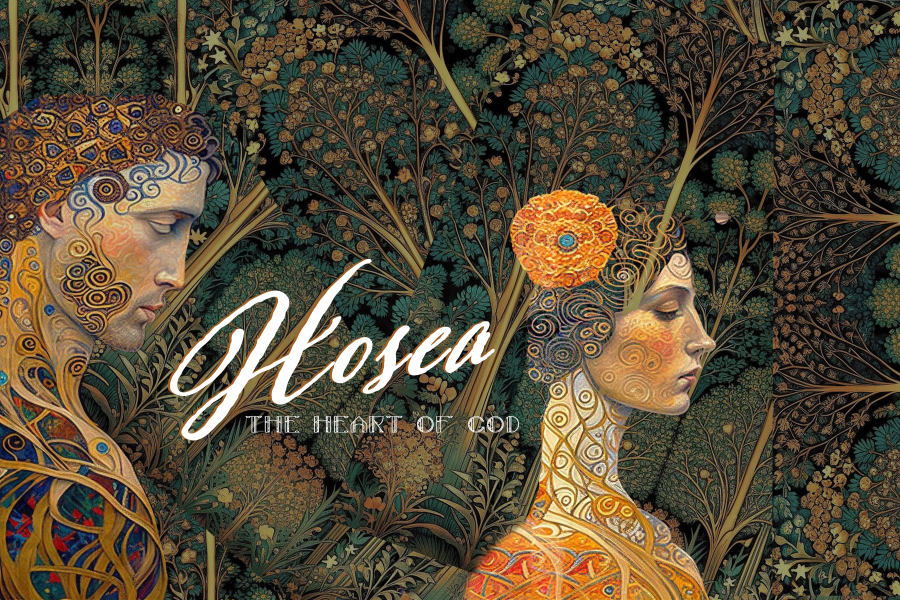
In Hosea 1, God gave the prophet Hosea the assignment to marry a wife of whoredom and have children of whoredom. This was to be a sign, a kind of living parable, of Israel’s whoring after other gods. Hosea takes Gomer to be his wife and has three children: Jezreel, No Mercy, and Not My People.
The first two chapters displayed God’s anger at the sin of His people as well as His unbreakable love for them. Today’s text continues that theme. Chapter 3 is the shortest chapter in the book, and in it, we see God’s continued discipline and love for His wayward bride.
THE COMMAND // VERSE 1
And the LORD said to me, “Go again, love a woman who is loved by another man, and is an adulteress, even as the LORD loves the children of Israel, though they turn to other gods and love cakes of raisins.”
This verse sets the context for the rest of the chapter. There are some who say that this is a different woman than Gomer. Others, such as Calvin, argue that it was only a vision, not reality. But it appears too connected with the first two chapters for it to be a vision. I believe that God is really telling Hosea to love his wayward wife back into his household.
She has given herself over to another man, and the text says plainly that she is an adulteress. We should not gloss over that statement. According to Deuteronomy 24, Hosea is entirely within his rights to divorce Gomer. Even in the New Testament, though Jesus said that divorce was permitted because of the hardness of the peoples’ hearts, He still permits divorce on the grounds of sexual immorality. So, even under the New Testament, Hosea was justified in separating from Gomer, which, of course, meant that God was well within His rights to cut off the Kingdom of Israel.
But things get much, much worse. Worse than divorce, God’s law commanded adultery to be punished by death. “If a man commits adultery with the wife of his neighbor, both the adulterer and the adulteress shall surely be put to death” (Leviticus 20:10). No wonder Calvin concluded that this must be a vision! How could God command Hosea to love Gomer again when the law commanded her death?
The last half of the verse answers the question: because that’s what Yahweh is doing with Israel. The people of Israel were just like Gomer. Their pursuit of other gods was spiritual adultery against the LORD.
But what of the cakes of raisin? It is quite possible that they were associated with idolatrous practices. It is also possible that they were symbols of Israel’s comfort and pleasure. Perhaps some the Israelites did not explicitly worship false gods, yet the gifts of Yahweh had replaced Him in their hearts and minds.
THE REDEMPTION // VERSE 2
So I bought her for 15 shekels of silver and a homer and a lethech of barley.
We aren’t given details of this purchase. Was Gomer simply living with one of her lovers? If so, why would Hosea need to purchase her back? More likely, her lover had become her pimp, using her for his own revenue. Some commentators, such as Boyce, think that she had become a slave and was being auctioned off. If so, slaves were usually stripped down so that the buyer could fully assess his purchase.
Either way, this must have easily been the most humiliating moment both Hosea and Gomer’s lives. Humiliating for him, because he is purchasing his own wife. Humiliating for her, because all of her sin and shame is fully exposed.
Duane Garrett estimates the total silver of Hosea’s purchase to be thirty shekels of silver, which was no small sum.
This ought to immediately remind us of our redemption in Christ. Like Gomer, our sin makes us fully deserving of death. And not simply physical death but spiritual death, everlasting death. Because we sin against the eternal God, our sin warrants an eternal punishment.
Whether Gomer was an actual slave or not, she was clearly a slave to her desires. And so are we, by nature. We are slaves to our sin, to our own desires and impulses. We see this clearly in the world around us as well. The world cries for us to follow our hearts and to be true to ourselves. It says that pursuing your desires is the path to freedom. But freedom is the ability to pursue the purpose for which we were created. Being governed by our passions is not freedom but slavery.
But Christ has redeemed His people from this slavery. Indeed, while we often use the word redemption, that is its technical meaning, something that is bought back. That is why the exodus is the greatest moment of redemption in the Old Testament. God was buying Israel back to Himself from their slavery in Egypt.
Hosea did the same with Gomer, and Christ has done so with us. He has redeemed us from the Egypt within our hearts. Even though God’s law requires our death, Jesus took died in our place, upholding the justice of God, even has He also shows us mercy. Hosea bought his adulterous wife for thirty pieces of silver; Christ was betrayed for thirty pieces of silver and gave His own precious blood to redeem His adulterous bride, as 1 Peter 1:17-19 says,
And if you call on him as Father, who judges impartially according to each one’s deeds, knowing that you were ransomed from the futile ways inherited from your forefathers, not with perishable things such as silver and gold, but with the precious blood of Christ, like that of a lamb without spot or blemish.
We have been redeemed by the blood of Christ.
THE RETURN // VERSE 3
And I said to her, “You must dwell as mine for many days. You shall not play the whore or belong to another man, so I will be to you.”
After the redemption, Hosea brings Gomer home. Most commentators take this as Hosea requiring a time of abstinence, which must be fulfilled before their marriage can be entirely restored. Of course, full and complete restoration often takes time. There is certainly hope that the marriage will be restored in full, but it does not immediately happen.
This period of abstinence, where Hosea has restored Gomer to his household but is not giving her conjugal rights, is the balance to what we observed in the Song of Songs. There, marital intimacy was celebrated as a glimpse back into Eden, but here it is what the refrain warned of. Passion is like a fire. It can warm and cook, or it can burn and consume. The solution to wayward passions and desires is often abstinence, giving a time for our minds to be renewed by God’s Word as we see in Romans 12.
Of course, this is far beyond applying only to sexual immorality. Think of an alcoholic who comes to Christ. Very rarely does the desire for alcohol entirely vanish upon salvation. Abstinence for a season or even permanently is often required to reset those desires and to develop a renewed mind. The same could apply to shopping, eating, entertainment, and any number of things. We are experts in taking God’s good gifts and treasuring them over the Giver Himself.
We should, therefore, ask ourselves as believers who have been purchased by Christ’s precious blood what things we need to abstain from? In 1 Peter 2, after he references Hosea in verse 10, he then says, “Beloved, I urge you as sojourners and exiles to abstain from the passions of the flesh which wage war against your souls.”
What are the passions or desires that are waging war on your soul today? Peter does not say to simply manage them better; he says to abstain from them. Cut them off.
THE JUDGMENT // VERSE 4
For the children of Israel shall dwell many days without king or prince, without sacrifice or pillar, without ephod or household gods.
The word ‘for’ ties this verse directly into verse 3. The period of abstinence between Hosea and Gomer was a picture of Israel’s coming exile. Notice the three groups of two. They will be without leadership, without ceremonies, and without guidance. These were each means by which Israel sinned against Yahweh, but they were also things that marked a nation as distinct from other nations.
The leadership of kings or princes often defined a people through their very name. Israel was named after their patriarch, Edom after Esau, Rome after Romulus. To be cut off from that leadership was to be disconnected from one’s ethnic heritage.
Sacrifices and pillars were ceremonies that marked the people’s ceremonies and history. 2 Kings 17 uses both of these as reasons for Israel’s destruction under the Assyrians. They set upon pillars and Asherim (v. 10). They made sacrifices to their idols, even offering their own sons and daughters (v. 17).
Finally, the ephod and the household gods were for a nation’s guidance. Of course, the Kingdom of Israel had already cut themselves off from the true ephod, which remained with the high priest in Jerusalem. In the ancient world, household gods were a symbol of one’s identity. In the Aeneid, Aeneas carries his household gods from the burning city of Troy to Rome. Augustine mocks this, noting that the gods could not defend Aeneas but needed to be defended by him. Nevertheless, it shows how household gods were tied to one’s identity.
Thus, Israel would be cut from the very things that set them apart as a nation. Why is the important? Because in 2 Kings 17, God gives the northern kingdom exactly what they always wanted. They chased after being like the other nations, and as in Roman 1, God gave them over to their sin. 2 Kings 17:17–18 gives a sample of why the northern kingdom was given over to their sins.
And they burned their sons and their daughters as offerings and used divination and omens and sold themselves to do evil in the sight of the LORD, provoking him to anger. Therefore the LORD was very angry with Israel and removed them out of his sight. None was left but the tribe of Judah only.
He lets them indeed become virtually indistinguishable from the other nations.
But remember that verse 4 is connected to verse 3. Verse 3 is a Hebrews 12 situation, while verse 4 feels like it belongs to Romans 1. Both are true.
THE PROMISE // VERSE 5
Again, Yahweh was entirely justified in both divorcing and damning Israel. And for many days it would appear that He had done just that. But then we come to verse 5:
Afterward the children of Israel shall return and seek the LORD their God and David their King, and they shall come in fear to the LORD and to his goodness in the latter days.
In the end, Israel’s being given over to the nations will prove to be a severe act of discipline, for they will return. They will repent, saying, “I will go and return to my first husband, for it was better for me then than now.” Though before their eyes saw without perception and their ears heard with understanding, they would now have eyes to see and ears to hear. And they will seek the LORD.
In Psalm 27:8, David writes the eternal dialogue between Yahweh and His people: “You have said, ‘Seek my face.’ My heart says to you, ‘Your face, O LORD, do I seek.’” As I have argued elsewhere, seek God’s presence/face is the very essence of being human because the chief end of man is to glorify God and enjoy Him forever. The Beatific Vision is the purpose for which we were made.
But we have a problem. Paul quotes both Psalm 14 and Psalm 58, when he writes,
None is righteous, no, not one;
no one understands;
no one seeks for God.
All have turned aside; together they have become worthless;
no one does good,
no even one.
How then will the children of Israel repent and seek Yahweh when “no one seeks for God?” That was Paul’s exact point. Only the gospel can rewrite our hearts and our desires. Ezekiel prophesied that God would give His people new hearts and new spirits that actually want to obey God in the new covenant. Through Jeremiah, Yahweh said that He would write His law upon His people’s hearts rather than upon tablets of stone. Each person in the kingdom of God would have God’s Spirit poured upon them, just like David or Moses did as kings and prophets.
In other words, God Himself will give His people the desire to seek Him. He will rewrite their hearts.
And they will also seek David their king. Remember that the northern kingdom of Israel had rejected David as their king for hundreds of years already. Of course, the literal David was long dead. The true king from David’s lineage is what is meant, which is ultimately Christ. As Gabriel spoke to Mary,
He will be great and will be called the Son of the Most High. And the Lord God will give to him the throne of his father David, and he will reign over the house of Jacob forever, and of his kingdom there will be no end.” (Luke 1:32–33)
Indeed, notice in Gabriel’s words that Christ will reign over the house of Jacob forever. He will be the “one head” who rules over both Israel and Judah, the whole children of Jacob, when God sows His people to Himself forever in the land.
God did indeed cast off His people, making them Not My People. He gave them over to their sins, letting them become like the nations that they longed to imitate. But God’s judgment would not last forever. God will give them His Spirit, and they will repent. He will again say to them, “Children of the living God.”
But when will this happen? Judah would be exiled later as well, but they would be restored to Jerusalem after seventy years. The Old Testament never records a restoration of the northern kingdom. Have God’s promises failed?
Notice that the final phrase is a time stamp for this promise. It will come to pass in the latter days. When is that? The New Testament’s answer is that we are presently living in the last days. Hebrews says so explicitly: “Long ago, in many times and in many ways, God spoke to our fathers by the prophets, but in these last days, he has spoke to us by his Son.” We are living in the last days, and we have been since the coming of the Holy Spirit upon Christ’s church. After this, comes the judgment.
Interestingly, Paul cites the promises of restoring Israel in Hosea as applying to the inclusion of the Gentiles among the people of God. Yahweh gave Israel over to their sin for many days, dispersing them among the nations, and now in a mysterious twist, He is using that judgment to fulfill His plan from the beginning. The church, both Jew and Gentile, is the restored kingdom, the uniting of all of God’s people under the kingship of Christ, whose primary message through His earthly ministry was, “Repent, for the kingdom of God is at hand.”
The LORD is fulfilling, not only His promise through Hosea here but also His promise to Abraham. All families of the earth are truly being blessed through him and through Christ. Indeed, just as Abraham himself was called out of paganism and made into the ancestor of God’s people, now the promise of Abraham is being fulfilled the same way.
Of course, it is not as though God cut Israel off and started over with the church. The church is not the LORD’s backup plan. He gave Israel the task of being a kingdom of priests and a light to the nations and also repeatedly told them that they would fail to do so. Rather than leading the nations, they imitated them. But where the physical kingdoms of Israel and Judah failed, the kingdom of God cannot.
The church is the covenant people of God, the people in whom the promises made to Israel are being fulfilled in Christ. And the church is given the same task that God gave to Israel in Exodus 19. “But you are a chosen race, a royal priesthood, a holy nation, a people for his own possession, that you may proclaim the excellencies of him who called you out of darkness into his marvelous light” (1 Peter 2:9). This is now, as Paul calls it, a heavenly citizenship, enabling God’s kingdom to infiltrate the kingdoms of this world like leaven working its way through the dough.
These are the last days, where Christ is gathering to be His people those who were once called Not My People. Every time someone repents, seeking Jesus as Lord and King, they become an offspring of Abraham, who was called out of the nations and became the man of faith. His children are also those of faith. God really has raised up offspring for Abraham from the very stones, for each of us possessed a heart of stone until the LORD, in His kindness, gave us a heart of flesh. The children of Abraham are not ultimately defined by geography or genealogy but by faith in Abraham’s promised offspring, Jesus Christ.
One day, the people of God will be gathered around the throne of God as one congregation, bowing before Jesus our king. Until that day, Christ is presently building His church, forming us into His holy temple so that Christ may be all in all.
Until the day we feast together in the fullness of the kingdom, we come together to this Table as a provision from our Shepherd while we are still in the wilderness of this world. Let us, therefore, set our minds and hearts upon Christ our Redeemer, who has purchased us with His very precious blood. Just as He has redeemed us once for all, so do we need His grace all the days of our life to seek Him, fear Him, and behold His goodness. Through this bread and cup, may we see more clearly our dependence on the grace of Christ. May we come to the Table this morning, repenting of our sins and seeking the LORD.


Pingback: My People Are Destroyed for Lack of Knowledge | Hosea 4 – B. C. Newton
Pingback: The Judgment Is for You | Hosea 5 – B. C. Newton